


 Top Rated Course

We may not have the course you’re looking for. If you enquire or give us a call on +48 221041849 and speak to our training experts, we may still be able to help with your training requirements.
Oracle vs Salesforce: A Guide to Choosing the Right CRM
The Knowledge Academy 19 December 2025Compare Oracle vs Salesforce, two leading CRM platforms, on features, pricing, scalability, and integration to find the best fit for your business needs. Oracle offers powerful enterprise capabilities and deep data control, while Salesforce shines with customisation, ease of use, and cloud-first agility across a global range.

Training Outcomes Within Your Budget!
We ensure quality, budget-alignment, and timely delivery by our expert instructors.
Table of Contents
Are you trying to decide between Oracle and Salesforce for your CRM? Choosing the right platform is a big step that can shape how your business connects with customers, manages data, and grows. Oracle and Salesforce are both trusted by companies worldwide, but they offer very different experiences.
Key factors like features, pricing, scalability, and how well the platform fits into your existing systems can greatly influence overall efficiency and customer satisfaction. This blog will walk you through a clear, side-by-side comparison of Oracle vs Salesforce to help you choose the CRM that aligns best with your goals and supports long-term success.
Table of Contents
1) What is Oracle?
2) What is Salesforce?
3) Oracle vs Salesforce: A Detailed Comparison
a) Oracle vs Salesforce: Features and Capabilities
b) Oracle vs Salesforce: Pricing and Plans
c) Oracle vs Salesforce: User Interface & Experience
d) Oracle vs Salesforce: Ease of Use
e) Oracle vs Salesforce: Customisation
f) Oracle vs Salesforce: Lead Management
g) Oracle vs Salesforce: Customer Engagement
h) Oracle vs Salesforce: Integrations
i) Oracle vs Salesforce: Service and Support
4) Conclusion
What is Oracle?
Oracle is leading enterprise software which performs top cloud computing and database technologies. Its Customer Relationship Management (CRM) system and it is one of the Oracle Cloud CX (Customer Experience) suites. These suites are designed to enable companies to manage the entire customer lifecycle which includes marketing and sales, to service and support.
Oracle CRM is well tailored for large organisations with intricate structures and industry-specific requirements. It is capable of supporting in-depth customisation, rich analytics, and smooth integration with many departments. Oracle CRM has various modules for sales automation, customer service, field service, marketing and commerce.
The major strength of this CRM is integration with other Oracle suites such as ERP, HCM, and SCM. It allows an integrated business environment for organisations. It also utilizes AI and real-time analytics to enhance customer interactions and decision-making. Oracle CRM has extensive usage across industries such as finance, healthcare, retail and manufacturing.
How Oracle CRM Works?
Here's what Oracle CRM does behind the scenes to provide you with streamlined, intelligent, and secure customer relationship management throughout your organisation:
1) Cloud-based environment: It is hosted on Oracle Cloud Infrastructure (OCI). It provides a secure, reliable and scalable platform to run your CRM requirements with confidence.
2) Middleware infrastructure: Oracle Fusion Middleware ties your data, apps and processes together. It ensures that everything flows well together in the background.
3) Real-time insights: You have real-time dashboards and reports to keep your team updated and enable them to make quicker, better business decisions.
4) AI and ML integration: Oracle CRM employs artificial intelligence and machine learning to provide predictions, insights and intelligent automation.
5) Automated workflows: Time-consuming, mundane tasks in sales, marketing and customer service are automated through integrated workflows that minimise manual effort.
Oracle CRM Architecture
Oracle Fusion Architecture is designed using three main layers: View, Business Logic, and Data.

1) The View Layer: is what users see and use. It includes the ADF-based interface and WebCenter, making it easy to access and navigate.
2) The Business Logic Layer: handles all the behind-the-scenes work, processing tasks, running workflows, and applying business rules through services and BPEL processes.
3) The Data Layer: securely stores all customer and business information in the database.
With added tools like Human Workflow and real-time monitoring, this setup helps teams work smarter, make faster decisions, and keep everything running smoothly.
What is Salesforce?
Salesforce is a cloud-based CRM platform that helps businesses manage sales, marketing, customer service and much more from a single system. It stores all customer data in one place by allowing teams to track interactions and follow up with leads and communicate clearly.
It includes tools like Sales Cloud, Service Cloud, Marketing Cloud, and Commerce Cloud. These tools help automate tasks, run focused marketing campaigns and provide customer support across various channels. Salesforce suits businesses of all sizes and industries because of its flexibility.
Salesforce also integrates with third-party apps and supports custom app development. It provides real-time analytics and team collaboration through Slack and Chatter. It provides AI-powered insights with Salesforce Einstein. These features help businesses make better decisions, personalise customer experiences and improve performance.
Master your sales strategies with our Salesforce CRM course – unlock your potential today!
How Salesforce CRM works?
Here’s how Salesforce CRM works behind the scenes to simplify and strengthen customer relationships across your business:
1) Centralised Customer Data: Salesforce stores every customer detail in a central system. This gives your team a complete view of each interaction. It helps them respond quickly and effectively.
2) Modular Functionality: Sales Cloud, Service Cloud, and Marketing Cloud provide tailored features for sales, support and marketing teams. It makes their jobs easier and more efficient.
3) Automation and Workflow Management: Salesforce handles routine tasks like lead assignment and email follow-ups. This allows your team to focus on building stronger customer connections.
4) AI-Powered Insights: Salesforce helps you spot trends, improve strategies and make confident business decisions based on real-time data. It also provides smart insights and reports.
5) Cloud-Based Access and Integration: Salesforce is a cloud-based tool, it works from any device and integrates with other tools your business already uses.
Salesforce CRM Architecture
Here’s a breakdown of the key components that make up the Salesforce CRM ecosystem and how they work together to create a connected, data-driven customer experience:

1) Core Platform: The Salesforce Platform connects Sales, Service, Field Service, OMS, and Community modules for end-to-end customer management.
2) Commerce & Marketing Integration: Commerce Platform links via Service and Marketing Connectors. Marketing tools like Datorama, Interaction Studio, and Social Studio enable targeted campaigns.
3) Data Management: Customer 360 Data Manager and GPID unify customer identities across systems.
4) Connectivity: MuleSoft Anypoint Platform integrates external systems like ERP, PIM, EDW, and Tableau for inventory, orders, and analytics.
5) App Development: Heroku enables app customisation, while Heroku Connect syncs data with Salesforce, ensuring seamless cross-platform experiences.
Master CRM management with Salesforce Admin Training - Start your journey today and build expertise!
Detailed Comparison of Oracle vs Salesforce
Here is a detailed comparison of Oracle and Salesforce CRM, outlining their core features, ease of use, pricing and overall suitability to help businesses choose the best solution.
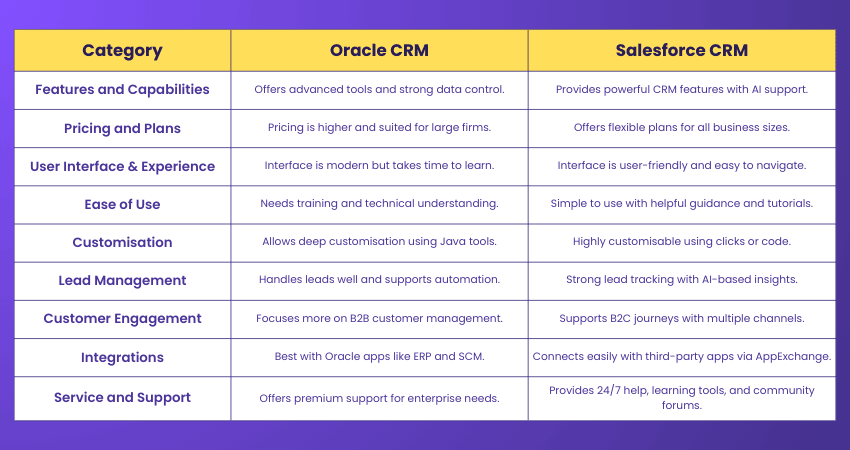
Oracle vs Salesforce: Features and Capabilities
Oracle CRM delivers robust features ideal for large enterprises. It includes advanced data control and deep integration with Oracle’s broader suite. Salesforce offers a wide range of CRM tools powered by AI. It enables flexible and scalable solutions across sales, service and marketing.
Oracle vs Salesforce: Pricing and Plans
Oracle charges higher prices and is primarily made for advanced enterprise requirements. Salesforce has flexible and tiered pricing plans ideal for small to enterprise-sized businesses. It has more affordable options and enables companies to scale features as they expand and grow.
Oracle vs Salesforce: User Interface & Experience
Oracle is a formal and data-driven interface that could be perceived as complicated by new users. Salesforce emphasises usability by providing a cleaner and more intuitive look with its Lightning Experience. It streamlines navigation, task completion, and workflow for day-to-day users.
Oracle vs Salesforce: Ease of Use
Oracle CRM usually requires more training and technical background to use effectively. In contrast, Salesforce is known for its user-friendly interface with step-by-step guidance. It has built-in tutorials for beginners, and it helps community. It makes easier for teams to get started and stay productive.
Oracle vs Salesforce: Customisation
Oracle allows deep customisation using Java and Fusion tools. It is suitable for IT-heavy environments. Salesforce supports both point-and-click customisation and custom coding through Apex. It gives users more flexibility depending on their technical skill level and business-specific customisation requirements.
Oracle vs Salesforce: Lead Management
Oracle manages leads effectively with structured workflows and integration into sales modules. Salesforce takes lead management further with AI-based lead scoring, real-time activity tracking and smart automation. It helps teams prioritise and convert leads faster with improved sales productivity.
Oracle vs Salesforce: Customer Engagement
Oracle’s customer engagement tools are strong for structured B2B models and enterprise reporting. Salesforce offers richer engagement for both B2B and B2C, with features like omnichannel communication, customer journey mapping, personalisation and proactive customer interaction through AI and automation.
Oracle vs Salesforce: Integrations
Oracle CRM integrates well within its own ecosystem. It includes ERP, SCM, and HCM tools. Salesforce provides broader integration capabilities via AppExchange and open APIs. It allows businesses to connect thousands of third-party apps and services to build a customised tech stack.
Oracle vs Salesforce: Service and Support
Oracle offers premium support with enterprise service levels tailored to complex needs. Salesforce provides 24/7 support across plans. Users can access to Trailhead for self-paced learning. It is an active user community with detailed documentation to ensure users always have help when needed.
Conclusion
The choice between Oracle vs Salesforce CRM depends on your business size, complexity and specific goals. Oracle is ideal for large enterprises needing deep integration and advanced control, while Salesforce offers greater flexibility, user-friendliness and strong AI capabilities. You can select the CRM that aligns best with your organisation’s long-term strategy, operational needs and customer engagement goals by understanding each system’s core features and fit.
Boost your sales skills with HubSpot CRM Training – Join today and get started!
Frequently Asked Questions
What are the 4 C's of Oracle?

The 4 C's of Oracle refer to,
1) Consolidation
2) Compatibility
3) Cloud
4) Cost-effectiveness.
These principles guide Oracle’s database and cloud strategies to ensure scalability, efficiency and performance.
What are the three 3 major components of Oracle Database?
The three major components of the Oracle Database are:
1) Oracle Instance - Includes memory structures (like SGA and PGA) and background processes that manage database operations.
2) Database Files - Stores actual data, control files, redo logs, and tablespaces.
3) Background Processes - Handles tasks like writing data to disk, managing memory, and recovery operations.
What are the Other Resources and Offers Provided by The Knowledge Academy?
The Knowledge Academy takes global learning to new heights, offering over 3,000 online courses across 490+ locations in 190+ countries. This expansive reach ensures accessibility and convenience for learners worldwide.
Alongside our diverse online course catalogue, encompassing 19 major categories, we go the extra mile by providing a plethora of free educational Online Resources like News updates, Blogs, videos, webinars, and interview questions. Tailoring learning experiences further, professionals can maximise value with our customisable Course Bundles.
What is The Knowledge Pass, and How Does it Work?
The Knowledge Academy’s Knowledge Pass, a prepaid voucher, adds another layer of flexibility, allowing course bookings over a 12-month period. Join us on a journey where education knows no bounds.
What are the Related Courses and Blogs Provided by The Knowledge Academy?
The Knowledge Academy offers various CRM Training, including Oracle CRM, Salesforce CRM, HubSpot CRM and Microsoft Dynamics CRM. These courses cater to different skill levels, providing comprehensive insights into HubSpot Lifecycle Stages.
Our Office Applications Blogs cover a range of topics related to CRM training, Microsoft Excel, Business Intelligence and AutoCAD. Whether you are a beginner or looking to advance your CRM Management skills, The Knowledge Academy's diverse courses and informative blogs have got you covered.

The Knowledge Academy


Global Training Provider
The Knowledge Academy is a world-leading provider of professional training courses, offering globally recognised qualifications across a wide range of subjects. With expert trainers, up-to-date course material, and flexible learning options, we aim to empower professionals and organisations to achieve their goals through continuous learning.

Upcoming Office Applications Resources Batches & Dates
Date
 Salesforce CRM Masterclass
Salesforce CRM Masterclass
Fri 4th Sep 2026
Salesforce CRM Masterclass
Fri 4th Dec 2026

 If you wish to make any changes to your course, please


