


 Top Rated Course

We may not have the course you’re looking for. If you enquire or give us a call on +48 221041849 and speak to our training experts, we may still be able to help with your training requirements.
AWS vs Azure vs Google Cloud: A Complete Guide
The Knowledge Academy 21 April 2026AWS, Azure, and Google Cloud are the top cloud service providers, offering services that support basic computing to advanced enterprise solutions. AWS leads with the largest market share and broadest service portfolio, while Azure integrates seamlessly with Microsoft products, and Google Cloud excels in AI, data, and analytics.

Training Outcomes Within Your Budget!
We ensure quality, budget-alignment, and timely delivery by our expert instructors.
Table of Contents
In the world of cloud computing, three giants dominate the skyline, AWS, Azure, and Google Cloud. Each offers powerful tools, vast capabilities, and game-changing technologies. But which one truly stands above the rest? Their strengths, ecosystems, and pricing models are the factors that will decide the winning party.
In this blog, you can compare the top three platforms, AWS vs Azure vs Google Cloud, across features, performance, pricing, and real-world use cases. Whether you're focused on AI, hybrid cloud, or cost savings, we’ll help you cut through the confusion and choose confidently. Let’s decode the cloud, one platform at a time.
Table of Contents
1) AWS vs Azure vs GCP
2) Difference Between AWS vs Azure vs Google Cloud
3) Benefits of Google Cloud, AWS and Microsoft Azure
4) Cloud Platform Key Tools: AWS, Azure and Google Cloud
5) Use Cases for AWS vs Azure vs GCP
6) Choosing Between AWS, Azure and Google Cloud
7) Conclusion
AWS vs Azure vs GCP
Amazon Web Services (AWS), Microsoft Azure, and Google Cloud Platform (GCP) are the top cloud providers, each with unique strengths. Here is a detailed overview of AWS vs Azure vs GCP:
What is AWS?
Amazon Web Services (AWS) is a leading cloud platform providing on-demand computing, storage, databases, and analytics. It helps organisations reduce costs and build secure, scalable digital solutions using a flexible pay-as-you-go model.
Key Features:
1) Compute: EC2 (virtual servers), Lambda (serverless computing)
2) Storage: S3 (object storage), EBS (block storage)
3) Databases: RDS, DynamoDB, Aurora
4) AI/ML: SageMaker, Rekognition
5) Security & Compliance: Identity and Access Management (IAM)
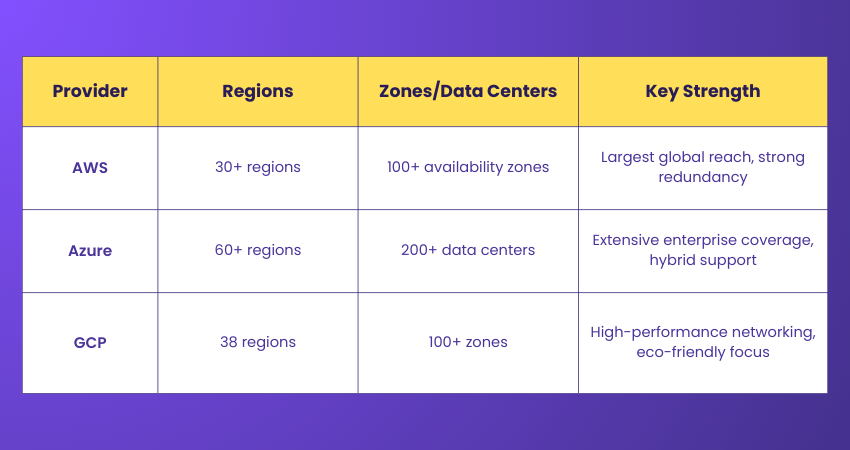
6) Deployment: Global data centres across multiple regions and availability zones
What is Microsoft Azure?
Microsoft Azure is a cloud platform offering compute, storage, networking, databases, AI, and analytics services. Launched in 2010, it enables organisations to build, deploy, and manage applications efficiently through Microsoft’s global data centres.
Key Features:
1) Seamless Microsoft Integration: Works with Windows Server, Active Directory
2) Hybrid Capabilities: Azure Arc and Azure Stack allow integration
3) AI & Analytics: Azure Machine Learning, Synapse Analytics, and Cognitive Services
4) Security & Compliance: Enterprise-grade security, compliance with global standards
5) Developer Tools: Integration with Visual Studio, GitHub, and DevOps tools
What is Google Cloud Platform?
Google Cloud Platform (GCP) is a cloud service suite that helps organisations build, deploy, and scale applications using the same infrastructure that powers Google Search, YouTube, and Gmail. Launched in 2011, it offers reliable, high-performance cloud solutions.
Key Features:
1) Compute Services: Google Compute Engine, App Engine and Cloud Functions
2) Data & Analytics: BigQuery, Dataflow, Dataproc
3) AI & ML: Vertex AI, AutoML, natural language and vision APIs
4) Storage Solutions: Cloud Storage, Persistent Disk, Filestore
5) Open-Source Leadership: Strong support for Kubernetes and containerised apps
6) Security & Compliance: End-to-end encryption, identity management
Difference between AWS vs Azure vs Google Cloud
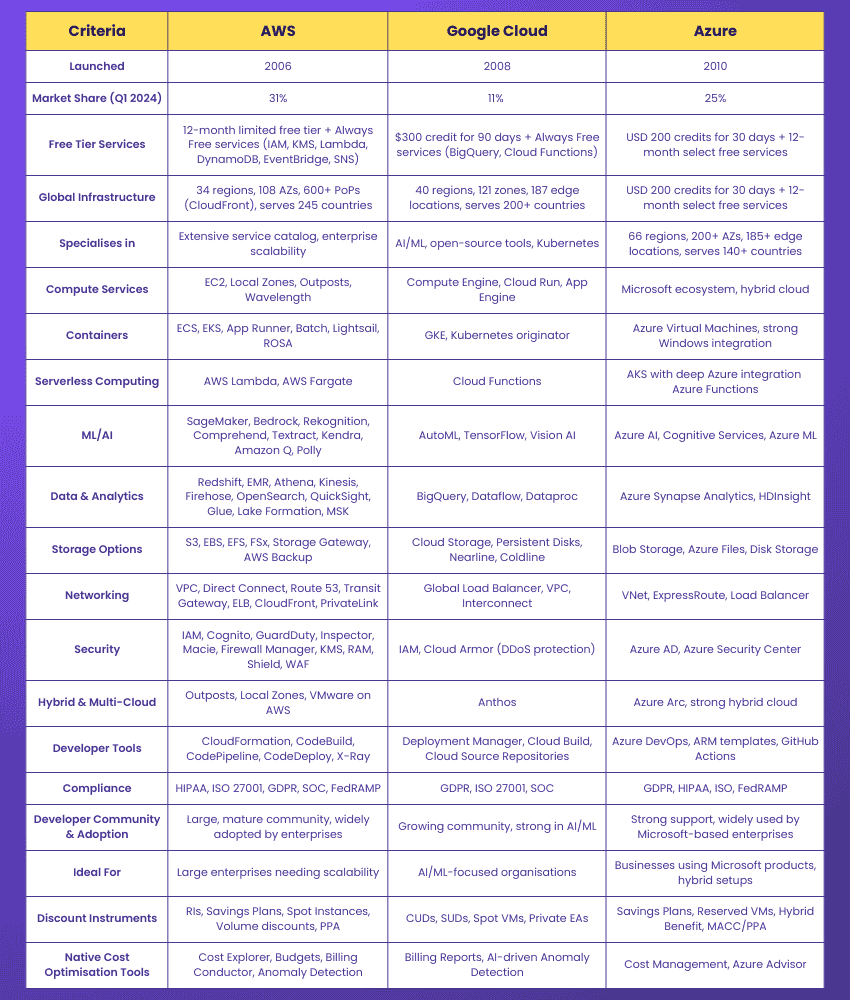
Here are the top three cloud providers compared across key aspects such as services, global infrastructure, pricing, and performance.
Benefits of Google Cloud, AWS and Microsoft Azure
Choosing the right cloud platform depends on your organisation’s needs, budget, and technical goals. Below is a clear comparison of the benefits and considerations of AWS, Azure, and Google Cloud.
Amazon Web Services
Pros:
a) Offers the largest range of cloud services, covering everything from networking to robotics.
b) Highly established platform known for strong reliability and robust security.
c) Delivers greater computing power compared to Azure and Google Cloud.
Cons:
a) Many enterprise software vendors on AWS require paid support.
b) The extensive number of tools and features can be confusing for beginners.
c) Provides fewer hybrid cloud options than competing platforms.
Microsoft Azure
Pros:
a) Easily integrates with existing Microsoft environments, making migration smooth.
b) Provides a wide array of powerful AI, machine learning, and analytics technologies.
c) Often more cost-effective than AWS and Google Cloud. Strong support for hybrid cloud deployments.
Cons:
a) Has fewer service offerings overall compared to AWS.
b) Primarily tailored for enterprise use, which may not suit all users.
Google Cloud
Pros:
a) Integrates seamlessly with other Google tools and applications.
b) Excels in containerised workloads with strong Kubernetes and container support.
Cons:
a) Offers a smaller range of services compared to AWS and Azure.
b) Provides limited enterprise-level support for large or complex deployments.
Cloud Platform Key Tools: AWS, Azure and Google Cloud
The major cloud providers continue to compete aggressively, offering powerful tools that support AI, machine learning, IoT, analytics, and serverless technologies. Each platform keeps expanding its capabilities based on market needs and customer expectations.
AWS Key Tools
Artificial Intelligence and Machine Learning: AWS provides Gluon, an open-source deep-learning framework that lets both developers and non-developers create neural networks without prior AI expertise. DeepLens, AWS’s AI-powered camera, enables tasks like OCR, image detection, and object recognition.
SageMaker to Serverless: AWS also delivers SageMaker for training and deploying ML models. Other essential tools include the Lex conversational interface used by Alexa, Greengrass for IoT communication, and Lambda for serverless computing.
Azure key tools
Cognitive Services: Azure offers a wide range of intelligent APIs such as Bing Web Search, Face API, Computer Vision, and Custom Vision. It also provides strong IoT management, analytics tools, and a serverless computing environment.
Supporting Microsoft Software: Azure integrates seamlessly with Microsoft’s on-premises solutions. Windows Server Backup connects directly to Azure Backup, and Visual Studio Team Services hosts and manages cloud-based development projects.
Google Cloud key tools
IoT to Serverless: Google Cloud includes advanced APIs for natural language, speech, translation, and more. It also supports IoT and serverless computing, although several offerings are still in beta versions.
Big on AI: Google Cloud leads in artificial intelligence innovation, largely due to TensorFlow, its open-source ML framework. TensorFlow has become a favourite among developers building scalable machine learning applications.
Use Cases for AWS vs Azure vs GCP
Each cloud provider excels in different scenarios depending on business needs, technology stacks, and integration requirements.
AWS
1) Enterprise Applications: Hosts large-scale enterprise apps like SAP, Oracle, and custom ERPs.
2) E-commerce Platforms: Powers scalable platforms like Netflix and Amazon.com.
3) Startups & DevOps: Preferred by startups for flexible development, testing, and deployment pipelines.
4) Machine Learning & Big Data: Offers services like SageMaker and Redshift for analytics, ML, and data lakes.
5) Disaster Recovery & Backup: Global infrastructure supports robust backup and failover strategies.
Azure
1) Microsoft-centric Workloads: Ideal for apps using Windows Server, SQL Server, .NET, and Active Directory.
2) Hybrid Cloud Solutions: Strong support for hybrid environments with Azure Stack and Azure Arc.
3) Enterprise & Government Projects: Popular in industries needing compliance (healthcare, finance, public sector).
4) Virtual Desktops & Productivity: Integrates with Microsoft 365 and Azure Virtual Desktop for remote work.
5) AI and Business Intelligence: Services like Azure Synapse Analytics and Power BI enhance enterprise insights.
GCP
1) AI/ML-driven Applications: Leverages Vertex AI, AutoML, and TensorFlow for intelligent app development.
2) Data-heavy Workloads: BigQuery and Dataflow power real-time analytics and massive data processing.
3) Containerised Applications: Best for Kubernetes, microservices, and CI/CD pipelines with GKE.
4) Media & Entertainment: Used for video rendering, streaming, and media analytics.
5) Open Source & Cloud-native Projects: Preferred for innovation with open standards and scalable APIs.
Choosing Between AWS, Azure and Google Cloud
Selecting the right cloud platform, whether AWS, Azure, or Google Cloud, depends on your business goals, technology stack, budget, and scalability needs.
Choose AWS if you:
a) Need a mature, reliable, and versatile platform
b) Plan to build large-scale global applications
c) Require extensive third-party integrations
d) Operate a startup, enterprise, or e-commerce business
Choose Azure if you:
a) Already use Microsoft tools like Office 365 or Windows Server
b) Need strong hybrid cloud capabilities
c) Work in highly regulated sectors requiring compliance
d) Want seamless integration across business systems
Choose GCP if you:
a) Focus on AI, ML, and data analytics
b) Build cloud-native or Kubernetes-based applications
c) Prefer simpler, cost-efficient pricing
d) Work in innovation-driven sectors like tech, media, or research
Conclusion
AWS, Azure, and Google Cloud each offer powerful cloud solutions, but the right choice depends on your specific needs. AWS is great for scalability and variety, Azure works best with Microsoft tools and hybrid setups, while GCP excels in AI and data-driven projects. Evaluate your goals, existing systems, and budget to find the best fit or consider a multi-cloud approach to get the best of all worlds.
Learn how Google Cloud Storage offers secure, cost-effective solutions for all your data storage demands. Dive into the cloud today!
Frequently Asked Questions
Which Cloud Platform is the Most Suitable for SAP?

AWS and Azure are both strong choices for SAP. AWS offers extensive SAP-certified infrastructure and flexibility, while Azure has a close partnership with SAP and deep integration with Microsoft tools. Choose based on your ecosystem, performance needs, and regional availability.
Which Cloud Platform is the Most Affordable?
Google Cloud Platform (GCP) is often seen as the most affordable due to its transparent pricing, sustained use discounts, and cost-effective options for data-intensive workloads. However, actual cost depends on usage, instance types, and long-term needs, so comparisons are essential.
What are the Other Resources and Offers Provided by The Knowledge Academy?
The Knowledge Academy takes global learning to new heights, offering over 3,000+ online courses across 490+ locations in 190+ countries. This expansive reach ensures accessibility and convenience for learners worldwide.
Alongside our diverse Online Course Catalogue, encompassing 17 major categories, we go the extra mile by providing a plethora of free educational Online Resources like Blogs, eBooks, Interview Questions and Videos. Tailoring learning experiences further, professionals can unlock greater value through a wide range of special discounts, seasonal deals, and Exclusive Offers.
What is The Knowledge Pass, and How Does it Work?
The Knowledge Academy’s Knowledge Pass, a prepaid voucher, adds another layer of flexibility, allowing course bookings over a 12-month period. Join us on a journey where education knows no bounds.
What are the Related Courses and Blogs Provided by The Knowledge Academy?
The Knowledge Academy offers various Google Cloud Certification, including the Introduction To Google Cloud Security, Google Cloud Bigtable Training and the Google Cloud Firestore Training. These courses cater to different skill levels, providing comprehensive into What is Object Storage.
Our Cloud Computing Blogs cover a range of topics related to Business, offering valuable resources, best practices, and industry insights. Whether you are a beginner or looking to advance your decision-making skills, The Knowledge Academy's diverse courses and informative blogs have got you covered.

The Knowledge Academy


Global Training Provider
The Knowledge Academy is a world-leading provider of professional training courses, offering globally recognised qualifications across a wide range of subjects. With expert trainers, up-to-date course material, and flexible learning options, we aim to empower professionals and organisations to achieve their goals through continuous learning.

Upcoming Cloud Computing Resources Batches & Dates
Date
 Google Cloud Training
Google Cloud Training
Fri 10th Jul 2026
Google Cloud Training
Fri 25th Sep 2026
Google Cloud Training
Fri 11th Dec 2026

 If you wish to make any changes to your course, please


