


 Top Rated Course

We may not have the course you’re looking for. If you enquire or give us a call on +48 221041849 and speak to our training experts, we may still be able to help with your training requirements.
Customer Service Automation: 5 Key Steps, Benefits, and Examples
The Knowledge Academy 04 May 2026Customer Service Automation uses AI and tools to handle queries, reduce response times, improve accuracy, and deliver efficient, scalable support experiences. Automation helps streamline support tasks such as automatic replies, ticket routing, inquiry resolution, and Data Management, reducing the need for direct human intervention.
Home
 Resources
Data, Analytics & AI
Customer Service Automation: 5 Key Steps, Benefits, and Examples
Resources
Data, Analytics & AI
Customer Service Automation: 5 Key Steps, Benefits, and Examples
Resources
Data, Analytics & AI
Customer Service Automation: 5 Key Steps, Benefits, and Examples

Training Outcomes Within Your Budget!
We ensure quality, budget-alignment, and timely delivery by our expert instructors.
Table of Contents
Customers today expect quick answers, seamless support, and round-the-clock service and that’s not always easy to deliver manually. This is where Customer Service Automation steps in, transforming how businesses interact with their customers. From chatbots to automated responses, it helps reduce wait times, improve consistency, and free up teams to focus on more complex queries.
But Customer Service Automation is not just about saving time; it’s about creating better customer experiences. When done right, it enhances satisfaction, boosts efficiency, and supports business growth. In this blog, we’ll explore key steps, benefits, and real-world examples to help you get started.
Table of Contents
1) What is Customer Service Automation?
2) Why is Customer Service Automation Important?
3) How Automated Customer Service Works?
4) Key Features of Customer Service Automation
5) Steps to Automate Customer Service
6) Benefits of Customer Service Automation
7) Challenges of Automated Customer Service
8) Examples of Automated Customer Service
9) Future of Customer Service Automation
10) Conclusion
What is Customer Service Automation?
Customer Service Automation is the use of AI, Machine Learning and rule-based systems to handle tasks that would typically require human effort. It goes beyond simply adding a chatbot to a website. A true automation strategy takes a holistic view of the customer journey. It identifies where automation can reduce friction, accelerate response times and maintain consistency.
It streamlines repetitive tasks such as answering common queries, routing tickets, retrieving customer data, sending follow-ups, and recommending help resources proactively. This enhances the customer experience and allows support teams to focus on more high-value interactions.

Why is Customer Service Automation Important?
Customer Service Automation is important because it enables businesses to handle customer queries quickly and consistently without relying entirely on manual effort. By automating routine tasks such as responses, ticketing, and follow-ups, organisations can reduce response times and improve overall service efficiency. This leads to a smoother and more reliable customer experience.
It also allows teams to focus on more complex and high-value interactions that require human attention. As businesses grow, automation helps manage increasing customer demands without significantly increasing costs. Ultimately, it improves productivity, enhances customer satisfaction, and supports scalable service operations.
How Automated Customer Service Works?
Businesses often adopt Customer Service Automation to promote self-service, reduce operational costs and minimise reliance on manual support. The process begins by implementing customer service software equipped with automation tools to manage large volumes of inquiries 24/7.
These systems can track customer feedback and satisfaction through automated support features, thus helping strengthen customer relationships. Automation tools can generate tickets, respond to FAQs, manage one-to-one interactions and guide customers through issues while offering relevant, knowledge-based suggestions.
Key Features of Customer Service Automation
Let's explore some key features related to Customer Service Automation:
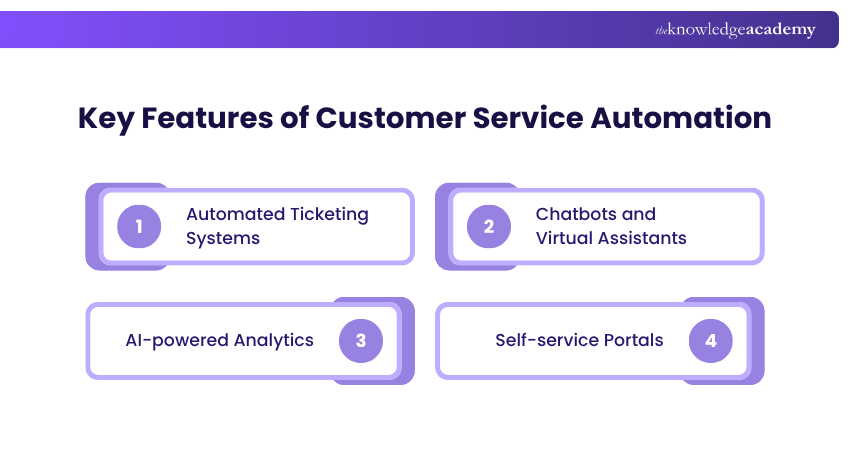
1) Automated Ticketing Systems
Automated ticketing systems simplify support processes by categorising and routing customer queries efficiently. When a request is received via phone, chat, or email, the system generates a ticket and directs it to the appropriate team or agent using predefined rules or AI-based analysis. This ensures quicker responses and accurate issue resolution.
2) Chatbots and Virtual Assistants
AI-driven Virtual Assistants and Chatbots are among the most widely used automation tools. It’s exemplified by the fact that the global Chatbot Market size is projected to reach £30.9 billion by 2033. They interact with customers across websites, messaging platforms, and call centres, delivering instant responses to common queries and handling routine tasks like order tracking, billing inquiries, and account updates. Advanced systems use Natural Language Processing (NLP) to understand context and manage more complex conversations effectively.
3) AI-powered Analytics
Beyond handling interactions, automation also supports Data Analysis. Artificial Intelligence and Machine Learning tools gather and analyse customer data to identify trends, highlight recurring issues, and uncover opportunities for improvement. These insights help refine support strategies, enhance products or services and amplify the overall customer experience. Predictive Analytics can also anticipate customer needs, allowing businesses to act proactively.
4) Self-service Portals
Self-service options like knowledge bases, help centres and FAQ sections allow customers to find answers independently without contacting support teams. AI-powered search and recommendations guide users to relevant information, reducing ticket volumes and improving satisfaction by allowing users to resolve the issues at their convenience.
Give your sales team the power of intelligent automation. Register for our AI Automation Training for Sales now!
Steps to Automate Customer Service
Automating customer service requires a structured approach. While the exact process may vary depending on business size and goals, most organisations can follow a common framework:
1) Identify Business Needs
Begin by reviewing existing customer service processes to pinpoint areas where automation can add the most value. The chosen technology should be flexible and capable of adapting to both business requirements and customer expectations.
2) Determine Which Tasks to Automate
Focus on repetitive, high-volume tasks that consume significant time, such as greeting customers, collecting account details or verifying information. These are easier to automate and provide a strong starting point. For instance, implementing an automated ticketing system can efficiently route queries to the right Agents, which reduces wait times.
3) Align the Team
Ensure that all team members understand how to use the automation tools effectively. Clearly define roles and responsibilities, including who'll manage and maintain the systems to ensure smooth operations.
4) Test Processes and Results Before Launch
Thoroughly test automation tools before launching them. This helps identify issues, ensures accuracy, and guarantees that the customer experience meets expected standards. Skipping this step may lead to poor service and customer dissatisfaction.
5) Maintain and Optimise Automation Solutions
Automation systems require regular monitoring, updates and improvements. Collect customer feedback after interactions and review performance regularly. Update responses, refine AI tools and maintain knowledge bases to keep the system effective.
Tracking key metrics is essential at this stage. Measures such as Customer Satisfaction Score (CSAT) help assess how satisfied customers are, while Net Promoter Score (NPS) indicates customer loyalty and their likelihood to recommend the business.
Let Artificial Intelligence do the heavy lifting as you focus on strategy and creativity. Sign up for our AI Automation Course for Marketing now!
Benefits of Customer Service Automation
Here are the major benefits of embracing Customer Service Automation:
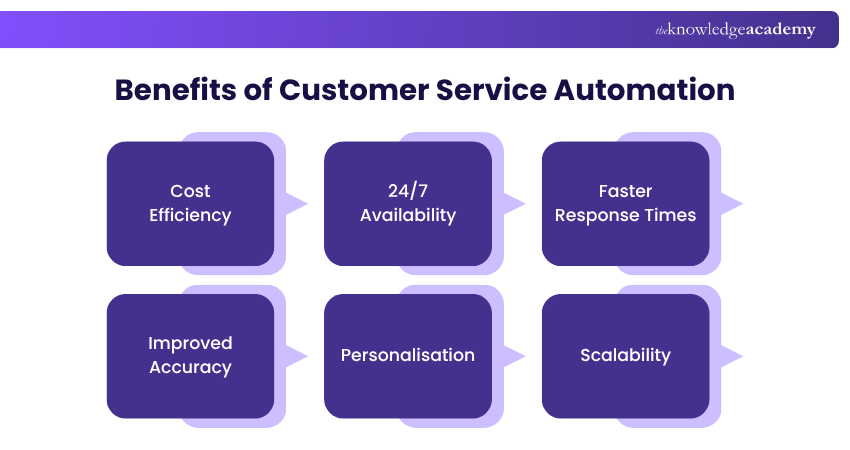
1) Cost Efficiency
By handling routine tasks, automation reduces the need for extensive human involvement, helping lower operational costs. It also allows businesses to scale support without a proportional increase in staffing.
2) 24/7 Availability
Automated systems operate continuously, allowing customers to access support at any time. Whether through chatbots or self-service portals, assistance is available beyond standard business hours, making it ideal for organisations serving global audiences across different time zones.
3) Faster Response Times
Automation delivers instant responses to common queries, significantly reducing waiting times. When human intervention is required, it ensures requests are routed and prioritised efficiently, speeding up overall resolution.
4) Improved Accuracy
Automated systems follow predefined rules and workflows, minimising the chances of human error. This ensures consistent, reliable responses and reduces mistakes associated with manual handling.
5) Personalisation
AI-driven automation can tailor responses using customer data, previous interactions, and purchase history. This enables more relevant and engaging experiences, making customers feel understood even in automated interactions.
6) Scalability
Automation can easily support growing customer demands. As businesses expand, automated systems can handle increased volumes without requiring additional resources or compromising service quality.
Challenges of Automated Customer Service
Customer Service Automation can present certain challenges. To maximise its effectiveness, organisations must recognise these limitations and plan accordingly. The most common challenges are outlined below:
1) AI Limitations: AI systems may struggle with complex or unfamiliar queries. Establishing clear escalation paths to human Agents helps make sure that the customers still receive accurate support.
2) Resource Allocation: Implementing automation often requires collaboration across teams. Starting with high-impact use cases can simplify adoption and reduce initial complexity.
3) Overreliance on Technology: Excessive dependence on automation can reduce the human touch customers value. Maintaining a balance between automated and human support helps preserve meaningful interactions.
4) Security Concerns: Automation involves handling sensitive customer data, making security a priority. Reliable platforms should include strong safeguards like Data Encryption, access controls and compliance measures to protect against potential breaches.
Build products that think ahead. Lead innovation with AI-powered automation skills in our AI Automation Course for Product Management now!
Examples of Automated Customer Service
Customer Service Automation can range from simple tools to advanced AI-driven systems, depending on a business's size and needs. Below are common examples of automated support solutions:
1) AI Agents: Advanced AI-powered bots capable of handling complex queries, trained on large volumes of customer interactions to deliver accurate and efficient resolutions.
2) Automated Ticketing Systems: AI-driven systems that categorise and route customer queries to the most ideal Agents, improving response times and overall customer experience.
3) Interactive Voice Response (IVR): Automated phone systems that greet callers, direct them to the appropriate department, process payments, and respond to common queries using pre-recorded messages.
4) Intelligent Routing: Smart routing systems that assign tickets based on agent skills, availability, workload, and priority, ensuring efficient handling of customer requests.
5) Autoresponders: Automation tools that send instant, consistent replies to customer inquiries across channels such as email and social media.
6) Automated Notifications: Systems that deliver proactive updates and alerts to customers based on predefined triggers and rules.
7) Workflow Automation: Tools that streamline internal processes by automating repetitive tasks and ensuring the smooth progression of customer service activities.
8) Automatic Translation: Translation tools that enable businesses to support customers in multiple languages, expanding global reach without increasing workload.
Future of Customer Service Automation
As AI, Machine Learning, and NLP continue to advance, Customer Service Automation is set to become more intelligent and personalised. The following trends are shaping the future:
1) Predictive Customer Service: AI will anticipate customer needs before issues arise by analysing behaviour, purchase history, and past interactions.
2) Fully Autonomous Support Agents: Next-generation AI Agents will handle more complex, context-driven conversations. With improved NLP, they will understand intent, tone and emotions.
3) Multimodal Customer Service: Automation will expand beyond text and voice to include images, video, and other inputs.
4) Seamless Omnichannel Integration: Automation will unify customer interactions across channels such as chat, email, phone, and social media.
5) Advancements in Voice and Conversational AI: Voice-based automation will become more sophisticated, enabling natural, conversational interactions. Systems will better understand context, intent, and even regional accents for more accurate responses.
6) Robotic Process Automation (RPA): RPA will streamline back-end operations like data entry, order processing and system updates.
7) Ethical and Responsible AI: As automation grows, organisations will prioritise transparency, fairness, and data privacy. Responsible AI practices will be essential to building trust and ensuring compliance.
Conclusion
Customer Service Automation is no longer a future concept. It’s a powerful driver of modern customer experiences. By combining the right tools with a human touch, businesses can deliver smarter and more personalised support. Embracing automation today means building stronger relationships and staying ahead in an increasingly customer-centric digital world.
Turn the most complex tasks into intelligent workflows with AI automation. Sign up for our AI Automation Training now!
Frequently Asked Questions
How is Automation Used in Customer Service?

Automation is used to handle repetitive tasks such as answering FAQs, routing tickets, sending follow-ups and providing self-service options. It reduces the response times and ensures consistent support across multiple channels. It allows Agents to focus on complex customer needs.
What are the Best Tools for Customer Service Automation?
Common tools include Chatbots, Automated Ticketing Systems, CRM platforms, knowledge bases, IVR systems, Workflow Automation Software and AI Analytics Tools. These solutions work together to improve efficiency, boost customer experience and support scalable service operations.
What are the Other Resources and Offers Provided by The Knowledge Academy?
The Knowledge Academy takes global learning to new heights, offering over 3,000+ online courses across 490+ locations in 190+ countries. This expansive reach ensures accessibility and convenience for learners worldwide.
Alongside our diverse Online Course Catalogue, encompassing 17 major categories, we go the extra mile by providing a plethora of free educational Online Resources like Blogs, eBooks, Interview Questions and Videos. Tailoring learning experiences further, professionals can unlock greater value through a wide range of special discounts, seasonal deals, and Exclusive Offers.
What is The Knowledge Pass, and How Does it Work?
The Knowledge Academy’s Knowledge Pass, a prepaid voucher, adds another layer of flexibility, allowing course bookings over a 12-month period. Join us on a journey where education knows no bounds.
What are the Related Courses and Blogs Provided by The Knowledge Academy?
The Knowledge Academy offers various AI Automation Courses, including the AI Automation Training for Customer Services, AI Automation Course for Product Management and the AI Automation Training for Sales. These courses cater to different skill levels, providing comprehensive insights into Agentic AI.
Our Data, Analytics & AI Blogs cover a range of topics related to Customer Service Automation, offering valuable resources, best practices, and industry insights. Whether you are a beginner or looking to advance your Automation expertise, The Knowledge Academy's diverse courses and informative blogs have got you covered.

The Knowledge Academy


Global Training Provider
The Knowledge Academy is a world-leading provider of professional training courses, offering globally recognised qualifications across a wide range of subjects. With expert trainers, up-to-date course material, and flexible learning options, we aim to empower professionals and organisations to achieve their goals through continuous learning.

Upcoming Data, Analytics & AI Resources Batches & Dates
Date
 AI Automation Training for Customer Services
AI Automation Training for Customer Services
Fri 14th Aug 2026
AI Automation Training for Customer Services
Fri 13th Nov 2026

 If you wish to make any changes to your course, please


