


 Top Rated Course


We may not have the course you’re looking for. If you enquire or give us a call on +44 20 4538 6376 and speak to our training experts, we may still be able to help with your training requirements.
How to Stop Overthinking Causes Signs and Ways to Control It
Michael Jones 30 March 2026To stop overthinking, practice mindfulness, stay present, limit decision time, challenge negative thoughts, breathe deeply, and take small actions. You can also journal, set healthy tech boundaries, exercise, practice gratitude, and seek support. Embrace How to Stop Overthinking naturally by weaving these practices into everyday life.

Training Outcomes Within Your Budget!
We ensure quality, budget-alignment, and timely delivery by our expert instructors.
Table of Contents
Have you ever found yourself replaying a conversation continuously in your mind and get the feeling that you said something wrong, and you don't even realise the fact that no one cares about it; that's how Overthinking impacts you in seconds. What starts as a simple thought gets converted to stress and mental exhaustion.
In this blog, we are going to find out what causes this Overthinking behaviour and How to Stop Overthinking. Learn the practical ways to create mental well-being, reduce stress, and how to reduce overthinking.
Table of Contents
1) What Is Overthinking?
2) Reasons Behind Overthinking
3) Types of Overthinking
4) 11 Ways to Stop Overthinking
5) Is Overthinking Anxiety?
6) What Trauma Causes Overthinking?
7) Conclusion
What Is Overthinking?
Overthinking refers to the habit of spending a lot of time thinking over something, a circumstance, or an issue unnecessarily. It tends to put an individual into too much analysis to the point where they struggle to change their focus to anything. Your heart is focused on one thing, and there is not much room to be clear and at peace.
Everyone overthinks at some point in life. Maybe you might be Overthinking the project you are going to submit next week, thinking about what will go wrong. To get rid of this habit, you have to know the reason and How to Stop Overthinking for your mental peace.

Reasons Behind Overthinking
There is no better universal cause for anxiety, stress and frustration than Overthinking. Before you get to know How to Stop Overthinking, first understand the core reasons that start the overthinking process in humans. The following are a few reasons you need to know:
1) Repeated Thoughts Keep Circling
Ever had a favourite song repeatedly playing in your mind? Just like that, only repeatedly, you keep thinking about the same thought without any reason. Like, did I do work perfectly, or did I mess up? Constantly thinking this in rewind mode ends up in exhausting Overthinking.
2) Constantly Second-guessing Decisions
Should I send the file now or in the morning? I got perfume to gift my friend, but should I change it to something else? This type of constant shift in choices results in overthinking, which often consumes time in making a proper decision.
3) Your Mind Won't Quiet Down
Your mind is like an internet browser with 50 tabs open. It doesn’t matter how much you try and concentrate, there’s usually another notion popping up, reminding you of something you forgot, something you need to do, or something that could go wrong.
4) Struggling to Make Decisions
Fear of making mistakes often fuels Overthinking. You hesitate, weigh every option endlessly, and end up stuck in indecision. But here’s the secret: making no decision is often worse than making the “wrong” one.
If you see yourself in these patterns, don’t worry - you’re not alone. The next step? Learning how to quiet the noise.
Types of Overthinking
There are different types of ways people overthink; many of these are caused by a negative or distorted way of processing thoughts. Once you are aware of the type, then How to Stop Overthinking starts unfolding. Here are three key types of Overthinking:
1) All-or-Nothing Thinking
This Overthinking type convinces you to see things in black and white and no other medium. You look at things as either a great success or a great failure. Consequently, even small events may become too decisive for you.
2) Catastrophising
This Overthinking happens when your mind goes directly to the worst-case scenario. The tiniest of issues, such as the failure of a test case, will seem like the end of your future. Anxiety is driven by speculation on the possibility of events that are not or cannot happen.
3) Overgeneralising
This type of Overthinking occurs when you start thinking the future will be the same as your past events. One failure turns into an attitude of believing that things will never work out. It makes you worry about patterns that might never happen in the actual sense.
Discover the secrets to mental resilience by joining our Mental Capacity Training – Join today!
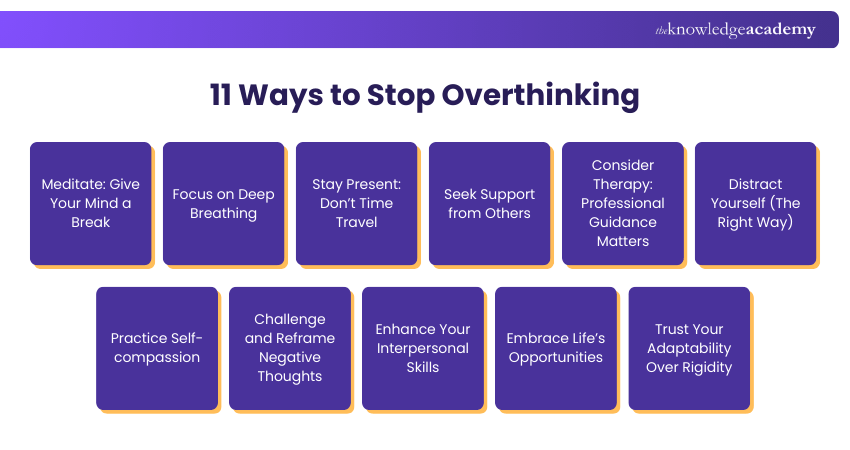
11 Ways to Stop Overthinking
Overthinking often stems from mental overload. Here’s How to Stop Overthinking naturally with simple, effective strategies you can apply daily.
1) Meditate: Give Your Mind a Break
Meditation is a better way to slow down your mind from over-exhaustion with unnecessary thoughts. Five minutes of meditation daily results in a decrease in anxiety and depression and an increase in memory and learning capacity.
2) Focus on Deep Breathing
When Overthinking moves, your breath turns shallow and fast. In such a circumstance, you must inhale deeply for four seconds, maintain for four seconds, then exhale for six seconds. This easy trick calms your worried device and alerts your mind to loosen up.
3) Stay Present: Don’t Time Travel
Overthinkers love to time travel - either reliving the past or stressing about the future. The solution? Anchor yourself in the now. Pay attention to your surroundings. Notice the colours, the sounds, the sensations. The present moment is your escape hatch from Overthinking.
Discover the secrets to mental resilience by joining our Mental Capacity Training – book your spot now!
4) Seek Support from Others
How to control Overthinking? Sometimes, you just need to get thoughts out of your head. Opening up to a friend or loved one can provide clarity and reassurance. A fresh perspective often helps break the cycle of overanalysing.
5) Consider Therapy: Professional Guidance Matters
If Overthinking is meddling with your existence, therapy can act as a game-changer. Cognitive Behavioural Therapy (CBT) is an effective way on How to Stop Overthinking, it helps reframe bad concept styles and teaches practical strategies on How to control Overthinking. Seeking assistance is a signal of power; rather, than a weak point.
6) Distract Yourself (The Right Way)
Not every distraction is horrific. If your mind is spiralling, shift your recognition to an enticing hobby. Play a musical tool, go for a run, paint, or try a new recipe. Channel your energy into something effective in preference to letting your mind wander aimlessly.
7) Practice Self-compassion
Imagine a friend came to you with their worries. Would you criticise them? Probably not. Yet, we are often our harshest critics. Speak to yourself with the same kindness you’d offer a friend. Instead of saying, “I always mess up,” try, “I’m learning and growing.” This mindset shift helps illustrate How to Stop Overthinking naturally with kindness.
8) Challenge and Reframe Negative Thoughts
Overthinking thrives on worst-case scenarios. But knowing How to Stop Overthinking naturally allows you to replace irrational thoughts with empowering ones. Instead of assuming, “What if I fail?” try asking, “What if I succeed?” Challenge irrational thoughts and replace them with empowering ones.
9) Enhance Your Interpersonal Skills
Poor communication can lead to overanalysing conversations and interactions. Strengthening your interpersonal skills,like active listening and assertiveness can help you navigate social situations with confidence and reduce unnecessary worry.
10) Embrace Life’s Opportunities
The problem of Overthinking is that it prevents you from taking effective action. You hesitated, looked at every angle, and the next thing you know, you just missed a good opportunity. What if you took the action the other way? Progress will only start outside of your comfort zone.
11) Trust Your Adaptability Over Rigidity
Life is unpredictable, and that’s okay. Instead of fearing uncertainty, accept this as true with your ability to conform. You’ve treated challenges before, and you’ll take care of them again. You should embrace flexibility and let go of the fear of control.
Enhance your focus and well-being with our Mindfulness Training- Sign up today!
Is Overthinking Anxiety?
Overthinking is not the same as anxiety but knowing How to Stop Overthinking naturally can prevent anxious cycles from gaining strength. While overthinking involves repetitive, excessive thought patterns, anxiety often fuels these thoughts. Anxiety creates worry, fear, and doubt, which intensify overthinking, trapping the mind in cycles of stress and indecision.
What trauma Causes Overthinking?
Overthinking can be triggered by past traumatic experiences such as abuse, neglect, loss, or chronic stress. Trauma often leaves unresolved fears, leading the mind to replay events, anticipate danger, and over-analyse situations as a way to regain control or avoid further emotional pain.
Learn expert strategies on how to overcome overthinking and anxiety with our Anxiety Course - start now!
Conclusion
Overthinking can gradually dominate your life, draining your energy, confidence, and decision-making ability. However, by applying practical techniques on how to stop overthinking and adopting a healthier mindset, you can break the cycle and restore calm, clarity, and control. Remember that progress begins with small, consistent steps, choosing presence over worry, action over hesitation, and self-trust over fear.
Learn strategies to improve mental well-being and workplace support with our Workplace Stress And Mental Health Identification For Manager - start today!
Frequently Asked Questions
How Do I Relax my Mind from Overthinking?

To relax your mind from Overthinking, try mindfulness exercises, deep breathing, or engaging in physical activities. Practicing meditation and journaling can also help quiet the mind. Additionally, limit screen time, listen to soothing music, practise gratitude, and spend time in nature for calmness.
Do Overthinkers Live Longer?
As for overthinkers living longer, there's no conclusive evidence suggesting that overthinking leads to a longer life. In fact, chronic stress from Overthinking can have negative effects on physical health. Healthy habits, mindfulness, and stress management are better linked to improved longevity.
What are the Other Resources and Offers Provided by The Knowledge Academy?
The Knowledge Academy takes global learning to new heights, offering over 3,000+ online courses across 490+ locations in 190+ countries. This expansive reach ensures accessibility and convenience for learners worldwide.
Alongside our diverse Online Course Catalogue, encompassing 19 major categories, we go the extra mile by providing a plethora of free educational Online Resources like Blogs, eBooks, Interview Questions and Videos. Tailoring learning experiences further, professionals can unlock greater value through a wide range of special discounts, seasonal deals, and Exclusive Offers.
What is The Knowledge Pass, and How Does it Work?
The Knowledge Academy’s Knowledge Pass, a prepaid voucher, adds another layer of flexibility, allowing course bookings over a 12-month period. Join us on a journey where education knows no bounds.
What are the Related Courses and Blogs Provided by The Knowledge Academy?
The Knowledge Academy offers various Mental Health Training, including Mindfulness Training, Mental Health and Wellbeing Training, and Positive Psychology Course. These courses cater to different skill levels, providing comprehensive insights into Emotional Wellbeing.
Our Health & Safety Blogs cover a range of topics related to Mental Health, offering valuable resources, best practices, and industry insights. Whether you are a beginner or looking to advance your Health and Safety skills, The Knowledge Academy's diverse courses and informative blogs have got you covered.

Michael Jones


Health and Safety Consultant and Compliance Trainer
Michael Jones is a seasoned health and safety expert with more than 15 years of experience in workplace safety, risk management, and compliance training. He has worked across construction, manufacturing, and corporate sectors, helping organisations meet legal requirements and create safer working environments. Michael’s training and writing are known for being practical, clear, and aligned with UK regulations.
View Detail


 If you wish to make any changes to your course, please


