


 Top Rated Course

We may not have the course you’re looking for. If you enquire or give us a call on +31 208081674 and speak to our training experts, we may still be able to help with your training requirements.
What is GDPR?
John Davies 14 July 2026The General Data Protection Regulation is a legal framework ensuring data privacy and security across the EU to enhance personal data protection and privacy. It outlines how organisations should collect and manage data and grants individuals control over their personal data while imposing strict compliance on organisations.

Training Outcomes Within Your Budget!
We ensure quality, budget-alignment, and timely delivery by our expert instructors.
Table of Contents

Have you ever wondered what happens to your personal data when you share it online? In a world where data is often called the new oil, safeguarding personal information has become paramount. Explore the General Data Protection Regulation (GDPR) – a game-changer in the realm of data privacy. But What is GDPR, and why should you care? This regulation has transformed how businesses handle your data, ensuring its security like never before.
Discover the essentials of GDPR, from its foundational principles to practical compliance steps, as you dive into this blog. Curious about What is GDPR? Let's go on this fascinating adventure together to unravel its impact on you and the future of data protection. Ready to get started? Let's dive in!
Table of Contents
1) What is GDPR?
2) History and Evolution of GDPR
3) GDPR Scopes and Penalties
4) Understanding GDPR Compliance
5) How to Prepare for GDPR Compliance?
6) What are the Basic Rules of GDPR?
7) What is GDPR Guideline?
8) Conclusion
What is GDPR?
The General Data Protection Regulation (GDPR) is an EU law designed to safeguard personal data and privacy. It came into force on 25 May 2018 and applies to all organisations that collect or process data belonging to individuals in the EU, regardless of where the organisation itself is located.
The regulation ensures personal information is handled lawfully, fairly, and securely. In the UK, GDPR operates alongside the Data Protection Act 2018, which adapts certain provisions to suit national requirements.

History and Evolution of GDPR
The General Data Protection Regulation (GDPR) is widely regarded as one of the world’s strongest data protection laws. It grants individuals more control over their personal information while setting strict rules for how organisations collect, process, and store that data.
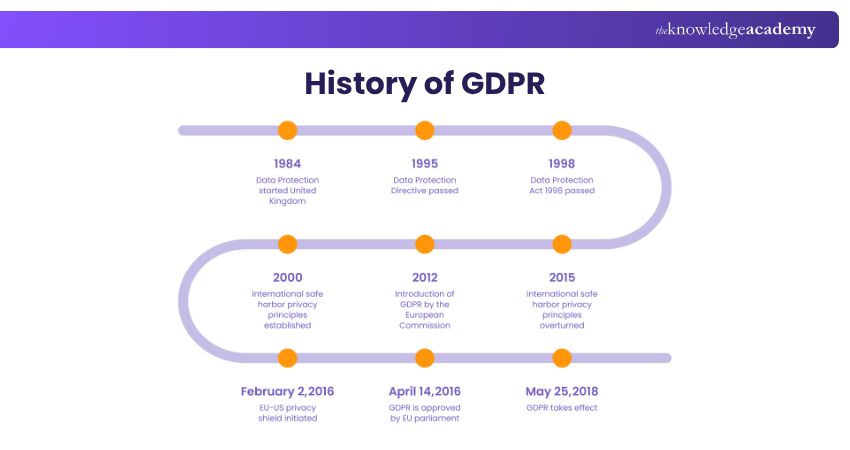
A Brief Timeline of Data Protection are as follows:
a) 1950s: The European Convention on Human Rights formally recognises the right to privacy.
b) 1995: The EU introduces the Data Protection Directive, setting minimum standards for privacy across member states.
c) 2000s: Rapid technological growth highlights the need for stronger, more harmonised rules.
d) April 2016: GDPR is formally adopted by the European Parliament and the European Council, after years of debate.
e) 25 May 2018: GDPR comes into effect, replacing the 1995 Directive and marking a new era of unified data protection laws.
Although GDPR applies across Europe, member states were permitted to make limited adjustments. In the UK, this led to the Data Protection Act 2018, which replaced the earlier 1998 Act and aligned national law with GDPR’s framework.
Protect personal data and master GDPR regulations - join our in-depth GDPR Training today!
GDPR Scopes and Penalties
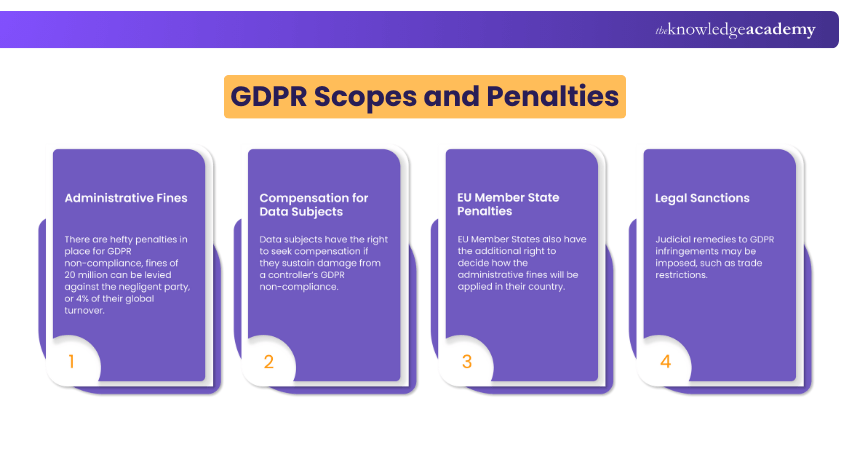
GDPR applies to how organisations collect, store, and use people’s personal data. Here are some of the key features:
1) Scope
The General Data Protection Regulation (GDPR) applies to any organisation that processes the personal data of individuals in the European Union. This includes companies, associations, public authorities, and in certain cases private individuals.
It is not limited to organisations within the EU. Any business or entity that offers goods or services to EU citizens, or employs people in the EU, must comply regardless of where it is located.
The regulation applies across all EU member states as well as the European Economic Area (EEA) countries, which include Iceland, Liechtenstein, Norway, and the United Kingdom. This wide scope ensures consistent protection of personal data across the region.
2) Penalties
GDPR violations can result in two levels of fines.
a) Lower-tier fines: Up to 10 million euros or 2% of global annual revenue, whichever is higher, typically for breaches like record-keeping or data security failures.
b) Upper-tier fines: Up to 20 million euros or 4% of global annual revenue, whichever is higher, usually for serious violations such as unlawful data processing, denial of rights, or illegal data transfers.
Fines apply to organisations of any size and are determined case by case. Regulators assess factors such as intent, number of individuals affected, mitigation steps taken, and cooperation with authorities.
Understanding GDPR Compliance
Understanding GDPR compliances has become a mandatory aspect of many organisations. It is one of the most significant privacy-based laws implemented in the past few years. Why is GDPR Important, to different organisations, as failing to abide by them can make them susceptible to penalties. These penalties generally come with hefty fines and as a result they act as a potential deterrent for any company to misuse the data.
The essence of complying with GDPR and the Data Protection Act is based on the thought of protecting a person’s vital information and thus safeguarding their fundamental rights. This compliance has led to an overall more ethically guided approach to data handling in EU-based organisations. As a result of these mandated privacy standards, data protection has become much more accessible for a large majority of people across the EU.
This compliance became prominent and started to take a foothold due to rising concerns regarding the use of personal information. With the increased emphasis on transparency, many organisations began referencing a GDPR Privacy Policy Template to ensure their practices aligned with the latest standards. This compliance can be credited to the technical revolution that took place over the last few years. This compliance to data protection is a successor to the Data Protection Directive established previously.
The GDPR Compliance is particularly applicable to a certain set of companies and organisations that meet certain criteria. These companies need to strictly comply with the regulations if they do not wish to be penalised, or worse, considered to have breached GDPR. Some of the factors which can decide if an organisation or company is bound to comply with GDPR or not are as follows:
1) EU Based Operation: Any organisation operating within the EU region is directly under the GDPR laws. Hence, if they are dealing with data that may include health, biometrics, cookies, Internet Protocol (IP) addresses, and the race of the individual, they need to abide by GDPR regulations.
2) Data of EU Residents: This applies to companies who are operating outside EU grounds but are handling the data of people who reside in the EU region. Any company or organisation that operates with such data is bound by GDPR regulations and compliance.
3) Employee Count: An organisation that asks for the personal information of its employees is bound by GDPR in terms of how their vital data is handled. This is particularly for an organisation that has over 250 people working under the firm. This compliance not only keeps the resident safe but also the employee and their confidential information.
4) Frequency of Data Processing: Although EU based rules and regulations are applicable for large scale organisation and a business that operate within EU, GDPR is not limited there. GDPR compliance is also applicable for any organisation which may process sensitive information provided by citizens of EU region. Even if the company is not directly responsible for obtaining the data, how they handle it is still controlled by GDPR rules.
Interested in making an organisation more GDPR compliant? Try our Dealing With Subject Access Requests (SAR) - An Executive Briefing Course!
How to Prepare for GDPR Compliance?
Preparing for GDPR goes beyond just ticking boxes. It requires organisations to rethink how personal data is managed, documented, and protected. Even if you comply with older data protection rules, GDPR introduces new requirements that demand fresh attention.
1) Data Mapping
Start by creating a complete inventory of the personal data you process. Record what data you collect, where it comes from, why you use it, where it is stored, and who has access. Include details of third-party processors, sub-processors, and international transfers.
Maintain a record of processing activities with assigned owners for each data flow. Use data-flow diagrams to uncover hidden or duplicate data stores. Review this register regularly, especially when new projects or vendors are introduced, to ensure it always reflects your operations.
2) Eliminate Unnecessary Data
Apply GDPR’s principle of data minimisation. Remove personal data that is outdated, irrelevant, or excessive. Create and enforce a data retention schedule to ensure secure deletion across all systems, including backups where feasible.
When you must keep data, restrict access and pseudonymise it to reduce risk. Simplify forms and processes so only essential information is collected. This reduces exposure in case of a breach and makes compliance much easier.
3) Implement Data Protection Measures
Strengthen both technical and organisational safeguards. Use encryption for data at rest and in transit, multi-factor authentication for sensitive access, and strict role-based permissions.
Deploy security measures like patch management, secure API controls, and pseudonymisation of test or analytics data. Establish an incident response plan to detect, report, and investigate breaches quickly. Ensure processors meet GDPR standards by conducting due diligence and adding compliance clauses to contracts.
4) Revaluate Your Documentation
Review and update all privacy-related documentation. Privacy notices should be transparent and clear, explaining what data is collected, the lawful basis for processing, retention timelines, and user rights.
Maintain consent logs when consent is your lawful basis, and ensure consent is specific, opt-in, and easy to withdraw. Document procedures for subject access requests (SARs) so requests for access, rectification, or deletion can be handled within the required one-month timeline.
Update your cookie policy and consent tools so users can make informed and flexible choices. Keep all documentation under version control and update it regularly.
Developing GDPR Policies and Procedures
Formalise your compliance programme with well-structured policies. These should cover data protection, access control, retention, vendor management, breach response, international transfers, and employee training.
Appoint a Data Protection Officer (DPO) if required or assign equivalent responsibility. Conduct Data Protection Impact Assessments (DPIAs) for high-risk activities and maintain an action log of findings. Run awareness training so staff understand their responsibilities.
Embed privacy by design and default into new projects so GDPR compliance is built into processes rather than treated as an afterthought. Establish an internal audit cycle to track compliance and address risks early.
What are the Basic Rules of GDPR?
GDPR rules include obtaining clear consent for data collection, ensuring data accuracy, providing individuals the right to access, correct, or delete their data, protecting data security, and notifying breaches promptly. Businesses must process data lawfully, transparently, and only for specific purposes.
What is GDPR Guideline?
GDPR guidelines are rules set by the EU to ensure organisations handle personal data responsibly. They outline how to collect, process, store, and protect data, emphasising user consent, transparency, and security. These guidelines aim to safeguard individual privacy while enabling lawful data use.
Get GDPR-ready! Prepare with our comprehensive list of GDPR Interview Questions & Answers. Start studying now!
Conclusion
Understanding What is GDPR is crucial for protecting personal data and ensuring compliance. This regulation not only enhances data security but also imposes strict penalties for non-compliance. By adhering to GDPR, organisations can safeguard individuals' information and maintain trust in the digital age. Embrace GDPR to stay ahead in an evolving, data-driven world! Additionally, with the need for Data Protection Officer becoming increasingly clear, organisations can further ensure GDPR compliance.
Master data protection with our Data Privacy Awareness Course – register now and secure your future!
Frequently Asked Questions
What are the Seven Main Principles of GDPR?

The seven main principles of GDPR are:
1) Lawfulness, fairness, and transparency
2) Purpose limitation
3) Data minimisation
4) Accuracy
5) Storage limitation
6) Integrity and confidentiality
7) Accountability
These principles ensure robust data protection and compliance.
What Does GDPR Stand for?
GDPR stands for General Data Protection Regulation. It is a legal framework implemented by the European Union (EU) to regulate the collection, use, and protection of personal data, ensuring individuals have greater control over their privacy and data rights.GDPR stands for General Data Protection Regulation. It is a legal framework implemented by the European Union (EU) to regulate the collection, use, and protection of personal data, ensuring individuals have greater control over their privacy and data rights.

John Davies


Cyber Security Governance & Assurance Specialist
John Davies is a cybersecurity expert specialising in governance, risk management, and compliance. With over 15 years in the field, he has led enterprise-wide security programmes across finance, healthcare and public sector organisations. His content provides practical guidance on building secure environments, managing risk and aligning with regulatory frameworks.


 If you wish to make any changes to your course, please


