


 Top Rated Course

We may not have the course you’re looking for. If you enquire or give us a call on +31 208081674 and speak to our training experts, we may still be able to help with your training requirements.
What is GCSE? Full Form, Subjects & Grading System
The Knowledge Academy 17 March 2026GCSE stands for General Certificate of Secondary Education, a UK qualification taken at 14–16. Exams at Year 11 lead to A-levels, college, or jobs. It builds essential knowledge across a wide range of core academic subjects. Results play a key role in shaping future academic choices and long-term professional career pathways.

Training Outcomes Within Your Budget!
We ensure quality, budget-alignment, and timely delivery by our expert instructors.
Table of Contents
Education choices can feel overwhelming, especially during the teenage years. One of the most important milestones for students in the UK is understanding What is GCSE and why it matters. These qualifications shape future study options and career paths. They influence subject specialisation and progression routes. Let’s break down everything you need to know.
Table of Contents
1) What Does GCSE Stand For?
2) Who is Eligible for GCSE?
3) How are GCSEs Graded?
4) The Importance of GCSEs
5) What are the Mandatory Subjects in GCSEs?
6) How to Choose Your GCSE Subjects?
7) Potential Pathways After GCSEs
8) What GCSEs Can Lead To?
9) Do Universities Look at GCSE or A Levels?
10) What is the Difference Between GCSE and A-Level?
11) Conclusion
What Does GCSE Stand For?
The UK has a standard academic qualification known as GCSE, which is the General Certificate of Secondary Education, and is typically done when students leave secondary school in the UK. Nevertheless, these exams are normally held in two years and at the end of Year 11; these tests are a part of the national curriculum.
As qualifications, GCSEs are the basic knowledge that enables one to advance in their studies, like A-Levels, BTECs, T Levels or apprenticeships. They are known in England, Wales and Northern Ireland and assist in influencing the further course of the student in the educational and career plan.

Who is Eligible for GCSE?
GCSEs are accessible to a wide range of learners, not just traditional secondary school students. Eligibility depends on age, study pathway, and registration through an approved exam centre.
1) Age Requirements
GCSEs are normally taken by students aged 14–16, representing the final two years of compulsory secondary education. Students outside this range generally do not sit the exams under standard school arrangements.
2) UK Students
Students living in the United Kingdom, whether in state or private schools, typically study GCSE subjects through the national curriculum and sit exams at the end of Year 11.
3) International Students
International learners can also take GCSEs through international schools or approved exam centres, gaining qualifications recognised both in the UK and abroad.
4) Homeschooled Students
Homeschooled students are eligible to sit GCSE exams by registering privately with a recognised examination centre while studying independently or with tutors.
5) Adult Learners
Adults of any age can take GCSEs to improve qualifications, change careers, or enhance skills, often through evening classes, online study, or private entry.
How are GCSEs Graded?
GCSEs are graded on a 9 to 1 scale, where 9 represents the highest grade and 1 the lowest. The new grading system now uses numbers instead of the old letter grades, providing a more precise assessment of student performance. Here’s how the new grades correspond to the old ones:
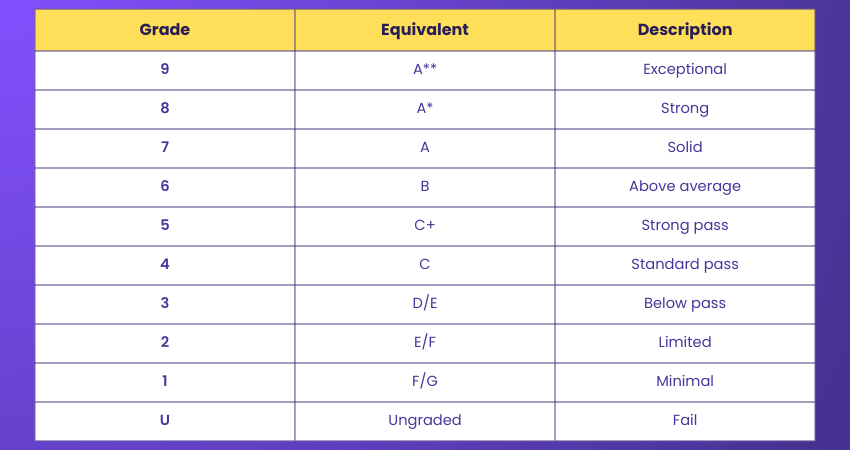
a) Grade 9 – Even higher than the old A*, indicating exceptional performance
b) Grade 8 – Below an A* but above an A, reflecting a strong understanding of the subject
c) Grade 7 – Slightly below an A but still very close, showing solid achievement
d) Grade 6 – Slightly better than a B, demonstrating above-average knowledge
e) Grade 5 – Below a B but above a C, also known as a 'strong pass'
f) Grade 4 – Equivalent to a C, referred to as a 'standard pass'
g) Grade 3 – Below a D but above an E, showing some understanding but not quite passing
h) Grade 2 – Between an E and an F, indicating a limited grasp of the material
i) Grade 1 – Between an F and a G, representing minimal achievement
j) Ungraded (U) – The lowest possible mark, and just like the old system, a U represents a fail
The Importance of GCSEs
GCSEs are very important as they lay the foundation for your future education and career. They are often the first major qualifications you'll earn and are crucial for getting into further education, like A-levels or vocational courses. With various GCSE options available, you can tailor your path according to your interests and career goals. Employers and universities also consider your GCSE results when evaluating you for jobs or admission.
What are the Mandatory Subjects in GCSEs?
In England, the national curriculum requires all students to study three core GCSE subjects until the age of 16:
a) English Language: Required for developing essential communication skills; students who do not achieve grade 4 must resit it. English Literature is taught in most schools, but it is not compulsory.
b) Mathematics: Compulsory because it builds key numeracy and problem‑solving skills. A grade 4 is required; otherwise, students must resit.
c) Science: All students study Science, usually as Combined Science (two GCSEs), though some schools offer separate sciences.
These core subjects form the essential foundation for progressing to post‑16 pathways such as A‑levels, BTECs, T Levels or apprenticeships.
Learn essential techniques for prioritising tasks with our Time Management Training – Join today!
How to Choose Your GCSE Subjects?
Here are some tips to help you decide the best GCSE subject options for your future.
1) Required Number of GCSEs
You should take a minimum of 5 subjects, and while it's possible to take up to 16 GCSEs, managing such a large number can be extremely challenging. Most students typically take around 9 GCSE subjects.
2) Select Subjects You Excel In
Choose subjects you are good at and enjoy. Doing well in these subjects will boost your overall grades and confidence.
3) Most Challenging GCSE Subjects
Some subjects are considered more challenging than others, like
a) Physics
b) English Literature
c) Maths
d) Computer Science
e) Economics
f) Biology
g) English Language
Think about whether you enjoy a challenge and are prepared to put in the extra effort.
4) Avoid Overloading with Too Many Subjects
Taking too many subjects can be overwhelming. It's better to focus on doing well in a manageable number of subjects than spreading yourself too thin.
5) Seek Advice from Others
Consult your teachers, parents or career advisors when choosing your subject. They can be useful and give you the information to make the right choices.
6) Easiest GCSE Subjects
While it's important to choose subjects you enjoy and are good at, some subjects are generally considered easier, like
a) Geography
b) Film Studies
c) Religious Studies
d) Media Studies
e) Hospitality and Catering
f) Business Studies
g) Drama
h) Physical Education
However, make sure they align with your interests and future goals.
7) Consider Your Future Goals and Career Aspirations
Think about what you want to do after school. If you have a specific career in mind, choose subjects that will help you get there. For example, if you want to be a doctor, focus on science subjects.
Learn how to deal with stress with our Stress Management Course – Join today!
Potential Pathways After GCSEs
After completing your GCSEs, you have several options. You can continue your education by taking Advanced Level qualifications (A-levels), Business and Technology Education Council Qualifications (BTECs), or other vocational qualifications, with many universities now focusing on digitising universities to offer more flexible learning opportunities. Alternatively, you can start an apprenticeship or enter the workforce, or explore what to do after GCSEs based on your career goals.
What GCSEs Can Lead To?
GCSEs are an important step for your future. They can help you move on to A Levels, vocational courses, or apprenticeships. Your GCSE results can also help you get your first job or choose a career path. Employers often use GCSE Grades 2025 to check your skills, especially in Maths and English. Strong GCSE results can also make your university applications more competitive, giving you an edge in the admissions process.
Do Universities Look at GCSE or A Levels?
Universities look at both GCSE and A Level results. GCSE grades are often used to check if you meet basic requirements, like passing in English and Maths. However, A Levels are more important because they show how well you've done in the subjects you want to study further. Some university courses may have specific GCSE grade requirements. For example, careers in medicine or engineering may require high grades in Science or Maths at GCSE level.
What is the Difference Between GCSE and A-Level?
GCSE and A Levels serve different stages in UK education with distinct purposes and expectations. GCSEs are broad qualifications taken at age 15–16 covering many subjects, while A Levels, taken at 16–18, focus on fewer subjects in much greater depth and prepare students for university or advanced study.
Conclusion
Understanding What is GCSE helps you see why these qualifications matter so much for future opportunities. They lay the foundation for further study, career choices, and personal growth. With the right preparation, GCSEs can be the first big step toward long-term success.
Learn the career development challenges with our Career Development Course – Sign up today!
Frequently Asked Questions
Can You Do an Access Course Without GCSEs?

Access to Higher Education Diplomas is a fast and popular way to qualify for university. They are equivalent to A Levels and usually take 9-12 months to complete. You don’t need GCSEs to start an Access to Higher Education Diploma, but most universities will require Maths and English qualifications when you apply.
Can I Apply for University Courses Without GCSE Grades?
Traditionally, universities required specific GCSE and A Level grades for their courses, often matching the subject you wanted to study. Now, the system is more flexible. Many universities are less strict about which GCSEs you have, though Maths and English are still the most commonly required. If you need these qualifications quickly.
What are the Other Resources and Offers Provided by The Knowledge Academy?
The Knowledge Academy takes global learning to new heights, offering over 3,000+ online courses across 490+ locations in 190+ countries. This expansive reach ensures accessibility and convenience for learners worldwide.
Alongside our diverse Online Course Catalogue, encompassing 17 major categories, we go the extra mile by providing a plethora of free educational Online Resources like Blogs, eBooks, Interview Questions and Videos. Tailoring learning experiences further, professionals can unlock greater value through a wide range of special discounts, seasonal deals, and Exclusive Offers.
What is The Knowledge Pass, and How Does it Work?
The Knowledge Academy’s Knowledge Pass, a prepaid voucher, adds another layer of flexibility, allowing course bookings over a 12-month period. Join us on a journey where education knows no bounds.
What are the Related Courses and Blogs Provided by The Knowledge Academy?
The Knowledge Academy offers various Personal Development Courses, including the Time Management Training, Attention Management Training, and Active Listening Training. These courses cater to different skill levels, providing comprehensive insights into Corresponding Angles.
Our Business Skills Blogs cover a range of topics related to GCSE, offering valuable resources, best practices, and industry insights. Whether you are a beginner or looking to advance your Literacy skills, The Knowledge Academy's diverse courses and informative blogs have got you covered.

The Knowledge Academy


Global Training Provider
The Knowledge Academy is a world-leading provider of professional training courses, offering globally recognised qualifications across a wide range of subjects. With expert trainers, up-to-date course material, and flexible learning options, we aim to empower professionals and organisations to achieve their goals through continuous learning.

Upcoming Business Skills Resources Batches & Dates
Date
 Career Development Course
Career Development Course
Fri 19th Jun 2026
Career Development Course
Fri 25th Sep 2026
Career Development Course
Fri 11th Dec 2026

 If you wish to make any changes to your course, please


