


 Top Rated Course

We may not have the course you’re looking for. If you enquire or give us a call on +31 208081674 and speak to our training experts, we may still be able to help with your training requirements.
Business Process Improvement - A Complete Guide
James Smith 13 February 2026Business Process Improvement (BPI) boosts efficiency by analysing workflows, cutting costs, and using technology to enhance overall organisational performance. It fosters continuous improvement by identifying bottlenecks and streamlining operations. Ultimately, BPI helps businesses deliver higher quality products and services.

Training Outcomes Within Your Budget!
We ensure quality, budget-alignment, and timely delivery by our expert instructors.
Table of Contents

As a business leader, you know that staying competitive requires more than just hard work. It demands smart, strategic process management. Business Process Improvement (BPI) is a key tool for driving operational excellence and sustainable growth. It allows you to take a step back, evaluate how your processes are functioning, and identify areas for optimisation.
From reducing operational waste to enhancing service delivery, Business Process Improvement empowers leaders to align processes with business goals and customer expectations. This blog will walk you through the essentials of BPI and how to harness it effectively to improve your bottom-line.
Table of Contents
1) What is Business Process Improvement?
2) How does Business Process Improvement Work?
3) Methodologies of Business Process Improvement (BPI)
4) Examples of Business Process Improvement (BPI) Projects
5) Benefits and Challenges of Business Process Improvement
6) What is the Business Process Improvement Flow?
7) What are KPIs for Business Process Management?
8) Conclusion
What is Business Process Improvement?
Business Process Improvement (BPI) is a strategic approach aimed at identifying, analysing, and enhancing existing business processes to achieve higher efficiency, effectiveness, and adaptability. It focuses on understanding how work is currently done within an organisation and finding opportunities to improve performance, reduce costs, eliminate waste, and increase the overall value delivered to customers.
At its core, BPI involves examining current workflows such as how products are made, services are delivered, or information is processed. Then comes redesigning these processes to be faster, efficient, and more aligned with organisational goals. This can include removing unnecessary steps, automating manual tasks through technology, improving communication flows, or adopting new methods or tools.

How Does Business Process Improvement Work?
Implementing Business Process Improvement (BPI) is a methodical strategy that is aimed at boosting the organisational efficiency and effectiveness of their operations. Below is a breakdown of each crucial step in the process:
1) Identify Processes to Improve
Begin by selecting specific processes to improve, ideally starting at the team level to allow for a deep dive into the process. This approach helps build process improvement skills for tackling more complex organisational processes later.
2) Map the Process
Once a process is selected, document each step using a flowchart or diagram. Involve regular users of the process to ensure all steps are captured accurately, providing a clear picture of the current process before making changes.
3) Analyse the Process
Use the flowchart to identify problems within the process. Engage all team members in discussions to gain diverse perspectives on what works, what doesn’t, and where bottlenecks occur. This collaborative analysis helps pinpoint areas for improvement.
4) Redesign the Process
After identifying issues, work with those involved to redesign the process. Ensure everyone understands the process’s goals and explores solutions collaboratively. Conduct an impact analysis if the process is complex to understand the full effects of changes.
5) Acquire Resources
List and secure the necessary resources for implementing the new process. Communicate with relevant departments to ensure they understand the benefits and requirements of the new process, facilitating smoother implementation.
6) Implement and Communicate Change
Consider running a pilot to identify potential issues before a full rollout. Involve affected individuals early in the process to encourage buy-in and reduce resistance to change.
7) Monitor Results
You need to establish key indicators to assess the improvement's effectiveness. After implementation, monitor the process closely to make sure that it performs as expected and make adjustments based on feedback from those involved (if needed).
Unlock Pro-level management skills – Register for Performance Management Training today!
Methodologies of Business Process Improvement (BPI)
BPI uses strategies to improve efficiency and productivity. Here's an overview of several fundamental methodologies:

1) Six Sigma
This data-driven approach aims to minimise defects, errors, and process variations to improve performance and customer satisfaction. The goal is to achieve a defect rate of 3.4 parts per million, representing six standard deviations from the mean.
2) Lean Six Sigma
This methodology focuses on waste reduction and process efficiency by combining Lean manufacturing principles with Six Sigma. It integrates the efficiency tools of Lean principle with Six Sigma's statistical rigour to enhance overall performance.
3) Total Quality Management (TQM)
Total Quality Management (TQM) is a management philosophy focused on achieving high quality in all aspects of an organisation. These elements ensure that businesses consistently meet customer expectations while enhancing efficiency and performance. Embracing these practices leads to higher productivity, reduced costs, and improved stakeholder satisfaction, highlighting the Benefits of Total Quality Management.
4) Business Process Reengineering (BPR)
Business Process Reengineering (BPR) is a strategic approach that involves fundamentally rethinking and redesigning business processes to achieve dramatic improvements in critical areas like cost, quality, service, and speed. BPR is typically used when incremental improvements are not sufficient, and transformative change is needed for competitiveness or survival.
5) Plan-Do-check-Act (PDCA)
Plan-Do-Check-Act (PDCA) is a continuous improvement cycle used to enhance processes and solve problems systematically.
a) Plan: Identify an issue or area for improvement and develop a strategy.
b) Do: Implement the plan on a small scale to test its effectiveness.
c) Check: Measure and analyse the results of the implementation.
d) Act: If successful, standardise the change; if not, revise the plan and repeat the cycle.
Examples of Business Process Improvement (BPI) Projects
Business Process Improvement (BPI) is a powerful strategy for enhancing organisational performance across various industries. Here are detailed examples of BPI projects that organisations commonly undertake:

1) Manufacturing Industry
Lean Manufacturing principles, such as value stream mapping, waste reduction, and continuous improvement, are key to manufacturing BPI. By analysing and optimising production processes, organisations can achieve greater efficiency, reduced lead times, and improved resource utilisation. Implementing quality management systems like ISO 9001 helps establish robust quality control processes, monitor performance, and drive continuous improvement.
2) Healthcare Sector
BPI helps in optimising efficiency in operations, enhances patient care, and improves delivery of essential healthcare's facility. Techniques such as streamlining administrative processes (patient registration, appointment scheduling, billing, and insurance claim processing) reduce paperwork and waiting times, enhancing efficiency and patient satisfaction. Additionally, BPI helps optimise patient flow and care coordination by analysing the patient journey, identifying bottlenecks, and implementing strategies, often as part of a Care Management Program, to improve movement through various departments.
3) Financial Services
BPI enhances operational efficiency, customer experience, and regulatory compliance in financial services. Streamlining customer onboarding processes, including account opening, KYC procedures, and documentation, reduces paperwork and enhances data accuracy. This optimisation improves the overall customer experience and operational efficiency.
4) Retail Sector
BPI enables retailers to improve operational effectiveness, reduce costs, enhance customer satisfaction, and stay competitive. By continuously evaluating and refining processes, retailers can adapt to changing consumer demands, improve profitability, and deliver exceptional shopping experiences. Implementing accurate demand forecasting, optimising replenishment processes, and leveraging technology solutions like RFID helps reduce stockouts, minimise excess inventory, and improve inventory turnover rates.
Build high‑performing teams and lead better – Sign up to our Team Development Training today!
Benefits and Challenges of Business Process Improvement
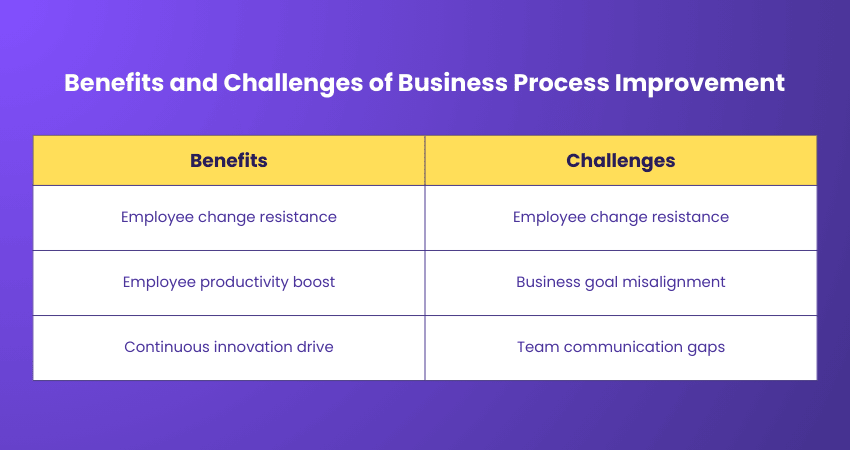
Business Process Improvement (BPI) offers numerous Benefits of Business Process Improvements and faces several challenges. Let’s discuss in details:
Benefits of Business Process Improvement
a) Optimised processes can significantly enhance customer service, customer experience, and ultimately customer satisfaction.
b) Improved processes can lead to a better worker experience.
c) Automation, innovation, and intelligence in processes support continuous enterprise transformation.
Challenges of Implementing BPI
a) Workers may resist changes introduced by BPI initiatives.
b) Unplanned improvements that are not aligned with business goals can hinder success.
c) Lack of communication across the organisation to relevant parties can impede the implementation of BPI.
What is the Business Process Improvement Flow?
The Business Process Improvement (BPI) flow is a structured, step-by-step approach used to enhance existing business processes for better performance. It typically begins with identifying and mapping current processes to understand how work is done. The next step is to analyse the process for inefficiencies, bottlenecks, or redundancies.
Based on this analysis, improvements are designed, often involving technology, automation, or procedural changes. The improved process is then implemented, monitored, and refined continuously to ensure it delivers the desired results. This flow ensures organisations remain agile, cost-effective, and customer-focused in an ever-changing business landscape.
What are KPIs for Business Process Management?
Key Performance Indicators (KPIs) for Business Process Management (BPM) are measurable values that assess the effectiveness and efficiency of business processes. Common BPM KPIs include cycle time (how long a process takes), cost per process, error rates, customer satisfaction scores, process compliance rate, and employee productivity.
These KPIs help organisations monitor performance, identify improvement areas, and ensure that business processes align with strategic goals. Tracking the right KPIs enables continuous process optimisation and supports better decision-making across all levels of the business.
Conclusion
Business Process Improvement (BPI) Strategy is focused on enhancing the efficiency and effectiveness of organisational processes. It is widely used across various industries, including manufacturing, healthcare, finance, and retail. By optimising processes, organisations can improve quality, reduce costs, and increase customer satisfaction. Furthermore, this approach helps businesses adapt to changing demands, streamline operations, and achieve better overall results.
Enhance decision-making and build high-performing teams - Start learning from Management Courses today!
Frequently Asked Questions
What is the Purpose of Process Improvement?

The purpose of Process Improvement is to make organisational operations more efficient and effective. By examining, evaluating, and refining business processes, organisations can eliminate inefficiencies, enhance quality, boost productivity, and deliver superior customer experiences.
What is Process Improvement Also Known As?
Process Improvement is also known as Business Process Improvement (BPI), business process optimisation, process reengineering, or simply process optimisation.
What are the Other Resources and Offers Provided by The Knowledge Academy?
The Knowledge Academy takes global learning to new heights, offering over 3,000+ online courses across 490+ locations in 190+ countries. This expansive reach ensures accessibility and convenience for learners worldwide.
Alongside our diverse Online Course Catalogue, encompassing 19 major categories, we go the extra mile by providing a plethora of free educational Online Resources like Blogs, eBooks, Interview Questions and Videos. Tailoring learning experiences further, professionals can unlock greater value through a wide range of special discounts, seasonal deals, and Exclusive Offers.
What is The Knowledge Pass, and How Does it Work?
The Knowledge Academy’s Knowledge Pass, a prepaid voucher, adds another layer of flexibility, allowing course bookings over a 12-month period. Join us on a journey where education knows no bounds.
What are the Related Courses and Blogs Provided by The Knowledge Academy?
The Knowledge Academy offers various Management Courses, including Management Training for New Managers, the Introduction to Management Course, and Introduction to Managing People Training. These courses cater to different skill levels, providing comprehensive insights into Business Process Management.
Our Business Skills Blogs cover a range of topics related to Business Process Improvements, offering valuable resources, best practices, and industry insights. Whether you are a beginner or looking to advance your business process skills, The Knowledge Academy's diverse courses and informative blogs have got you covered.

James Smith


Digital Marketing Manager and Trainer
James Smith is a digital marketing professional with over a decade of experience in SEO, content strategy, paid media and analytics. He has supported both SMEs and global brands in transforming their digital presence. James’s writing and training are rooted in results-driven tactics and the latest marketing trends.
View Detail
Upcoming Business Skills Resources Batches & Dates
Date
 Certified Kanban Foundation and Practitioner Training
Certified Kanban Foundation and Practitioner Training
Wed 2nd Sep 2026
Certified Kanban Foundation and Practitioner Training
Wed 9th Dec 2026

 If you wish to make any changes to your course, please


