


 Top Rated Course

We may not have the course you’re looking for. If you enquire or give us a call on +31 208081674 and speak to our training experts, we may still be able to help with your training requirements.
What is Social Entrepreneurship: Meaning, Examples & Benefits
The Knowledge Academy 19 February 2026Social Entrepreneurship involves solving social and environmental challenges through business models that prioritise social impact and financial sustainability. It combines innovation with a strong sense of purpose to create long-term solutions. They ensure sustainable and scalable impact while balancing ethical business practices.

Training Outcomes Within Your Budget!
We ensure quality, budget-alignment, and timely delivery by our expert instructors.
Table of Contents
Let’s say that you are running a business that’s not only successful but also creating positive change in the world. Sounds like a perfect blend of success and purpose, right? This is what Social Entrepreneurship is all about. But What is Social Entrepreneurship?
It’s the art of creating a business that addresses social issues while remaining financially sustainable. It shows that profit and purpose can work together. In this blog, we will explore What is Social Entrepreneurship, how it works, real-world examples, and the key benefits it offers to individuals, communities, and the wider economy. Let’s explore how you can create a lasting impact!
Table of Contents
1) What is Social Entrepreneurship?
2) Key Elements of Social Entrepreneurship
3) Types of Social Entrepreneurship
4) Entrepreneurship vs Social Entrepreneurship
5) Social Entrepreneurship in Society
6) Social Entrepreneurship Examples
7) How to Become a Social Entrepreneur?
8) Benefits of Social Entrepreneurship
9) Challenges of Social Entrepreneurship
10) Future of Social Entrepreneurship
11) Conclusion
What is Social Entrepreneurship?
Social Entrepreneurship is an approach to business that focuses on solving social, cultural, and environmental challenges through innovative and sustainable solutions. Unlike traditional businesses that primarily aim to maximise profit, social enterprises are driven by a clear mission to create positive change.
They use commercial business strategies to generate revenue, but their main objective is to address societal issues such as poverty, education gaps, healthcare access, unemployment, and climate change. Through this, Social Entrepreneurship maintains a strong balance between purpose and profitability.

Key Elements of Social Entrepreneurship
Social Entrepreneurship is not just about starting a business with good intentions. It is built on specific elements that guide how impact is created and sustained. They define how social enterprises operate, measure success, and balance purpose with profitability. Let's check those key elements:
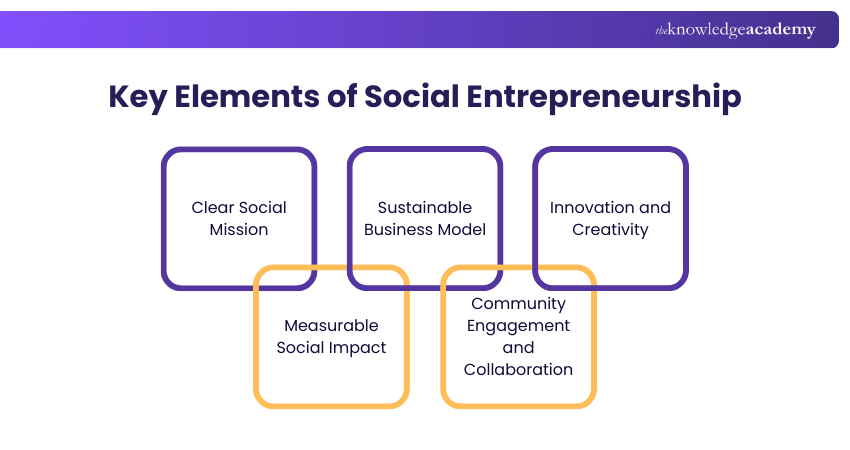
1) Clear Social Mission: Every social enterprise has a clear goal to solve social or environmental problems. The mission guides decisions and keeps the focus on creating positive change.
2) Sustainable Business Model: Social Entrepreneurs use revenue-generating models to fund their operations. Instead of relying on donations, they sell products or services to remain financially stable and independent.
3) Innovation and Creativity: They apply innovative ideas, technologies, or processes to solve problems effectively. This often involves challenging traditional systems and introducing new, practical approaches.
4) Measurable Social Impact: Success is measured not only by financial performance but also by the positive change created. Social enterprises track outcomes to ensure they are making a meaningful difference.
5) Community Engagement and Collaboration: Social enterprises work closely with communities and stakeholders to create practical, inclusive solutions that meet real needs.
Types of Social Entrepreneurship
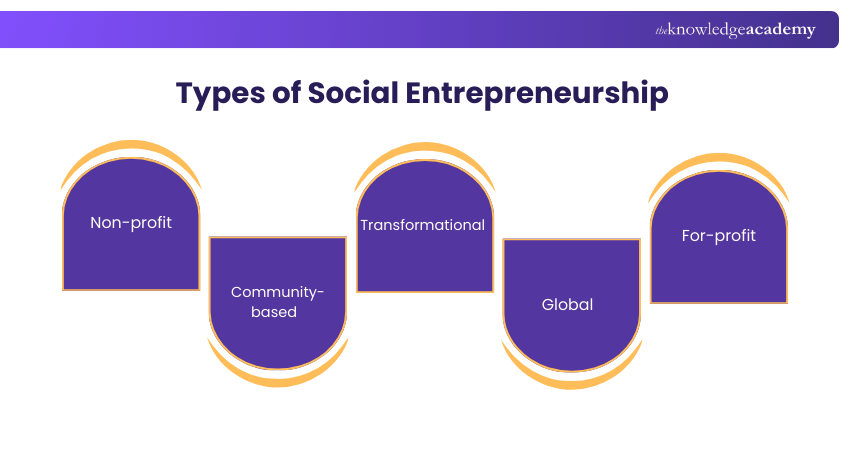
Social Entrepreneurship manifests in various forms, each with a unique approach to fostering societal progress:
1) Non-profit
Non-profit social enterprises focus entirely on addressing social or environmental issues rather than generating profit for owners. They often rely on donations, grants, or fundraising activities to support their mission. Any surplus income is reinvested into programmes and community initiatives to expand their impact.
Example: Non-governmental Organisations (NGOs) working on education for underserved children.
2) Community-based
Community-based Social Entrepreneurship centres on solving local problems within a specific region or group. These ventures work closely with local residents to address issues such as unemployment, education gaps, or public health concerns. Their solutions are designed to directly benefit and strengthen the community they serve.
Example: A community-run cooperative providing employment to local women.
3) Transformational
Transformational Social Entrepreneurship aims to drive systemic and long-term change. Rather than simply addressing immediate symptoms, these ventures focus on tackling root causes of social problems. Their work often involves innovation, advocacy, or influencing public policy to reshape existing systems and structures.
Example: A startup creating a new low-cost medical technology that makes healthcare more accessible.
4) Global
Global Social Entrepreneurship operates across borders to address international challenges such as poverty, climate change, or access to healthcare. These organisations collaborate with global partners and use scalable models to create impact in multiple countries.
Example: A global initiative providing clean drinking water technologies in multiple developing nations.
5) For-profit
For-profit social enterprises combine commercial success with a strong social mission. They generate revenue through the sale of products or services while prioritising social impact. Profits are often reinvested to grow the business and increase its positive contribution to society.
Example: A company selling eco-friendly products to reduce plastic waste.
Unlock the secrets to creating and maintaining connections by joining our Building Business Relationships Course!
Entrepreneurship vs Social Entrepreneurship
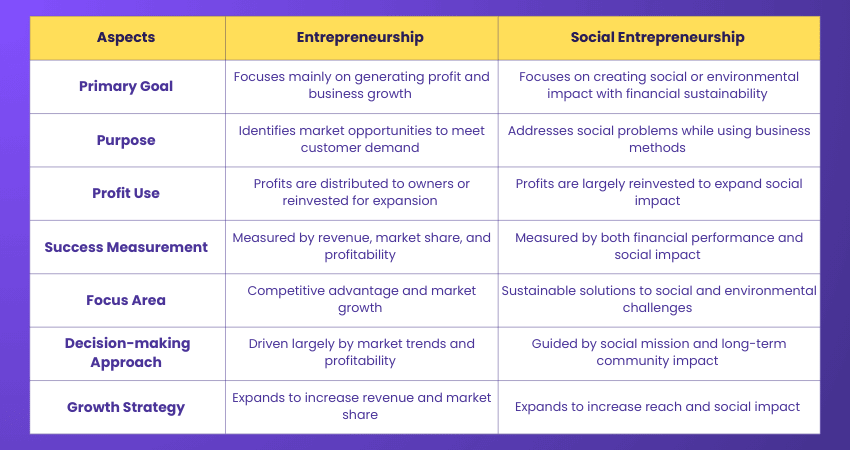
Entrepreneurship and Social Entrepreneurship both involve starting and managing ventures, but their core purposes differ. Traditional entrepreneurship primarily focuses on identifying market opportunities and generating profit. Entrepreneurs aim to create products or services that meet customer needs while maximising financial returns and business growth.
On the other hand, Social Entrepreneurship combines business principles with a strong social or environmental mission. While it also generates revenue, profit is not the sole objective. The main focus is to create measurable and positive impacts on society.
Let's check more about the difference between entrepreneurship and Social Entrepreneurship with the table below:
Social Entrepreneurship in Society
Social Entrepreneurship holds a significant role in addressing challenges that traditional systems sometimes struggle to solve. Governments and private businesses may not always reach marginalised communities or tackle complex social issues effectively. Social enterprises step in to fill these gaps by offering innovative, practical, and community-focused solutions.
Beyond solving problems, knowing What is Social Entrepreneurship also strengthens society by promoting inclusive growth and shared value. It empowers communities by creating jobs, encouraging skill development, and fostering self-reliance. In this way, it supports a balanced and responsible society where business progression benefits a wider group of people.
Social Entrepreneurship Examples
Social Entrepreneurship can be seen across many sectors where innovative ideas and practical business strategies are used to create long-term, sustainable change. Below are a few illustrative examples that demonstrate how it works in different areas.
1) Affordable Healthcare Services
Imagine a social enterprise that sets up low-cost mobile clinics in rural areas. It charges a small fee for consultations and medicines, making healthcare accessible while covering operational costs. The revenue earned helps expand services to more villages.
2) Sustainable Farming Initiative
Consider a venture that trains small-scale farmers in eco-friendly farming techniques and purchases their produce at fair prices. The products are then sold in urban markets, generating stable income for farmers while promoting sustainable agricultural practices. This model balances profitability with environmental responsibility.
3) Skill Development for Youth
Picture an organisation that provides vocational training to unemployed young people. It partners with local businesses to place trainees in jobs and funds its programmes through course fees and corporate sponsorships.
4) Recycling and Waste Management Business
A company could collect plastic waste from communities, recycle it into usable products, and sell those items commercially. This reduces environmental pollution while creating employment opportunities.
5) Education Technology Platform
Imagine an online learning platform that offers affordable digital courses to students in underserved regions. Subscription fees keep the platform running, while discounted access ensures inclusivity.
Improve your communication and build meaningful connections with our Social Skills Training – Register today!
How to Become a Social Entrepreneur?
Now you have a clear understanding of What is Social Entrepreneurship, let’s check how to become a Social Entrepreneur:
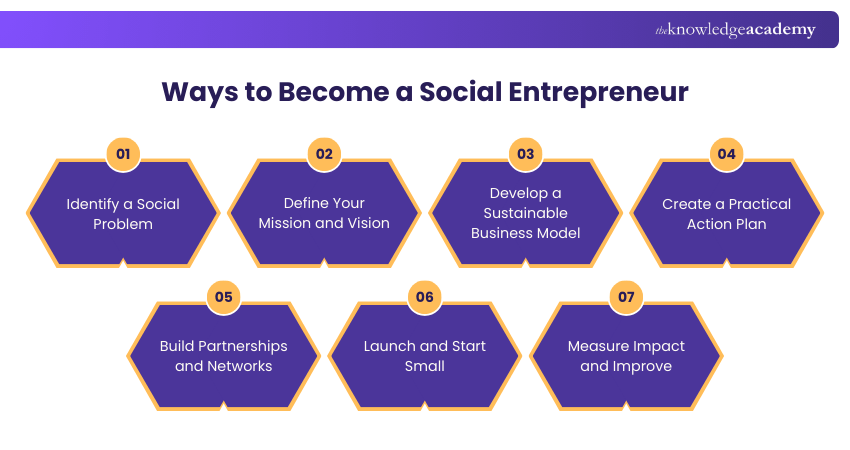
1) Identify a Social Problem: Start by recognising a social or environmental issue that needs attention. Research the root causes and understand how they affect individuals or communities.
2) Define Your Mission and Vision: Clearly outline what changes you want to create. Your mission should guide every decision and reflect on the long-term impact you aim to achieve.
3) Develop a Sustainable Business Model: Plan and form a business model that generates revenue while supporting your social purpose. Plan how your product or service will fund operations and growth.
4) Create a Practical Action Plan: Prepare a roadmap that includes goals, target audiences, funding sources, and timelines. A structured plan increases clarity and direction.
5) Build Partnerships and Networks: Collaborate with stakeholders, mentors, investors, and community members. Strong partnerships enhance resources and credibility.
6) Launch and Start Small: Begin with a pilot project to test your ideas. Gather feedback, refine your approach, and make improvements before expanding.
7) Measure Impact and Improve: Track both financial performance and social outcomes. Regular evaluation helps ensure your venture remains effective and aligned with its mission.
Benefits of Social Entrepreneurship
Social Entrepreneurship creates value beyond aiming for profits. It improves communities while promoting responsible business practices and long-term economic growth. Its benefits include the following:
1) Addresses social and environmental issues in practical and sustainable ways
2) Encourages long-term development rather than short-term relief
3) Creates employment opportunities, especially for marginalised groups
4) Promotes innovation through creative problem-solving approaches
5) Strengthens communities by fostering inclusion and self-reliance
Challenges of Social Entrepreneurship
While Social Entrepreneurship creates meaningful impact, it also comes with unique challenges. Those challenges are:
1) Difficulty in securing consistent and long-term funding
2) Challenges in measuring and proving social impact
3) Balancing financial sustainability with social mission
4) Limited resources and operational constraints
5) Regulatory and policy barriers in certain sectors or regions
Future of Social Entrepreneurship
The future of Social Entrepreneurship looks promising as more individuals, investors, and organisations recognise the importance of purpose-driven businesses. Here's what it is set to expect:
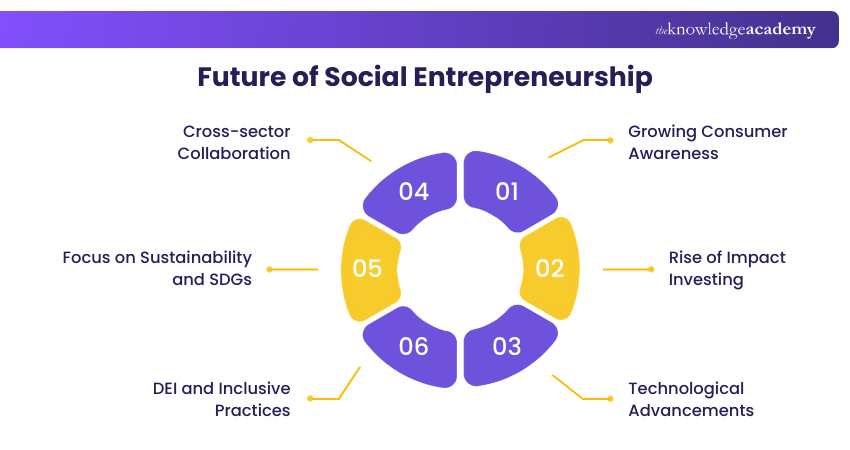
1) Growing Consumer Awareness: More consumers prefer purpose-driven brands, encouraging the growth of social enterprises.
2) Rise of Impact Investing: Investors increasingly support ventures that deliver financial returns and attainable social impact.
3) Technological Advancements: Digital tools and data analytics help social enterprises scale faster and measure impact effectively.
4) Cross-sector Collaboration: Partnerships between governments, businesses, and non-profits strengthen large-scale solutions.
5) Focus on Sustainability and SDGs: Social enterprises are aligning with the global Sustainable Development Goals (SDGs) to drive long-term impact.
6) DEI and Inclusive Practices: Greater emphasis on Diversity, Equity, and Inclusion (DEI) ensures fair opportunities and broader community representation.
Conclusion
Gaining proper knowledge on Social Entrepreneurship proves that business success and social responsibility can go hand in hand. By combining innovation, sustainability, and a clear social mission, social enterprises address pressing challenges while remaining financially viable. Whether you are an aspiring entrepreneur, investor, or conscious consumer, supporting purpose-driven ventures can contribute to meaningful and lasting change.
Empower yourself with tools that drive professional growth with our Personal Development Courses – Explore now!
Frequently Asked Questions
What Skills are Needed for a Social Entrepreneur?

A Social Entrepreneur needs leadership, problem-solving, and innovative thinking skills. Financial Management and strategic planning ensure sustainability, strong communication and networking build partnerships, while resilience and empathy help address community needs and create meaningful social impact.
What is the Difference Between CSR and Social Entrepreneurship?
Corporate Social Responsibility (CSR) refers to corporate initiatives where established companies contribute to social causes alongside their core business activities. But Social Entrepreneurship builds an entire business model around solving social problems, making social impact the primary mission.
What are the Other Resources and Offers Provided by The Knowledge Academy?
The Knowledge Academy takes global learning to new heights, offering over 3,000 online courses across 490+ locations in 190+ countries. This expansive reach ensures accessibility and convenience for learners worldwide.
Alongside our diverse Online Course Catalogue, encompassing 19 major categories, we go the extra mile by providing a plethora of free educational Online Resources like Blogs, eBooks, Interview Questions and Videos. Tailoring learning experiences further, professionals can unlock greater value through a wide range of special discounts, seasonal deals, and Exclusive Offers.
What is the Knowledge Pass, and How Does it Work?
The Knowledge Academy’s Knowledge Pass, a prepaid voucher, adds another layer of flexibility, allowing course bookings over a 12-month period. Join us on a journey where education knows no bounds.
What are the Related Courses and Blogs Provided by The Knowledge Academy?
The Knowledge Academy offers various Personal Development Courses, including the Entrepreneurship Course, the Organisational Skills Course and the Building Business Relationships Course. These courses cater to different skill levels, providing comprehensive insights into Sentiment Analysis.
Our Business Skills Blogs cover a range of topics related to Social Entrepreneurship, offering valuable resources, best practices, and industry insights. Whether you are a beginner or looking to advance your Entrepreneurial skills, The Knowledge Academy's diverse courses and informative blogs have you covered.

The Knowledge Academy


Global Training Provider
The Knowledge Academy is a world-leading provider of professional training courses, offering globally recognised qualifications across a wide range of subjects. With expert trainers, up-to-date course material, and flexible learning options, we aim to empower professionals and organisations to achieve their goals through continuous learning.

Upcoming Business Skills Resources Batches & Dates
Date
 Entrepreneurship Course
Entrepreneurship Course
Fri 17th Jul 2026
Entrepreneurship Course
Fri 9th Oct 2026

 If you wish to make any changes to your course, please


