


 Top Rated Course

We may not have the course you’re looking for. If you enquire or give us a call on +31 208081674 and speak to our training experts, we may still be able to help with your training requirements.
Latest Data Science Trends You Need to Know in 2026
Lily Turner 30 March 2026Curious about Data Science Trends? From AI advancements to Big Data Analytics and low-code tools, these trends are revolutionising industries. This blog dives into the latest innovations and emerging technologies redefining the future of Data Science. Let’s explore what’s ahead and discover how these trends can transform your business!

Training Outcomes Within Your Budget!
We ensure quality, budget-alignment, and timely delivery by our expert instructors.
Table of Contents
Assume that you're exploring a vibrant city, where each corner reveals new insights and opportunities. Ever pondered how businesses anticipate market shifts or how personalised suggestions seem so accurate? These wonders are powered by the latest Data Science Trends.
In this blog, we’ll delve into the groundbreaking innovations and insights that are revolutionising industries. Ready to explore the world of data science and uncover what's on the horizon? Let's explore this blog!
Table of Contents
1) The Latest Data Science Trends
2) Emerging Trends in Data Science
a) Auto ML
b) Augmented Analytics
c) TinyML and Small Data
d) Generative AI
3) Conclusion
The Latest Data Science Trends
From Data Analytics powered by AI to Quantum Computing, the Data Science Trends include many. Let’s take a look at some of them here:
1) AI-powered Data Analytics
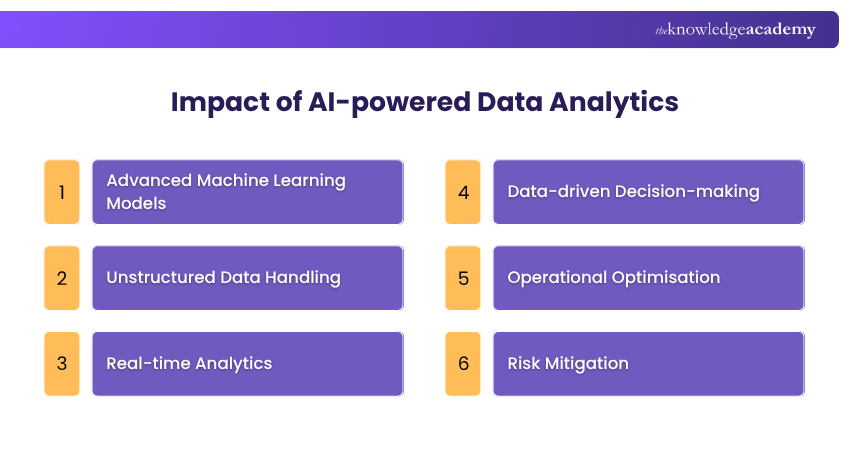
Within the field of Data Science, Advanced Intelligent Data Analysis is currently disrupting how businesses make valuable use of data, turning large, intricate datasets into useful information. Its profound impact on modern businesses is evident in several key areas:
a) Advanced Machine Learning Models: AI-anchored analytics depends on data and statistics feeding advanced machine learning mechanisms for pattern recognition, prognostication, and insightful outcomes.
b) Unstructured Data Handling: AI is particularly adept at the analysis of unstructured data like text, visual and digital and consequently expands its range across healthcare, finance and marketing.
c) Real-time Analytics: AI makes real time analytics possible in areas such as IoT, getting rid of latency and achieving better response time.
d) Data-driven Decision-making: AI for businesses helps improve accurate decisions and so make better decision making in strategic planning and other formations.
e) Operational Optimisation: Knowledge from AI contributes to improving efficiency, rationalisation, and customer satisfaction, which in turn give companies an advantage.
f) Risk Mitigation: AI exposes unsuspected threats and opportunities because of its ability to scan data intensively and quickly which enhances organisational robustness.
Elevate your Data Science expertise with our Data Science And Blockchain Training – Sign up now!
2) Edge Computing in Data Analysis
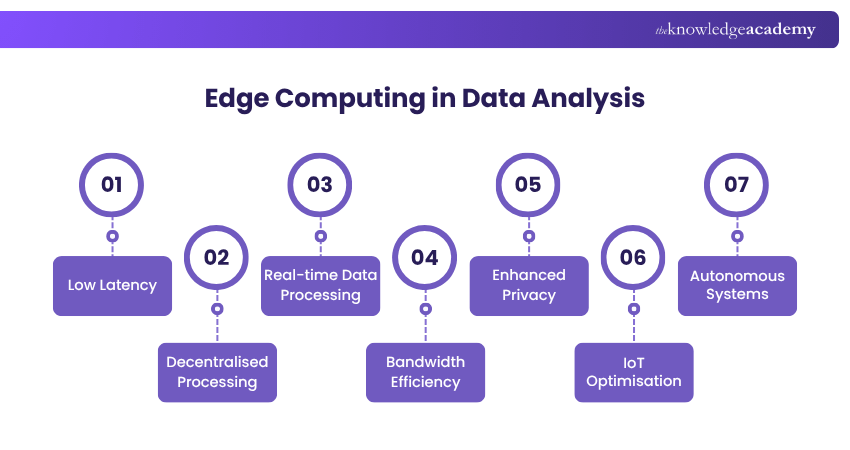
Edge computing processes data close to its source, rather than relying on centralised cloud servers, offering numerous benefits to businesses:
a) Low Latency: This way, edge computing shrinks the distance that data has to travel, which is a specific necessity when it comes to processing in real-time, for which applications like autonomous systems are needed.
b) Decentralised Processing: It provides resources to the local devices for example IoT sensors and the mobile devices so as to deliver efficient and scalable performance.
c) Real-time Data Processing: While fulfilling the need of making almost instantaneous decisions like in cases of self-driving cars, remote health monitoring, and similar.
d) Bandwidth Efficiency: Because it minimises the amount of large data volumes that need to be transmitted to central servers it calls for less bandwidth hence its consistently downward cost.
e) Enhanced Privacy: Storing data close to where it is produced is secure and private, which is beneficial for industries that require it such as health.
f) IoT Optimisation: User of IoT devices become privileged to have improved response times and low energy consumptions, making IoT devices more efficient.
g) Autonomous Systems: Self-driving cars and drones can make important decisions through edge computing without connecting them to scattered data centres.
3) Responsible AI and Ethics
Responsible AI requires the creation and implementation of AI algorithms that are ethical, meet human rights standards, and are sensitive to the community’s culturally promoted norms.
It has come to cover everything from concerns like equity, readability, responsibility, and prejudice reduction in addressing organisational and societal transformations.
a) Human-centric Design: Governing AI makes sure that AI systems target the benefits of the society without disturbing the wellbeing of the society.
b) Bias Mitigation: It also addresses how approaches can be made fair and equity by trying to mitigate bias in algorithms that are used for hiring, loaning, and even arresting people.
c) Transparency: As a polite and detailed decision-making system, Responsible AI enhances user trust in the AI solutions.
d) Accountability: AI’s repercussions are managed as developers and organisations are to be responsible for their actions, and legal.
e) Trust Building: Ethical AI means that netizens trust AI solutions, which is vital for stable relationships between providers and consumers in the future.
f) Legal Risk Reduction: By avoiding biases, it decreases the likelihood of lawsuits related to discriminatory AI.
g) Social Responsibility: The effectiveness of ethical AI implementation makes the business more attractive to socially responsible customers and shareholders.

4) Natural Language Processing (NLP)
Natural Language Processing (NLP) is the interdisciplinary scientific study of how to program computers to process and analyse large measures of natural language data. Its applications are transforming modern businesses in several impactful ways:
a) Improved Customer Service: Real-time chat support enabled by NLP increases productivity through round-the-clock availability of assistants, while cutting costs.
b) Data Insights: The sentiment analysis can also be used in content summarisation to extract meaningful information from massive textual information.
c) Conversational AI: New discoveries in NLP are helping chats respond to users’ questions and look more natural for users to interact with.
d) Sentiment Analysis: Thereby, text analysis allows one to measure customer’s satisfaction, read public opinion, or understand market trends.
e) Content Summarisation: Through NLP, long documents can be summarised whereby the general information is condensed to fit a small section in the document.
f) Language Accessibility: The participation of B2B translation tools based on artificial intelligence prescribes the opportunities for companies to enter new markets and overcome language barriers.
Become an expert in Data Science with our Advanced Data Science Certification – Sign up now!
5) Quantum Computing in Data Science
Quantum computing implores the laws of quantum mechanics to taste calculations that are practically beyond any possibility conventional computers. Its transformative potential offers several key benefits:
a) Improved Performance: The problems that quantum computers are good for are things like factorisation and optimisation; the kind of things that are exponentially useful for things like data analysis and modelling.
b) Reduced Processing Time: It reduces the number of hours needed to analyse extensive data through sophisticated pattern recognition to a few hours through quantum computing.
c) Enhanced Security: However, on the flip side, quantum computing poses a threat to classical cryptographic methods, but it also provides the way for constructing quantum-safe cryptography that holds better solutions to guard data.
d) New Possibilities: One of the primary areas of application of quantum technology is in emerging technologies in many other fields, which range from healthcare to pharmaceuticals, weather prediction to new approaches to supply chain design involving solving of hitherto unsolvable problems.
Quantum computing is on the doorstep to transform Data Science to perform means of problem solving, data protection, and data analysis.
6) AI as a Service (AIaaS)
AIaaS can be defined as the concept of making AI available as a service to organisations, thus allowing adding AI capabilities and expanding AI in business with little cost intervention. Organisations can integrate into AI ecosystems extensively developing themselves, using models like GPT-3 from OpenAI as APIs. Currently, AIaaS is slowly becoming one of the mainstream trends in different industries.
a) Cost-efficient AI: Unlike traditional models where a business would need to develop their massive in-house capabilities for Artificial intelligence applications, AIaaS models comes at an affordable price and are fully built-in-house solutions which can be easily implemented into a business.
b) Customised Solutions: Companies can choose AI services that are relevant for certain purposes, for example voice recognition system or sales prediction, so it will work professionally with no extra unnecessary features.
c) Domain-specific Models: It means that AIaaS provides business-specialised skilled models for healthcare or retail industries. These models solve specific problems and when required, they present the solutions to enhance efficiency.
d) Compliance Challenges: Issues of regulation and compliance cannot go unnoticed when organisations are implementing AIaaS. To implement the policy ethically and legally proper protection of data and compliance with the standards is required.
Ignite your analytical journey with our Python Data Science Training – Sign up today!
Emerging Trends in Data Science
Here following are the emerging trends in Data Science:
1) Auto ML
AutoML refers to tools that automate different steps of Machine Learning to build Machine learning models. AutoML helps to incorporate the whole process of data preprocessing, model selection, and hyperparameters optimisation.
Thus, giving businesses and people with non-technical backgrounds the ability to use ML. It spurs advancements, the rate of mistakes is lowered, and it is programmable for growth.
2) Augmented Analytics
Augmented Analytics is a way of embedding Artificial Intelligence and machine learning into data analysis to(self-)drive insights and difficult data analysis. It helps users bring to the surface patterns, outcomes and make decisions in a shorter period of time.
Augmented analytics allows business users to involve analytics in a more advanced level of organisational decision-making processes.
3) TinyML and Small Data
TinyML is a new approach to solvepredictive problems for devices with low power and fewer resources where it leans towards IoT, wearables and edge devices. In addition, the approaches centered on small data target cases where data is scanty, working under the presumption of small data to provide satisfactory results even when utilising transfer learning and synthetic data.
4) Generative AI
The generative AI training allows machines to develop synthesis, using GANs, transformers as well as other models, to produce new creations of text, images, audio, and videos. Some of its uses involve creative fields, marketing, and content creation.
In the current world, the technological advancement in generative AI is changing how customers interact with services or products and building digital assets.
Conclusion
There are new and shifting Data Science Trends appearing that change industries as they advance the availability and relevancy of data science. These include AutoML, TinyML, augmented analytics, and generative AI that is making things smoother, improving insights and real-time opportunities. These trends, when adopted by these organisations open new opportunities, improve processes and give an advantage. Being enmeshed with them prepares for the dynamic and data-centric world forecasted.
Revolutionise your career with our Data Science Training – Sign up today!
Frequently Asked Questions
What are the Data Science Job Trends?

Data Science job trends highlight growing demand for roles like Data Analysts, Machine Learning Engineers, and AI Specialists. Industries such as healthcare, finance, and e-commerce are leading in adoption. Skills in Python, SQL, and AI tools are essential, with hybrid remote opportunities on the rise.
What Factors are Fueling the Swift Advancement of Data Science?
The rapid evolution of data science is driven by advancements in machine learning, AI, and big data technologies. Increased computing power, cloud adoption, and tools like AutoML simplify processes, while the demand for real-time analytics, IoT integration, and domain-specific solutions accelerates innovation.
What are the Other Resources and Offers Provided by The Knowledge Academy?
The Knowledge Academy takes global learning to new heights, offering over 3,000 online courses across 490+ locations in 190+ countries. This expansive reach ensures accessibility and convenience for learners worldwide.
Alongside our diverse online course catalogue, encompassing 17 major categories, we go the extra mile by providing a plethora of free educational Online Resources like News updates, Blogs, videos, webinars, and interview questions. Tailoring learning experiences further, professionals can maximise value with our customisable Course Bundles.
What is The Knowledge Pass, and How Does it Work?
The Knowledge Academy’s Knowledge Pass, a prepaid voucher, adds another layer of flexibility, allowing course bookings over a 12-month period. Join us on a journey where education knows no bounds.
What are the Related Courses and Blogs Provided by The Knowledge Academy?
The Knowledge Academy offers various Data Science Courses, including the Python Data Science Course, Data Science with R Training and the Predictive analytics Training. These courses cater to different skill levels, providing comprehensive insights into Data Science Key Processes and Tools.
Our Data Analytics and AI Blogs cover a range of topics related to Data Science and Analytics, offering valuable resources, best practices, and industry insights. Whether you are a beginner or looking to advance your Data Science and Analytical Skills, The Knowledge Academy's diverse courses and informative blogs have got you covered.

Lily Turner


Senior AI/ML Engineer and Data Science Author
Lily Turner is a data science professional with over 10 years of experience in artificial intelligence, machine learning, and big data analytics. Her work bridges academic research and industry innovation, with a focus on solving real-world problems using data-driven approaches. Lily’s content empowers aspiring data scientists to build practical, scalable models using the latest tools and techniques.
View Detail
Upcoming Data, Analytics & AI Resources Batches & Dates
Date
 Python Data Science Course
Python Data Science Course
Mon 17th Aug 2026
Python Data Science Course
Mon 23rd Nov 2026

 If you wish to make any changes to your course, please


