


 Top Rated Course

We may not have the course you’re looking for. If you enquire or give us a call on +91-181-5047001 and speak to our training experts, we may still be able to help with your training requirements.
Is TOGAF Certification Useful for Enterprise Architecture Careers
The Knowledge Academy 09 April 2026The TOGAF® certification is useful in validating expertise in Enterprise Architecture and providing a structured understanding of the TOGAF® framework. It helps professionals to design and manage IT architectures aligned with business goals. It enhances professional credibility and shows a strong understanding of architectural principles.
Home
 Resources
Business Improvement
Is TOGAF Certification Useful for Enterprise Architecture Careers
Resources
Business Improvement
Is TOGAF Certification Useful for Enterprise Architecture Careers
Resources
Business Improvement
Is TOGAF Certification Useful for Enterprise Architecture Careers

Training Outcomes Within Your Budget!
We ensure quality, budget-alignment, and timely delivery by our expert instructors.
Table of Contents

The TOGAF® is a widely valued framework for designing, planning, implementing, and governing enterprise information technology architecture. Professionals in the field of enterprise architecture often seek certifications to validate their skills, and one of the most asked questions by them has been, ‘Is the TOGAF® Certification Useful?’
With its structured methodology, best practices, and tools, the TOGAF® equips architects with the knowledge and techniques to align IT strategy with business objectives and drive successful digital transformation.
This blog will explore various factors of the TOGAF® Certification, which contributes to the significance of acquiring it in 2023.
Table of Contents
1) What is TOGAF®?
2) Benefits of the TOGAF® Certification
3) The TOGAF® Certification value in 2023
4) The TOGAF® Certification process
5) Career opportunities with the TOGAF® Certification
6) Conclusion
What is TOGAF®?
The TOGAF® is a globally acknowledged framework for enterprise architecture. It provides a structured methodology, best practices, and tools to assist organisations in designing, planning, implementing, and governing their enterprise information technology architecture.
One of the critical features of the TOGAF® is its Architecture Development Method (ADM), which outlines a step-by-step process for developing and managing enterprise architectures. The ADM consists of various phases, including architecture vision, business architecture, data architecture, application architecture, technology architecture, and architecture governance. Each phase offers specific guidelines, techniques, and deliverables to support architects' architectural endeavours.
Benefits of the TOGAF® Certification
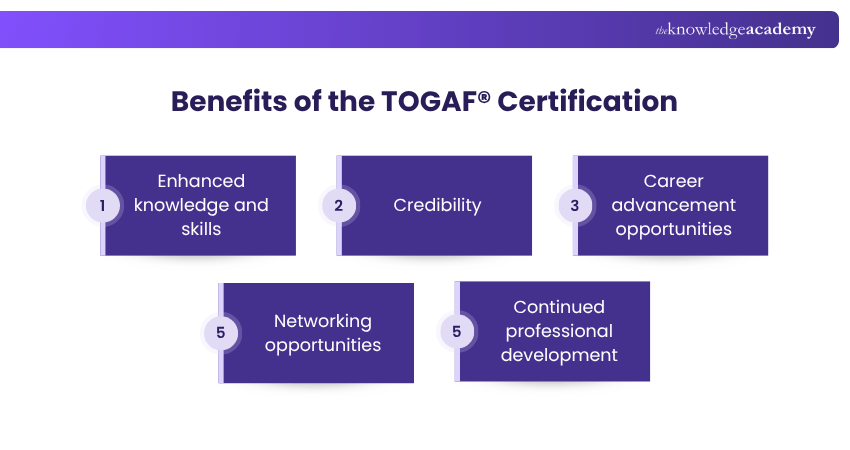
Obtaining the TOGAF® Certification offers a range of benefits for professionals in enterprise architecture. Let's explore some of the key advantages:
a) Enhanced knowledge and skills: The TOGAF® Certification equips professionals with the knowledge and skills to architect and design effective IT solutions that align with business objectives. Through comprehensive training and examination, TOGAF® Certification ensures that architects have a solid foundation in enterprise architecture's key concepts and practices.
b) Credibility: The TOGAF® Certification value is globally recognised by organisations across various industries. Employers value the TOGAF® certified professionals for their proven knowledge and skills in developing and managing enterprise architectures. This recognition can lead to increased career opportunities and the ability to work on prestigious projects with organisations worldwide.
c) Career advancement opportunities: With the rapid growth of digital transformation initiatives in organisations, the demand for skilled enterprise architects is rising. The TOGAF® Certification opens doors to exciting career opportunities, as many companies actively seek certified professionals to drive their strategic IT initiatives.
Having the TOGAF® Certification on your resume helps in setting you stand out from other candidates. It reflects your commitment to professional development and ability to apply industry-standard practices in enterprise architecture.
d) Networking opportunities: The TOGAF® Certification connects you to a global community of enterprise architects and professionals. Through participation in the TOGAF® related events, conferences, and online forums, you can expand your professional network, collaborate with peers, and exchange insights and best practices. Networking with other TOGAF-certified professionals can provide valuable learning opportunities and potential collaborations on projects.
e) Continued professional development: The TOGAF® Certification is not a one-time achievement but a continuous learning and development journey. The framework is regularly updated to align with industry trends and best practices.
The TOGAF® Certification value can go through periodic renewals. By staying updated with the latest version of the framework, you demonstrate your commitment to professional growth and staying at the forefront of enterprise architecture.
The TOGAF® Certification value in 2023
As we step into 2023, the relevance of TOGAF® Certification remains high due to several factors that shape the business and technology landscape. Let's explore the current relevance of TOGAF® certification:
Increasing demand for enterprise architects
Organisations worldwide recognise enterprise architecture's strategic importance in achieving their digital transformation goals. The demand for skilled enterprise architects is soaring in today's rapidly evolving business environment, where organisations strive to leverage technology for competitive advantage.
The TOGAF® Certification equips professionals with the knowledge and skills required to guide enterprises through the complex process of aligning their IT strategies with business objectives, making them valuable assets in the digital age.
Emphasis on digital transformation
Digital transformation is significant for most businesses across industries today. As organisations aim to embrace emerging technologies, optimise processes, and drive innovation, a robust enterprise architecture framework is critical. The TOGAF® provides a structured approach to support organisations in their digital transformation journeys.
It helps architects design architectures that facilitate seamless integration of new technologies, enable agility and scalability, and drive business value. The TOGAF® certified professionals possess the expertise to navigate the challenges of digital transformation and ensure the successful implementation of technology initiatives.
Prepare for success with top TOGAF® interview questions. Get expert insights and ace your interview today!
Alignment with industry standards and best practices
The TOGAF® is based on industry-recognised standards and best practices in enterprise architecture. It provides a common language and comprehensive framework that aligns with global architectural standards, ensuring organisation consistency and interoperability.
The TOGAF® certified professionals are well-versed in these industry standards and best practices, enabling them to develop architectures that adhere to the highest quality and compliance standards. This alignment with industry norms reinforces the relevance and value of the TOGAF® Certification in 2023 and beyond.
Integration with emerging technologies
The TOGAF® has evolved to incorporate the integration of emerging technologies into enterprise architectures. As technologies like cloud computing, Artificial Intelligence (AI), Internet of Things (IoT), and blockchain continue to reshape industries, architects with the TOGAF® Certification are equipped to design architectures that leverage these technologies effectively.
They can assess the impact of emerging technologies on the organisation's IT landscape, identify opportunities for innovation, and develop architectures that support the seamless integration and optimal utilisation of these technologies.
Focus on risk management and security
Organisations significantly emphasise risk management and security in an era of increased cybersecurity threats and data privacy concerns. The TOGAF® addresses these concerns by incorporating risk management and security considerations into the architectural process. The TOGAF® certified professionals possess the knowledge and skills to identify and mitigate risks, ensure data protection, and design architectures that comply with regulatory requirements.
Ready to become a TOGAF® expert? Register for our TOGAF® Foundation And Practitioner Training Course today!
The TOGAF® Certification Process
The TOGAF® Certification is designed to validate an individual's knowledge and understanding of the framework and its application in enterprise architecture. Various aspects of the certification include the different levels of certification, training and examination, and certification renewal. Let's explore these in detail:
Levels of certification
There are two levels of the TOGAF® Certification which are as follows:
1) TOGAF® Foundation level: This is the first level of the TOGAF® certification. It provides a basic understanding of the key concepts, terminology, and principles of the TOGAF®. The Foundation Level certification serves as a prerequisite for higher-level certifications.
2) TOGAF Practitioner Level: This is the second level of the TOGAF® certification. The Certified level certification validates the ability to analyse and apply the concepts and techniques of the TOGAF® in real-world enterprise architecture projects.
Training and examination
The TOGAF® training can help candidates on How to Study for the TOGAF® Exam and attempt the exam better. Let's look at the training and examination parts for the TOGAF® in detail:
1) Training: To prepare for the TOGAF® certification, individuals can attend accredited training courses offered by various training providers. These courses cover the core concepts, methodologies, and best practices of the TOGAF®, helping candidates build a strong foundation in enterprise architecture.
2) Examination: After completing the training, candidates can register for the TOGAF® Certification examination. The examination tests the candidate's knowledge and understanding of the TOGAF®.
It typically consists of multiple-choice questions that assess the candidate's ability to apply the TOGAF® principles and concepts to different scenarios. Clearing the examination is necessary to achieve the TOGAF® certification.
Certification Renewal
The TOGAF® certifications are valid for a certain period, typically three years. To maintain their certification, individuals need to renew it periodically. Renewal involves demonstrating ongoing professional development in enterprise architecture and staying up-to-date with the latest version of the TOGAF®.
The renewal process may require candidates to accumulate professional development hours, attend refresher courses, or pass a renewal examination, depending on the specific requirements set by The Open Group®.
Find out how TOGAF® and ITIL compare to improve your IT management approach!
Career opportunities with the TOGAF® Certification
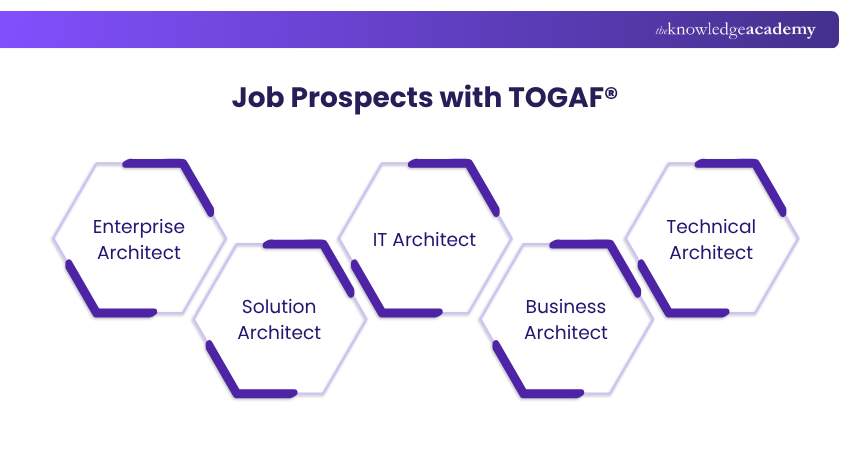
As a certified professional with the TOGAF® Certification, you can access various exciting and fulfilling career opportunities in enterprise architecture.The TOGAF® Roles & Responsibilities help define these key positions, guiding professionals in aligning with organisational architecture needs. Let's explore some of the key roles that you can pursue with the TOGAF® certification.
1) Enterprise Architect: Enterprise Architects are responsible for designing and overseeing the architecture of the entire enterprise, ensuring that technology initiatives support the organisation's goals, enhance operational efficiency, and drive innovation.
2) Solution Architect: Solution Architects focus on designing specific solutions within the enterprise architecture. They work closely with business stakeholders, project managers, and technical teams to develop innovative and efficient solutions that address specific business needs. With the TOGAF® certification, you have the expertise to analyse requirements, evaluate technology options, and create solution architectures.
3) IT Architect: IT Architects are responsible for designing and managing an organisation's IT infrastructure and systems. They leverage the TOGAF® 9.2 to ensure that the technology landscape supports the business requirements and aligns with industry best practices.
4) Business Architect: Business Architects bridge the gap between business strategy and IT initiatives. They analyse business processes, identify areas for improvement, and design architectures that enable the organisation to achieve its strategic objectives. The TOGAF® Certification equips you with the tools and methodologies to align business and IT strategies, optimise business processes, and drive organisational change.
5) Technical Architect: Technical Architects focus on the technical aspects of the enterprise architecture, including software, hardware, networks, and databases. They design and oversee the implementation of technical solutions, ensuring that they align with the overall architecture and meet the organisation's performance and scalability requirements. They are also expected to be well trained in the TOGAF® architecture.
Conclusion
The TOGAF® Certification has emerged as an asset for professionals in the field of enterprise architecture. We hope this blog has been helpful in answering your question ‘Is the TOGAF® Certification Useful?’ in 2023. When considering a career in enterprise architecture, it’s also essential to understand the potential financial rewards, such as the Business Architect Salary, which offers promising compensation for certified professionals.
Sign up for our TOGAF® BA Foundation Training Course and unlock new possibilities in the world of enterprise architecture!
Frequently Asked Questions

The Knowledge Academy


Global Training Provider
The Knowledge Academy is a world-leading provider of professional training courses, offering globally recognised qualifications across a wide range of subjects. With expert trainers, up-to-date course material, and flexible learning options, we aim to empower professionals and organisations to achieve their goals through continuous learning.


 If you wish to make any changes to your course, please


