


 Top Rated Course

We may not have the course you’re looking for. If you enquire or give us a call on +44 1344 203 999 and speak to our training experts, we may still be able to help with your training requirements.
10 Best Crisis Management Tools You Need to Know
The Knowledge Academy 04 February 2026Crisis Management Tools help organisations manage incidents, communication, and continuity with alerts, reporting, task tracking, and post-crisis learning. Some popular tools include X Pro, Sprout Social, Mailchimp, Hootsuite, Everbridge and Talkwalker. They ensure quick detection of emerging crises and reduced reputational damage.

Training Outcomes Within Your Budget!
We ensure quality, budget-alignment, and timely delivery by our expert instructors.
Table of Contents

Imagine your company facing an unexpected crisis, like a Cyber Security Attack or a severe weather event. In moments like these, you might find yourself asking: how prepared are you to handle the situation? This is where the right Crisis Management Tools come into play. These tools are crucial for real-time monitoring, providing actionable insights, and ensuring smooth communication throughout the crisis.
In this blog, we’ll dive into 10 must-have Crisis Management Tools that can help your business navigate any challenge seamlessly. From maintaining operations to boosting your confidence in crisis handling, these solutions are designed to keep you prepared and boost Resilience. Let’s dive in!
Table of Contents
1) What is Crisis Management?
2) 10 Best Crisis Management Tools
3) Benefits of Using Crisis Management Tools
4) Future of Crisis Management
5) What are the Five P’s of Crisis Management?
6) What is the Difference Between Crisis Management and Incident Management?
7) Conclusion
What is Crisis Management?
Crisis Management is the approach of managing and responding to unforeseen circumstances that can harm an organisation. It involves planning, quick Decision Making, and clear communication to minimise damage and protect the company's reputation. Effective Crisis Management helps businesses stay operational during difficult situations.
The goal is to resolve the crisis efficiently while maintaining trust with employees, customers, and other stakeholders. Here are four major core steps of Crisis Management:
a) Identification: Find potential crises that could impact your organisation.
b) Preparation: Create plans and strategies for worst-case scenarios.
c) Response: Apply those plans precisely during the crisis.
d) Recovery: Return to normal conditions and assess the effectiveness of the response.

10 Best Crisis Management Tools
Crisis Management Tools empower businesses to overcome challenges, ensuring swift response and efficient recovery. Let’s understand the top 10 tools available in the market.
1) X Pro
X Pro, formerly TweetDeck, is one of the best Crisis Management Tools and an excellent resource for handling Social Media emergencies and tracking your brand. X Pro allows you to establish a specific column for monitoring brand mentions and set up a search term to view all responses and tweets. After resolving the issue, this function lets you observe reactions and assess your crisis-handling actions.
Furthermore, X Pro assists in monitoring activities such as mentions of your brand, sharing or quoting of posts and favourites, gaining new followers, and being included in lists. While simple and efficient, it is solely available to subscribers of the X Premium tier.
Key Features:
a) Columns Customisation: Track feeds, hashtags, and mentions
b) Real-time Monitoring: Monitor brand interactions in real-time
c) Multiple Account Management: Manage accounts through a single dashboard
d) Scheduled Tweets: Organise Social Media posts ahead of time
e) Advanced Search Filters: Filter for accurate content monitoring
f) List Management: Manage lists for users
g) Activity Tracking: Monitor mentions, followers, and retweets through activity tracking
h) Tweet Analytics: Understand performance metrics
i) Multi-user Access: Collaborate as a team with multiple users having access
j) Notifications: Alerts for significant activities, such as receiving replies
2) Everbridge
Everbridge is an enterprise-grade Critical Event Management (CEM) platform designed to automate and streamline crisis response. It enables organisations to maintain command and control during emergencies.
Key Features:
a) Unified Command Platform: It coordinates response activities, teams, resources, and communications from a single dashboard. It includes operator interfaces, incident logs, integrated chat, and conferencing tools.
b) Dynamic Task Management: It transforms static plans into actionable tasks. These tasks can be assigned and updated in real time during crises.
c) Mobile-first Response: It supports mobile deployment of response plans. This enables teams to collaborate and activate protocols from anywhere.
d) Real-time Risk Intelligence: It incorporates real-time risk feeds, contextual data and situation reports. Its visual command centres help with informed decision-making.
e) Scenario Testing & Planning: It facilitates scenario-based testing to uncover gaps. It supports comprehensive crisis planning from prevention to recovery.
3) Talkwalker
Talkwalker is a powerful social listening and media monitoring platform widely used as a Crisis Management Tool. It allows brands to monitor and analyse online conversations to detect emerging crises, manage brand reputation, and guide strategic responses.
Key Features:
a) Extensive Source Coverage: It tracks mentions across 30+ social networks and 150+ million websites. This includes blogs, news sites, forums, and broadcasts.
b) Sentiment Analysis & Alerts: It provides real-time sentiment tracking and custom alerts. It helps identify negative buzz or misinformation early.
c) Influencer & Conversation Mapping: It identifies key opinion leaders and maps conversation clusters. It also visualises trending topics and virality patterns.
d) Competitive Benchmarking: It compares brand performance against competitors. It tracks share of voice, engagement, sentiment, and emerging industry trends.
e) AI-Powered Insights: It utilises AI tools, including "Yeti" assistant. It generates summaries, reports and strategic insights from vast data.
While change Is Inevitable, risks don’t have to be. Learn to anticipate and assess risks in our Risk Management for Change Training - Sign up now!
4) Mailchimp
Mailchimp is among the most popular Crisis Management Tools. It’s a flexible email marketing tool that enables the creation and targeting of professional email campaigns. It is also an effective resource for handling Social Media emergencies, with complimentary and premium options.
If your brand receives negative attention online, you can lessen the impact by sending out an email campaign to reassure customers. Mailchimp allows you to create personalised templates, utilise ready-made ones for effectiveness, and develop a customised email plan that fits your requirements.
Key Features:
a) Drag-and-Drop Builder: Easily design custom emails
b) Pre-designed Templates: Quick setup with professional designs
c) Audience Segmentation: Target groups by behaviour and demographics
d) Automation: Schedule welcome emails and reminders
e) Analytics: Track campaign performance
f) Integration: Connect with platforms like WordPress and Shopify
g) A/B Testing: Optimise engagement by testing email versions
h) Custom Signup Forms: Build branded forms for list growth
i) Multi-channel Marketing: Reach through email, Social Media, and postcards
j) Customer Journey Builder: Personalise campaigns for individual users
5) Mailjet
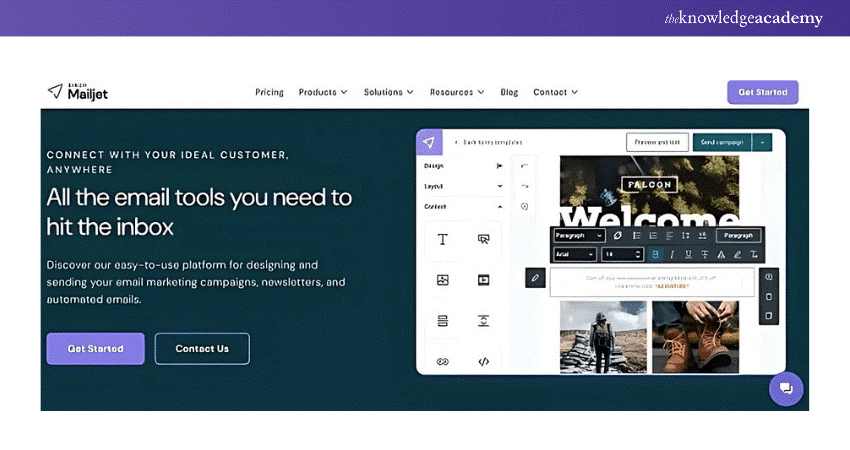
Mailjet is among the better Crisis Management Tools for handling email crises, perfect for large companies looking to communicate with customers consistently. It offers a variety of beautifully crafted templates that can be customised, along with robust tools for analysing and segmenting customer data. With Mailjet, you can instantly modify templates and track transactional emails, paying attention to essential metrics.
You can evaluate campaign effectiveness and design customised email campaigns for targeted customer groups. Mailjet is a vast email marketing platform that makes customer communication easier and more efficient.
Key Features:
a) Customisable Templates: Use customisable options or create your own
b) Real-time Analytics: Monitor performance with real-time analytics
c) Segmentation: Divide customers into different targeted groups
d) A/B Testing: Improve email performance by conducting tests
e) Transactional Email Monitoring: Monitor transactional emails in real-time
f) Collaborative Tools: Enable teams to work on campaigns together
g) Automation: Set up automated sequences for emails
h) SMTP Relay: Incorporate for sending transactional emails
i) API Integration: Link up with platforms such as WordPress and Shopify
j) Data Security: Secure data storage that follows General Data Protection Regulation (GDPR) regulations
6) Slack
Slack is a Crisis Management Tool for team collaboration in the cloud, keeping your team connected constantly. It offers a fast and easy way to have private conversations with your whole team, individual members, or groups dedicated to specific projects.
Slack encourages smooth teamwork and productivity by allowing users to exchange vital information and promptly contact the appropriate individuals. It is also completely free to download and use, making it available to all users.
Key Features:
a) Real-time Messaging: Instantly communicating with either individuals or groups
b) Channels: Categorise discussions by team, project, or subject by creating channels
c) File Sharing: Easily exchange documents, images, and files during conversations
d) Integrations: Link with platforms such as Google Drive, Trello, and Zoom to enhance workflow efficiency
e) Search Functionality: Easily locate important information within messages and files using the search tool
f) Notifications: Personalise alerts to keep up with important updates
g) Video and Voice Calls: Hold team meetings using the video and voice call features
h) Collaboration Tools: Utilise threads and mentions to organise and prompt communication
i) Security: Offers high-level security for data and compliance in enterprises
j) Cross-platform Access: Access is available on both desktop and mobile devices, allowing teams to remain connected no matter where they are
Strengthen your organisation's risk strategy with the MoR® Management of Risk Course – Sign up now!
7) Sprout Social
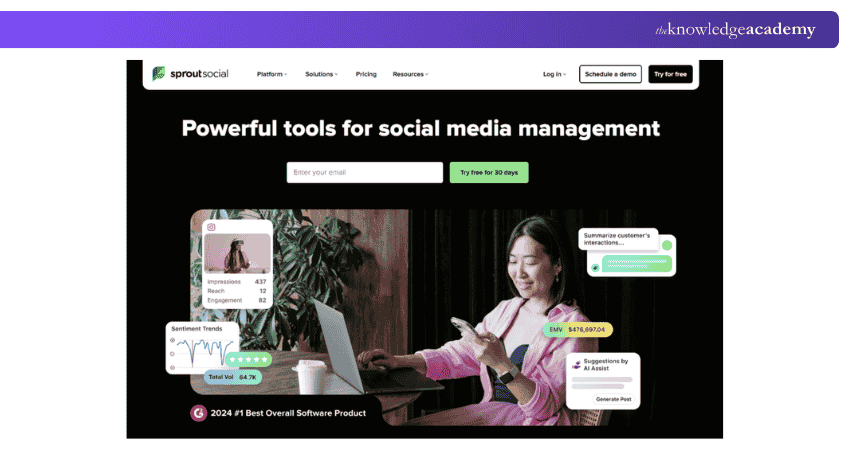
The Sprout Social platform allows for immediate tracking of brand mentions on various Social Media platforms. It aids in promptly recognising negative feedback and resolving issues as they occur.
Sprout Social is one of the best Crisis Management Tools that enables direct interaction with stakeholders, enabling quick responses to prevent reputation damage. Moreover, its robust reporting and analytics features show how well your crisis communication plan works, allowing you to monitor developments and make necessary changes.
Key Features:
a) Social Media Monitoring: Oversee Social Media mentions and hashtags of the brand
b) Sentiment Analysis: Identify whether the sentiment is positive, neutral, or negative
c) Engagement Instruments: Address comments and messages in a timely manner
d) Social Listening: Social Listening involves observing trends and conversations
e) Analytics and Reporting: Produce in-depth performance reports
f) Schedule Content: Automate posting on Social Media platforms
g) Collaboration Tools: It enables team members to work together
h) Tailored Dashboards: Concentrate on important measurements
i) Audience Insights: Audience demographics analysis is provided for insights
j) Integrate Across Multiple Platforms: Control numerous accounts in a single location
8) CisionOne
CisionOne is an advanced, AI-powered media intelligence platform tailored for PR and communications teams. It offers real-time monitoring across digital, broadcast, print, and Social Media channels, delivering insights to help you detect and respond to emerging crises swiftly. Here are its key features:
a) Comprehensive Media Monitoring: It tracks real-time coverage across print, online, TV, radio, podcasts, magazines, and Social Media. It can do it via live mention streams and alerts.
b) Instant Insights & Reporting: It offers powerful analytics, intuitive dashboards, and branded, interactive reports. These are easily customisable and shareable.
c) Journalist Outreach & CRM: It provides a curated database of 500,000+ media contacts (journalists and outlets)/ It's also got tools to build lists, send releases and track engagement.
d) Social Listening & Management: It's got integrated social intelligence to monitor conversations, schedule posts, engage audiences, and measure performance. All of these are available within the same platform.
e) AI-powered Alerts & Assistance: It's got features such as the React Score, AI-driven summaries, keyword suggestions, and a conversational AI assistant. They help detect crises, summarise coverage and streamline search and outreach.
f) Extensive Global Coverage: Monitors over 100 million sources across 90+ languages. This includes premium, behind-paywall and niche regional media.
Our Senior Management Training is designed for decision-makers ready to shape the future - Register now!
9) Google Alerts
Google Alerts is a fantastic choice if you want a cost-effective Crisis Management Tool for your website. It alerts you when your brand name is mentioned in negative comments or particular search terms, enabling you to track conversations about your company online.
Google Alerts assists in monitoring search trends linked to your company and identifying the keywords connected to your brand. This vital understanding allows you to act promptly by generating favourable content and establishing relevant links, crucial aspects of a proactive SEO plan.
By keeping up to date with Google Alerts, you can handle possible problems before they get worse and safeguard your brand's online reputation efficiently.
Key Features:
a) Real-time Notifications: Receive notifications for keywords with real-time alerts
b) Customisable Queries: Create personalised queries to receive notifications for mentions of your brand
c) Flexible Frequency: Select from instant, daily, or weekly notifications
d) Extensive Coverage: Monitors references on websites, blogs, and news sources
e) Email Delivery: Notifications sent straight to your email
f) Tracking trends: Keep an eye on new keywords and search trends
g) Easy Setup: Fast and easy setup
h) Free for Use: Access is completely free of charge
i) Global Coverage: Monitors in numerous languages and regions
j) SEO Assistance: Recognise chances for creating content and building links
10) Hootsuite

Hootsuite is a trustworthy and comprehensive tool that brands can use to create a Social Media Crisis Management strategy at no cost. Monitoring crucial Social Media activity is made easy with its well-designed applications for various devices, ensuring versatility in managing crisis responses.
The platform offers different options for monitoring basic analytics and more advanced data, but the free version is adequate for a simple Crisis Management strategy. Using Hootsuite, you can keep track of Social Media profiles on LinkedIn, Facebook, Instagram, and X.
Key Features:
a) Multi-platform Management: Manage social accounts from a single dashboard with multi-platform management.
b) Real-time Monitoring: Keep tabs on mentions, hashtags, and keywords
c) Scheduling Posts: Plan posts in advance for various platforms
d) Analytics: Assess the effectiveness of Social Media
e) Tailored Streams: Keep an eye on content or users
f) Team Collaboration: Engage with your team by assigning tasks and working together.
g) Mobile/Desktop Applications: Control accounts across all devices
h) Cloud-based: Access from any location using cloud services
i) Free and Paid Options: Basic features are free, with the option to upgrade for additional features at a cost.
j) Content Curation: Uncover and distribute relevant content
Plan for the unexpected and master Project Risk before it happens. Sign up for our Project Risk Management Course now!
Benefits of Using Crisis Management Tools
Crisis Management Tool offers fully-fledged support to organisations, enabling them to face unexpected challenges while keeping their reputations. Here are some benefits:

1) Reduced Reputational Damage
The faster you can control a crisis, the smaller the impact on your brand's reputation. These tools help reduce damage to your reputation by facilitating a quick and efficient reaction. It addresses concerns quickly and shows transparency to stop negative sentiments from spreading.
2) Proactive Crisis Planning and Prevention
These tools are helpful during reactive events. By examining past data and recognising possible weaknesses, you can create a crisis communication strategy. This strategy describes duties, obligations, and communication methods, many of which are outlined in the Crisis Management Job Description, ensuring an efficient and well-organised crisis response.
3) Quicker Detection of Emerging Crises
Crisis Management Tools enable real-time monitoring and alert systems, allowing organisations to immediately identify potential issues before they escalate. This ensures a prompt and effective response to mitigate risks.
4) Enhanced Decision-making Through Data Analytics
These tools provide valuable data insights through features like sentiment analysis and media monitoring reports. These insights reveal how audiences react, allowing you to create more targeted and effective communication. Instead of sending a standard press release, you can tailor your message to address specific public concerns, ensuring it resonates effectively.
Measure and manage performance with ease. Sign up for our Performance Management Training now!
Future of Crisis Management
Crisis Management is changing fast with new technology and smarter ways of predicting problems. Modern tools give organisations the ability to spot risks early and prepare strong response plans before issues grow.
Evolving Technologies
a) There are already available as well as emerging platforms that are great at gathering data and managing crises.
b) AI-driven Analytics are getting sharper, making it easier to turn raw data into useful insights.
c) With cheaper smartphones and wider internet access, more people are online, which means there are more voices to monitor.
d) Improved translation tools now help brands track public opinion across languages.
e) This helps them create reports that connect better with their audience.
f) At the same time, crisis apps can send instant alerts to the right team members.
g) This reduces response times and helps issues get solved quickly.
What are the Five P’s of Crisis Management?
The five P’s of Crisis Management are: Predict, Prevent, Prepare, Perform and Practice. This framework aims to reduce uncertainty about the future. It accomplishes this by updating inputs, gathering intelligence on possible threats, identifying potential targets, and recognising vulnerabilities.
What is the Difference Between Crisis Management and Incident Management?
Although Crisis Management and Incident Management share similar processes, they differ in scope, impact, and goals:
a) Incident Management focuses on smaller, routine disruptions, aiming to restore operations quickly with minimal effort.
b) Crisis Management deals with larger, high-impact events that can seriously affect an organisation’s reputation, stability, or overall operations. It requires a broader and more strategic response.
Conclusion
Crisis Management Tools are essential for companies to swiftly address risks, protect their reputation, and minimise operational disruptions. These tools enable real-time monitoring, data insights, and efficient communication. By leveraging these tools, companies can proactively prepare, respond promptly, and recover from unexpected challenges.
Stay ahead of cyber risks with our Cyber Security Risk Management Course today!
Frequently Asked Questions
What are the Rules of Crisis Management?

Rules for Crisis Management involve acting quickly, communicating, being transparent, taking accountability, and using the event as a learning opportunity to avoid future problems.
What are the Stages of Crisis Management?
Crisis Management stages include identification, preparation, response, recovery, and evaluation to ensure a complete and effective resolution.
What are the Other Resources and Offers Provided by The Knowledge Academy?
The Knowledge Academy takes global learning to new heights, offering over 3,000+ online courses across 490+ locations in 190+ countries. This expansive reach ensures accessibility and convenience for learners worldwide.
Alongside our diverse Online Course Catalogue, encompassing 19 major categories, we go the extra mile by providing a plethora of free educational Online Resources like Blogs, eBooks, Interview Questions and Videos. Tailoring learning experiences further, professionals can unlock greater value through a wide range of special discounts, seasonal deals, and Exclusive Offers.
What is The Knowledge Pass, and How Does it Work?
The Knowledge Academy’s Knowledge Pass, a prepaid voucher, adds another layer of flexibility, allowing course bookings over a 12-month period. Join us on a journey where education knows no bounds.
What are the Related Courses and Blogs Provided by The Knowledge Academy?
The Knowledge Academy offers various Management Courses, including the Crisis Management Training, Performance Management Training, and Introduction to Managing People Course. These courses cater to different skill levels, providing comprehensive insights into Operations Management.
Our Business Skills Blogs cover a range of topics related to Crisis Management, offering valuable resources, best practices, and industry insights. Whether you are a beginner or looking to advance your Crisis Management skills, The Knowledge Academy's diverse courses and informative blogs have got you covered.

The Knowledge Academy


Global Training Provider
The Knowledge Academy is a world-leading provider of professional training courses, offering globally recognised qualifications across a wide range of subjects. With expert trainers, up-to-date course material, and flexible learning options, we aim to empower professionals and organisations to achieve their goals through continuous learning.

Upcoming Accounting and Finance Resources Batches & Dates
Date
 Crisis Management Training
Crisis Management Training
Fri 10th Jul 2026
Crisis Management Training
Fri 2nd Oct 2026

 If you wish to make any changes to your course, please


