


 Top Rated Course


We may not have the course you’re looking for. If you enquire or give us a call on +352 20 33 17 60 and speak to our training experts, we may still be able to help with your training requirements.
Structure of Java Program: A Step-by-Step Guide
The Knowledge Academy 07 February 2026Java is a widely used Programming language recognised for its ease of use, flexibility, and ability to work on different OS. Thus, understanding the Structure of a Java Program is essential for developers. This blog will assist you in understanding every Structure of Java Program, thus allowing you to produce optimised code.

Training Outcomes Within Your Budget!
We ensure quality, budget-alignment, and timely delivery by our expert instructors.
Table of Contents

Are you finding it difficult to grasp the Structuring of Java Programs? Many inexperienced developers face this challenge frequently. Understanding the format of a Java Program is not only a technical necessity but also an essential ability that can significantly enhance your coding effectiveness and clarity, a topic extensively covered in Java Books. An in-depth comprehension of Java's foundational elements, such as documentation and package declarations, up to the primary method, is crucial for developing robust and sustainable code.
This blog will discuss Structure of Java Program Java and how it offers a detailed explanations that will improve your Programming abilities. Immerse yourself in discovering how a properly organised Java Program can enhance your Java Skills and keep you at the forefront of the technology industry.
Table of Contents
1) Documentation Section
2) Package Statement
3) Import Statements
4) Interface Section
5) Class Definition
6) Class Variables and Variables
7) Main Method Class
8) Methods and behaviour
9) Conclusion
Documentation Section
In Java programming, the documentation part is a section of the program that includes comments and is not mandatory. While these comments help explain the code, they differ from a Java Script Object, which is a data structure used to store and organise information in key-value pairs. Proper documentation is essential in Java Automation Testing to ensure clarity and maintainability of test scripts. They are beneficial for Programmers to clarify the code or make annotations for future use. Comments in Java, along with Java Annotations, can come in one of three forms: single line with (//), multi-line with (/* ... /), or documentation comments with (/* ... */). Documentation comments are especially beneficial for producing JavaDoc, an HTML-formatted code documentation.

Package Statement
In Java, the package statement plays a crucial role in defining a namespace for the classes within a program. It aids in logically organizing classes and prevents naming conflicts. Positioned at the beginning of the source file, it follows the syntax: (package packageName;). For instance, the code (package com.example.myapp;) categorizes the classes within the (com.example.myapp) namespace. Similarly, understanding the Life Cycle of a Thread in Java is essential for managing thread states efficiently.
Import Statements
Import statements in Java enable you to incorporate classes from other packages into your Program. Using a package allows you to access its classes and interfaces without needing to specify their complete file path. The import statement comes after the package statement and can be written as (import packageName.className;) or (import packageName.*;) to bring all classes from a package. By utilising (import java.util.Scanner;), you can make use of the Scanner class for input purposes.
Interface Section
The interface section includes interfaces that outline methods but do not provide their implementation. Interfaces allow for abstraction in Java. They outline the required actions for a class without detailing the methods for achieving them. Understanding the difference between abstract class vs Java interface is crucial in determining when to use each approach. An interface is defined by using the 'interface' keyword and specifying the interface name. For example,
|
interface Animal { void eat (); void sleep (); } |
Every class that uses this interface needs to have functions for 'eat ()' and 'sleep ()' implemented.
Class Definition
The class definition acts as the framework for a Java Program, detailing the format and actions of objects generated from the class. The class name is declared using the 'class' keyword followed by the keyword class. For example,
|
public class MyClass { // Class body } |
The class name is required to begin with a capital letter, and the filename resembles with the class name.
Learn JavaScript from scratch with our JavaScript For Beginners Course – Register now!
Class Variables and Variables
Variables in a class, known as fields, are defined within the class but not within any specific methods. They represent the characteristics of the class. Java has various types of variables, and understanding how to manipulate them, such as swapping two variables in Java, is essential for working with data in a program.
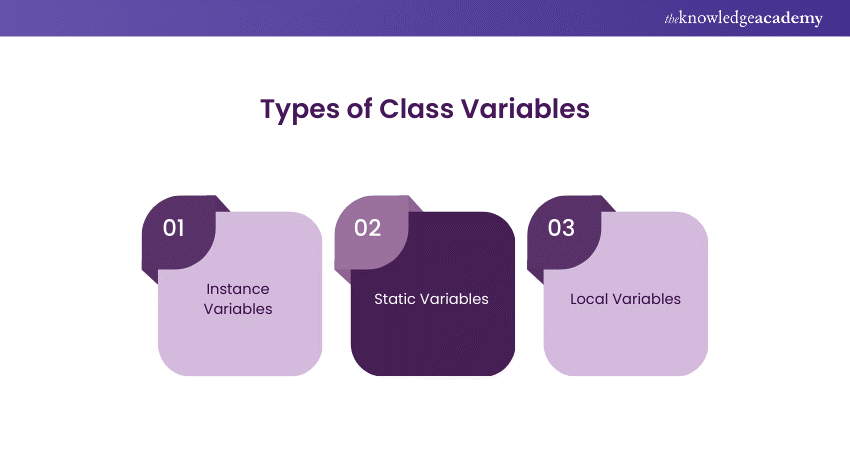
a) Instance Variables: Instance variables are positioned within a class but not within any method and are specific to each individual instance of that class.
b) Static Variables: Static variables are declared using the 'static' keyword and can be accessed by all instances of a class. In a Bubble Sort Program in Java, a static variable can be used to track the number of swaps or iterations throughout the sorting process.
c) Local Variables: To be successful, it is important to prioritise time management. Local variables are those displayed inside a method and can only be accessed within that method.
For example:
|
public class MyClass { int instanceVar; // Instance variable static int staticVar; // Static variable } |
Master Java Programming with our Java Programming Course today!
Main Method Class
The primary function initiates the execution process and acts as the starting point for every Java Program. When exploring the History of Java Programming Language, it becomes evident that its structured approach to execution was a key factor in its widespread adoption. The primary function is identified by a particular signature: (public static void main(String[] args). Every component of this signature has its function.
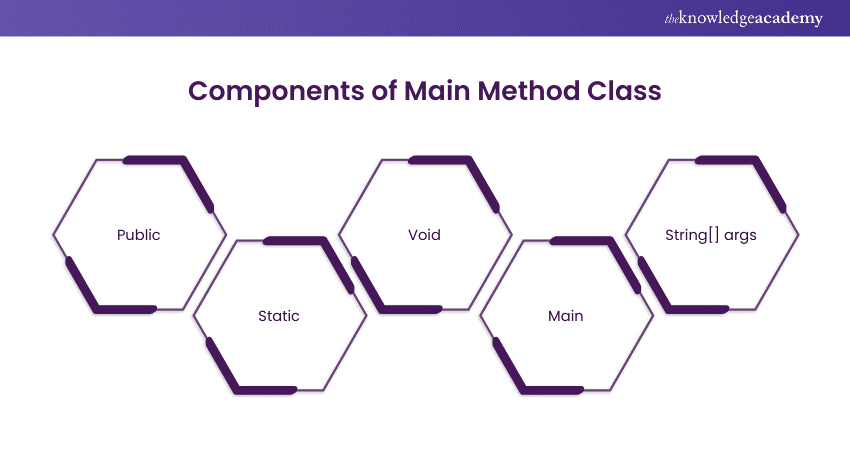
a) Public: The function can be accessed from any location
b) Static: The method does not require an object of the class to be created before calling.
c) Void: The method doesn't have a return value
d) Main: The Java runtime recognises this as the method's name
e) String[] args: Array of strings named args for storing command-line arguments.
For example:
|
public class MyClass { public static void main(String[] args) { System.out.println("Hello, World!"); } } |
Methods and Behaviour
Java Hello World Program is a simple example of how methods determine how a class behaves. They hold the rules that define the capabilities of an object. A return type, method name, and parameters (if any) are necessary when declaring a method. The content of the method body consists of instructions that specify what the method does.
Methods can either give back values or have no return value, indicating they do not give back anything. Parameters that enable passing values into the process can also be accepted by them.
Don’t miss out on acing your Java interview—check out our Java Interview Questions and Answers now!
Conclusion
We hope you understand how crucial the Structure of a Java Program is to write clean, efficient, and maintainable code. By mastering each component—from documentation and package statements to the main method, class definitions, and incorporating Java SQL Package for database interactions—you lay a strong foundation for your programming journey. A well-structured Java Program not only enhances code readability but also streamlines debugging and future maintenance, a concept frequently highlighted in Data Structure Interview Questions. As you continue to develop your skills, remember that a clear Program Structure, along with the integration of packages like the Java SQL Package, is the key to scalable and professional-level Java applications.
Start your Java Engineering career with our Java Engineer Training – Join now!
Frequently Asked Questions
What are the Four Basic Syntax of Java?

The four fundamental syntax elements include Variables, data types, operators, and control statements. It forms a building block for crafting effective Java code.
What is the Structure of Java Method?
In Java, a method contains both a method header (modifiers, return type, method name, and parameters) and a method body carrying statements surrounded by curly braces that state the method's functionalities.
What is the Java Program?
A Java Program comprise of Java language instructions, which are put together into bytecode and run by the Java Virtual Machine (JVM) to attain platform independence.
What are the Other Resources and Offers Provided by The Knowledge Academy?
The Knowledge Academy takes global learning to new heights, offering over 3,000+ online courses across 490+ locations in 190+ countries. This expansive reach ensures accessibility and convenience for learners worldwide.
Alongside our diverse Online Course Catalogue, encompassing 19 major categories, we go the extra mile by providing a plethora of free educational Online Resources like Blogs, eBooks, Interview Questions and Videos. Tailoring learning experiences further, professionals can unlock greater value through a wide range of special discounts, seasonal deals, and Exclusive Offers.
What is The Knowledge Pass, and How Does it Work?
The Knowledge Academy’s Knowledge Pass, a prepaid voucher, adds another layer of flexibility, allowing course bookings over a 12-month period. Join us on a journey where education knows no bounds.
What are the Related Courses and Blogs Provided by The Knowledge Academy?
The Knowledge Academy offers various Java Courses, including the Java Programming Course, JavaScript For Beginners, and Java Engineer Training. These courses cater to different skill levels, providing comprehensive insights into Java Method Server.
Our Programming & DevOps Blogs cover a range of topics related to Java, offering valuable resources, best practices, and industry insights. Whether you are a beginner or looking to advance your Programming skills, The Knowledge Academy's diverse courses and informative blogs have got you covered.

The Knowledge Academy


Global Training Provider
The Knowledge Academy is a world-leading provider of professional training courses, offering globally recognised qualifications across a wide range of subjects. With expert trainers, up-to-date course material, and flexible learning options, we aim to empower professionals and organisations to achieve their goals through continuous learning.


 If you wish to make any changes to your course, please


