


 Top Rated Course

We may not have the course you’re looking for. If you enquire or give us a call on +352 20 33 17 60 and speak to our training experts, we may still be able to help with your training requirements.
Ruby vs Python: Which Programming Language Should You Choose?
The Knowledge Academy 18 April 2026Curious about Ruby vs Python? Ruby and Python are both versatile, general-purpose languages, but each has unique strengths. Compare their speed, syntax, use cases, and career scope to understand which language suits your development goals, project needs, and long-term career growth in tech.

Training Outcomes Within Your Budget!
We ensure quality, budget-alignment, and timely delivery by our expert instructors.
Table of Contents
Related Courses

Ruby and Python are two of the most popular Programming languages in the world. Have you ever wondered which language is more efficient for Web Development? Or which one offers a smoother learning curve for beginners? This blog will explore Ruby vs Python in various aspects, such as syntax, performance, libraries, frameworks, community, and more.
This blog will explore Ruby vs Python in various aspects, such as syntax, performance, libraries, frameworks, community, and more. We will compare the differences between Ruby and Python based on their features, advantages, and disadvantages. By the end of this blog, you will better understand Ruby vs Python and be able to choose the one that fits your needs and goals.
Table of Contents
1) What is Ruby?
2) What is Python?
3) Key Differences Between Ruby and Python
4) Similarities Between Ruby and Python
5) Which offers more career Opportunities between Python and Ruby
6) Which language is better for automation scripting?
7) Conclusion
What is Ruby?
Ruby, created by Yukihiro Matsumoto, is a dynamic, object-oriented programming language known for its simplicity and productivity. It emphasises elegant syntax and readability, supporting multiple programming paradigms. Ruby Data Types play a crucial role in enhancing its expressive nature and developer-friendly features.
Popular in web development, especially with Ruby on Rails, Ruby’s support for automatic memory management and dynamic typing makes it ideal for both beginners and experienced developers seeking efficiency and creativity. Proficiency in Ruby can also assist in preparing for Ruby Interview Questions, which typically focuses on its fundamental features and practical uses in development.
Using Ruby to Build Applications
Ruby is a dynamic, open-source Programming language with a focus on simplicity and productivity. Here’s how Ruby can be leveraged to build robust applications:
a) Web Development: Ruby on Rails simplifies building complex web applications with its CoC and DRY principles.
b) Server-Side Scripting: Ruby’s readable syntax enables dynamic web pages and efficient backend processes.
c) Data Processing: Robust libraries and gems make Ruby excel at parsing datasets, transforming data, and automating workflows.
d) Web Scraping: Tools like Nokogiri and Mechanize allow Ruby to efficiently extract and automate data collection from websites.
e) API Development: Frameworks like Grape and Sinatra offer lightweight alternatives to Rails for creating RESTful APIs.
f) Prototyping and MVPs: Ruby’s simplicity and rapid development make it ideal for prototyping and building MVPs, aiding start-ups in quick iteration.

Features of Ruby
a) Interpreted Language
Ruby runs without prior compilation, allowing developers to test and modify code quickly, unlike compiled languages like C or Java.
b) Dynamic and Flexible
It supports runtime code changes, offering flexibility and enabling the development of highly expressive and adaptable applications.
c) Readable and Expressive Syntax
Ruby’s syntax is clean and natural, making code easy to read, write, and maintain—ideal for rapid development.
d) Open Source and Cross-Platform
Freely available and compatible with various operating systems, Ruby is accessible to developers across different platforms.
e) Fully Object-Oriented
Everything in Ruby is an object, including basic data types, allowing for modular, reusable code through inheritance and encapsulation.
f) Strong Community Support
Ruby has a vast developer community and extensive libraries, with Ruby on Rails being a leading framework for scalable web applications.
Benefits of Ruby
Ruby boosts productivity with its readable syntax, strong community support, and scalability. It suits a range of projects, from small web apps to large-scale enterprise solutions.
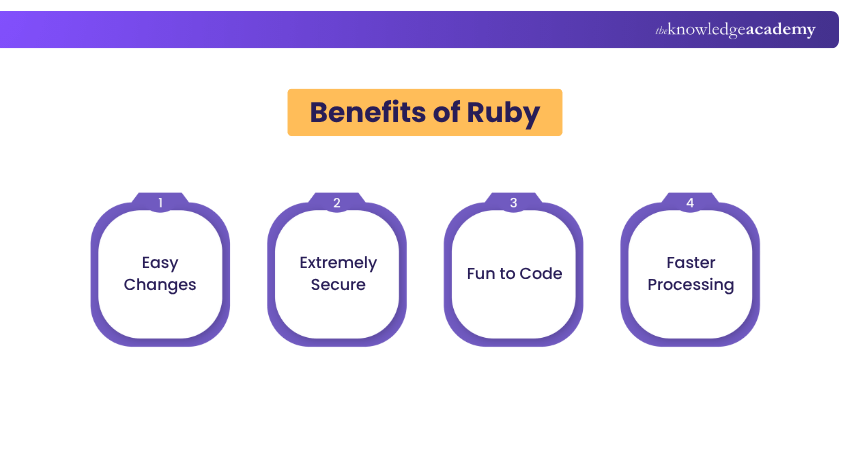
Easy Changes
Ruby’s flexible structure makes it easy to modify code, ideal for iterative and agile development.
Extremely Secure
Built-in security features like data encryption and SQL injection prevention make Ruby a secure development choice.
Fun to Code
Its elegant, readable syntax makes coding in Ruby enjoyable and engaging for developers.
Faster Processing
Ruby allows quick development cycles and performs efficiently when optimised correctly.
Drawbacks of Ruby
While Ruby offers many advantages, it also comes with some limitations that may affect its suitability for certain projects.
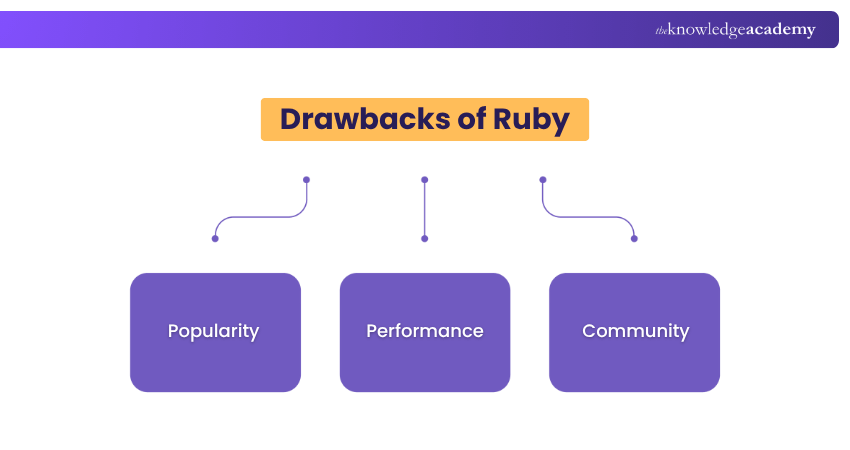
Popularity
Ruby’s popularity has declined over the years, with many developers shifting towards more in-demand languages like Python or JavaScript, which offer broader job opportunities and modern frameworks.
Performance
Ruby is often criticised for slower execution speed compared to compiled languages. For performance-critical applications, this can be a disadvantage, particularly in high-traffic environments.
Community
Although Ruby has a loyal community, it is smaller than those of other mainstream languages. This may result in fewer updates, limited third-party tools, and slower progress in addressing emerging technology needs.
What is Python?
Python, created by Guido van Rossum, is a high-level, versatile Programming language known for its readability and simplicity. It's clear syntax makes it ideal for both beginners and experienced developers. Supporting multiple Programming paradigms, including object-oriented, imperative, and functional, Python is widely used in web development, data analysis, artificial intelligence, and more. Its extensive libraries and frameworks enhance its popularity, making it a go-to language for various applications.
Take your coding skills to the next level with our Python Course – join us now and tackle real-world projects!
Applying Python in Applications
Python’s versatility and extensive ecosystem make it a top choice for a wide range of applications. From web development to data science, Python’s simplicity and powerful libraries enable developers to tackle complex tasks with ease. Here are some key areas where Python excels:
1) Web Development: Python excels with frameworks like Django and Flask, offering scalable and flexible solutions for web applications.
2) Data Science and Machine Learning: Libraries such as Pandas, NumPy, and SciPy, along with frameworks like TensorFlow and Keras, make Python ideal for data manipulation and machine learning.
3) Automation and Scripting: Python’s simplicity and readability make it perfect for automating repetitive tasks and scripting workflows, boosting productivity.
4) Web Scraping: Tools like BeautifulSoup and Scrapy enable efficient data extraction from websites for market research and analysis.
5) Game Development: Python, with libraries like Pygame, is great for creating simple games and prototyping.
6) Networking and Cybersecurity: Python is widely used for network automation, penetration testing, and security analysis, with tools like Paramiko and PyCrypto.
Features of Python
a) Simple and Readable Syntax
Python’s syntax is clean and easy to understand, making it ideal for beginners and efficient for experienced developers.
b) Interpreted and High-Level
Python is an interpreted, high-level language that handles memory management and other low-level details, simplifying development.
c) Cross-Platform Compatibility
It runs seamlessly across different operating systems, including Windows, macOS, and Linux, ensuring broad accessibility.
d) Extensive Standard Library
Python offers a rich set of built-in libraries and modules, supporting everything from web development to machine learning.
e) Object-Oriented and Functional
Python supports multiple programming paradigms, including object-oriented and functional styles, providing flexibility in coding approaches.
f) Dynamic Typing
With dynamic typing, Python allows variable types to be determined at runtime, speeding up development but requiring careful debugging.
g) Large Community Support
Python boasts one of the largest programming communities, ensuring vast resources, third-party libraries, and ongoing innovation.
Benefits of Python
Let's look at some of the benefits that make Python popular amongst developers:
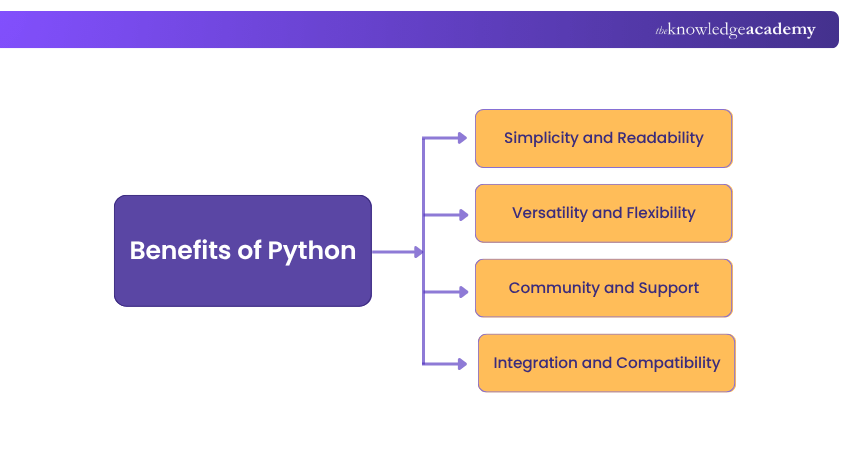
Simplicity and Readability
Python’s clear, intuitive syntax closely resembles natural language, making it easy to learn and ideal for rapid development and maintenance.
Versatility and Flexibility
Python supports multiple domains from web development and automation to AI, data science, and IoT, adapting easily to a wide range of applications.
Community and Support
With a vast, active global community, Python offers extensive resources, regular updates, third-party libraries, and strong developer support.
Integration and Compatibility
Python integrates well with other languages and technologies, making it suitable for building scalable, cross-platform, and enterprise-grade applications.
Master and unleash the full potential of Ruby in your development projects with our comprehensive Ruby Programming Course!
Drawbacks of Python
While Python offers numerous advantages, it also comes with a few limitations that may impact certain types of development projects.
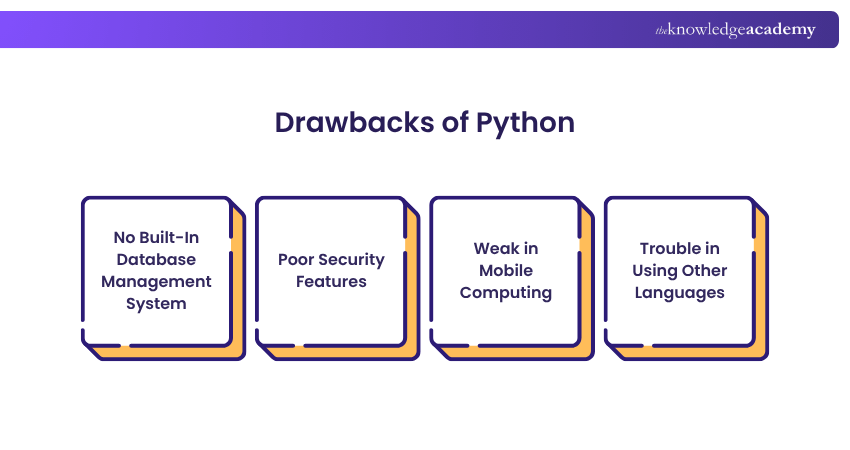
No Built-In Database Management System
Python lacks a native database management system, requiring integration with external tools, which can complicate database-driven development.
Poor Security Features
Python does not have strong built-in security features, making it less suitable for applications that demand high levels of data protection.
Weak in Mobile Computing
Python is not commonly used for mobile app development, with limited frameworks and lower performance compared to other languages in this area.
Trouble in Using Other Languages
Integrating Python with languages like C, C++, or Java can be challenging and may affect performance or compatibility in complex systems.
Key Differences Between Ruby and Python
While Ruby and Python are both high-level, interpreted languages with similar goals, they differ in design philosophy, application, and ecosystem. Here's a breakdown of their key distinctions:
Web Apps
Ruby is widely known for web development, primarily through Ruby on Rails, which encourages convention over configuration. Python, while also strong in web development with Django and Flask, is more general-purpose and used across broader domains.
Open-Source Community
Both languages have vibrant open-source communities. However, Python’s global reach is broader, encompassing fields like AI, automation, and scientific computing, while Ruby’s community is more concentrated around web development.
Machine Learning
Python dominates machine learning with an extensive ecosystem, including TensorFlow, Keras, and sci-kit-learn. Ruby lacks depth and community support in this area, making it less suitable for data-driven or AI projects.
Frameworks and Libraries
Ruby offers powerful tools like Ruby on Rails and Sinatra for web development. Python, in contrast, provides a more diverse set of libraries for web, data science, automation, and more, making it more versatile overall.
Code Side-by-Side
Python is known for its straightforward, readable syntax that emphasises simplicity. Ruby offers expressive and elegant code with multiple ways to achieve the same result, appealing to developers who value flexibility and creativity.
Performance
In general, Python slightly outperforms Ruby in execution speed and efficiency. While neither is as fast as compiled languages, Python’s growing optimisation tools give it a slight edge in runtime performance.

Master text like a pro – join our Basic Perl Programming Training today!
Similarities Between Ruby and Python
Ruby and Python share many characteristics that make them popular choices among developers. Here are some key similarities between Ruby and Python:
1) High-Level Languages: Both Ruby and Python are high-level, interpreted languages, making them easy to read and write and suitable for rapid development.
2) Dynamic Typing: Both languages use dynamic typing, allowing for more flexibility in coding and reducing the need for explicit type declarations.
3) Object-Oriented: Ruby and Python are both object-oriented languages, supporting concepts like classes, inheritance, and polymorphism, which help in organising and managing code efficiently.
4) Extensive Libraries and Frameworks: Both languages boast extensive libraries and frameworks that simplify development tasks. Ruby has Rails, while Python has Django and Flask, among others.
5) Community Support: Both Ruby and Python have strong, active communities that contribute to a wealth of resources, including documentation, tutorials, and third-party libraries.
6) Cross-platform Compatibility: Both languages are cross-platform, meaning they can run on various operating systems like Windows, macOS, and Linux without requiring significant changes to the code.
7) Focus on Developer Productivity: Both Ruby and Python emphasise developer productivity and code readability, making them popular choices for beginners and experienced developers alike.
Which Offers more Career Opportunities Between Python and Ruby
Both Ruby and Python offer solid career prospects, but Python leads in demand and versatility. Its widespread use in AI, data science, automation, and web development make it a preferred choice across industries. With over 11 million developers using Python globally, it is especially popular among emerging professionals and widely adopted in enterprise environments.
Ruby, while strong in web development, particularly with Ruby on Rails, is more niche and favoured by startups and smaller teams. Job platforms show Ruby roles account for less than 3% of development opportunities. In contrast, Python is a high-priority skill for top employers, making it more valuable for long-term career growth.
Which language is better for automation scripting?
Python is widely regarded as the top automation scripting language due to its simple syntax, extensive libraries, and broad applicability in tasks like file manipulation, data scraping, and system administration. Its strong support for testing frameworks such as PyTest and Robot Framework makes it ideal for a variety of automation scenarios.
Ruby, while also used in automation, especially with Selenium and web testing, is less prevalent and has fewer specialised tools and community resources compared to Python. For most automation use cases, Python’s versatility, ecosystem, and ease of use make it the better choice.
Conclusion
Both Ruby and Python bring their unique flair to the Programming world. Ruby’s elegant syntax and web development strengths contrast beautifully with Python’s versatility and rich libraries. The ultimate choice between Ruby vs Python lies in your hands, so explore both languages and see which aligns with your project needs.
Join our Ruby with Cucumber Training and discover how to create robust and maintainable tests!
Frequently Asked Questions
What is the Learning Curve Like for Ruby vs Python?

Python has a gentler learning curve due to its simple, readable syntax, making it ideal for beginners. Ruby is also beginner-friendly but may be slightly harder to grasp due to its flexible and expressive coding style.
Does Ruby Support Multithreading Like Python?
Yes, Ruby supports multithreading and handles it efficiently. Ruby threads are lightweight and easy to use, allowing concurrent operations, especially with I/O tasks, similar to Python’s threading model. It improves performance without complex setup.
What are the Other Resources and Offers Provided by The Knowledge Academy?
The Knowledge Academy takes global learning to new heights, offering over 3,000+ online courses across 490+ locations in 190+ countries. This expansive reach ensures accessibility and convenience for learners worldwide.
Alongside our diverse Online Course Catalogue, encompassing 19 major categories, we go the extra mile by providing a plethora of free educational Online Resources like Blogs, eBooks, Interview Questions and Videos. Tailoring learning experiences further, professionals can unlock greater value through a wide range of special discounts, seasonal deals, and Exclusive Offers.
What is Knowledge Pass, and How Does it Work?
The Knowledge Academy’s Knowledge Pass, a prepaid voucher, adds another layer of flexibility, allowing course bookings over a 12-month period. Join us on a journey where education knows no bounds.
What are the Related Courses and Blogs Provided by The Knowledge Academy?
The Knowledge Academy offers various Programming Courses, including Python Training, PHP Course and Ruby Programming Course. These courses cater to different skill levels, providing comprehensive insights into Types of Trees in Data Structures.
Our Programming & DevOps Blogs cover a range of topics related to Ruby Programming, offering valuable resources, best practices, and industry insights. Whether you are a beginner or looking to advance your Programming skills, The Knowledge Academy's diverse courses and informative blogs have you covered.

The Knowledge Academy


Global Training Provider
The Knowledge Academy is a world-leading provider of professional training courses, offering globally recognised qualifications across a wide range of subjects. With expert trainers, up-to-date course material, and flexible learning options, we aim to empower professionals and organisations to achieve their goals through continuous learning.

Upcoming Programming & DevOps Resources Batches & Dates
Date
 Ruby Programming Course
Ruby Programming Course
Mon 27th Jul 2026
Ruby Programming Course
Thu 10th Sep 2026
Ruby Programming Course
Mon 26th Oct 2026
Ruby Programming Course
Thu 10th Dec 2026

 If you wish to make any changes to your course, please


