


 Top Rated Course

We may not have the course you’re looking for. If you enquire or give us a call on +44 1344 203 999 and speak to our training experts, we may still be able to help with your training requirements.
8 Useful Tips for PMP Exam Prep
The Knowledge Academy 13 July 2026Project Management Professional (PMP) Exam assesses project management knowledge, covering areas like scope, time, cost, quality, risk, communication, and stakeholders. Read this blog to discover 8 useful tips for PMP Exam Prep, unravelling the exam pattern and paving the way for certification success. Keep reading to learn more!

Training Outcomes Within Your Budget!
We ensure quality, budget-alignment, and timely delivery by our expert instructors.
Table of Contents
Globally, the demand for Project Management Professionals (PMPs) is increasing day by day. If you’re looking to secure your future in Project Management, you’re at the right place. As per Glassdoor, the average PMP salary of £45 762 per annum, makes Project Management a rewarding career.
If you want an upper hand over other candidates in the field of Project Management, you should consider getting certified as a Project Management Professional (PMP). The PMP exam is one of the most challenging tests, and the preparation demands a significant amount of time, effort, and devotion.
If you’re just starting your career or want to get to a higher position in the field of Project Management, we have got you covered. This guide will help you understand how to study, what to study and everything else you will require throughout your PMP Exam preparation journey for the Project Management Professional (PMP) Exam.
Table of Contents
1) How to Start PMP Exam Preparation?
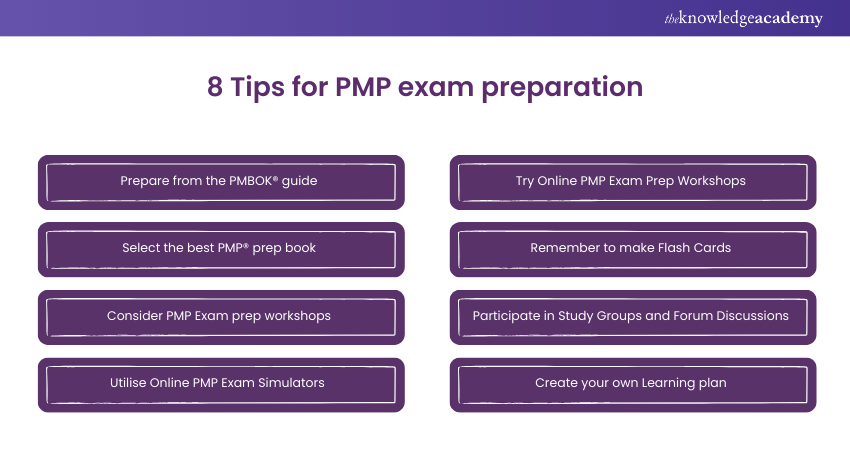
2) Top 8 Tips for PMP Exam Preparation
3) What Type of Questions are Expected?
4) Conclusion
How to Start PMP Exam Preparation?
If you’re all the way here, you have understood the PMP certification exam’s requirements and we hope you have ensured your eligibility. Further, we will provide you with a few suggestions on how to start your PMP exam preparation.
The number of PMP certification holders is increasing rapidly. This means there is a massive competition and you will have to master the entire PMP course with the appropriate amount of effort, devotion, and guidance. To assist in getting the PMP certification, we are providing a step-by-step strategy.
a) Examine
Before you begin your preparation, thoroughly understand the subject material you intend to cover. Examine all of the charts, graphs, and headers in the PMBOK Guide and your other exam preparation materials. Gain familiarity with the areas you desire to cover, as it will provide you with a better grasp of where to find them in the book. It will make both - the initial study and the last-minute revision - easier. Starting with this type of research will also make it easier for you to organise information in your thoughts systematically and logically.
b) Strategies
Discover your motivation and start with the topic that interests you the most to stay motivated throughout the day. Plan before commencing your day’s work. Plan your schedule and determine what you want to learn from the materials you have set to study. Study goals or recap questions from your PMP study materials first, so you can understand what you’re aiming for, where you’re going and what you need to complete before the end of the day.
c) Research
Before you begin your preparation, thoroughly understand the subject material you intend to cover. Start your everyday study by making a list of questions you should be able to answer by the end of the day. Starting with this type of research will also make it easier for you to organise information in your thoughts systematically and logically. Thus, Research is a key step in PMP Exam Preparation.
d) Break-down
Break down your study plan for the day, based on cognitive psychology studies. According to this study, the first and ending parts of a study session are the most memorable. Take advantage of this methodology by breaking up your study periods into smaller parts. For instance, if your total study time is five hours, divide it into six 45-minute sessions with brief breaks in between. This will help you recap the things you studied before the break and help you grasp the next topics quickly.
Want to gain a certification that demonstrates your Project Management skills and experience? Sign up for PMP Certification Training!
Top 8 Tips for PMP Exam Preparation
Here we will provide you with the most widely used top tips for PMP exam preparation:
1) Prepare from the PMBOK® Guide
Use PMBOK® Guide as your main weapon to get on the battlefield of the PMP exam, as the exam is mostly based on the PMBOK® Guide. Treat this Guide as your roadmap for PMP exam preparation. Plan to study one topic/ knowledge area from the PMBOK® followed by other materials. This will help you cover each and every topic thoroughly. You will also be avoiding studying repetitive topics, as other materials frequently repeat the information from a different angle. Familiarise yourself with the structure and layout of the PMBOK® Guide. Understand how the processes, knowledge areas, and process groups are organised. Go through each process outlined in the PMBOK® Guide thoroughly. Understand the inputs, tools and techniques, and outputs (ITTOs) associated with each process. Memorise key definitions, formulas, and concepts presented in the PMBOK® Guide. This includes understanding terms such as Critical Path, Earned Value Management (EVM), and various estimation techniques.
Solve practice questions based on the PMBOK® Guide content. This helps reinforce your understanding and prepares you for the format and style of questions in the actual exam. While the PMBOK® Guide is the primary resource, it might not cover every aspect in detail. Choose reliable resources covering relevant PgMP Exam topics, including textbooks, PMP Study Guide, courses, and practice exams.
Develop flashcards, mind maps, or other study aids to help memorise key information from the PMBOK® Guide. This can aid in quick revision and retention of important concepts.Try to relate the concepts from the PMBOK® Guide to real-life project management scenarios. This will not only enhance your understanding but also help you apply the knowledge effectively in the exam and in your professional practice.
Remember, conquering the PMBOK® Guide requires consistent effort and dedication. By following these steps, you're PMP Exam Prepararation is miles ahead of competition.
2) Select the best PMP® prep book
Selecting a reliable PMP® Exam Preparation book is crucial for effective study. Start by researching popular PMP® prep books available in the market. Look for reviews, ratings, and recommendations from other PMP® aspirants to identify reputable options. Ensure the book covers all the knowledge areas and domains tested in the PMP® exam, as outlined in the PMBOK® Guide. It should also include practice questions, explanations, and exam-taking strategies.
Check the credentials and experience of the book's author(s). Authors with extensive project management experience and PMP® certification themselves are likely to offer valuable insights and practical tips. Confirm that the book aligns with the latest edition of the PMBOK® Guide and reflects any recent changes or updates to the PMP® exam content outline. Look for a book that offers a substantial number of practice questions with detailed explanations. Practice questions help assess your understanding, identify weak areas, and familiarise you with the exam format.
Many prep books include simulated exams or online practice tests. Take advantage of these resources to simulate exam conditions and assess your readiness for the actual PMP® exam.
By selecting a quality PMP® prep book and incorporating it effectively into your study routine, you can excel PMP Exam Preparation.
3) Consider PMP Exam prep workshops
Many aspirants join the PMP test prep workshops to complete the 35 contact hours. This is the best option for someone who prefers a classroom environment and one-on-one engagement for preparation. It provides you with an opportunity to meet other aspiring project management professionals, in addition to networking through a PMI® membership.
4) Utilise Online PMP Exam Simulator
PMP® simulators are online mock tests for the PMP exam questions. You can assess your degree of preparedness as you will be given a series of questions in the same structure as the actual PMP® exam. With these, you will grow familiar with the timing and pressure of the exam as these mocks tend to simulate the test setting.
5) Try Online PMP Exam Prep Workshops
Fear preparing on your own, then these PMP Exam Prep workshops are the best option. You can choose to opt for online PMP exam prep workshops as their cost is comparatively less. Select the option that suits your learning style and do a lot of comparison and testimonial reading before selecting the offline/online workshop.
6) Remember to make flashcards
Make short notes from these books to add-on to the topics you have already studied in the PMBOK® Guide. You can take the help of paper or electronic flashcards for this. You can paste these on the book you’re studying, notes or anywhere near your study table. Downloadable flashcards may be printed or also used on a computer or smartphone.
7) Participate in Study Groups and Forum Discussions
Study groups and discussion forums may be quite beneficial in preparing for your PMP® test. As an active member in study groups and discussion forums, you may assist others and get help with your doubts, discover other beneficial resources, and drastically shorten the time necessary to prepare for the exam.
8) Create your own Learning Plan
Every individual learns at a different pace and is comfortable with specific methods of learning. Taking your understanding of the topics so far into consideration, you can devise your own study plan. This way, you stay motivated to push forward but at a pace, you are comfortable in. Here are some points to remember for your learning plan:
a) The extent of your familiarity with the exam topics
b) The amount of time that you wish to contribute to studying
c) Your decided date and time to take the examination
d) Deciding on training techniques that are better suited for you: self-study or instructor-led
Start your preparation from here – sign up for the Introduction to Project Management course!
What Type of Questions are Expected?
The PMP® exam typically consists of a variety of question types designed to assess your understanding of project management principles, processes, and practices. Here are the main types of questions you can expect:
1) Scenario-based Questions: These questions present you with a project management scenario and ask how you would respond or what action you would take in that situation. They often require critical thinking and application of project management concepts to real-world scenarios.
2) Knowledge-based Questions: These questions assess your understanding of fundamental project management concepts, terminology, and principles. They may ask you to define terms, identify processes, or explain key concepts.
3) Calculation-based Questions: Some questions require you to perform calculations related to project management metrics, such as Earned Value Management (EVM), critical path analysis, or risk analysis. These questions often involve applying formulas and interpreting results.
4) Interpretation of Diagrams and Charts: You may encounter questions that require you to interpret diagrams, charts, graphs, or project schedules (e.g., Gantt charts, network diagrams). These questions test your ability to analyse project data and make informed decisions based on visual representations.
It's essential to familiarise yourself with each question type and practice answering various question formats during your PMP Exam Preparation. Practicing with sample questions, taking simulated exams, and reviewing explanations for correct and incorrect answers can help you become more comfortable with the question types and improve your overall exam performance.
Check whether you are ready?
While the PMI has never declared the minimum marks for qualifying, it is believed that scoring 62% will help you pass the exam. Most of the toppers follow the 85 percent rule. We suggest you aim to answer atleast 85% of questions correctly in the practice test to ensure that you qualify for the exam with no hassle. This not only helps you to understandPMP Exam Preparation and to check whether you’re ready for the PMP exam or not, but also helps in evaluating How Hard Is The PMP Exam.
Conclusion
In this blog, we explored the key points you should keep in mind while preparing for the PMP exam. These PMP Exam Prep Tips can open doors to valuable opportunities in project management across industries worldwide. Achieving this credential demonstrates your professional expertise, practical knowledge, and commitment to excellence in Project Management. Start your preparation today and take the next step toward advancing your career.
Also, check out our blog to prepare the top PMP interview questions to ace your interview!
Frequently Asked Questions
How does PMP certification validate project management skills and expertise, contributing to career growth?

PMP certification validates project management skills globally, leading to career growth by increasing job prospects, advancing career opportunities, boosting salaries, ensuring professional development, and enhancing project performance.
Can earning a PMP certification lead to salary increases or promotions in project management roles?
PMP-certified professionals typically command higher salaries compared to their non-certified counterparts. Employers value the knowledge, skills, and expertise demonstrated by PMP certification and are willing to offer competitive compensation packages to certified professionals.

The Knowledge Academy


Global Training Provider
The Knowledge Academy is a world-leading provider of professional training courses, offering globally recognised qualifications across a wide range of subjects. With expert trainers, up-to-date course material, and flexible learning options, we aim to empower professionals and organisations to achieve their goals through continuous learning.


 If you wish to make any changes to your course, please


