


 Top Rated Course

We may not have the course you’re looking for. If you enquire or give us a call on +44 20 4538 6376 and speak to our training experts, we may still be able to help with your training requirements.
Top 10+ Benefits of Artificial Intelligence
Scarlett Adams 13 July 2026Artificial Intelligence (AI) is reshaping the world by automating processes and enabling smarter decision-making. Its impact spans industries, revolutionising the way we work and live. Explore the best transformative Benefits of Artificial Intelligence in this blog! Uncover how AI is enhancing efficiency and shaping the future.

Training Outcomes Within Your Budget!
We ensure quality, budget-alignment, and timely delivery by our expert instructors.
Table of Contents
Artificial Intelligence (AI) is a concept which has been on everyone’s mind for quite some time now. From quick suggestions on search engines like Google and Bing to chatbots and auto-focus features in smartphone camera applications, AI has become a part of everyday life.
The Benefits of Artificial Intelligence arose as an idea associated with robots and has now permeated every process available online. It hasn’t spared even email in the form of auto-completions. Read through this blog to learn the different advantages of Artificial Intelligence.
Table of Contents
1) How Does Artificial Intelligence Work?
2) Benefits of Artificial Intelligence
a) Diminishes Human Error
b) Smart Decision Making
c) Medical Innovations
d) Data Analysis
e) Automates Repetition
f) Business Efficiency
g) Risk Taking
h) Available 24/7
i) Digital Assistance
3) Conclusion
How Does Artificial Intelligence Work?
Artificial Intelligence (AI) refers to the development of computer systems capable of performing tasks that typically require human intelligence. These tasks include recognising speech, making decisions, and identifying patterns.
Here's how AI works:
a) Data Collection: AI systems learn from large amounts of data. This data can come from various sources like text, images, or sensor inputs.
b) Algorithms: AI uses algorithms, which are sets of rules or instructions, to process this data. These algorithms help the system identify patterns and make predictions.
c) Training: During the training phase, the AI system is provided with data and adjusts its algorithms to improve accuracy. This process is often iterative, meaning it repeats many times to refine the system's performance.
d) Inference: Once trained, the AI system can make inferences or decisions based on new data. One of the AI example, it can recognise objects in images or translate languages in real-time.
e) Feedback Loop: AI systems often include a feedback loop where they learn from their mistakes and improve over time.
There are different technologies behind the successful working of AI, including:
a) Machine Learning (ML): A subset of AI where systems learn from data to improve their performance on specific tasks.
b) Deep Learning: A more advanced form of ML that uses neural networks with many layers to analyse complex data.
c) Natural Language Processing (NLP): Enables computers to understand and respond to human language.
AI is used in various applications today, from virtual assistants like Siri and Alexa to recommendation systems on platforms like Netflix and Amazon.
Benefits of Artificial Intelligence
Artificial Intelligence boasts a diverse array of impactful uses, which we will explore in the following list. The advantages of Artificial Intelligence are manifold, offering solutions that enhance productivity, drive innovation, and provide unprecedented insights across various sectors. From automating mundane tasks to enabling complex Data Analysis, AI's benefits, including its transformative impact on AI Email Marketing, are reshaping the way we live and work. In Artificial Intelligence Interview Questions, candidates are often asked to elaborate on these advantages and discuss how AI-driven solutions are revolutionising industries.
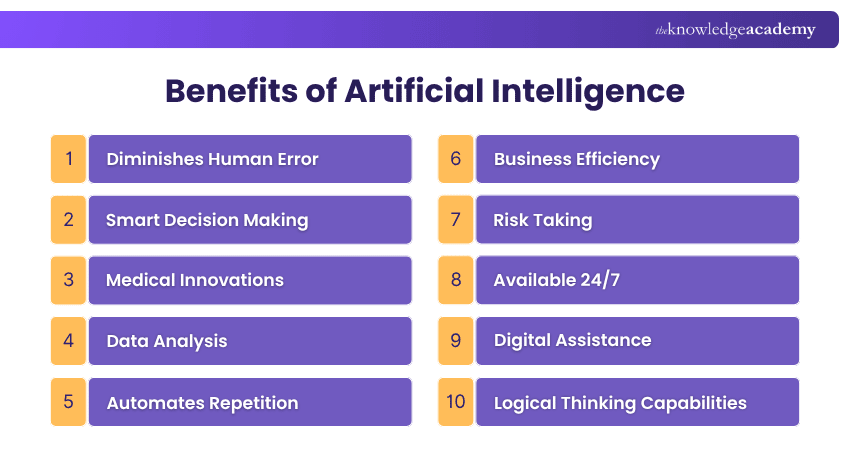
1) Diminishes Human Error
Humans are prone to errors, but properly programmed computers can make fewer mistakes in specific areas. AI decisions, based on compiled data and designed algorithms, enhance accuracy and precision while reducing errors.
Additionally, AI systems continuously improve through learning and Data Analysis, allowing them to deliver more accurate and efficient results over time. This helps organisations enhance productivity, maintain consistency, and make better data-driven decisions across various applications.
2) Smart Decision Making
Artificial Intelligence has been utilised in business for a very long time now. This means that it has led to an increase in efficiency and smartness in business decisions. AI has been programmed to perform a diverse range of tasks, including data delivery coordination, maintaining data consistency and providing forecasts for companies. AI has been made capable of even quantifying any uncertainties to boost decision-making for a company.
The distinction between AI and human beings is human emotion. This is probably the biggest line is drawn between AI and humans. Discover the key differences between Artificial Intelligence vs Emotional Intelligence and their impact on the future of work! It is capable of detecting variance at granular levels, which would be rather baffling to the perception of humans.
3) Medical Innovations
One of the booming sectors for AI applications is the Medical or Healthcare industry. The implementations of AI in the medical domain have proven to exceed the boundaries of human expectation and even imagination, as detailed in the Artificial Intelligence in Healthcare Guide. For example, Remote patient monitoring technology enables healthcare providers to carry out clinical diagnoses followed by suggested treatment procedures.
This process does not require the patient's presence at the hospital. Additionally, the benefits of Artificial Intelligence techniques have also permeated monitoring contagious diseases and predicting their future effects. The leverage of AI in healthcare, through advanced artificial intelligence techniques, leads to the deployment of precise and efficient innovations designed to care for patients suffering from these diseases, hopefully also finding a cure for them.
Gain practical skills in machine learning and big data technologies with our Advanced Data Analytics Course– Register now!
4) Data Analysis
Data analysis methods and techniques have evolved considerably over the years, and the involvement of AI and Machine Learning technology has sent efficiency skyrocketing. To go into detail, AI is designed to generate predictive models and algorithms to execute the data. After which, the AI proceeds to understand the possible outcomes of various scenarios.
With AI's involvement in the data industry, automation is carried out on the work which would generally be performed by a human Data Analyst. The impression may come across as the Data Analyst being replaced by AI. However, AI's existence is meant to improve Data Analysts' abilities. These improvements involve increased speed, the scale of the data being analysed, and the data's granularity which is monitored.
5) Automates Repetition
Repetitive tasks are still common in many jobs, often not fully utilising human potential. AI can automate these tasks, such as manufacturing processes and email responses. By automating repetitive jobs, productivity is increased, allowing you to focus on creativity and other tasks that particularly require human skills.
Learn how to use AI technologies in daily tasks and business operations with the AI Productivity Foundation and Practitioner (The Users) Training – Register today!
6) Business Efficiency
Since the advent of AI, companies have pounced at the opportunity to evolve their business forecasting efficiencies, where critical decisions are made more promptly and prepared with a contingency plan in the case of any emergency. Furthermore, Risk Management typically relies on Data Analysis and Management. Using AI-supported tools would aid companies in their risk management processes and respective outcomes in the case of crises.
Integrating AI with Machine Learning can generate scenarios to guide businesses in planning a strategy for rapid disaster recovery. Data analysis generally generates observations of the audience or the economic trends that may impact marketing efforts. This is followed by tailor-made messages being scheduled at the right times without any involvement or intervention from the marketing team.
7) Risk Taking
This can probably be counted as one of the prime Benefits of Artificial Intelligence. Risk is a term that describes any situation potentially exposing someone or something to danger. Moreover, humans are generally prone to taking risks followed by either successful outcomes or errors. Inadvertently, emotions also come into play during human decision-making.
At this point, AI takes over by significantly decreasing errors and increasing precision. This is because every instance of a decision made in AI is based on information gathered previously and a particular set of algorithms. Since AI systems are designed and programmed by humans, their accuracy depends on how effectively they are developed and trained. When implemented properly, AI can greatly reduce errors and deliver highly precise results.
8) Available 24/7
This benefit would be quite the no-brainer. It implies the precedence of AI over humans in terms of productivity over long periods. Even the adjective 'long' is a massive understatement for AI's so-called 'stamina'. Artificial Intelligence can operate endlessly, as it is designed as a machine to run as long as it is programmed to do so. It learns non-stop based on a model which trains input and produces the respective outputs.
AI can, without a doubt, think much faster than human beings and carry out many tasks simultaneously with high-accuracy results. This implies that AI can work tirelessly around the clock at even repetitive jobs as long as AI Algorithms support them.
9) Digital Assistance
Using Artificial Intelligence, scientists and designers came up with a technology called a 'Chatbot'. More precisely, a 'predictive chatbot' is an advanced computer application simulating a conversation with the people interacting with it. Digital assistants generally utilise NLP and Natural Language Understanding (NLU) to learn a human language on the go and offer a human-like conversational experience.
These chatbots are supported by algorithms that process the incoming data in the form of purchase preferences, home possession, family size and location. After this, data models are generated to recognise behaviour patterns and the refinement of patterns is carried out as the data is added with each conversation.
10) Logical Thinking Capabilities
Concerning the 5th benefit described earlier in this blog, Artificial Intelligence technology is void of emotions and very rational in its approaches to decision-making. These reasons contribute to precise and accurate outcomes from decisions because they are not interfered with by biased views or emotions. Now a counter to this apparent strength of AI in decision-making is that if humans programme AI, can it also be biased?
Two types of biases exist in AI, namely 'data bias' or 'algorithmic bias', and 'societal bias'. The former involves algorithms trained with biased data, and the latter involves data containing societal assumptions and norms. These assumptions and norms arise from humans having certain blind spots or even particular expectations in our thought processes.
Enhance your ability to interpret data AI tools and technologies with Artificial Intelligence (AI) for Business Analysts Training – Sign up soon!
11) Daily Applications
Reading until this point in the blog, you have been introduced to the complex and large-scale applications of Artificial Intelligence. There also exist regular applications that are commonly well-known to most users of technology.
A few notable examples include:
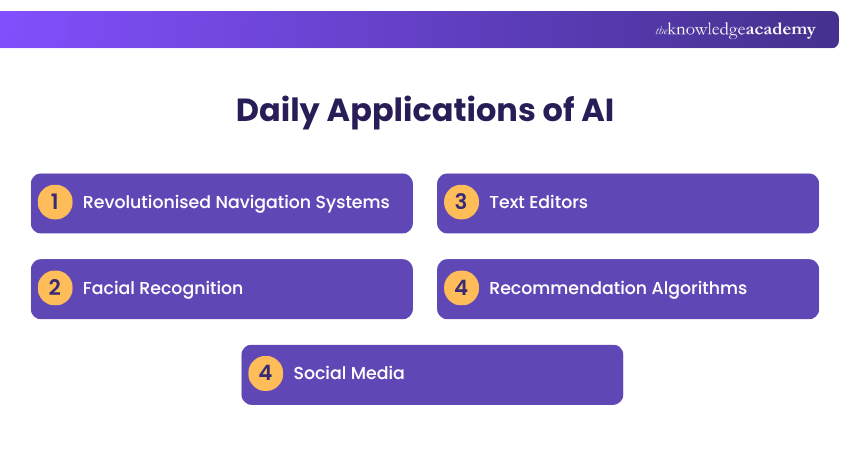
1) Revolutionised Navigation Systems: Predictive traffic conditions and immersive city view, like in Google Maps.
2) Facial Recognition: Virtual facial filters are used in the camera, and facial detection is used to unlock phones.
3) Text Editors: Use of NLP to recognise improper language and suggestions for corrections. AI editors are designed through the collaborative effort between linguists and computer scientists teaching them grammar.
4) Recommendation Algorithms: Learned behaviour by online services supported by smart systems and tracked online user activity. This is followed by data collection, storage and analysis using machine and Deep Learning Techniques.
5) Social Media: Social Media applications designed with AI monitor content and provide advertisements to targeted end-users to ensure they remain invested and plugged in 'online' regularly.
Master your concepts in the applications of Artificial Intelligence by creating your own algorithms. Sign up for the Machine Learning Coursenow!
Solving Complex Problems
AI technology, starting from simple Machine Learning to advanced Deep Learning, has made it capable of solving complex problems. AI helps many businesses in multiple industries with various tasks.
It includes fraud detection, personalised customer interactions, weather forecasting, medical diagnosis, etc. This technology allows companies to address their challenges more effectively. It leads to higher productivity and lower costs.
Identifies Patterns
AI effectively detects patterns in your data, enabling faster predictions. This can expedite marketing decisions by swiftly providing a broader perspective.
AI surpasses human abilities in identifying patterns in text, numbers, and images. This advantage enhances your marketing analytics and aids in crafting your next Digital Marketing strategy.
Conclusion
Artificial Intelligence is changing the way individuals and businesses operate by improving efficiency, accuracy, productivity and decision-making. From automation and personalised recommendations to advanced data analysis and enhanced customer experiences, AI continues to create new opportunities across various industries. As technology evolves, the Benefits of Artificial Intelligence are expected to grow even further, helping organisations innovate, solve complex problems, and remain competitive in an increasingly digital world.
Explore the future of innovation and intelligence with Artificial Intelligence Courses – Join now!
Frequently Asked Questions
How can Businesses Benefit from Adopting AI?

Businesses can benefit from adopting AI by automating repetitive tasks, improving operational efficiency, enhancing customer experiences and supporting data-driven decision-making. AI helps organisations reduce costs, increase productivity, predict market trends, and deliver services that improve customer satisfaction and business growth.
What are Some AI Applications in Everyday Life?
AI is widely used in everyday life through virtual assistants, recommendation systems, navigation apps, facial recognition, smart home devices, chatbots, and online shopping platforms. It also powers language translation, spam filters, personalised advertisements, and smartphone features, making daily tasks more convenient and efficient.

 If you wish to make any changes to your course, please


