


 Top Rated Course

We may not have the course you’re looking for. If you enquire or give us a call on +44 1344 203999 and speak to our training experts, we may still be able to help with your training requirements.
IPv4 vs. IPv6: What’s the Difference and Why Does it Matter?
John Davies 14 February 2026IPv4 vs IPv6 highlights differences in addressing, headers, and scalability, helping organisations understand today’s IP networking requirements. It explains clearly why IPv6 adoption is growing globally. This comparison also supports better planning for secure, efficient, and future-ready network infrastructure strategies.
Home
 Resources
IT Infrastructure & Networking
IPv4 vs. IPv6: What’s the Difference and Why Does it Matter?
Resources
IT Infrastructure & Networking
IPv4 vs. IPv6: What’s the Difference and Why Does it Matter?
Resources
IT Infrastructure & Networking
IPv4 vs. IPv6: What’s the Difference and Why Does it Matter?

Training Outcomes Within Your Budget!
We ensure quality, budget-alignment, and timely delivery by our expert instructors.
Table of Contents
Understanding the operation of internet protocols has become a necessity for contemporary networks as digital connectivity continues to grow. IPv4 vs IPv6 discloses the evolution of addressing, performance, and scalability in a way that they can cope with the demands of the day. Let's look into the major factors that are influencing the future of IP networking.
Table of Contents
1) Understanding IPv4 and IPv6
2) What is IPv4 (Internet Protocol Version 4)
3) What is IPv6 (Internet Protocol Version 6)?
4) How Do IPv4 and IPv6 Work?
5) IPv4 vs IPv6
6) How Does IPv6 Improve on IPv4?
7) When Would You Use IPv6 Over IPv4?
8) Future Outlook for IPv6
9) Conclusion
Understanding IPv4 and IPv6
IPv4 has been the backbone of the internet for years, but its limited address space hinders the growth of the current era. IPv6 was created in order to give an enormous address pool that can cater to the global connectivity of today and even longer periods of time.
Both protocols do the same task, identifying devices on a network, but IPv6 gives all the advantages of better Security, Efficiency, and Scalability. Once people recognise these differences, it will be easier for them to learn modern networking concepts.

What is IPv4 (Internet Protocol Version 4)
IPv4 is the fourth version of the Internet Protocol (IP) that identifies any device that uses it with a numerical IP address. It supports 4.3 billion unique addresses and connectionless communication is implemented with Uniform Domain-Name Dispute-Resolution Policy (UDRP). But its address scope was too small and a change from 4 to IPv6 with supposedly "unlimited" addresses, made it ideal for global internet communication.
What is IPv6 (Internet Protocol Version 6)?
IPv6 is the latest standard that is being developed. It provides a greater number of unique IP addresses compared to IPv4, with 128 bits, which account for approximately 340 undecillion unique numbered spaces. The IPv6 standard helps to manage increased demands on the internet, optimising routing procedures, strengthening security sparkles and simplifies over net configuration.
Transform your networking career with our CCNP Training (Cisco Certified Network Professional) – Get started now!
How Do IPv4 and IPv6 Work?
IPv4 and IPv6 work through several core mechanisms that define how data is transmitted, addressed, and made compatible across networks:
Packet-based Communication
Both IPv4 and IPv6 operate at the network layer, functioning as connectionless protocols where data is sent in discrete packets. Each packet has a header and payload and is routed independently across networks. Packets may take different paths but are reassembled in the correct order by higher layers like TCP or UDP.
Addressing and Routing
IPv4 uses 32-bit addresses, while IPv6 uses 128-bit addresses, greatly expanding the number of available IPs. IPv6 also enables more efficient network hierarchy and routing, improving scalability and performance.
Incompatible by Design
Due to different header formats, IPv4 and IPv6 cannot communicate directly. Networks or devices must support both protocols through dual-stack configurations or use translation and tunnelling methods to ensure interoperability.
IPv4 vs IPv6
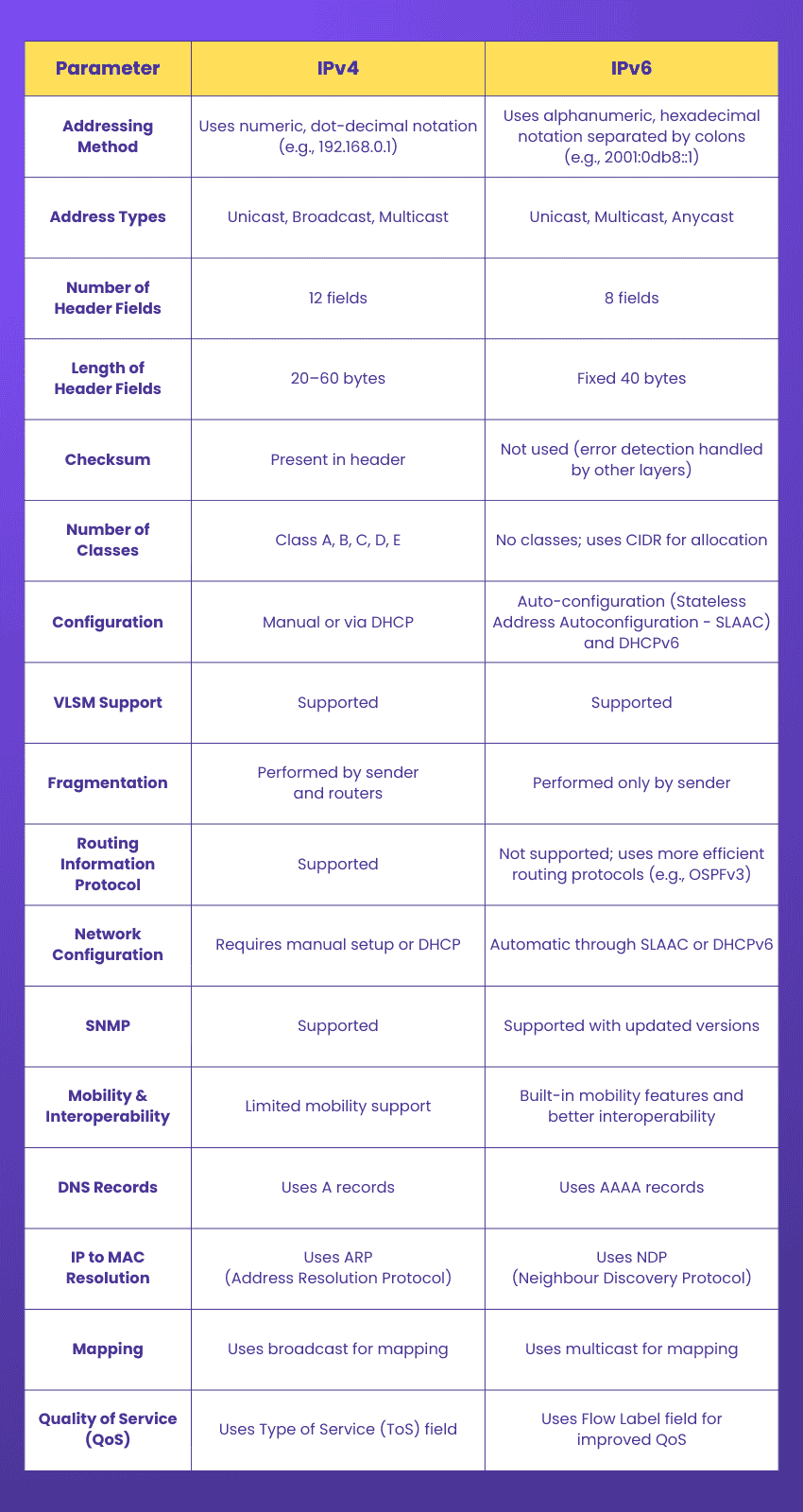
Grasping the contrasts between IPv4 and IPv6 is a necessity for today's networking. The following table brings out the most important differences in terms of addressing, structure, and scalability.
How Does IPv6 Improve on IPv4?
IPv6 is an improvement on IPv4 by simplifying the network processes and eliminating the old world limits, such as NAT, resulting in efficient and scalable connectivity to the current environment.
Autoconfiguration
Address autoconfiguration Stateless Address Autoconfiguration (SLAAC) is used in IPv6, in which devices do not depend on a DHCP server to configure their IP addresses, minimising network traffic and management load.
Routing
IPv6 is a more efficient routing protocol that should replace NAT, simplify the header format and allowing hierarchical addressing and aggregation to simplify the routing process and accelerate packet delivery.
Security
IPv6 also has built-in security features, including mandatory IPsec support and privacy extensions, and it has better default protection and provides better security routing than IPv4.
When would you use IPv6 over IPv4?
IPv6 would be used over IPv4 when a network needs a much larger room of addresses for already more devices in the long run. It is particular for growing organisations, global services or an IOT landscape where there is an insufficient number of addresses presented by the IPv4.
Advantages of IPv6 over IPV4 includes larger address space, both for hosts as well as routing with little hex characters exchange and built-in security via Internet Protocol Security (IPSec) and easier configuration. These features improve the performance, scalability and management of modern, high demand networks.
Master the basics of networking concepts by signing up for our Cisco Certified Network Professional Boot Camp Week 1 Course now!
Future Outlook for IPv6
IPv6 has a bright future, as it solves the problems of IPv4 transfer and supports the fast increase in IoT and 5G. Besides, its enormous address space and scalability are the guarantees of the Internet's long-term expansion.
The transition from IPv4 to IPv6 is gaining momentum in enterprises and cloud platforms, as the modern infrastructure demands. The growing adoption will, in turn, deliver a more secure, efficient, and future-ready connectivity.
Conclusion
The difference between IPv4 and IPv6 is an important factor for modern networks to evolve in terms of scalability, security, and performance. Apart from the growing internet usage, IPv6 adoption will also result in long-term efficiency and preparedness. Making this transition today prepares organisations for the future of connectivity.
Explore our expert-led Cisco Training courses for advanced networking skills. Sign up now!
Frequently Asked Questions
Which is Faster – IPv4 or IPv6?

IPv6 has the potential to be faster than IPv4 on account of the elimination of NAT, which is one of its major features, as well as routing and packet processing that are more efficient. Nevertheless, speed differences in the real world are affected by network arrangement, equipment, and settings.
Can you use both IPv4 and IPv6?
Yes, you can use both IPv4 and IPv6 through a dual-stack configuration. This setup allows devices and networks to run both protocols simultaneously, ensuring compatibility with older systems while taking advantage of IPv6 benefits like larger address space and enhanced security.
What are the Other Resources and Offers Provided by The Knowledge Academy?
The Knowledge Academy takes global learning to new heights, offering over 3,000 online courses across 490+ locations in 190+ countries. This expansive reach ensures accessibility and convenience for learners worldwide.;
Alongside our diverse Online Course Catalogue, encompassing 19 major categories, we go the extra mile by providing a plethora of free educational Online Resources like Blogs, eBooks, Interview Questions and Videos. Tailoring learning experiences further, professionals can unlock greater value through a wide range of special discounts, seasonal deals, and;Exclusive Offers.
What is The Knowledge Pass, and How Does it Work?
The Knowledge Academy’s Knowledge Pass, a prepaid voucher, adds another layer of flexibility, allowing course bookings over a 12-month period. Join us on a journey where education knows no bounds.
What are the Related Courses and Blogs Provided by The Knowledge Academy?
The Knowledge Academy offers various Cisco Courses, including the IPv6 Basics, Cisco MPLS Training, and Cisco Umbrella Training. These courses cater to different skill levels, providing comprehensive insights into ARP.
Our IT Infrastructure & Networking Blogs cover a range of topics related to Earned Value Management, offering valuable resources, best practices, and industry insights. Whether you are a beginner or looking to advance your Project Management skills, The Knowledge Academy's diverse courses and informative blogs have got you covered.

John Davies


Cyber Security Governance & Assurance Specialist
John Davies is a cybersecurity expert specialising in governance, risk management, and compliance. With over 15 years in the field, he has led enterprise-wide security programmes across finance, healthcare and public sector organisations. His content provides practical guidance on building secure environments, managing risk and aligning with regulatory frameworks.

Upcoming IT Infrastructure & Networking Resources Batches & Dates
Date
 IPv6 Basics

 If you wish to make any changes to your course, please


