


 Top Rated Course

We may not have the course you’re looking for. If you enquire or give us a call on 01344 203999 and speak to our training experts, we may still be able to help with your training requirements.
Python Data Types: Meaning, Examples, and Best Practices
Richard Harris 14 July 2026Python data types define the kind of value a variable holds and determine how data is stored, manipulated, and what operations can be performed on it. Learn how Python data types define variable behaviour, enable specific operations, and support efficient coding through clear, simple examples and explanations.

Training Outcomes Within Your Budget!
We ensure quality, budget-alignment, and timely delivery by our expert instructors.
Table of Contents
In terms of prominence, Python ranks very high in the list of Programming Languages, thanks to its remarkable code readability and simple syntax. But what exactly lies at the heart of this language's functionality? The answer lies in its basic building blocks - Data Types. Understanding the Python Data Types is vital for any aspiring programmer.
With applications ranging from Web Development and game creation to scientific and mathematical computing, Python continues to prove its versatility to developers. This blog explores the essential Python Data Types and their importance. Read on and enhance your Python knowledge base!
Table of Contents
1) What are Data Types in Python
2) Basic Data Types in Python
3) Importance of Python Data Types
4) Type Conversion in Python
5) Best Practices for Working with Data Types in Python
6) What are mutable and immutable data types in Python?
7) Conclusion
What are Data Types in Python
Python data types are classifications that define the nature of values a variable can hold. They determine how information is stored, accessed, and manipulated within a program. Python offers a diverse set of data types to handle everything from basic values to complex data structures. Common types include integers (whole numbers), floats (decimal numbers), and strings (text). More complex data types such as lists, tuples, dictionaries, and sets enable developers to organise and manage data efficiently.
These data types form the foundation of Python programming, allowing data to be structured and processed in line with specific application requirements. Each type has unique characteristics: lists maintain ordered collections, while dictionaries use key-value pairs for fast, targeted data access. Choosing the right data type helps make code more readable, flexible, and easier to maintain.

Take the first step in becoming a skilful Django developer by signing up for our Python Django Training.
Basic Data Types in Python
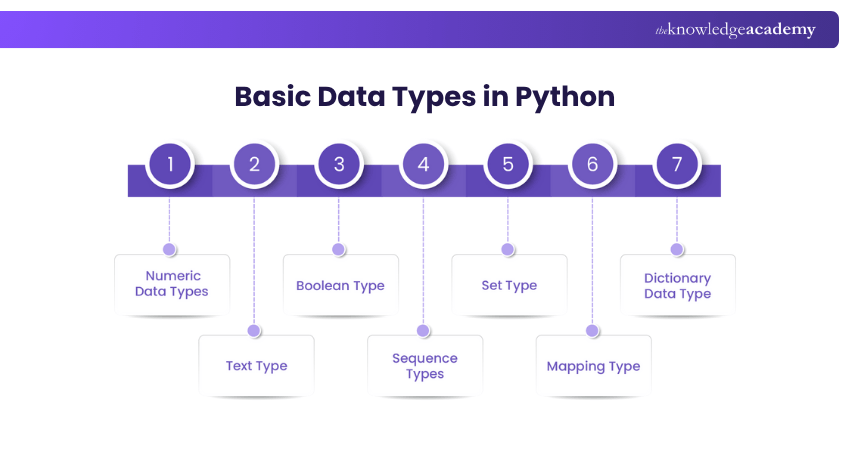
Python, as a dynamically typed language, provides a collection of basic Data Types that serve as the building blocks for data representation and manipulation. These form the foundation of any Python program. So, let's explore the basic Python Data Types and understand their characteristics:
1) Numeric Data Types
Numeric Data Types in Python encompass three primary categories:
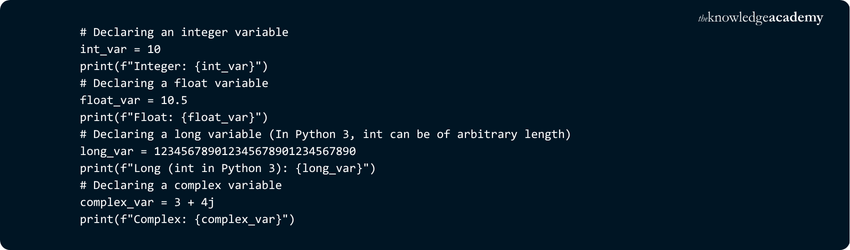
a) Integer: Integers are whole numbers, both positive and negative, without any fractional part. They can represent a wide range of numerical values and are commonly used for counting and mathematical operations. Its example includes:

b) Float: Floats are numbers with decimal points, enabling the representation of real numbers. They are used for more precise mathematical calculations, including scientific and financial computations. Its example include:

c) Complex: Complex numbers consist of a real and an imaginary part and are represented as a + bj, where a and b are real numbers. j represents the square root of -1. They are used in advanced mathematical and engineering applications. Its example includes:

d) Long: Long integers represent whole numbers of arbitrary length, making them suitable for calculations requiring high precision and large values. In Python 3, the int data type automatically adjusts to accommodate the number's size, ensuring no overflow error for huge integers.
Here’s an example:

Here's a code snippet that declares an integer, a float, a long and a complex variable:
2) Text Type
Strings are sequences of characters and are used to represent textual data. They can be enclosed within single, double, or triple quotes. Python treats strings as immutable objects, meaning their contents cannot be changed after creation. Its example includes:

Here’s a code snippet that declares a text variable:

Gain the expertise to analyse data and unlock the power of decision-making. Join our Python Data Science Training now!
3) Boolean Type
The Boolean Data Type represents binary truth values, either True or False. They are integral in decision-making and flow control in Python programming. However, non-Boolean objects can also be evaluated in a Boolean context and determined to be true or false. This is denoted by the class bool. Its example includes:

Here's a Python code snippet that declares a Boolean variable:

4) Sequence Types
Sequence types in Python encompass two primary categories:
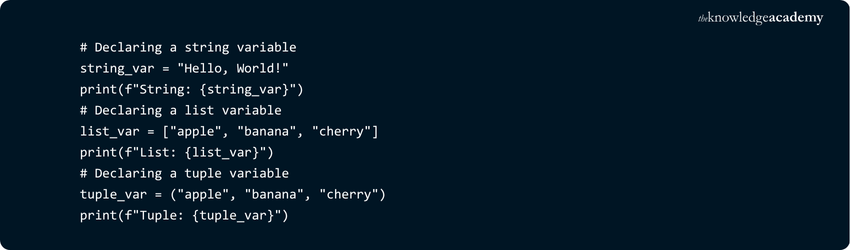
a) String: In Python, strings are arrays of bytes representing Unicode characters. They consist of one or more characters enclosed in single, double, or triple quotes, which is a crucial point in the Python List vs Array discussion. In the context of a Python String, these sequences function similarly to arrays but are optimised for handling characters efficiently. Each character is essentially a string of length one, represented by the str class. Here’s an example:

b) List: Lists are dynamic collections that can store elements of different Data Types. They are mutable, allowing for easy modification of elements. Lists are versatile and widely used for data storage and manipulation, especially in scenarios involving Python Threading where concurrent access to data structures is required. Its example includes:

c) Tuple: These are similar to Lists but immutable, meaning their elements cannot be changed after creation. They are commonly used to represent fixed collections of data.

Example includes:Here's a code snippet that declares a string, a list, and a tuple variable
5) Set Type
Sets are unordered collections of unique elements. They are useful for various operations like removing duplicates from a list and testing membership. Python provides a set Data Type along with corresponding set operations. Their example includes:

Here's a code snippet that declares a set variable:

6) Boolean Type
The Boolean Data Type represents binary truth values, either True or False. They are integral in decision-making and flow control in Python programming. However, non-Boolean objects can also be evaluated in a Boolean context and determined to be true or false. This is denoted by the class bool. Its example includes:

Here's a Python code snippet that declares a Boolean variable:

Build a solid foundation in two of the most powerful programming languages by signing up for our Introduction To Programming With Python And Java Training.
Importance of Python Data Types
Data Types are crucial in Python programming, making it one of the most powerful and versatile programming languages available. They provide a myriad of benefits that contribute to the efficiency, reliability, and flexibility of programs. Let's explore the significance of Python Data Types and understand why they are of paramount importance to developers:
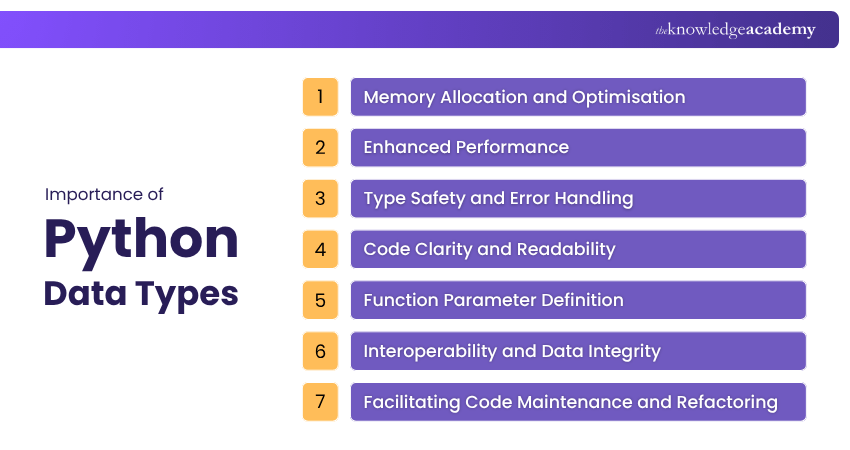
1) Memory Allocation and Optimisation
They allow Python to allocate memory for variables and data structures efficiently. By specifying the Data Type of a variable, the programming language can reserve the appropriate amount of memory. As a result, it minimises wastage and optimises memory usage. This optimisation is particularly essential when dealing with large datasets or resource-constrained environments.
2) Enhanced Performance
With the correct use of Data Types, Python programs can achieve better performance. Operations involving specific these components are often more efficient, as the programming language can apply optimised algorithms tailored to those types.
For instance, Numeric Data Types like integers and floating-point numbers have dedicated arithmetic operations that are faster than generic ones.
3) Type Safety and Error Handling
Python's strong typing system, enforced through Data Types, ensures type safety. It prevents unintended operations on incompatible Data Types. As a result, it reduces the likelihood of runtime errors and bugs. This results in more reliable and robust code.
4) Code Clarity and Readability
Explicitly specifying the types of data enhances code clarity and readability. When reading someone else’s code or revisiting your own after a significant time gap, knowing the Data Types used helps understand the purpose. It also helps in determining the context of variables and data structures.
Looking to kickstart your coding journey? Register now for our Programming Training.
5) Function Parameter Definition
Data Types aid in defining function parameters. They make it easier to understand what types of arguments a function accepts. This provides clear guidance to developers. As a result, it prevents the passing of incorrect Data Types as function arguments.
6) Interoperability and Data Integrity
Python's Data Types ensure seamless data exchange between different parts of a program and even between different programs. This interoperability is vital when integrating Python code with other languages or systems. Additionally, these components safeguard the integrity of data throughout its lifecycle, preventing unintended modifications.
7) Facilitating Code Maintenance and Refactoring
When modifying or refactoring code, Data Types help maintain consistency in data representations. This makes the process smoother and reduces the risk of introducing errors.
Type Conversion in Python
Type conversion is the process of changing a value from one data type to another. This is often required in programming to ensure that operations are handled correctly and data can be used in the intended way.
Python offers a flexible approach to type conversion, supporting both automatic (implicit) and manual (explicit) methods.
1) Implicit type conversion
In implicit type conversion, Python automatically converts one data type to another during expression evaluation. This typically happens when a smaller or less precise type (like int) is used with a larger or more precise type (like float). Python promotes the value to the more general type to preserve accuracy.
Example:

Output:

Here, the integer 5 is implicitly converted to a float to match 3.5, ensuring the operation does not lose precision.
2) Explicit type conversion
Explicit type conversion, also known as type casting, requires the use of built-in functions to manually convert one data type into another. Common functions include int(), float(), and str(). This method is useful when automatic conversion is not applied or when converting between incompatible types, such as converting a string to a number before performing a mathematical operation.
Example:

Output:

Explicit conversion gives you more control, particularly when working with user input or reading data from external sources.
Take the first step in becoming a skilful Django developer by signing up for our Python Django Training.
Best Practices for Working with Data Types in Python
Working efficiently with Python data types involves understanding their behaviour and using them appropriately to improve code readability, performance, and accuracy. Below are some best practices:
a) Use appropriate data types for the task: Choose data types that best represent the nature of your data. For instance, use a list for ordered collections, a dict for key-value pairs, and a set when uniqueness is required.
b) Avoid unnecessary type conversions: Excessive or careless type casting can lead to performance issues or unexpected behaviour. Use conversions only when essential.
c) Leverage built-in functions and methods: Python provides a wide range of built-in methods for each data type. Familiarising yourself with them can simplify operations and reduce code length.
d) Maintain consistency in data structures: Keeping data types consistent throughout your program helps avoid logical errors and makes the code easier to debug and maintain.
e) Be mindful of mutability: Understand which data types are mutable (list, dict, set) and which are immutable (int, float, str, tuple). This knowledge helps prevent unintended changes and improves program stability.
f) Use type hints where applicable: Python supports optional type hints, which improve code clarity and help tools detect potential bugs earlier in development.
By following these practices, developers can write cleaner, more efficient Python code that makes full use of the language's powerful and flexible data type system.
What are mutable and immutable data types in Python?
In Python, data types are classified as mutable or immutable based on their ability to be changed after creation. Mutable data types can be modified in place, meaning their content can be updated without changing their identity in memory. Common examples include list, dict, and set, where elements can be added, removed, or changed directly.
On the other hand, immutable data types cannot be changed once they are created. Any modification results in the creation of a new object. Examples include int, float, str, and tuple. For instance, changing a string results in a new string being created rather than altering the original. Understanding the difference between these types is essential for writing efficient, predictable Python code and avoiding unintended behaviour.
Conclusion
Python Data Types form the backbone of any Python programming. By understanding and utilising the appropriate types of data effectively, programmers can efficiently handle, manipulate, and represent data. As a result, they can create elegant and robust solutions for a wide array of real-world challenges.
Gain skills to build dynamic applications and advance your career in programming by signing up for our Python Programming Course.
Frequently Asked Questions
How can Python Help in Data Analysis and Business Intelligence?

Python is suitable for BI and analytics because it offers flexibility, simplicity, vast libraries, and visualisation capabilities to work with vast, complex datasets. Its scalability makes it perfect for Big Data Analytics and integrates well with BI tools and databases.
How do I handle mixed data types in a Python list?
Python lists support mixed data types. You can store integers, strings, floats, and even other lists together. Use type checking (type() or isinstance()) to handle elements appropriately during iteration or operations.

Richard Harris


Senior Full Stack Developer and Technology Educator
Richard Harris is a highly experienced full-stack developer with deep expertise in both frontend and backend technologies. Over his 12-year career, he has built scalable web applications for startups, enterprises and government organisations. Richard’s writing combines technical depth with clear explanations, ideal for developers looking to grow in modern frameworks and tools.


 If you wish to make any changes to your course, please


