


 Top Rated Course


We may not have the course you’re looking for. If you enquire or give us a call on 01344 203999 and speak to our training experts, we may still be able to help with your training requirements.
AgileSHIFT vs. APMG Change Management: A Complete Comparison
David Evans 08 May 2026AgileSHIFT vs APMG Change Management represents two frameworks tackling organisational transformation from distinct angles; agility versus structured change. Explore how each approach empowers teams, manages resistance, and delivers lasting change in dynamic business environments. Dive in for further insights!

Training Outcomes Within Your Budget!
We ensure quality, budget-alignment, and timely delivery by our expert instructors.
Table of Contents
Change is an essential aspect of organisational growth and adaptability. Organisations often turn to structured frameworks like AgileSHIFT and APMG Change Management to manage it effectively. However, choosing between the two, AgileSHIFT vs APMG Change Management can be challenging.
AgileSHIFT promotes enterprise-wide agility, while APMG Change Management focuses on guiding people through change. In this blog, we’ll provide a detailed comparison of AgileSHIFT vs APMG Change Management, helping you understand their features, differences, and benefits.
Table of Contents
1) What is AgileSHIFT?
2) What is APMG Change Management?
3) Key Differences Between AgileSHIFT vs APMG Change Management
4) Which is Better? AgileSHIFT or APMG Change Management
5) Conclusion
What is AgileSHIFT?
AgileSHIFT is a framework certified by PeopleCert that, enables organisations to embrace and implement Agile practices at an enterprise level. The Need of ITIL and PRINCE2 Agile Certifications is essential for organisations to stay adaptable, responsive, and innovative in an ever-evolving business landscape.
At its core, it focuses on cultural transformation, acknowledging that adopting Agile principles requires a shift in mindset and behaviours across the entire organisation. It provides a structured approach to enable this transformation, equipping individuals, teams, and leaders with the necessary skills and knowledge to drive organisational change effectively.
The key principles of AgileSHIFT revolve around value-driven delivery, collaboration, and continuous learning. It encourages organisations to prioritise delivering value to customers and stakeholders, fostering a customer-centric approach. It also emphasises the importance of empowered teams, enabling them to make decisions, take ownership of their work, and collaborate effectively, showcasing the Benefits of AgileShift.
It enables organisations to leverage the effectiveness of Agile methodologies like Scrum, Kanban, and Lean while simultaneously fostering a culture of continuous improvement. By adopting AgileSHIFT, organisations can navigate the complexities of digital transformation, overcome resistance to change, and drive successful Agile initiatives throughout their operations. Professionals looking to validate their skills can consider taking the Agileshift Exam to prove their proficiency.
What is APMG Change Management?
APMG Change Management is a widely recognised qualification and methodology that provides a structured approach to managing the people side of change within organisations. Developed by the APM Group, it focuses on equipping individuals and organisations with the skills and tools necessary to effectively plan, implement, and sustain change initiatives.
The methodology emphasizes the importance of understanding and addressing the human aspects of change within the change management plan.
APMG Change Management offers a set of best practices, techniques, and tools that guide organisations in navigating change successfully. It offers a framework for evaluating the effects of change, identifying stakeholders, developing communication strategies, and effectively managing resistance to change. The methodology helps organisations build a structured and proactive approach to change, enabling them to minimise disruption, ensure stakeholder buy-in, and maximise the chances of successful outcomes.
Learn the fundamentals of Agile methodology and understand how to adopt Agile principles and practices in your organisation with the Agile Overview Training - sign up now!
Key Differences Between AgileSHIFT vs APMG Change Management
While AgileSHIFT and APMG Change Management aim to facilitate effective organisational change, several key differences set them apart. Understanding these differences can help organisations choose the best approach to their needs and context.
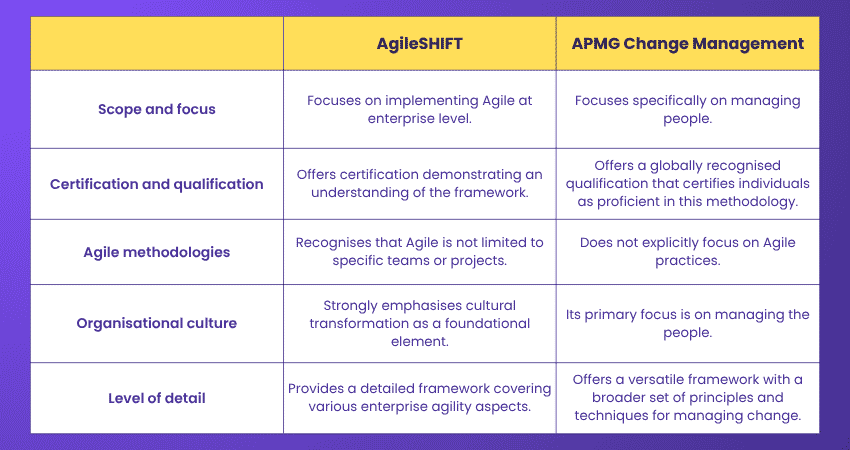
Let's explore some of the differentiating factors.
Scope and Focus
AgileSHIFT primarily focuses on implementing Agile practices at the enterprise level, emphasising cultural transformation, value-driven delivery, and empowered teams. It provides a holistic framework for organisations to embrace agility throughout their operations.
On the other hand, APMG Change Management focuses specifically on managing the people side of change. It offers a structured approach to address the human aspects of change, including stakeholder engagement, communication, and resistance management. It can be applied to any type of change initiative, regardless of whether it involves Agile practices or not.
Certification and Qualification
AgileSHIFT offers a certification program that allows individuals to demonstrate their understanding and application of the framework. The certification covers various topics, including the agile mindset, value-driven delivery, creating a culture of transparency and collaboration, and leading organisational change.
APMG Change Management offers a globally recognised qualification that certifies individuals as proficient in this methodology. The qualification covers key areas such as Change Management principles, processes, stakeholder engagement, communication, and managing resistance. It gives individuals a comprehensive understanding of Change Management practices and techniques.
Agile Methodologies
AgileSHIFT focuses on implementing Agile practices at the enterprise level. It emphasises cultural transformation, recognising that agility is not limited to specific teams or projects but should permeate throughout the entire organisation. The framework aims to shift the mindset, behaviours, and ways of working to foster agility across departments and functions.
While APMG Change Management is not exclusive to Agile Methodologies,it does not explicitly focus on Agile practices. Instead, it offers a broader set of tools, techniques, and principles to be applied in various change contexts. It can be applied to traditional waterfall projects, hybrid approaches, or any other change initiative requiring effective management of the people side.
Become an Agile change agent and transform your organisation with the Agile Change Agent training.
Organisational Culture
AgileSHIFT strongly emphasises cultural transformation as a foundational element of successful Agile adoption. It recognises that the organisation's culture is crucial in enabling or inhibiting agility. It guides shifting mindsets, behaviours, and ways of working to create an environment that supports and sustains agility across the organisation.
APMG Change Management acknowledges the importance of organisational culture, but its primary focus is on managing the people side of change. It provides methodologies and techniques to engage stakeholders, address resistance, and foster a supportive environment for change.
Level of Detail
AgileSHIFT provides a comprehensive and detailed framework covering various aspects of enterprise agility aspects. It offers guidance on implementing Agile practices, fostering collaboration, and creating a customer-centric approach. The framework provides organisations with a structured roadmap and actionable steps to drive Agile transformation throughout the organisation.
APMG Change Management offers a versatile framework that provides a broader set of principles and techniques for managing change. It allows organisations to tailor the methodology to suit their needs and context. It offers flexibility in its application, allowing organisations to choose the level of detail and depth required for their change initiatives.
APMG Change Management, while also providing a structured approach, offers a broader set of principles and techniques that apply to managing change in general. It provides a more versatile framework that can be customised to suit different organisational needs and contexts.
Learn the AgileSHIFT® methodology and all the fundamental knowledge and help transform your organisation with the AgileSHIFT® Training - join now.
Which is Better? AgileSHIFT or APMG Change Management
Comparing AgileSHIFT vs APMG Change Management, you can understand which is better suited for your organisation depending on various factors and considerations. Let's evaluate the strengths and considerations of each approach to help you make an informed decision.
AgileSHIFTStrengths
a) Enterprise Agility: AgileSHIFT provides a comprehensive framework for organisations to implement Agile practices at the enterprise level. It promotes cultural transformation, value-driven delivery, and empowered teams, enabling organisations to become more adaptable, responsive, and customer-centric.
b) Alignment with Agile Methodologies: It incorporates and promotes various Agile methodologies like Kanban, Scrum and Lean. If your organisation is looking to adopt and leverage these methodologies, AgileSHIFT can provide a structured approach to implementation.
c) Focus on Cultural Change: It recognises the importance of cultural transformation and mindset shifts within the organisation. It provides guidance and tools to foster an agile culture and enable individuals and teams to embrace Agile principles.
Unlock your potential and drive your career forward with our SAFe Agile Certification!
APMG Change Management Strengths
a) Holistic Change Management: APMG Change Management provides a structured approach to managing the people side of change, applicable to a wide range of change initiatives. It offers a comprehensive set of tools and techniques for stakeholder engagement, communication, and addressing resistance to change.
b) Flexibility and Adaptability: It is adaptable to different methodologies and approaches. It can be customised to suit your organisation's specific needs and context, whether you are implementing Agile practices or following a more traditional project management approach.
c) Globally Recognised Qualification: It offers a globally recognised qualification, providing individuals with a standardised understanding of Change Management principles and techniques.
Considerations for AgileSHIFT
If your organisation primarily focuses on agile practices and methodologies, APMG Change Management may not explicitly guide agile-specific Change Management. However, it can still be applied alongside agile methodologies. While it acknowledges the importance of organisational culture, it may not provide as detailed guidance on cultural transformation as AgileSHIFT.
Considerations for APMG Change Management
If your organisation primarily focuses on agile practices and methodologies, APMG Change Management may not explicitly guide agile-specific change management. However, it can still be applied alongside agile methodologies. While it acknowledges the importance of organisational culture, it may not provide as detailed guidance on cultural transformation compared to AgileSHIFT.
Conclusion
Both AgileSHIFT and APMG Change Management offer valuable frameworks for effective Change Management. The choice between AgileSHIFT vs APMG Change Management depends on your organisation's specific needs, context, and goals.Change Management Principles help in aligning as well as differentiating between approaches. If you are seeking to implement Agile practices at the enterprise level and prioritise cultural transformation, AgileSHIFT may be the better fit. If you require a flexible Change Management approach applicable to various methodologies and change initiatives, APMG Change Management can provide a comprehensive framework.
Master the skills you need to lead your team in the age of enterprise agility with our comprehensive Agile Training- join now!
Frequently Asked Questions
Which is Better for Leading Digital Transformation: AgileSHIFT or APMG Change Management?

AgileSHIFT is ideal for driving agile transformation and cross-functional adaptability, while APMG Change Management supports change leadership and employee transition during transformations.
Can AgileSHIFT and APMG Change Management be Used Together?
Yes, combining AgileSHIFT’s focus on agile culture with APMG’s structured change approach provides a comprehensive strategy for managing mindset shifts and process change.
What are the Other Resources and Offers Provided by The Knowledge Academy?
The Knowledge Academy takes global learning to new heights, offering over 3,000+ online courses across 490+ locations in 190+ countries. This expansive reach ensures accessibility and convenience for learners worldwide.
Alongside our diverse Online Course Catalogue, encompassing 17 major categories, we go the extra mile by providing a plethora of free educational Online Resources like Blogs, eBooks, Interview Questions and Videos. Tailoring learning experiences further, professionals can unlock greater value through a wide range of special discounts, seasonal deals, and Exclusive Offers.
What is The Knowledge Pass, and How Does it Work?
The Knowledge Academy’s Knowledge Pass, a prepaid voucher, adds another layer of flexibility, allowing course bookings over a 12-month period. Join us on a journey where education knows no bounds.
What are the Related Courses and Blogs Provided by The Knowledge Academy?
The Knowledge Academy offers various Agile Training, including the Agile Project Management Foundation & Practitioner (AgilePM®) Training and the Certified Scaled Agile Framework Leading SAFe® 6.0 Training. These courses cater to different skill levels, providing comprehensive insights into Agile Case Studies.
Our Project Management Blogs cover a range of topics related to Agile Methodology, offering valuable resources, best practices, and industry insights. Whether you are a beginner or looking to advance your Project Management skills, The Knowledge Academy's diverse courses and informative blogs have got you covered.

David Evans


Certified Project Trainer and Agile Delivery Expert
David Evans brings over a decade of hands-on experience in project delivery, Agile transformation, and team leadership. With a background in technology and business consulting, David has led cross-functional teams through Agile and Waterfall projects in both public and private sectors. He combines technical knowledge with practical insights to help readers navigate the challenges of modern project environments.


 If you wish to make any changes to your course, please


