


 Top Rated Course

We may not have the course you’re looking for. If you enquire or give us a call on + 1-866 272 8822 and speak to our training experts, we may still be able to help with your training requirements.
What is Retrieval-Augmented Generation and How Does It Work?
The Knowledge Academy 25 April 2026Retrieval-Augmented Generation (RAG) combines retrieval of relevant documents with generative models to produce more accurate and context-aware responses. This enables the LLM to access and incorporate external knowledge in real time, reducing its reliance on only pre-trained data and mitigating the risk of generating inaccurate content.

Training Outcomes Within Your Budget!
We ensure quality, budget-alignment, and timely delivery by our expert instructors.
Table of Contents
Ever wish your AI could look things up before answering? Having fresh and accurate information backed by trusted sources is what every AI user desires. This is made possible by Retrieval-Augmented Generation (RAG). It’s a powerful technique that blends the creativity of language models with the precision of real-time information retrieval. In short, RAG bridges the gap between static training and dynamic knowledge.
In this blog, we’ll break down how Retrieval-Augmented Generation works, why it’s a game-changer for smarter, more accurate responses, and how it’s shaping the future of Machine Learning and AI. So read on and explore the brains behind next-gen intelligent systems!
Table of Contents
1) What is Retrieval-Augmented Generation?
2) Why is Retrieval-Augmented Generation Important?
3) How Does Retrieval-Augmented Generation Work?
4) Types of Retrieval-Augmented Generation (RAG)
5) Why Choose Retrieval-Augmented Generation (RAG)?
6) How Retrieval-Augmented Generation Supports Your Teams?
7) Industry-specific Use Cases of Retrieval-Augmented Generation
8) Conclusion
What is Retrieval-Augmented Generation?
Retrieval-Augmented Generation (RAG) is a powerful technique that improves a Large Language Model’s (LLM) output. It does this by retrieving information from an authoritative external knowledge base before giving a response. Large Language Models trained on massive datasets and billions of parameters can then deliver more accurate results for tasks like answering questions, language translation, and sentence completion.
RAG expands on the already powerful capabilities of LLMs to specific domains or an organisation's internal knowledge base, all without the need for retraining the model. It's a cost-effective approach towards elevating LLM output so it remains accurate and useful in numerous contexts.
Why is Retrieval-Augmented Generation Important?
LLMs are powerful, but their fixed training data can make them unpredictable. This is where Retrieval-Augmented Generation becomes essential; it bridges the gap between static knowledge and real-time accuracy.
Without RAG, LLMs often face issues such as:
1) Giving false answers when they don’t know the correct one.
2) Providing outdated or generic information instead of specific, current details.
3) Pulling responses from unreliable sources.
4) Confusing terms that have different meanings in different contexts.
RAG helps solve these problems by guiding the LLM to fetch information from trusted, up-to-date sources. This ensures accuracy, gives organisations more control over responses, and helps users understand how answers are formed.
How Does Retrieval-Augmented Generation Work?
Without RAG, an LLM answers based only on what it learned during training. With RAG, there’s an extra step where an information retrieval system pulls relevant data from new sources using the user’s question. Here's how it works:
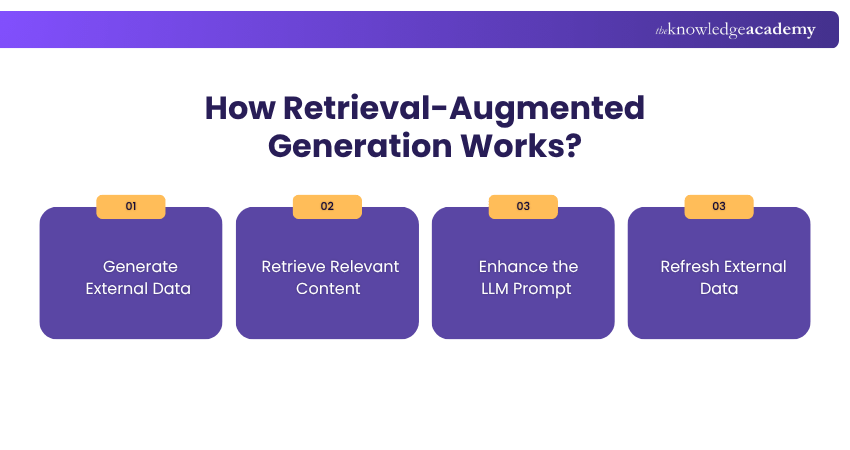
1) Generate External Data
External data is information outside the LLM’s original training set. It can originate from APIs, databases, or document repositories and may be stored as files, database records, or lengthy text. An AI method called Language Model (LM) Embeddings turns this data into numerical form and stores it in a vector database, creating a searchable knowledge base.
2) Retrieve Relevant Content
The user’s query is also converted into a vector, then matched with the stored data to find the most relevant results. For example, a retail chatbot asked, “What’s the return policy for electronics?” could retrieve the store’s electronics return policy and the customer’s past purchase details. This relevance is calculated using vector mathematics.
3) Enhance the LLM Prompt
RAG then adds the retrieved information to the user’s query, creating an augmented prompt. This utilises Prompt Engineering to provide the LLM with sufficient context to deliver a precise and useful answer.
4) Refresh External Data
External data can become outdated, so it must be refreshed regularly. This can be done through automated real-time updates or scheduled batch processing. The updated documents are re-embedded to keep the knowledge base accurate.
Start your journey creating AI with Develop Generative AI Solutions With Azure OpenAI Service AI050 Course — register now and level up.
Types of Retrieval-Augmented Generation (RAG)
There are three categories of Retrieval-Augmented Generation: Vector-based, knowledge graph and ensemble RAG. Let’s explore them in detail:
1) Vector-based RAG
In this method, information such as text or images is converted into numbers (vectors) that capture their meaning. These vectors are stored in a special database known as a vector database. When you ask a question, the system quickly finds the most relevant matches based on these numerical representations.
2) Knowledge Graph RAG
A knowledge graph stores data as “nodes” (things) and “relationships” (connections between things). This helps RAG make human-like connections between ideas. It’s great for answering complex questions that require linking related facts or concepts.
3) Ensemble RAG
Here, more than one retrieval method runs simultaneously, such as vector search and keyword search. The results are then combined, so one method’s strengths can make up for another’s weaknesses. This improves accuracy and gives more reliable answers.
Want to take a journey into the future of intelligence? Our cutting-edge OpenAI Training will show you the way - register now!
Why Choose Retrieval-Augmented Generation (RAG)?
RAG provides powerful advantages to standard text generation, particularly for fact-based or data-driven responses. Here's why you should choose Retrieval-Augmented Generation:
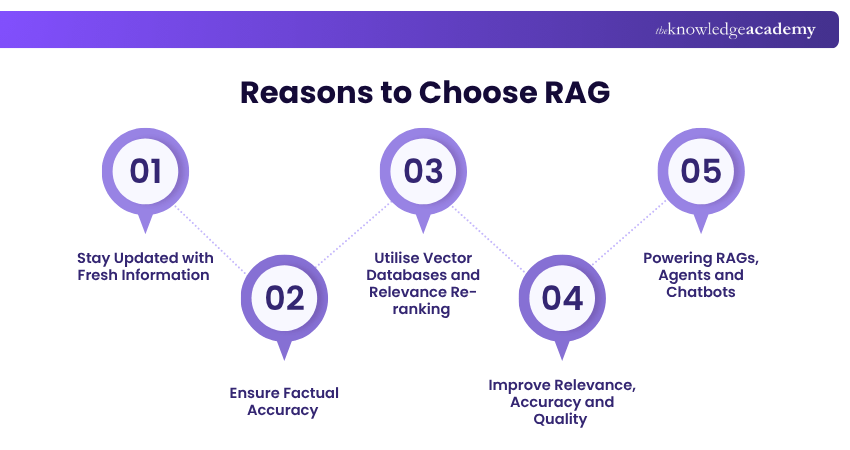
1) Stay Updated with Fresh Information
LLMs are trained on static data, which can result in outdated or incomplete answers. RAG solves this by retrieving the latest, most relevant information for the LLM to use in its response.
2) Ensure Factual Accuracy
LLMs are adept at generating engaging text but can often make factual errors due to their training data containing inaccuracies or biases. By providing reliable facts as part of the input prompt, RAG helps prevent outputs that deviate from reality (also called AI hallucinations). It ensures the answer is grounded in accurate information.
3) Utilise Vector Databases and Relevance Re-ranking
RAG retrieves information through a search. Vector databases store data as numerical representations that capture meaning, making it easy to find content that’s semantically similar to a query. These can store various formats, including text, images and audio. Advanced tools can combine semantic and keyword searches, then re-rank results to find the most relevant matches.
4) Improve Relevance, Accuracy and Quality
The quality of RAG responses depends on retrieving the right information from a trusted source. With fine-tuning and Prompt Engineering, the LLM can be guided only to generate text based on retrieved facts, reducing contradictions and improving user trust. Evaluation tools like Vertex Eval Service can measure key metrics, such as coherence, fluency, and safety, to continually improve performance.
5) Powering RAGs, Agents and Chatbots
RAG can be built into any LLM-powered agent or chatbot that needs current, private, or specialised information. This means responses are more detailed, context-aware, and useful. Your data, combined with RAG, is what makes your AI application accurate and scalable.
Build machines that learn, think and evolve with the power of Deep Learning. Sign up for our Deep Learning Course now!
How Retrieval-Augmented Generation Supports Your Teams?
RAG can make your organisation more efficient by combining LLMs, a Cloud-based data engine, your CRM system, and conversational AI. Together, they can create powerful AI agents tailored to each department. Consider these possibilities:
1) Service: A service AI agent, connected to your CRM, can provide faster and more helpful customer support. It can personalise interactions, offer proactive help based on customer needs and manage requests across multiple channels.
2) Sales: A sales AI agent can help grow your pipeline and revenue. It can automatically nurture inbound leads and provide coaching to sales representatives.
3) Marketing: A marketing AI agent can create personalised content, deliver targeted campaigns throughout the customer journey and adjust strategies automatically based on performance data.
4) Commerce: A commerce AI agent can offer personalised shopping experiences, recommend relevant products and streamline ordering. It can also assist in backend tasks like inventory optimisation and product description generation.
Industry-specific Use Cases of Retrieval-Augmented Generation
Here are some examples of industry-specific Retrieval-Augmented Generation:
1) Financial Services: An AI agent can use customer data to give Representatives, relevant insights and provide personalised recommendations based on an individual’s financial goals.
2) Healthcare: An AI agent can answer patient questions and help schedule the most suitable provider for their needs.
3) Manufacturing: An autonomous agent can monitor equipment performance and optimise production processes for efficiency.
4) Automotive: A RAG AI agent can create promotions based on real-time inventory and detect potential vehicle maintenance issues.
Conclusion
Retrieval-Augmented Generation transforms AI from a static source of knowledge into a continually informed assistant. By blending powerful LLMs with real-time and trustworthy data, RAG delivers answers that are accurate and relevant. More than just about smarter responses, it’s about crafting AI you can trust to stay current and truly helpful.
Join the revolution where algorithms meet ambition to craft future-ready possibilities. Sign up for our Artificial Intelligence & Machine Learning Training now!
Frequently Asked Questions
What is the Output of Retrieval-Augmented Generation?

The output of Retrieval-Augmented Generation (RAG) integrates retrieved external information with the LLM’s generative capabilities to produce accurate, context-rich text. Depending on the task, this could be an answer, a summary, a translation, or even code, all guided by the retrieved data.
What is the Difference Between Retrieval Model and Generative Model?
A retrieval model searches and selects relevant information from a database or knowledge source, while a generative model creates new content based on learned patterns. Retrieval ensures accuracy and factual grounding, whereas generation provides fluency, creativity, and adaptability in responses.
What are the Other Resources and Offers Provided by The Knowledge Academy?
The Knowledge Academy takes global learning to new heights, offering over 3,000+ online courses across 490+ locations in 190+ countries. This expansive reach ensures accessibility and convenience for learners worldwide.
Alongside our diverse Online Course Catalogue, encompassing 17 major categories, we go the extra mile by providing a plethora of free educational Online Resources like Blogs, eBooks, Interview Questions and Videos. Tailoring learning experiences further, professionals can unlock greater value through a wide range of special discounts, seasonal deals, and Exclusive Offers.
What is The Knowledge Pass, and How Does it Work?
The Knowledge Academy’s Knowledge Pass, a prepaid voucher, adds another layer of flexibility, allowing course bookings over a 12-month period. Join us on a journey where education knows no bounds.
What are the Related Courses and Blogs Provided by The Knowledge Academy?
The Knowledge Academy offers various Artificial Intelligence & Machine Learning Courses, including the Natural Language Processing (NLP) Fundamentals With Python Course and the Deep Learning Course. These courses cater to different skill levels, providing comprehensive insights into AI Orchestration.
Our Data, Analytics & AI Blogs cover a range of topics related to Retrieval-Augmented Generation, offering valuable resources, best practices, and industry insights. Whether you are a beginner or looking to advance your AI and Machine Learning skills, The Knowledge Academy's diverse courses and informative blogs have got you covered.

The Knowledge Academy


Global Training Provider
The Knowledge Academy is a world-leading provider of professional training courses, offering globally recognised qualifications across a wide range of subjects. With expert trainers, up-to-date course material, and flexible learning options, we aim to empower professionals and organisations to achieve their goals through continuous learning.

Upcoming Data, Analytics & AI Resources Batches & Dates
Date
 Natural Language Processing (NLP) Fundamentals with Python
Natural Language Processing (NLP) Fundamentals with Python
Thu 13th Aug 2026
Natural Language Processing (NLP) Fundamentals with Python
Thu 19th Nov 2026

 If you wish to make any changes to your course, please


