


 Top Rated Course

We may not have the course you’re looking for. If you enquire or give us a call on + 1-866 272 8822 and speak to our training experts, we may still be able to help with your training requirements.
What is a Certified Professional in Healthcare Risk Management?
The Knowledge Academy 29 May 2026Exploring Certified Professionals in Healthcare Risk Management: Discover the roles and responsibilities they hold, the essential skills they require, and the steps to become one. This overview covers eligibility, education, experience, and the examination process, paving the way for a fulfilling career in the healthcare industry.

Training Outcomes Within Your Budget!
We ensure quality, budget-alignment, and timely delivery by our expert instructors.
Table of Contents
In the complex and ever-evolving world of healthcare, managing risks is paramount. Organisations strive to provide safe and high-quality care through their care management program while minimising potential hazards. This is where a Certified Professional in Healthcare Risk Management comes into play.
Further, if you are searching for a future-oriented career, the Healthcare Risk Management field has a lot to offer. Still trying to figure out where to start? Read this blog to learn who a Certified Professional in Healthcare Risk Management (CPHRM) is. Additionally, learn how to become one and what the benefits are.
Table of Contents
1) What are the responsibilities of a Certified Professional in Healthcare Risk Management?
2) Skills required by a Healthcare Risk Management Certified Professional
3) How to become a Healthcare Risk Management Certified Professional?
a) Eligibility and education
b) Experience
c) Understanding the examination
4) Conclusion
What are the Responsibilities of a Certified Professional in Healthcare Risk Management?
A Healthcare Risk Management Certified Professional is an individual who possesses specialised certifications and the necessary qualifications, knowledge, and skills to identify, assess, and mitigate risks in healthcare settings.
They are vital in ensuring the safety and well-being of patients, healthcare providers, and the organisation. Their expertise and knowledge are instrumental in identifying and mitigating risks in healthcare settings. Let’s explore the key responsibilities and contributions of these professionals:
a) Developing and Implementing Risk Management Strategies: The Healthcare Risk Management Certified Professionals are responsible for assessing potential risks and analysing data. They also collaborate with multidisciplinary teams to create effective risk mitigation plans.
b) Identifying and Assessing Risks: Through meticulous analysis and observation, certified professionals conduct risk assessments and evaluate existing protocols and procedures. Apart from that, they implement proactive measures to minimise adverse events.
c) Investigating Incidents and Near-misses: When incidents or near-misses occur, these professionals play a critical role in conducting thorough investigations. They analyse the root causes, identify contributing factors, and provide recommendations to prevent similar incidents from occurring in the future.
d) Policy Development and Compliance: Certified professionals work closely with regulatory agencies and legal teams to ensure compliance with healthcare regulations and standards. They develop and update policies and procedures that address potential risks, aligns with the industry’s best practices, and adhere to legal requirements.
e) Collaboration and Education: In Healthcare Risk Management, certified professionals foster a culture of safety by promoting collaboration and education among healthcare providers. They facilitate training programs, workshops, and educational initiatives to enhance risk awareness and promote best practices. As a result, they contribute to a safer and more well-informed healthcare environment.
f) Continuous Improvement: Certified professionals are integral in monitoring Risk Management programs, evaluating its effectiveness, and implementing modifications as needed. They stay up to date with emerging trends, advancements in technology, and regulatory changes to ensure organisations stay ahead of potential risks.
g) Collaboration with Stakeholders: Healthcare Risk Management Certified Professionals collaborate with various stakeholders, including healthcare providers, administrators, legal teams, and patient advocates. They facilitate open communication and work together to implement Risk Management strategies that align with the organisation's goals and values.
Skills Required by a Healthcare Risk Management Certified Professional
Becoming a Certified Professional in the Healthcare Risk Management field requires a diverse set of skills to navigate the complexities of the role effectively. So, let’s explore the key skills required:
a) Risk Assessment and Analysis: Certified professionals should be proficient in conducting risk assessments, identifying vulnerabilities, and evaluating the impact of risks on patients’ safety and organisational outcomes.
b) Regulatory Knowledge: A thorough understanding of healthcare regulations and standards is vital for Healthcare Risk Management professionals. They should be familiar with local, national, and international regulations governing healthcare practices, privacy laws, and patient rights.
c) Quality Improvement Methodologies: Proficiency in quality improvement methodologies such as Lean Six Sigma or Plan-Do-Study-Act (PDSA) cycles benefits Healthcare Risk Management professionals greatly.
d) Communication and Collaboration: Effective communication and collaboration skills are critical for Healthcare Risk Management professionals. They must engage with diverse stakeholders, including healthcare providers, administrators, legal teams, and patient advocates respectively.
e) Critical Thinking and Problem-Solving: Healthcare Risk Management professionals should be able to analyse complex situations, identify root causes of risks, and develop innovative solutions. The capacity to anticipate potential risks, consider multiple perspectives, and adapt strategies to evolving circumstances is crucial for effective Risk Management.
f) Ethics and Professionalism: Certified professionals must maintain confidentiality, handle sensitive information with discretion, and adhere to ethical principles in their decision-making processes. Professionalism encompasses accountability, integrity, and a commitment to putting patients’ safety and organisational well-being at the forefront of their work.
g) Leadership and Change Management: Healthcare Risk Management professionals often lead teams to implement Risk Management strategies and drive organisational cultural change. Strong leadership skills, such as influencing others and guiding teams through change processes, are valuable assets in this field.
Continuous learning and adaptability: Healthcare Risk Management professionals must be adapting and committed to continuous learning. They should stay informed about emerging risks, new technologies, and best practices in Risk Management.
Give a boost to your risk management career with the Management of Risk (MoR®) Foundation V3 Course – Join today!
How to Become a Healthcare Risk Management Certified Professional?
Certification in Healthcare Risk Management is a great way to extend knowledge and boost career prospects in the healthcare field. The American Hospital Association (AHA) offers Healthcare Risk Management Certifications to aspiring healthcare professionals.
However, to become a Healthcare Risk Management Certified Professional, the candidates must appear for a certification examination. The CPHRM exam is developed for Healthcare Risk Management Professionals to validate their knowledge and competencies in Risk Management in healthcare.
Furthermore, candidates must possess the appropriate education and experience in Healthcare Risk Management to be eligible to appear for the certification. So, let’s explore the requirements to become a Healthcare Risk Management Certified Professional:
Eligibility and Education
Anyone who has graduated recently or already is a healthcare professional can obtain a certification in Healthcare Risk Management. But it is worth noting, a solid educational background is also essential for aspiring Healthcare Risk Management professionals. Many employers seek candidates with:
a) Bachelor’s in Healthcare Administration, Nursing, Public Health, or other fields with five years of experience
b) An associate degree with seven years of experience
c) High school diploma with in-hand experience of nine years
Experience
Obtaining any of the above-mentioned degrees provides a foundational understanding of healthcare systems, risk assessment methodologies, patient safety principles, and legal and ethical considerations.
On the other hand, working experience in the relevant field validates the candidate’s capabilities of implementing Risk Management techniques across various healthcare environments. They must have at least 3,000 hours of Risk Management experience.
Understanding the Examination
Appearing for the Healthcare Risk Management Certification examination is vital to becoming a CPHRM. Not just appearing but passing the exam with flying colours is important to demonstrate your knowledge and efficiency to the Hiring Managers.
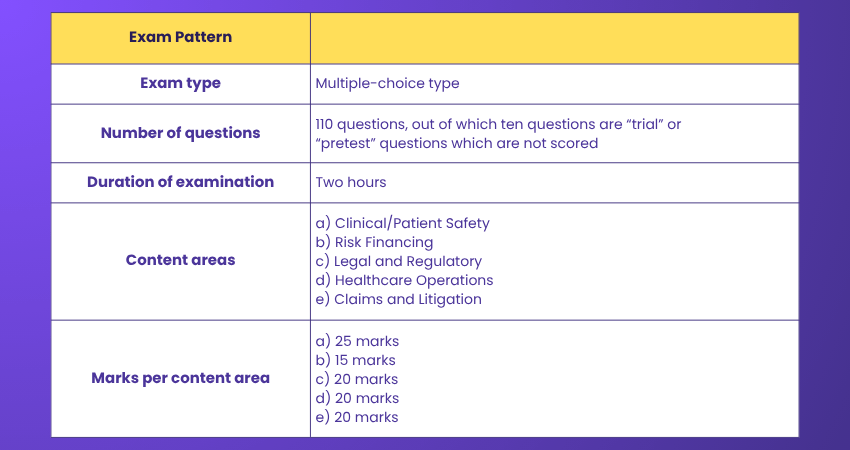
Further, to pass the certification exam, knowing the exam pattern inside out is equally crucial. So, let’s have a look at the Healthcare Risk Management Certification examination:
Conclusion
A Certified Professional in Healthcare Risk Management plays a pivotal role in identifying, assessing, and mitigating risks in healthcare settings. As the healthcare landscape evolves, the significance of these professionals will continue to grow, ensuring a safer and more secure healthcare system for all.
Gain comprehensive framework for risk management and a structured approach with the MoR® Management of Risk Training – Join now!
Frequently Asked Questions
What is the Difference Between CPHQ and CPHRM?

The difference between CPHQ and CPHRM lies in focus. CPHQ emphasises quality improvement, patient outcomes, and performance metrics, while CPHRM focuses on identifying, mitigating, and managing patient safety and organisational risks.
What is a Certified Risk Management Professional?
A Certified Risk Management Professional (CRMP) is a trained expert who identifies, assesses, and manages organisational risks. They apply structured approaches to reduce threats, ensure compliance, and support informed decision-making, helping organisations maintain stability and achieve their goals.
What are the Other Resources and Offers Provided by The Knowledge Academy?
The Knowledge Academy takes global learning to new heights, offering over 3,000+ online courses across 490+ locations in 190+ countries. This expansive reach ensures accessibility and convenience for learners worldwide.
Alongside our diverse Online Course Catalogue, encompassing 17 major categories, we go the extra mile by providing a plethora of free educational Online Resources like Blogs, eBooks, Interview Questions and Videos. Tailoring learning experiences further, professionals can unlock greater value through a wide range of special discounts, seasonal deals, and Exclusive Offers.
What is The Knowledge Pass, and How Does it Work?
The Knowledge Academy’s Knowledge Pass, a prepaid voucher, adds another layer of flexibility, allowing course bookings over a 12-month period. Join us on a journey where education knows no bounds.
What are the Related Courses and Blogs Provided by The Knowledge Academy?
The Knowledge Academy offers various MoR® Management of Risk Training, including the MoR® 4 Practitioner Risk Management Certification, Management of Risk (MoR®) Foundation V3 Course, and the Certified Risk Management Professional CRMP Training. These courses cater to different skill levels, providing comprehensive insights into Best Crisis Management Tools.
Our Project Management Blogs cover a range of topics related to Healthcare Risk Management, offering valuable resources, best practices, and industry insights. Whether you are a beginner or looking to advance your Project Management skills, The Knowledge Academy's diverse courses and informative blogs have got you covered.

The Knowledge Academy


Global Training Provider
The Knowledge Academy is a world-leading provider of professional training courses, offering globally recognised qualifications across a wide range of subjects. With expert trainers, up-to-date course material, and flexible learning options, we aim to empower professionals and organisations to achieve their goals through continuous learning.

Upcoming Project Management Resources Batches & Dates
Date
 Risk Management Black Belt
Risk Management Black Belt
Mon 6th Jul 2026
Risk Management Black Belt
Mon 2nd Nov 2026

 If you wish to make any changes to your course, please


