


 Top Rated Course

We may not have the course you’re looking for. If you enquire or give us a call on + 1-866 272 8822 and speak to our training experts, we may still be able to help with your training requirements.
What Is Agile Manifesto? Key Values, Principles and Benefits
David Evans 21 April 2026The Agile Manifesto is a document outlining principles for software development, flexibility, collaboration, and the delivery of working software over plans. It reshaped how software is built, faster, smarter, and more human-centered. Agile isn’t just a method; it’s a mindset that keeps teams focused and customers happy.

Training Outcomes Within Your Budget!
We ensure quality, budget-alignment, and timely delivery by our expert instructors.
Table of Contents

What is Agile Manifesto? It’s more than just a document; it’s the foundation of how modern teams deliver value faster and smarter. Born in 2001 by a group of forward-thinking Software Developers, the Agile Manifesto set out to redefine how projects are approached, prioritising flexibility, collaboration, and customer satisfaction.
Instead of sticking rigidly to outdated plans, it encourages adaptability in the face of change. Its principles have since transformed not only Software Development but also industries worldwide. From startups to large enterprises, the Agile mindset drives innovation and continuous improvement. In this blog, we’ll explore the Agile Manifesto’s values, principles, and its powerful impact on today’s work culture.
Table of Contents
1) The Four Agile Manifesto Values
2) The 12 Agile Manifesto Principles
3) The Benefits of Agile Manifesto
4) How to Use Agile Manifesto?
5) Agile vs Scrum and Other Methodologies
6) Conclusion
The Four Agile Manifesto Values
The Agile Software Development is formed in four core values that serve as guiding principles for Agile teams. These principles help teams stay focused on producing genuine value by placing an emphasis on adaptability, teamwork, and practical solutions over inflexible procedures.
1) Individuals and Interactions Over Processes and Tools
This value emphasises how crucial people are to the successful development of software. Although processes and tools are helpful, human collaboration should always be supported rather than replaced by them. Innovation and problem-solving are fueled by effective teamwork and communication. Agile encourages teams to interact frequently, share ideas openly, and work together toward a common goal.

Looking to innovate with Agile? Get all the answers in our comprehensive blog on What is Agile Transformation!
2) Working Software Over Comprehensive Documentation
Delivery was slowed down by the need for substantial upfront documentation in traditional development before any coding started. Agile reverses this by giving priority to useful software that produces results rapidly. Agile teams use user stories in place of lengthy, technical documents. These are succinct, targeted summaries of features as seen by the user. This enables developers to build and release software incrementally, make real-time improvements, and meet user needs more effectively.
Practice makes perfect! Dive into mock interviews to refine your responses to common Agile interview questions and gain confidence in your abilities!
3) Customer Collaboration Over Contract Negotiation
Agile encourages ongoing customer involvement throughout the process rather than securing everything in a contract before development starts. This helps teams stay in line with user expectations by guaranteeing that the product changes in response to real-time feedback. By collaborating regularly with customers, developers can make iterative changes and deliver a product that truly resonates with users.
4) Responding to Change Over Following a Plan
Traditional planning often resists change, viewing it as a disruption. Agile embraces change as a pathway to improvement. In fast-paced environments, requirements can evolve quickly, and Agile teams are built to adapt. By working in short, iterative cycles (sprints), teams can adjust priorities, incorporate feedback, and continuously refine the product. This flexible approach leads to better results and faster time to market.
Join our Agile Programme Management (AgilePgM®) Course to learn more about Agile Project Management!
The 12 Agile Manifesto Principles
At its core, Agile Manifesto also involves 12 principles. These principles are as follows:
1) Satisfy Clients Through Early and Continual Delivery
The first principle of Agile focuses on delighting the customer. Delivering working software early and regularly shows clear progress and builds trust. It reduces uncertainty and gives users something tangible to react to. Frequent releases enable quicker validation of features and value. Ultimately, this principle keeps the customer at the centre of development efforts.
2) Welcome Fluctuating Requirements
Agile acknowledges that change is inevitable, especially in today’s fast-paced world. Rather than resisting change, Agile teams embrace it, even in late stages of development. This flexibility ensures that the product remains relevant and aligned with user needs. It also enhances innovation, allowing teams to build better solutions. Welcoming change is key to staying competitive.
3) Deliver Value Persistently
Agile promotes continuous delivery of valuable software. Instead of waiting for a big launch, teams release features incrementally. This method reduces risk, improves feedback loops, and maintains user engagement. It also allows businesses to realise ROI sooner. Delivering persistently ensures steady progress and tangible value at each iteration.
4) Communicate Better For Better Synchronisation
Daily collaboration between business and development teams ensures everyone is aligned. Frequent communication clears up misunderstandings early. It also speeds up decision-making and helps maintain focus on goals. Agile encourages short, structured meetings like stand-ups to keep momentum going. Good communication fosters a culture of openness and transparency.
5) Reduce Micromanagement
Agile thrives on trusting individuals to manage their own work. Team members should feel empowered to take ownership and make decisions. Leaders act more as facilitators than managers. Reducing micromanagement boosts morale, creativity, and accountability. Agile encourages autonomy and values results over strict oversight.
Unlock your potential and drive your career forward with our SAFe Agile Certification!
6) Communicate in Person
Agile highlights face-to-face conversation as the most efficient form of communication. While digital tools are helpful, direct interaction reduces ambiguity. It allows for quicker clarification and better emotional understanding. In remote teams, video calls and real-time chats replicate this dynamic. Strong interpersonal communication accelerates teamwork and trust.
7) Produce a Working Software
In Agile, a functioning product is the primary indicator of progress. Fancy documentation or theoretical roadmaps don’t matter if the product isn’t usable. Teams focus on creating working iterations that users can test. This ensures feedback is based on real experiences, not assumptions. Releasing working software regularly also boosts team confidence.
8) Maintain a Sustainable Working Rate
Agile rejects the culture of overwork and burnout. Teams should maintain a consistent, manageable pace throughout the project. Sustainable productivity allows for better focus and long-term performance. It also supports mental well-being and reduces turnover. A steady pace ensures the team remains engaged and efficient over time.
9) Consistent Excellence Enhances Agility
Agile requires technical excellence; it is not an option. Faster change is made possible by dependable systems, well-designed code, and clean code. It is simpler to adjust to new requirements when the foundation is solid. High standards reduce technical debt and future maintenance costs. Excellence today means agility tomorrow.
10) Simplicity is Vital
Agile encourages doing only what’s essential. Simplicity keeps workflows clean, reduces waste, and speeds up delivery. It also makes products easier to use and maintain. The challenge lies in identifying the most valuable work and focusing on that. Simple solutions are often the most effective.
11) Self-managing Teams Create More Value
Agile teams are trusted to organise their own work. This autonomy leads to quicker decisions, greater creativity, and stronger engagement. With clear goals, teams manage their tasks without waiting for instructions. Self-management empowers team members to step up and own outcomes. It builds accountability and drives high performance.
12) Regularly Reflect at Your Work Progress
Agile teams pause regularly to reflect on how to improve. These retrospectives help identify both successes and pain points. By addressing issues early, teams prevent small problems from escalating. Continuous improvement keeps the team evolving and growing. Reflection is the engine behind Agile’s adaptability.
Unlock essential Project Management tips—get your Agile Project Management Methodology PDF now!
The Benefits of Agile Manifesto
Because various teams execute best practices in diverse ways, the advantages of Agile Project Management can vary from situation to situation. However, it is widely acknowledged that Agile provides the following fundamental advantages:
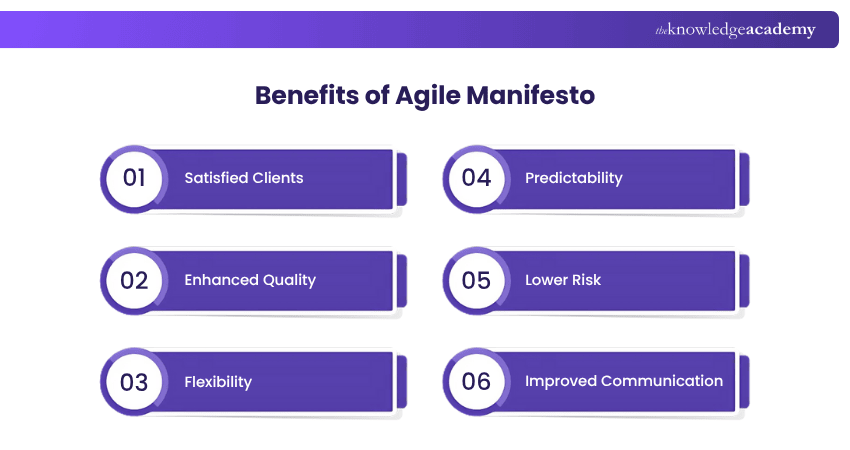
1) Satisfied Clients
Agile teams communicate with their clients and demonstrate that they respect their feedback by including them in the development process. Stakeholders want to be involved at every stage of the project life cycle so they can provide feedback and guarantee the outcome will meet their needs. These customised outputs will probably enhance user experience overall and increase client retention.
2) Enhanced Quality
Agile Project Management practises take an iterative approach, in which procedures are enhanced with each iteration. One of the fundamental ideas of Agile is that continuous improvement and quality control lead to better products.
3) Flexibility
Flexibility is Agile's main tenet. Agile teams are adaptable to change and can do so without much disturbance, even at the last minute. Since project deliverables are flexible, teams may simply review their strategies and realign their priorities to meet revised objectives. Teams that are flexible can deliver consistently and successfully handle clients' shifting requirements.
4) Predictability
Agile teams complete their work in brief intervals known as Sprints. It is simpler for Project Managers to assess team performance and allocate resources in accordance with these predetermined durations (such as two weeks). Additionally, the estimation process is made simpler by the fact that expenses are easier to predict for short-term projects than for long-term ones.
5) Lower Risk
Developers constantly evaluate their progress during Sprints, giving them increased project visibility and the ability to identify roadblocks rapidly. These minor problems can be resolved before they become more serious, resulting in an efficient risk mitigation procedure, and increasing the project's likelihood of success.
6) Improved Communication
Face-to-face contact and ongoing interaction are prioritised by Agile teams. To ensure that everyone is on the page and pursuing the same goals, they typically hold daily meetings. They avoid uncertainty by communicating often with one another, which helps them accomplish their goals.
How to Use Agile Manifesto?
The Agile Manifesto is a document that defines the values and principles of Agile Software Development. To use the Agile Manifesto, you need to follow these steps:
a) Read the four values and 12 principles of the Agile Manifesto. They describe what Agile Software Development is and how it differs from traditional methods.
b) Choose an Agile methodology that suits your project and team. There are many Agile methodologies, such as Scrum, Kanban, XP, and Lean, that apply the values and principles of the Agile Manifesto in different ways.
c) Implement the Agile practices and techniques that are relevant to your chosen methodology. For example, if you use Scrum, you need to have daily stand-up meetings, Sprint planning, Sprint reviews, and Sprint retrospectives.
d) Inspect and adapt your process and product regularly. Agile Software Development is based on feedback and learning, so you need to review your work frequently and make improvements based on customer and stakeholder input.
e) Collaborate and communicate with your team and customers. Agile Software Development emphasises the importance of individuals and interactions over processes and tools, so you need to foster a culture of trust, respect, and transparency among all the people involved in your project.
Become a certified Agile project manager. Register for Agile Project Management Practitioner (AgilePM®) Course now!
Agile vs Scrum and Other Methodologies
Agile is a philosophy of Software Development that is based on the Agile Manifesto, a document that expresses the core values and principles of Agile. Agile emphasises flexibility, collaboration, feedback, and adaptation over rigid processes, documentation, contracts, and plans.
Scrum is one of the most popular frameworks that implements the Agile philosophy. Scrum involves a Product Owner who works with cross-functional teams to define and prioritise a list of tasks called the product backlog. The teams work in short iterations, called Sprints, to deliver potentially shippable increments of the product.
There are other frameworks and methodologies that follow the Agile philosophy, such as Kanban, Crystal, Lean and Extreme Programming. Each of them has its own rules, roles, and practices, but they all share the common goal of delivering software that meets the needs and expectations of the customers and stakeholders.
Want to become an Agile Project Manager? Register for our Agile Project Management Foundation (AgilePM®) Course today!
Conclusion
The Agile Manifesto provides a novel method for creating software that genuinely benefits people in a world where change is inevitable. It serves as a reminder that working together, being flexible, and providing genuine value are more important than checking boxes on a strict plan. So, What is Agile Manifesto? It’s not just a set of principles but a mindset that empowers teams to stay flexible, learn fast, and keep improving.
Want to become an Agile Project Manager? Register for our Agile Project Management Foundation (AgilePM®) Course today!
Frequently Asked Questions
What is a Project in Agile?

A project in Agile is a collaborative effort to deliver a valuable and potentially shippable product or service. Agile projects are based on Agile values and principles, emphasising customer satisfaction, collaboration, feedback, and adaptation over rigid processes, documentation, contracts, and plans. Agile projects are typically divided into smaller units of work called sprints, which are time-boxed periods of one to four weeks.
What is the Agile Manifesto Plan?
The Agile Manifesto plan is not specific but rather a set of values and principles that guide the planning process of Agile projects. The Agile Manifesto states that Agile teams value responding to change over following a plan. It means that Agile teams do not create detailed and fixed plans at the beginning of the project but rather plan iteratively and incrementally throughout the project lifecycle.
What are the Other Resources and Offers Provided by The Knowledge Academy?
The Knowledge Academy takes global learning to new heights, offering over 3,000+ online courses across 490+ locations in 190+ countries. This expansive reach ensures accessibility and convenience for learners worldwide.
Alongside our diverse Online Course Catalogue, encompassing 17 major categories, we go the extra mile by providing a plethora of free educational Online Resources like Blogs, eBooks, Interview Questions and Videos. Tailoring learning experiences further, professionals can unlock greater value through a wide range of special discounts, seasonal deals, and Exclusive Offers.
What is The Knowledge Pass, and How Does it Work?
The Knowledge Academy’s Knowledge Pass, a prepaid voucher, adds another layer of flexibility, allowing course bookings over a 12-month period. Join us on a journey where education knows no bounds.
What are the Related Courses and Blogs Provided by The Knowledge Academy?
The Knowledge Academy offers various Agile Training, including the Agile Project Management Foundation (AgilePM® V3) Course, Lean Portfolio Management SAFe® Course, and Certified SAFe® For Teams Course. These courses cater to different skill levels, providing comprehensive insights into Workflow Management.
Our Project Management Blogs cover a range of topics related to Agile Manifesto, offering valuable resources, best practices, and industry insights. Whether you are a beginner or looking to advance your Project Management skills, The Knowledge Academy's diverse courses and informative blogs have got you covered.

David Evans


Certified Project Trainer and Agile Delivery Expert
David Evans brings over a decade of hands-on experience in project delivery, Agile transformation, and team leadership. With a background in technology and business consulting, David has led cross-functional teams through Agile and Waterfall projects in both public and private sectors. He combines technical knowledge with practical insights to help readers navigate the challenges of modern project environments.

Upcoming Project Management Resources Batches & Dates
Date
 AgilePM® Foundation & Practitioner (AgilePM® v3)
AgilePM® Foundation & Practitioner (AgilePM® v3)
Mon 13th Jul 2026
AgilePM® Foundation & Practitioner (AgilePM® v3)
Mon 14th Sep 2026
AgilePM® Foundation & Practitioner (AgilePM® v3)
Mon 9th Nov 2026

 If you wish to make any changes to your course, please


