


 Top Rated Course


We may not have the course you’re looking for. If you enquire or give us a call on +39 800580270 and speak to our training experts, we may still be able to help with your training requirements.
What Is SERP Visibility? Meaning and Importance
James Smith 23 April 2026SERP Visibility refers to how prominently a website appears in search results on Search Engine Results Pages (SERPs) in response to a specific query. Higher visibility means a greater chance of attracting organic traffic from users. Improving SERP Visibility involves optimising your content, keywords, and technical SEO elements.

Training Outcomes Within Your Budget!
We ensure quality, budget-alignment, and timely delivery by our expert instructors.
Table of Contents
When you search for something online, what do you notice first? The sites that appear at the top of the Search Engine Results Pages (SERPs) are the ones with high SERP Visibility. But how can you achieve that coveted top position? In this blog, we’ll break down what SERP Visibility is, why it’s essential for your online presence, and the steps you can take to improve your website’s position in search engine results. Read on!
Table of Contents
1) What is SERP Visibility?
2) Why is SERP Visibility Important?
3) How to Calculate SERP Visibility?
4) General Techniques to Improve SERP Visibility
5) How is SERP Visibility Used?
6) How to Improve Your SERP Visibility?
7) SERP Visibility Toolkit
8) Conclusion
What is SERP Visibility?
SERP Visibility refers to how prominently and frequently your website appears in Search Engine Results Pages (SERPs) for relevant queries. It’s often measured as a percentage, combining your rankings and click-through potential. It directly reflects your site’s search presence and discoverability.
High SERP Visibility means your content consistently appears in front of your target audience, driving more organic traffic and brand awareness. Low visibility suggests you may need to improve SEO strategies, content quality, backlink profile, or keyword targeting to compete better in search results. It combines two main factors:
1) Ranking Position: Higher positions like top 3 results get more clicks, so they increase visibility.
2) Keyword Coverage: How many of your target keywords your site ranks for, and their search volume.

Why is SERP Visibility Important?
SERP Visibility is important because it directly affects how much organic traffic your website receives. When your pages appear more often and in higher positions for relevant searches, users are far more likely to click through to your site. In short, visibility is the bridge between strong SEO and real business results.
Key Reasons Why it Matters:
1) Drives Organic Traffic: Higher rankings naturally bring more visitors without relying on paid ads.
2) Boosts Brand Awareness: Frequent appearances build recognition and trust.
3) Improves Click-through Rates: Higher positions attract more clicks.
4) Outperforms Competitors: The higher your page ranks, the more users will click on it.
5) Enhances Return on Investment (ROI): Increases the value of your SEO efforts over time.
How to Calculate SERP Visibility?
SERP Visibility measures the estimated monthly traffic your site could receive from the tracked keywords in your SEO project. It’s calculated by combining search volume for each query with the click-through rate (CTR) for your current ranking position. Here is the basic formula to calculate SERP Visibility:

Steps to Calculate:
1) List Tracked Keywords: The terms you want to rank for.
2) Note Ranking Positions: For each keyword, record your SERP position.
3) Apply Click-Through Rate (CTR) Values: Use average CTR per ranking position (e.g., Position 1 ≈ 30%, Position 2 ≈ 15%).
4) Multiply by Search Volume: Estimate clicks for each keyword.
5) Sum all Estimated Clicks: Across all keywords.
6) Divide by Total Possible Clicks: If you ranked #1 for all keywords.
General Techniques to Improve SERP Visibility
Improving your website’s visibility on Search Engine Results Pages (SERPs) is essential for attracting organic traffic and growing your online presence. Let's discuss some techniques essential for standing out in today’s competitive digital landscape.
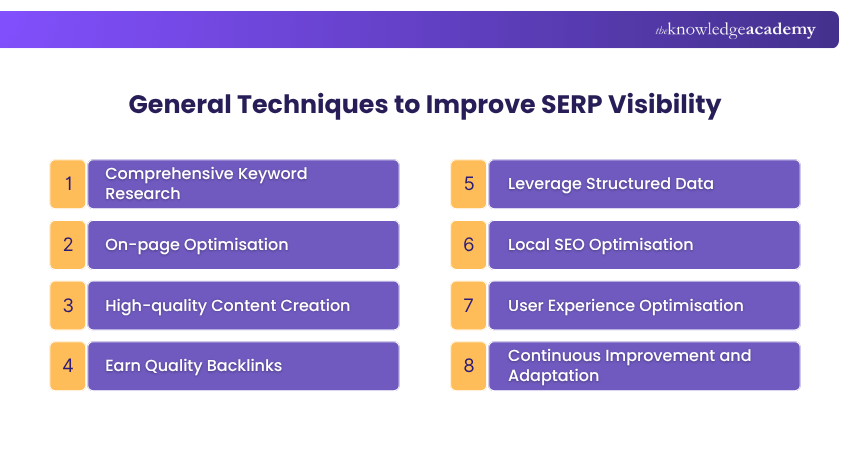
1) Comprehensive Keyword Research
Strong SERP visibility starts with the right keyword strategy. Go beyond high-volume terms and focus on search intent such as informational, navigational, or transactional to ensure your content aligns with what users are really searching for. This includes a mix of:
a) Primary keywords for main topics.
b) Long-tail keywords for specific searches with lower competition.
c) Latent Semantic Indexing (LSI) terms to strengthen topical relevance.
Use Keyword Gap Analysis to find terms your competitors rank for but you don’t, ensuring you cover all relevant opportunities.
Understand how google sees your site – Start Google Search Console Training today!
2) On-page Optimisation
Make sure each page is both user-friendly and easy for search engines to understand and focus on:
a) Title Tags and Meta Descriptions with primary keywords while keeping them compelling.
b) Header Tags (H1, H2, H3) for structured readability.
c) Image alt Text for accessibility and additional keyword relevance.
d) URL Structure is short, descriptive, and keyword-rich.
Internal linking between related pages spreads authority and helps search engines crawl efficiently, improving ranking signals.
3) High-quality Content Creation
Content is the backbone of SERP Visibility. Focus on value, depth, and originality:
a) Write in-depth guides, tutorials, and resource pages that address user pain points.
b) Use engaging formats like videos, infographics, and interactive elements.
c) Keep content updated to maintain relevance and ranking potential.
Well-researched content not only ranks better but also earns backlinks organically.
4) Earn Quality Backlinks
Backlinks from authoritative, relevant sites remain one of the strongest ranking factors. Aim for:
a) Guest posting on high-authority sites in your niche.
b) Digital PR to get mentioned in reputable publications.
c) Content outreach share valuable resources that others naturally link to.
Quality matters more than quantity, a single link from a trusted source can outweigh dozens of low-quality ones.
5) Leverage Structured Data
Implement schema markup to help search engines better interpret your content and display enhanced results. Examples include:
a) Review schema for star ratings.
b) FAQ schema for collapsible answers.
c) Event schema for dates and details.
Rich snippets improve click-through rates by making your listing stand out visually on SERPs.
Ready to Go Digital? Start with the Digital Marketing Tools Training with us today!
6) Local SEO Optimisation
If you target a local audience, optimise for local search visibility:
1) Claim and update your Google Business Profile.
2) Use local keywords with city or region names.
3) Get listed in local directories and gather positive customer reviews.
This ensures your business appears in map packs and location-specific searches, driving targeted local traffic.
7) User Experience Optimisation
Google values user satisfaction, so improve site usability:
a) Mobile-friendliness ensures responsive design.
b) Site speed aims for under 3 seconds load time.
c) Clear navigation makes important pages accessible in 2–3 clicks.
d) Accessibility features such as readable fonts and colour contrast.
A smooth user experience lowers bounce rates and encourages longer sessions, which positively impacts rankings.
8) Continuous Improvement and Adaptation
SEO is not static. Track your SERP performance, keyword rankings, and CTR regularly. Adapt by:
a) Monitoring Google algorithm updates and adjusting strategies.
b) Refreshing outdated content to maintain relevance.
c) Testing new content formats and keyword targeting.
Proactive adaptation ensures you stay competitive even as search trends and algorithms change.
How is SERP Visibility Used?
SERP Visibility is a strategic performance indicator for tracking your website’s search presence and growth potential. Businesses, marketers, and SEO professionals rely on it to make informed decisions and measure success in Digital Marketing.
1) Measure SEO Effectiveness: It helps monitor how well your content ranks for targeted keywords over time, showing which pages perform best and where improvement is needed.
2) Identify Ranking Opportunities: Spot high-potential keywords where small position gains could bring significant traffic increases.
3) Track Algorithm Impact: Assess how Google updates affect your search presence, allowing for quick adjustments.
4) Benchmark Against Competitors: Compare your visibility percentage with competitors to gauge market share in search results.
5) Guide Content Strategy: It directs your focus towards keywords, topics, and pages that can deliver the most significant visibility improvements.
6) Prioritise SEO Resources: Invest time and budget where ranking improvements will yield the largest traffic and revenue gains.
How to Improve your SERP Visibility?
Boosting SERP Visibility requires a combination of technical optimisation, content strategy, and authority building. Key steps include:
1) Conduct Thorough Keyword Research
a) Target a balanced mix of short-tail and long-tail keywords.
b) Use competitor analysis to find untapped opportunities.
2) Optimise On-page SEO
a) Write compelling, keyword-rich title tags and meta descriptions.
b) Structure content with headings, bullet points, and internal links for better crawlability.
3) Publish High-quality, Relevant Content
a) Create content that fully answers user queries and covers topics in depth.
b) Update existing content regularly to maintain freshness and ranking potential.
4) Build a Strong Backlink Profile
a) Acquire backlinks from reputable, niche-relevant sites.
b) Use guest posting, partnerships, and share-worthy resources to attract links naturally.
5) Use Structured Data Markup
a) Implement schema to enhance search listings with rich snippets.
b) Highlight reviews, FAQs, products, or events for higher click-through rates.
6) Enhance User Experience (UX)
a) Ensure mobile-friendliness, fast load speeds, and intuitive navigation.
b) Reduce bounce rates by offering clear CTAs and engaging page design.
7) Optimise for Local Search (if applicable)
a) Maintain an updated Google Business Profile.
b) Target local keywords and earn positive customer reviews.
8) Track, Analyse, and Adapt
a) Monitor SERP Visibility scores regularly.
b) Respond quickly to ranking drops or algorithm updates with strategy adjustments.
Click, learn, succeed with our Google Analytics Certification - Your Digital Marketing future starts here!
SERP Visibility Toolkit
Achieving strong visibility on Search Engine Results Pages (SERPs) requires more than just good content. It also depends on using the right tools and resources to track progress and make informed decisions. Below is a list of essential tools that form your SERP Visibility Toolkit.
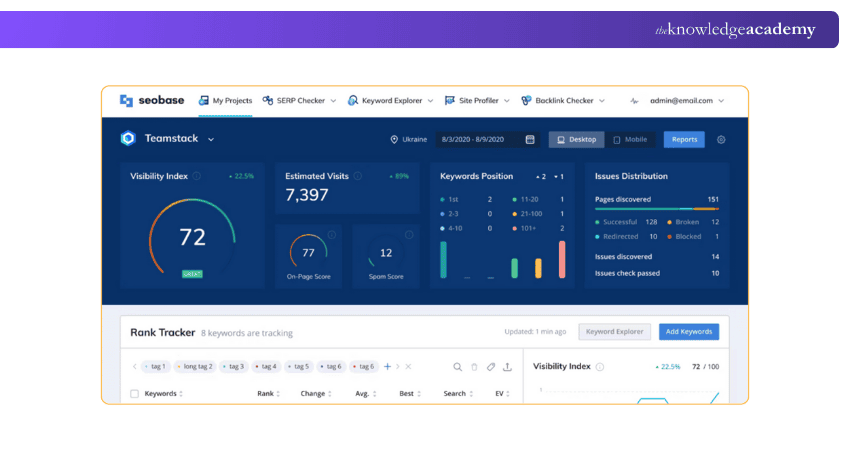
1) Seobase SERP Checker
Seobase’s SERP Checker is a dedicated tool for tracking keyword rankings and monitoring SERP Visibility over time. It allows you to:
a) Check positions for specific keywords in different locations and devices.
b) Track visibility percentage to measure SEO performance.
c) Analyse competitors’ keyword positions and compare visibility scores.
How it Helps: Gives a direct, visual representation of how your keyword rankings contribute to your overall SERP Visibility, making it easier to spot quick-win opportunities.
2) Google Analytics
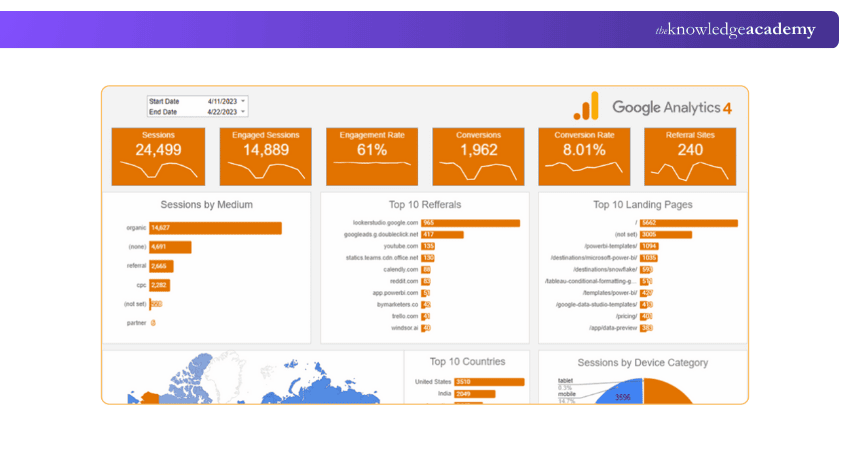
Google Analytics tracks website traffic, user behaviour, and engagement metrics. For SERP Visibility, it can:
a) Show which pages attract the most organic visits.
b) Help measure the impact of ranking improvements on traffic.
c) Identify high-performing and underperforming content.
How it helps: By connecting keyword performance to user actions (like conversions or bounce rates), you can see not just where you rank but how those rankings translate into business results.
3) Google Search Console
Google Search Console is essential for monitoring how your site performs in Google Search. It provides:
a) Average position and click-through rate (CTR) for each keyword.
b) Total impressions and clicks from search results.
c) Indexing issues and coverage reports.
How it helps: Offers direct insights from Google, showing which queries generate visibility, where you’re losing positions, and what technical fixes can improve rankings.
4) Google Keyword Planner
Google Keyword Planner is a free keyword research tool that helps you:
a) Discover new keyword opportunities.
b) Check monthly search volumes and competition levels.
c) Forecast potential traffic gains from ranking improvements.
How it Helps: Guides your content and optimisation strategy by ensuring you target the right keywords with the highest potential to improve SERP Visibility.
Conclusion
SERP Visibility is crucial for online success, and it reflects how prominently your website appears on Search Engine results pages, influencing organic traffic and brand exposure. By optimising SEO strategies, you can improve SERP Visibility, attract more users, and ultimately boost conversions, ensuring your website stands out in a competitive digital landscape.
Join the Digital Revolution - Start with our Digital Marketing Courses today and excel in this field!
Frequently Asked Questions
What is the Difference Between SEO and SERP?

Search Engine Optimisation (SEO) is the process of improving a website’s content and structure to rank higher in search engines. Search Engine Results Page (SERP) is the page displayed by a search engine when a user enters a query. SEO helps you appear on the SERP.
What does Restrict Visibility Mean?
Restrict visibility means limiting who can see certain content or information. In websites or software, it often refers to privacy settings or user permissions that control access to specific pages, files, or features based on roles or user groups.
What are the Other Resources and Offers Provided by The Knowledge Academy?
The Knowledge Academy takes global learning to new heights, offering over 3,000+ online courses across 490+ locations in 190+ countries. This expansive reach ensures accessibility and convenience for learners worldwide.
Alongside our diverse Online Course Catalogue, encompassing 17 major categories, we go the extra mile by providing a plethora of free educational Online Resources like Blogs, eBooks, Interview Questions and Videos. Tailoring learning experiences further, professionals can unlock greater value through a wide range of special discounts, seasonal deals, and Exclusive Offers.
What is The Knowledge Pass, and How Does it Work?
The Knowledge Academy’s Knowledge Pass, a prepaid voucher, adds another layer of flexibility, allowing course bookings over a 12-month period. Join us on a journey where education knows no bounds.
What are the Related Courses and Blogs Provided by The Knowledge Academy?
The Knowledge Academy offers various Digital Marketing Courses, including the Digital Marketing Tools Training, Performance Marketing Training and the LinkedIn Marketing Course. These courses cater to different skill levels, providing comprehensive insights into What is SERP.
Our Digital Marketing Blogs cover a range of topics related to SERP Visibility, offering valuable resources, best practices, and industry insights. Whether you are a beginner or looking to advance Digital Marketing skills, The Knowledge Academy's diverse courses and informative blogs have got you covered.

James Smith


Digital Marketing Manager and Trainer
James Smith is a digital marketing professional with over a decade of experience in SEO, content strategy, paid media and analytics. He has supported both SMEs and global brands in transforming their digital presence. James’s writing and training are rooted in results-driven tactics and the latest marketing trends.
View Detail

 If you wish to make any changes to your course, please


