


 Top Rated Course

We may not have the course you’re looking for. If you enquire or give us a call on +852 2592 5349 and speak to our training experts, we may still be able to help with your training requirements.
What is TOGAF®? Everything You Need to Know
The Knowledge Academy 13 July 2026The TOGAF® is a widely used Enterprise Architecture framework for designing, planning, implementing, and managing IT architecture solutions. It helps organisations align business goals with technology, improve efficiency, and support better decision-making. It also allows businesses to remain flexible in changing technological conditions.

Training Outcomes Within Your Budget!
We ensure quality, budget-alignment, and timely delivery by our expert instructors.
Table of Contents
The TOGAF® is an Enterprise Architecture developmental methodology used by leading businesses worldwide. It is mainly used to plan and design IT architecture and improve business efficiency. However, many modern-day IT organisations are unaware of What is TOGAF®?
The TOGAF® was developed by The Open Group®, a not-for-profit industry leader in Enterprise Architecture Frameworks. The Open Group® updates and reiterates it from time to time based on the requirements of enterprises. Understanding TOGAF® is essential for navigating the complex landscape of modern enterprises irrespective of if you’re an aspiring architect or a seasoned professional.
In this blog, we will focus on What is TOGAF®, how it evolved, an overview and everything else about the TOGAF® Certification.
Table of Contents
1) TOGAF® Meaning
2) Evolution of The TOGAF®
3) Overview of the TOGAF® Framework
4) What are the Primary Goals of The TOGAF®?
5) What is Enterprise Architecture
6) The Four Pillars of The TOGAF®
7) How do Businesses Derive Benefits from The TOGAF®?
8) Is The TOGAF® Certification Useful?
9) The TOGAF® Certification Salary
10) Conclusion
TOGAF® Meaning
The TOGAF® is an Enterprise Architecture standard that offers a high-level framework for managing Enterprise Software Development. The Open Group® introduced TOGAF® first in 1995. The TOGAF® Framework is used by more than 80% of Global 50 companies and 60% of Fortune 500 companies.
The use of TOGAF® is benefitting organisations that have implemented or intend to create an enterprise-wide technological infrastructure to serve mission-critical business applications using open platforms. This framework ensures architecture standards, consistent standards, methodologies and communication among Enterprise Architecture professionals.
It helps these professionals conduct Enterprise Architecture work more efficiently. As highlighted in the Teradata Architecture Guide, it also includes a model of iterative development industry best practices, a collection of reusable materials from previous architecture, and tools and techniques for creating, implementing, and maintaining Enterprise Architecture.
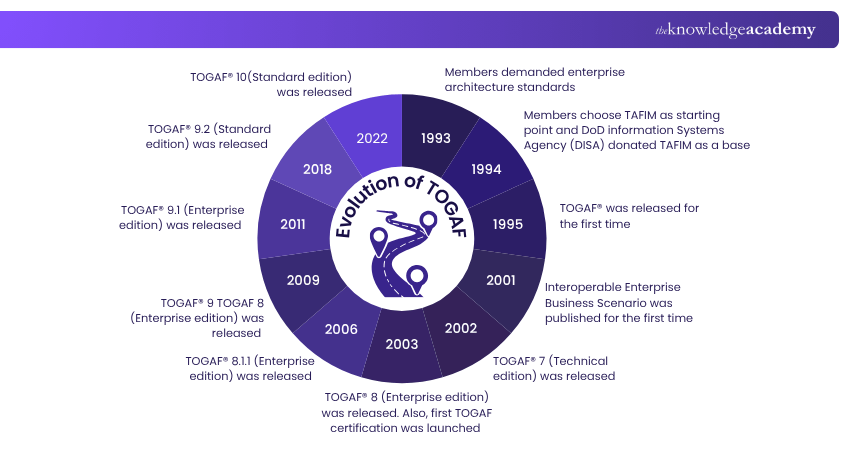
Evolution of TOGAF®
Enterprise Architecture is a subset of computer architecture that was first studied in the mid-1960s. Technology only advanced over the following few decades, and today, most businesses, regardless of size or scale, utilise the internet to streamline, accelerate, and occasionally even make their corporate operations more transparent. In the world of Enterprise Architecture, frameworks like TOGAF® vs SABSA have become critical in shaping how organisations manage their technology and systems, ensuring alignment with business goals and strategies.
Today, Enterprise Architecture is a crucial factor necessary to make sense of various hardware and software used across on-premise and cloud environments. Good enterprise architecture ensures high-level security when sharing data over the internet.
First introduced in 1995, The Open Group® took massive inspiration from the US Department of Defense’s Enterprise Architecture Framework (EAF) called Technical Architecture Framework for Information Management (TAFIM) to develop TOGAF®. Soon after the TOGAF® was published, the USDoD stopped using the TAFIM, but it continues to be employed worldwide even today.
The Open Group® also accredits programs and tools that adhere to The TOGAF® requirements. Currently, 71 courses and eight tools have been created by various institutions and are certified by the Open Group®. Here's a detailed look of how TOGAF® evolved over the years:
Overview of the TOGAF® Framework
The TOGAF® is a great tool to help firms with achieving alignment of IT goals and the overall business goals. It helps to create and organise requirements at the beginning of the project and leave few errors and a simple process.
Organisations that implement Agile methods will find the TOGAF® more useful due to its flexibility to meet the organisation's specific needs easily. After restructuring its newest model using a modular approach, it is easier to implement the TOGAF® in any business sector. Understanding the TOGAF® vs ArchiMate® can further help organisations choose the most suitable framework based on their unique requirements and architectural goals.
The TOGAF® is divided into two main groups based on the content and extended guidance, respectively. Whole thing made of the TOGAF® requirements and practices was included in these groups. This is what gave the framework its structure.
Some of the topics, such as Agile methodologies, Business Architecture, Data and Information Architecture, and Security Architecture, are further elaborated in the detailed guidance section of the TOGAF®. Moreover, TOGAF® Roles & Responsibilities are essential in defining key functions within the framework, while the TOGAF® Essential content at its core proves to be a vital foundation for anyone who wishes to initiate the implementation process.
Boost your earning potential by gaining the TOGAF® certification. Register in TOGAF® Foundation and Practitioner Training now!
What are the Primary Goals of The TOGAF®?
The TOGAF® intends to help enterprises organise and address all critical business needs through these primary goals:
1) The process should start with all users speaking the language they understand and using the same words and terms (TOGAF® Terminology). It must be achieved by putting the whole organisation on the same page, and eliminating all possible communication problems, thus ensuring that everyone understands the structure, content, goals and objectives uniformly.
2) Avoid being "locked in" to proprietary Enterprise Architecture solutions. The TOGAF® Framework is freely accessible to the companies who utilise it for internal purposes and not for commercial purposes.
3) Help companies save costs and use them more efficiently.
4) Earn reasonable Return on Investment (ROI).
5) Give the reader a detailed overview of the organisational structure.
6) To have a flexible, scalable framework that could handle the success of organisational transformation.
7) It enables these businesses of all sizes within different sectors to rely on a common framework for Enterprise Architecture.
What is Enterprise Architecture
An Enterprise Architecture (EA) is a conceptual framework that specifies how enterprises should be structured and run. An Enterprise Architecture can determine how a business can achieve its current and future objectives. This architecture involves conducting, designing, planning, and implementing analysis for the successful development and execution of strategies in an enterprise.
In the 1980s, as business technologies advanced and adaption to rapid technological change became crucial to company strategy. This made the usage of EA frameworks to soar. Later, this method was extended to include not just Information Technology (IT) but businesses across all domains. EA focuses on bringing legacy systems and processes together to create a seamless environment.
This is helpful for firms going through digital transformation, technology upgrades, and business process adjustments. One such EA framework is the TOGAF® which aims to bring standardised IT Software Development practices.
EA practices identify, encourage and implement required changes in an enterprise to comprehend a company's strategic vision. Then everything from business operations to supporting technology, partner relationships, various types of infrastructure, hiring and training, and anything else crucial is aligned to improve the company's performance.
The TOGAF® Architecture Development Method
The TOGAF® Architecture Development Method (ADM) is the complete and full-fledged framework for Enterprise Architecture Development and management. The TOGAF® provides a structured method for preparing, maintaining, and managing architectures that guide the organisation in the full cycle of architectural change.
ADM is iterative development based, enabling Architects to maintain the architecture in a continuously refined and adaptive state with changes in business needs and technology. This is an approach with many defined phases, each having its inputs, outputs, and steps, ranging from preliminary planning through implementation to maintenance.
With the ADM, organisations can offer coherence, harmonisation, and interoperability amid their IT systems. They can also plan business course of actions with the need for strategic purposes and worth to business.
The TOGAF® Architecture principles
The TOGAF® Architecture principles are basic guidelines that guide decision-making, determining the designing, and implementing architectures within an organisation. They capture the values, goals, and constraints of any organisation, guiding IT Architects in the making of choices that will assure consistency, interoperability, and their alignment with business objectives.
A few examples to The TOGAF® Architecture Principles may include modularity, standardisation, flexibility, and scalability. They would postulate that if the set of principles is followed by them, then the architecture that would emerge would be sound, adaptive, and future-proof to the needs of the current and foreseeable business, all of which would be a lower complexity and risk.
The TOGAF® Architecture Building Blocks
The TOGAF® Architecture Building Blocks are minimum necessary elements used to build the IT Architecture organisation. These building blocks represent the major factors of architecture, which are data, applications, technology, and business processes, being configured and put together to fulfill a set of specific business functions and requirements. A good building block possess the following characteristics:
a) It considers application and usage. Moreover, it evolves to exploit technology and standards.
b) It may be integrated or a culmination other building blocks.
c) It may be a subassembly of other building blocks.
Essentially, a building block is re-usable and replaceable, and well specified.
The Four Pillars of The TOGAF®
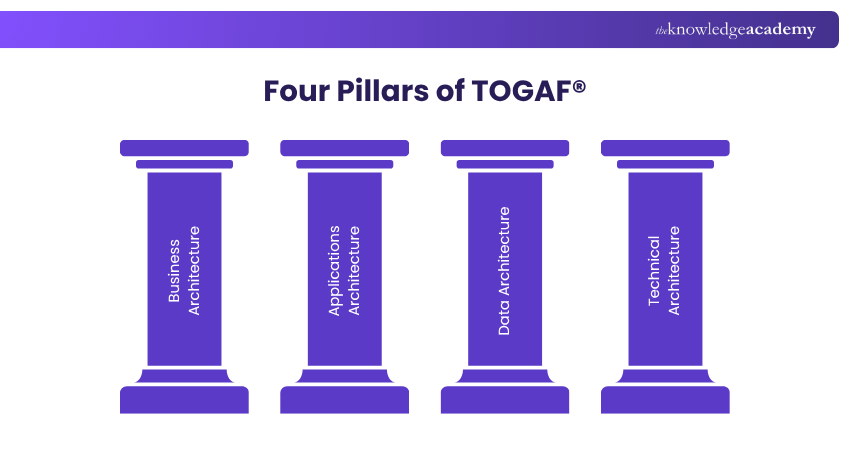
The TOGAF® Framework is based on a set of foundational principles known as the “Four Pillars of the TOGAF®. These pillars are essential for successful Enterprise Architecture development and management. The four pillars are as follows:
Business Architecture
The TOGAF® Business Architecture covers the modeling of the structure, the operations, and the interactions of business units that make up the organisation. It ensures that the Enterprise Architecture is in alignment with business objectives and underpins the business strategies.
Applications Architecture
Applications Architecture covers the definition and design of architecture and technology elements for an application, their relationships, and maps to the business processes. This should also be considered in the light of integration with other applications, the platform for technologies, and human-computer interfaces.
Data Architecture
Data Architecture is the major key area embracing structuring, organisation, and management of data in such a way that it supports the business requirement concerning the management, retrieval, and use of data to a maximum. It mostly checks that the information is controlled and safe in respect of consistency and accuracy.
Technical Architecture
This includes the hardware, software platforms, and networks, communication protocols, or any other technical components that would guarantee the technological environment was aligned with organisational needs
Sign up for TOGAF® Foundation and Practitioner - Foundation Course accredited by The Open Group® to boost your career in Enterprise Architecture!
How do Businesses Derive Benefits from The TOGAF®?
The TOGAF® helps businesses focus on governance and meeting their present and future business objectives. Enterprises can implement software technology in a structured and organised way with the TOGAF® methodology.
Making significant changes to a large organisation may be a nightmare as there are many factors to consider when planning. But businesses may get help from the TOGAF® professional. Professionals can help them simplify complicated technical processes by establishing a set of ROIs. Different sections of the company can then help achieve this set of ROIs. Additionally, businesses can enhance their readiness by taking a TOGAF® Practise Test, ensuring their team is well-prepared for the framework's implementation and challenges.
Collaboration across various departments and business units, both within and outside of IT, is crucial for successful software development. TOGAF® Case Study shows how it helps overcome challenges by aligning key stakeholders and ensuring everyone is on the same page, streamlining the process and fostering better communication.
The TOGAF® provides the methodology for organisations to effectively reach point A to point B, considering the requirements of all participating departments. With the help of this framework, Enterprise Architects ensure that all components of technology infrastructure and processes are functioning smoothly. This provides early detection of any problem in any of the departments. The methodology incorporates all organisational features, including ITIL vs COBIT vs TOGAF®, and others.
The fact that The TOGAF®-based architectures can be employed again is their main advantage. Once the company's blueprint has been created, it can be improved and used again. The blueprint is modified to reflect the latest changes. New and enhanced tools and processes are added with each upgrade of The TOGAF® to boost enterprise efficiency significantly.
Businesses should assess their needs to choose which components of the TOGAF® framework to focus on. The modular improvements to the TOGAF® Standard should make it simpler than ever to create a unique framework. Starting with the fundamental principles, organisations can choose which elements of the expanded guideline section to implement later.
Sign up for the TOGAF® Foundation and Practitioner - Foundation Course accredited by The Open Group® to boost your career in Enterprise Architecture!
Is The TOGAF® Certification Useful?
Developers and technical leads need to master the complex principles of enterprise architecture for success in their careers. According to The Open Group®, there are more than 70,000 TOGAF® 9 certified professionals worldwide. Because TOGAF® is an industry widely accepted methodology and framework, enterprise architects can benefit significantly from obtaining this certification. Additionally, it is an internationally recognised vendor-neutral credential.
Comparing the long-term benefits of the TOGAF®, it is a low-cost certification for enterprise architects. Additionally, the certificate doesn’t expire, so the professionals can enhance their knowledge continuously as The Open Group® bring new updates in the TOGAF®. The low cost of TOGAF® helps businesses upskill their staff without having to spend huge sums.
The Open Group® allows you to take the TOGAF® certification from the comfort of your home instead of sticking to a classroom program. It also provides tools that will help you learn at your convenience and schedule. Obtaining the TOGAF® certification will demonstrate that you can manage enterprise architecture and implement technologies using the TOGAF® framework. It will validate your skills in working on data, technology and enterprise application and the overall business goals.
The TOGAF® certified professional oversees several meetings, projects, and portfolios of work, including:
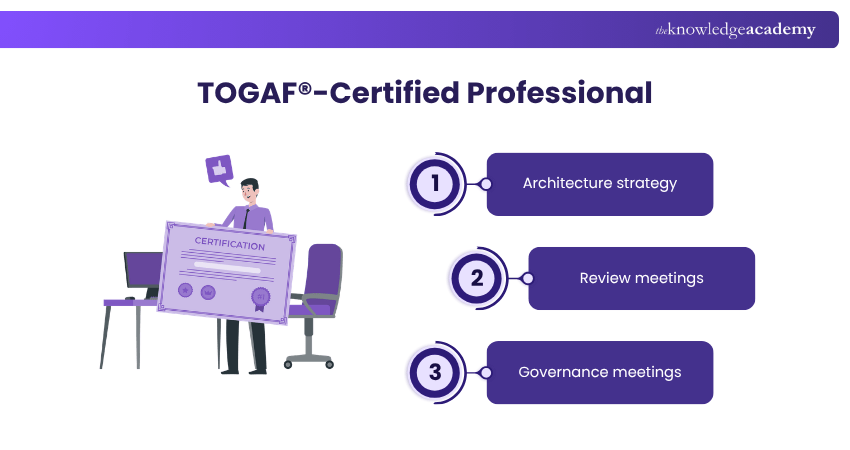
1) Architecture strategy – it includes analysing and strategising current and future IT architectures of the company.
2) Review meetings – in these meetings the investors meet often to discuss the state of current architectures.
3) Governance meetings - These involve the decision-makers who affect the organisation's policies, security, and processes.
The TOGAF® Exam cost
The TOGAF® exam cost can vary depending on factors like location and additional taxes. It is important to note that the exam fees will be included in the course cost for the TOGAF® training programs. The table below shows the list of exams and their respective costs:
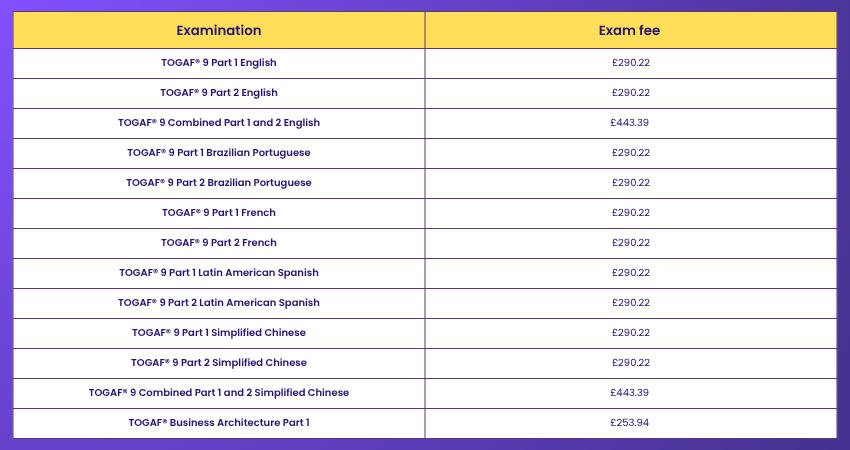
Source: The Open Group®
The TOGAF® Interview Questions
Some of the top interview questions you can expect while attending an interview for The TOGAF® certified professional are as follows:
Question 1: Outline the important steps of the TOGAF® Architecture Development Method (ADM). Further, explain the significance of these steps in the architecture development process.
Question 2: How TOGAF® ensures that IT architecture is linked with business goals. Can you provide me with an example to understand how it is linked at present between IT architecture and the business goals, say, in some of your ongoing projects or handled earlier?
Question 3: What are some common challenges encountered during The TOGAF® implementation, and how would you address them?
Question 4: In brief, explain the role and importance of stakeholder management to the TOGAF® and give your way of ensuring stakeholders communicate and collaborate effectively in the process of developing architectures.
Question 5: How could this be brought together with the other frameworks and methodologies like Agile and DevOps in a way that could still remain coherent and add to a smooth process in developing IT architecture?
Unlock your potential with the most up-to-date TOGAF® Interview Questions and land your dream job!
The TOGAF® Books
Here are five recommended TOGAF® books to help you master Enterprise Architecture:
TOGAF® 9 Foundation Study Guide by Rachel Harrison
The book forms a complete guide with every vital aspect scribed to TOGAF® 9. It includes major subject areas that are part of the TOGAF® 9.2 Foundation Level certification program, such as the TOGAF® Architecture Development Method (ADM), architectural artifacts, governance, and many others. With clear explanations, practical examples, and review questions, the book effectively reinforces learning.
TOGAF® 9 Certified Study Guide by Rachel Harrison
This book is a sequel to the Foundation Study Guide for readers who need more details about advanced ideas and techniques of TOGAF® 9 applied in building enterprise architecture for purposes of passing the Certified Level certification exams. Matters that are dealt with in this material include architecture governance, management of stakeholders, architectural capability framework, and architectural views and viewpoints. It does so with the inclusion of case studies, exercises, and practice exam questions that will be crucial to aiding the reader in effective preparation towards the certification exam.
TOGAF® 9 Certified Study Guide – 4th Edition by The Open Group®
It is the official study guide by The Open Group® to prepare for the examination that forms part of the certification at the TOGAF® 9 Certified Level. It is a very detailed guide on very many aspects, from advanced subjects such as architectural patterns, building blocks, interoperability, to areas concerning security architecture. Full of hundreds of realistic practice questions, case studies, and more, this book arms readers with an objective to hone their understanding and be ready for the exam.
Enterprise Architecture at Work: Modelling, Communication and Analysis by Marc Lankhorst, et al.
Although not exclusively focused on the TOGAF® this book delivers quite useful information on current practices in enterprise architecture, methodologies, modeling techniques, and analytic approaches. It covers almost every part related to enterprise architecture, like business architecture, information architecture, application architecture, and technology architecture. This provides pragmatic advice for applying architectures, with practical advice on how to apply architectural principles and frameworks, like TOGAF®, in the real world.
TOGAF® 9: Quick Start Guide for IT Enterprise Architects by Kevin Lindley
The book is intended to meet the needs of IT enterprise architects looking to have a synopsis and elementary explanation of the essential concepts and principles of the TOGAF® 9. These concepts are what will enable them to kick-start their architectural initiatives. It gives a summary of the TOGAF® framework, including core components, architecture development method, and key deliverables. It is written to the architect, containing actionable advice, best practices, examples, and more, guiding them in the best ways of applying TOGAF® in their organisation.
The TOGAF® Certification Salary
You can choose to pursue the TOGAF® certification from multiple online or classroom training institutions that are authorised by The Open Group®. Obtaining the TOGAF® certification will boost your salary compared to other peers in the industry. Additionally, preparing for interviews with TOGAF® Interview Questions can further increase your chances of success in landing a role that leverages this certification.
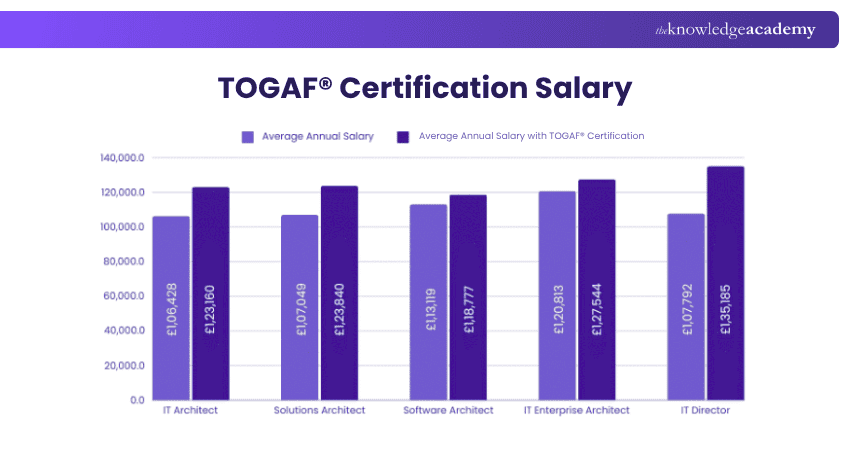
Source: PayScale
Conclusion
It should be clear by now that the simple goal of the TOGAF® is to make the different components in an enterprise architecture function smoothly with the least amount of time and effort. With the TOGAF®, businesses can achieve their business goals much faster and more efficiently. If you're wondering How to Study for the TOGAF® Exam, comment below and ask our expert if you have doubts about the TOGAF® certification.
Get world-class TOGAF® Practitioner training – sign up for the TOGAF® Foundation and Practitioner - Practitioner Training!
Frequently Asked Questions
What is the difference between the TOGAF® and ITIL?

The TOGAF® focuses on Enterprise Architecture Development, aligning IT with business goals. ITIL, however, concentrates on IT service management best practices, optimising IT services' delivery and support to meet business requirements and enhance customer satisfaction.
Is TOGAF® a professional qualification?
Yes, the TOGAF® offers professional qualifications through certification exams. These certifications validate expertise in Enterprise Architecture principles and methodologies, providing professionals with credentials recognised globally for their proficiency in architecture development and management.

The Knowledge Academy


Global Training Provider
The Knowledge Academy is a world-leading provider of professional training courses, offering globally recognised qualifications across a wide range of subjects. With expert trainers, up-to-date course material, and flexible learning options, we aim to empower professionals and organisations to achieve their goals through continuous learning.


 If you wish to make any changes to your course, please


