


 Top Rated Course

We may not have the course you’re looking for. If you enquire or give us a call on +30 2111995372 and speak to our training experts, we may still be able to help with your training requirements.
What is the ITIL 4 Service Value System? Explained
John Davies 29 April 2026ITIL 4 introduces the Service Value System as a fundamental framework. It describes how all the components and activities of an organisation work together to generate value. Explore the ITIL 4 Service Value System, a comprehensive approach for Service Management with inputs, components, and results shaped by demand and opportunity.

Training Outcomes Within Your Budget!
We ensure quality, budget-alignment, and timely delivery by our expert instructors.
Table of Contents
ITIL 4’s Service Value System (SVS) is like a recipe for success in today’s digital world. It’s a set of guidelines that help organisations make sure they’re doing the right things in the right way to deliver value to the people who matter most: their customers and stakeholders.
Think of SVS as a master chef’s secret sauce. It mixes together all the essential ingredients—like processes, technology, and activities—and cooks them to perfection. This ensures that every part of the organisation works together smoothly. Read this blog further to understand the ITIL 4 Service Value System in detail.
Table of Contents
1) What is ITIL 4 Service Value System?
2) Five elements of ITIL 4 Service Value System
3) Why do you need a Service Value System?
4) What is ITIL Service Value Chain?
5) Conclusion
What is ITIL 4 Service Value System?
The ITIL 4 Service Value System is a key concept within IT Service Management. It defines the organisation's overall activities essential for delivering value to customers. The activities of the ITIL 4 Service Value Chain include planning, improvement, engagement, design, transition, obtaining, delivering, and supporting.
The Service Value System (SVS) acts as a guide to organisations in their Service Management endeavours. By incorporating the SVS, organisations can optimise their Service Management processes, ensure responsible resource allocation and continuously improve to meet the needs of customers and stakeholders.
Five elements of ITIL 4 Service Value System
The below image is the structure of the ITIL 4 Service Value System:
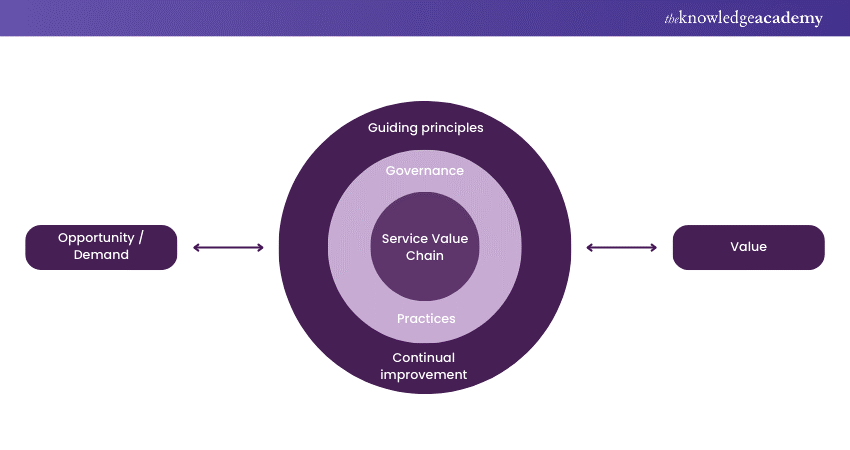
The five elements that can assist in deriving the value from the demand transformation are as follows:
1) Guiding principles
2) Governance
3) Service Value Chain
4) Practices
5) Continual improvement
Guiding Principles
The Guiding principles help an organisation create the foundation required for setting the culture, strategies, goals, management structure, or type of work, to guide the respective organisation in any circumstances.
The seven Guiding principles of the ITIL 4 Service Value System are:
a) Focus on value
b) Start where you are
c) Progress iteratively with feedback
d) Collaborate and promote visibility
e) Think and work holistically
f) Keep it simple and practical
g) Optimise and automate
Governance
Governance is a way by which an organisation can be controlled and directed by a formal framework to support the business objectives and create value. The key people who perform governance activities are board members/directors or management executives.
Service Value Chain
This operational model helps your organisation to adapt, perform, and deliver multiple sets of interconnected activities flexibly to make value realisation possible.
There are six key activities in the Service Value Chain:
a) Plan
b) Engage
c) Design & transition
d) Obtain/build
e) Delivery and support
f) Improve
Practices
Practice is the expansion of processes, capabilities, and outcomes. It is a set of organisational resources that aims to achieve an objective based on the elements of the four dimensions of Service Management.
Continual improvement
Continual improvement ensures that the organisation performs consistently, fulfilling the stakeholders' expectations. It consistently focuses on customer value through a high level of organisational activities to support practices, services, and initiatives.
Learn Everything about ITIL Framework and its role in modern ITSM. Join ITIL® 4 Foundation Certification – today!
Why do you need a Service Value System?
The Service Value System (SVS) is crucial for organisations as it provides a structured approach to delivering value to customers through IT-enabled services. It ensures that all operational activities are aligned with business goals. It prioritises initiatives that directly contribute to their success and optimise resource allocation for maximum efficiency.
The Service Value System promotes a customer-centric approach that emphasises understanding customer needs and preferences. This increases customer satisfaction, fosters loyalty, and differentiates them in competitive markets. Additionally, it facilitates continual improvement by providing mechanisms for regular assessment, adaptation, and optimisation of service delivery processes.
What is ITIL Service Value Chain?
The ITIL Service Delivery Guide highlights the ITIL Service Value Chain as the central element in the Service Value System. As an operating model, it focuses on creating services, delivering the services and continuous improvement. It uses a result-based approach to achieve service value, which is the main objective of the Service Value Chain.
The Service Value Chain is highly flexible and can adapt to several approaches, like Centralised IT and DevOps, to fulfil the need for various models of Service Management. This flexibility enables an organisation to fulfil the varying demand of the clients and shareholders. ITIL incident management is crucial for handling service disruptions and maintaining operational stability within this framework.
The six value chain activities are namely:
a) Planning
b) Improving
c) Engaging
d) Designing and automation
e) Obtaining
f) Building
g) Delivering and supporting
These activities in the ITIL 4 Service Value System represent the steps taken by an organisation to create value. All these activities transform the inputs into outputs. All these activities transform inputs into outputs, which are demanded from outside the value chain or through ITIL Demand Management from other activities. These six activities are interconnected, and they receive and provide triggers to create further actions.
Want to become familiar with ITIL DPI? Join ITIL® 4 Strategist: Direct, Plan And Improve Training now!
Conclusion
We hope you have understood the importance of ITIL 4 Service Value Systems and its significance in implementing Service Management across all areas of an organisational setup. A deep understanding of the ITIL 4 Practices is crucial for effectively implementing the Service Value System and delivering value to the organization. Overall, the ITIL 4 Service Value System is a more appropriate and practical approach for an organisation to adapt to changes and stay integrated to garner the best outcome or value.
Join the ITIL® 4 Specialist: Create Deliver And Support Certification to take your career to new heights!
Frequently Asked Questions
How does the ITIL 4 Service Value System benefit organisational performance?

In the ITIL 4 Service Value System, there is a key component that helps transform the needs of the stakeholders into benefits. This helps the organisation understand the importance of value creation, thereby increasing the organisational performance.
Are there specific job roles that directly benefit from expertise in the ITIL 4 Service Value System?
There are specific job roles which directly benefit from expertise in the ITIL 4 Service Value System. These jobs are:
a) IT Professionals
b) ITSM Managers
c) Service Managers
d) Database Administrators
e) Service Process Owners.
What are the other resources and offers provided by The Knowledge Academy?
The Knowledge Academy takes global learning to new heights, offering over 3,000+ online courses across 490+ locations in 190+ countries. This expansive reach ensures accessibility and convenience for learners worldwide.
Alongside our diverse Online Course Catalogue, encompassing 17 major categories, we go the extra mile by providing a plethora of free educational Online Resources like Blogs, eBooks, Interview Questions and Videos. Tailoring learning experiences further, professionals can unlock greater value through a wide range of special discounts, seasonal deals, and Exclusive Offers.
What is Knowledge Pass, and how does it work?
The Knowledge Academy’s Knowledge Pass, a prepaid voucher, adds another layer of flexibility, allowing course bookings over a 12-month period. Join us on a journey where education knows no bounds.
What are related courses and blogs provided by The Knowledge Academy?
The Knowledge Academy offers various ITIL® Certification Training, including ITIL 4 Foundation Certification Course, ITIL 4 Specialist: Create Deliver and Support CDS, and ITIL 4 Specialist: Drive, Plan and Improve DPI. These courses cater to different skill levels, providing comprehensive insights into ITIL 4 Guiding Principles.
Our IT Service Management blogs cover a range of topics related to ITIL 4, offering valuable resources, best practices, and industry insights. Whether you are a beginner or looking to advance your IT Service Management skills, The Knowledge Academy's diverse courses and informative blogs have you covered.

John Davies


Cyber Security Governance & Assurance Specialist
John Davies is a cybersecurity expert specialising in governance, risk management, and compliance. With over 15 years in the field, he has led enterprise-wide security programmes across finance, healthcare and public sector organisations. His content provides practical guidance on building secure environments, managing risk and aligning with regulatory frameworks.

Upcoming IT Service Management Resources Batches & Dates
Date
 ITIL® 5 Foundation Certification
ITIL® 5 Foundation Certification
Mon 15th Jun 2026
ITIL® 5 Foundation Certification
Wed 17th Jun 2026
ITIL® 5 Foundation Certification
Mon 22nd Jun 2026
ITIL® 5 Foundation Certification
Wed 24th Jun 2026
ITIL® 5 Foundation Certification
Mon 29th Jun 2026
ITIL® 5 Foundation Certification
Wed 1st Jul 2026
ITIL® 5 Foundation Certification
Mon 6th Jul 2026
ITIL® 5 Foundation Certification
Wed 8th Jul 2026
ITIL® 5 Foundation Certification
Mon 13th Jul 2026
ITIL® 5 Foundation Certification
Wed 15th Jul 2026
ITIL® 5 Foundation Certification
Mon 20th Jul 2026
ITIL® 5 Foundation Certification
Wed 22nd Jul 2026
ITIL® 5 Foundation Certification
Mon 27th Jul 2026
ITIL® 5 Foundation Certification
Wed 29th Jul 2026
ITIL® 5 Foundation Certification
Mon 3rd Aug 2026
ITIL® 5 Foundation Certification
Wed 5th Aug 2026
ITIL® 5 Foundation Certification
Mon 10th Aug 2026
ITIL® 5 Foundation Certification
Wed 12th Aug 2026
ITIL® 5 Foundation Certification
Mon 17th Aug 2026
ITIL® 5 Foundation Certification
Wed 19th Aug 2026
ITIL® 5 Foundation Certification
Mon 24th Aug 2026
ITIL® 5 Foundation Certification
Wed 26th Aug 2026
ITIL® 5 Foundation Certification
Tue 1st Sep 2026
ITIL® 5 Foundation Certification
Mon 7th Sep 2026
ITIL® 5 Foundation Certification
Wed 9th Sep 2026
ITIL® 5 Foundation Certification
Mon 14th Sep 2026
ITIL® 5 Foundation Certification
Wed 16th Sep 2026
ITIL® 5 Foundation Certification
Mon 21st Sep 2026
ITIL® 5 Foundation Certification
Wed 23rd Sep 2026
ITIL® 5 Foundation Certification
Mon 28th Sep 2026
ITIL® 5 Foundation Certification
Wed 30th Sep 2026
ITIL® 5 Foundation Certification
Mon 5th Oct 2026
ITIL® 5 Foundation Certification
Wed 7th Oct 2026
ITIL® 5 Foundation Certification
Mon 12th Oct 2026
ITIL® 5 Foundation Certification
Wed 14th Oct 2026
ITIL® 5 Foundation Certification
Mon 19th Oct 2026
ITIL® 5 Foundation Certification
Wed 21st Oct 2026
ITIL® 5 Foundation Certification
Mon 26th Oct 2026
ITIL® 5 Foundation Certification
Wed 28th Oct 2026
ITIL® 5 Foundation Certification
Mon 2nd Nov 2026
ITIL® 5 Foundation Certification
Wed 4th Nov 2026
ITIL® 5 Foundation Certification
Mon 9th Nov 2026
ITIL® 5 Foundation Certification
Wed 11th Nov 2026
ITIL® 5 Foundation Certification
Mon 16th Nov 2026
ITIL® 5 Foundation Certification
Wed 18th Nov 2026
ITIL® 5 Foundation Certification
Mon 23rd Nov 2026
ITIL® 5 Foundation Certification
Wed 25th Nov 2026
ITIL® 5 Foundation Certification
Mon 30th Nov 2026
ITIL® 5 Foundation Certification
Wed 2nd Dec 2026
ITIL® 5 Foundation Certification
Mon 7th Dec 2026
ITIL® 5 Foundation Certification
Wed 9th Dec 2026
ITIL® 5 Foundation Certification
Sun 13th Dec 2026
ITIL® 5 Foundation Certification
Mon 14th Dec 2026
ITIL® 5 Foundation Certification
Mon 21st Dec 2026
ITIL® 5 Foundation Certification
Wed 23rd Dec 2026
ITIL® 5 Foundation Certification
Tue 29th Dec 2026

 If you wish to make any changes to your course, please


