


 Top Rated Course

We may not have the course you’re looking for. If you enquire or give us a call on +08000201623 and speak to our training experts, we may still be able to help with your training requirements.
13 Types of Neural Networks and Their Applications
Lily Turner 24 February 2026Neural Networks vary by use: feedforward models, CNNs for images, RNNs (LSTM/GRU) for sequences, transformers for NLP, and GANs for data generation. They support tasks like classification, prediction, and pattern recognition. Model choice depends on data type, complexity, performance needs, and overall efficiency.

Training Outcomes Within Your Budget!
We ensure quality, budget-alignment, and timely delivery by our expert instructors.
Table of Contents

Neural Networks have become an essential part of contemporary AI, providing the capability for machines to derive, adapt, and make decisions based on complicated data. The cases that involve Types of Neural Networks span various domains, such as the recognition of pictures and the comprehension of natural language.
To grasp what is going on in AI evolution, it is important to understand the Types of Neural Networks, so that picking a model that fits the task will be easier. Let us take a look at the different types and the areas in which they are most beneficial.
Table of Contents
1) What are Neural Networks?
2) How Neural Networks Work?
3) 13 Types of Neural Networks
4) Pros and Cons of Neural Networks
5) Applications of Neural Networks Across Industries
6) What is the Difference Between RNN and GAN?
7) How to Choose the Right Neural Network?
8) Conclusion
What are Neural Networks?
A Neural Network is a computation model that mimics the brain’s functioning, with nodes that are connected to each other and transmit data in a fashion similar to the brain’s neurons. Moreover, they are the foundation of deep learning, which enables models to recognise and predict from data through learning without directed programming.

How Neural Networks Work?
Neural Networks, a core component of Brain Inspired Artificial Intelligence, are key AI models composed of interconnected artificial neurons arranged in input, hidden, and output layers. Data enters through the input layer and is processed by hidden layers via weighted connections that adjust during training to optimise accuracy.
The training process, called backpropagation, refines these weights using algorithms like Gradient Descent in Machine Learning to minimise prediction errors. The output layer provides the final result, such as image classification or speech recognition.
Deep learning extends Neural Networks with multiple hidden layers, enabling more complex feature extraction. Convolutional Neural Networks (CNNs) excel in image analysis, while Recurrent Neural Networks (RNNs) manage sequential data. Neural Networks' adaptability makes them effective across tasks like image recognition, speech processing, and natural language understanding.
Join PySpark Training to develop scalable data processing skills and work confidently with big data frameworks platforms.
13 Types of Neural Networks
Here are the 13 Types of Neural Networks which are most used in the industry:
1) Perceptron
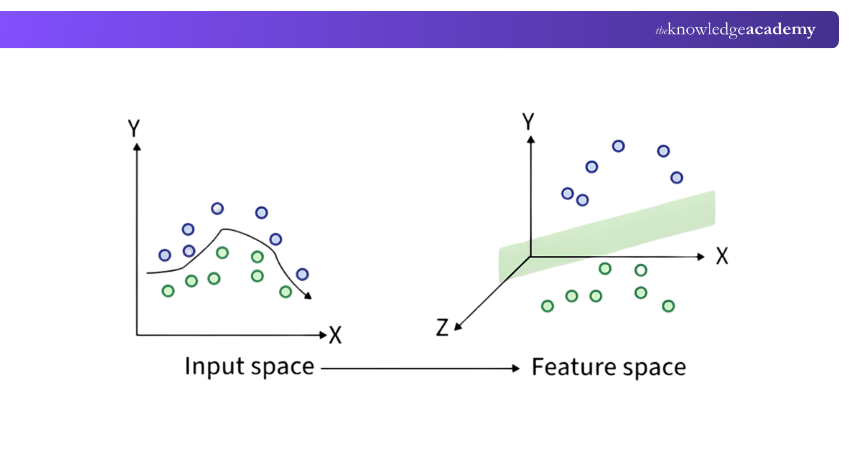
The Perceptron model, developed by Minsky and Papert, is one of the earliest and simplest neural models. It serves as a foundational unit in Machine Learning. It performs computations to detect patterns in input data, functioning as a Threshold Logic Unit (TLU) for binary decisions.
The Perceptron uses weighted inputs and an activation function to produce an output, making it suitable for binary classification tasks. It defines a hyperplane, represented by w⋅x+b=0, where w is the weight vector, x is the input vector, and b is the bias.
Advantages: Perceptrons can implement logic gates like AND, OR, and NAND.
Disadvantages: They handle only linearly separable problems and fail with non-linear cases like the XOR problem.
2) Multilayer Perceptron
The Multi-Layer Perceptron (MLP) is an entry point into complex Neural Networks suited for tasks like speech recognition, machine translation, and complex classification. MLPs feature a multilayered structure with input, output, and multiple hidden layers, forming a fully connected network.
Operation:
a) Bidirectional Propagation: Utilises forward propagation to compute outputs and backpropagation to adjust weights based on errors.
b) Weight Adjustment: Weights are optimised during backpropagation to minimise prediction errors.
c) Activation Functions: Nonlinear functions enhance modelling capabilities, with softmax often used in the output layer for multi-class classification.
Advantages: Effective for deep learning due to dense layers and backpropagation.
Disadvantages: It is complex to design and maintain, and performance can be slow depending on the number of hidden layers.
3) Convolutional Neural Networks
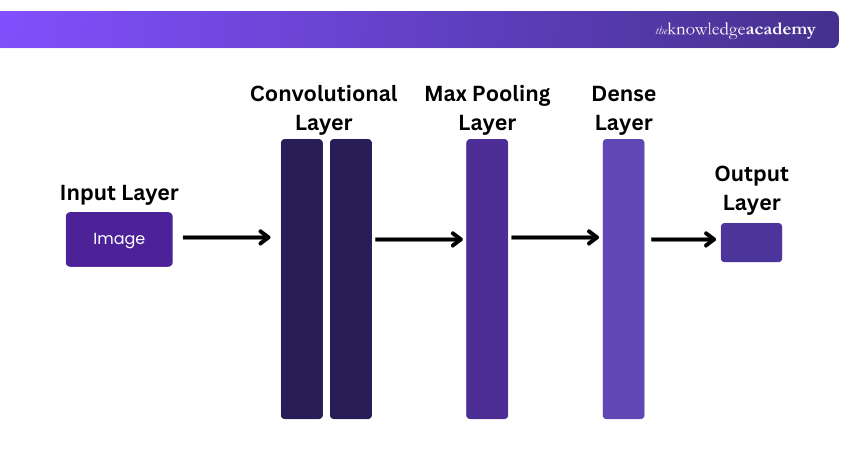
Convolutional Neural Networks (CNNs) are specialised for tasks like image processing, computer vision, speech recognition, and machine translation. Unlike standard Neural Networks, CNNs have a three-dimensional neuron arrangement, making them highly effective for visual data.
Structure:
a) Convolutional Layer: Filters extract features (edges, textures) from localised regions.
b) Pooling Layer: Reduces spatial dimensions, retaining essential information and lowering computational load.
c) Fully Connected Layer: Classifies images based on extracted features.
Operation:
a) Feature Extraction: Utilises filters to detect patterns and objects.
b) Activation Functions: ReLU introduces non-linearity, while softmax aids in multi-class classification.
Advantages: Efficient for deep learning with fewer parameters compared to fully connected layers.
Disadvantages: Complex to design and maintain and can be slow with many hidden layers.
4) Recurrent Neural Networks
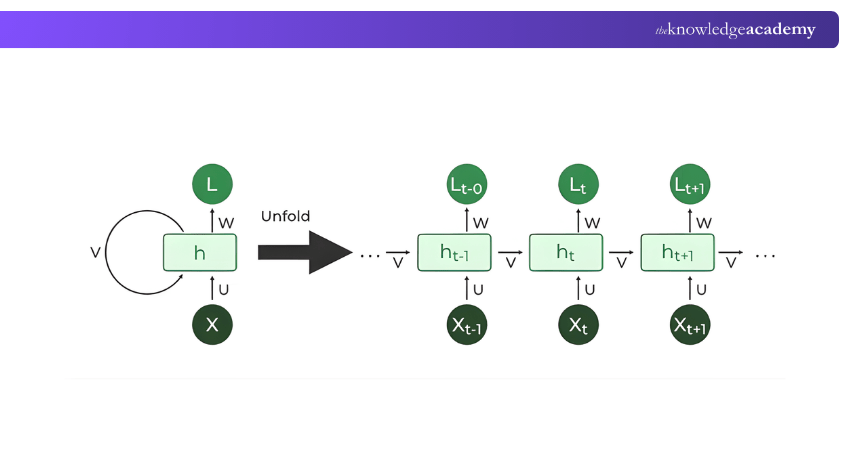
Recurrent Neural Networks (RNNs) excel at processing sequential data, making them ideal for tasks like language modelling, machine translation, speech recognition, and time-series prediction. Unlike Feed-Forward Neural Networks, RNNs have connections that loop back, allowing information to persist and capturing dependencies across time steps.
Operation:
a) Sequential Processing: This process maintains an internal state, processing input sequences one step at a time and retaining context from previous inputs.
b) Activation Functions: Utilises functions like tanh or ReLU to capture complex temporal patterns.
Advantages: Efficient for sequential data, capturing dependencies in time-based tasks.
Disadvantages: RNNs are prone to issues like vanishing or exploding gradients, making training challenging over long sequences. Additionally, they can be slower compared to simpler Neural Networks.
5) Long Short-term Memory Networks
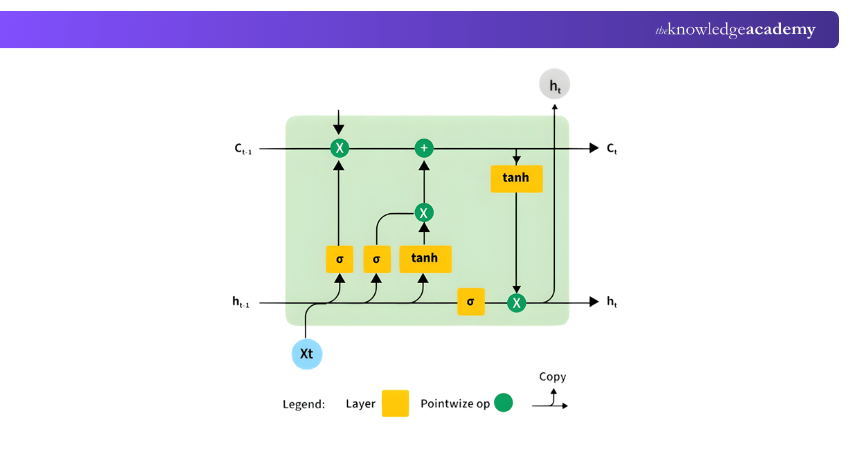
Long Short-term Memory (LSTM) networks are a type of recurrent neural network (RNN) designed to manage long-range dependencies in sequential data. Unlike standard RNNs, LSTMs use special memory cells and gating mechanisms to regulate information flow, allowing them to retain past information for extended periods. This makes them particularly useful for tasks involving time-series data, natural language processing, and speech recognition.
Operation:
a) Memory Cell: Stores relevant past information while discarding irrelevant details.
b) Gating Mechanism: Utilises input, forget, and output gates to regulate data flow.
c) Sequential Learning: Processes sequences step by step, making it suitable for tasks like machine translation and sentiment analysis.
Advantages:
a) Handles long-term dependencies effectively
b) Reduces the vanishing gradient problem
c) Works well for speech recognition, time-series forecasting, and NLP
Disadvantages:
a) Computationally expensive due to multiple gates
b) Requires large datasets for optimal performance
c) Training takes longer than simpler models
6) Gated Recurrent Units (GRUs)
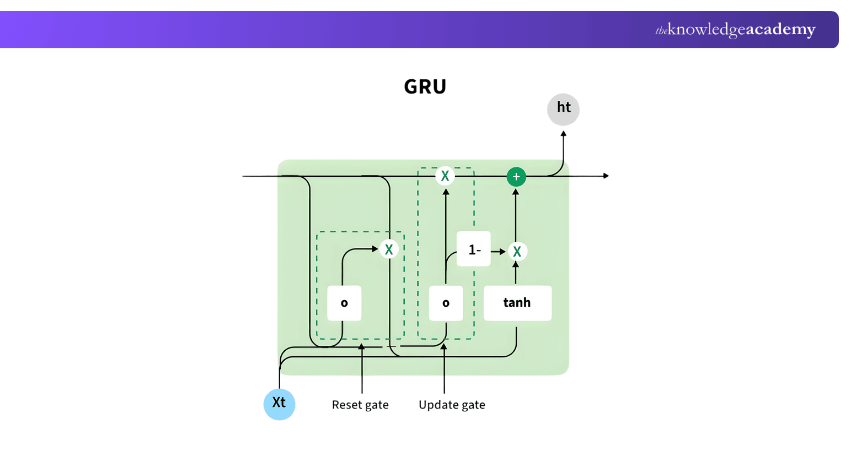
Gated Recurrent Units (GRUs) belong to the family of recurrent neural networks that are optimised for dealing with sequential data efficiently. The flow of information is regulated by the gating mechanisms, and at the same time, the vanishing gradient problem is solved. GRUs are simpler in structure with a smaller number of parameters than their counterparts, the LSTM.
Operation:
a) Use two gates, called the update gate and reset gate to manage memory
b) Control how much past information is retained at each time step
c) Decide how much new input is added to the current state
Advantages:
a) Quicker to train due to a simpler network structure
b) Require lower computational power compared to LSTMs
c) Deliver strong performance across many sequence-based tasks
d) Effectively capture short and medium-term dependencies
Disadvantages:
a) Less effective for modelling very long or highly complex sequences
b) Limited flexibility due to a simpler gating structure
c) May underperform compared to LSTMs on tasks needing long-term context
7) Radial Basis Function Networks (RBFNs)
Radial Basis Function Networks (RBFNs) are a type of neural network that uses radial basis functions as hidden layer activations and excel at function approximation, classification, and regression tasks with complex input-output patterns. They typically have a simple three-layer structure with an input layer, a hidden layer of RBF neurons, and a linear output layer.
Operation:
a) Measure the distance between the input data and the hidden neuron centres
b) Use radial basis functions, commonly Gaussian, to compute activations
c) Pass transformed inputs to a linear output layer for prediction
Advantages:
a) Effective for function approximation, classification, and regression
b) Faster training due to a simple three-layer architecture
c) Perform well on problems with non-linear data patterns
Disadvantages:
a) Performance depends on selecting suitable centres and spread values
b) Can become computationally expensive with large or high-dimensional datasets
c) Less scalable compared to deep neural network models
8) Generative Adversarial Networks (GANs)
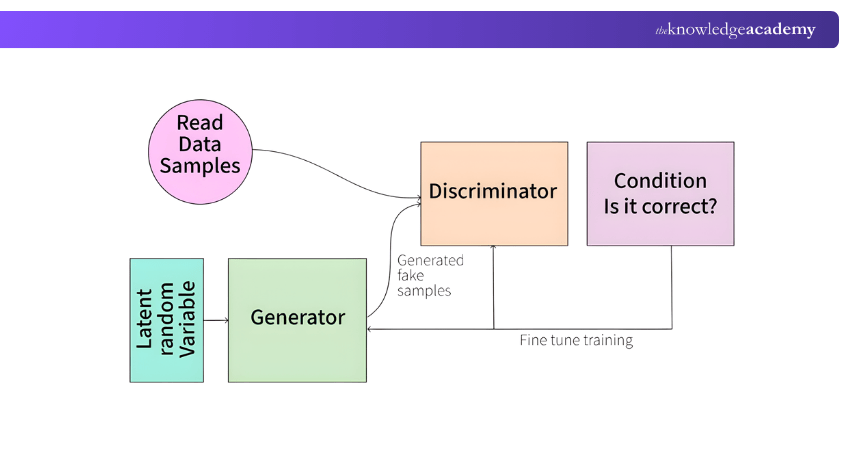
Generative Adversarial Networks (GANs) are a type of neural network architecture where two models, a generator and a discriminator, compete in a training process to create realistic new data samples that resemble real-world data. This adversarial setup enables GANs to generate high-quality synthetic content like images and sound.
Operation:
a) It comprises two networks: a generator that produces fake data and a discriminator that distinguishes real from fake.
b) Both are trained together, so the generator gets better at fooling the discriminator.
c) The discriminator improves as it learns to detect more subtle differences between real and synthetic samples.
Advantages:
a) Capable of producing highly realistic synthetic data that closely matches real data distributions.
b) Do not require labelled training data, making them useful for unsupervised tasks.
c) Versatile across applications, including image synthesis, style transfer, and data augmentation.
Disadvantages:
a) Training can be difficult and unstable, requiring significant computational resources.
b) Risk of overfitting or generating biased outputs if trained on limited or skewed data.
c) Often act as black boxes with limited interpretability of how results are formed.
9) Feed Forward Neural Networks
Feed-forward Neural Networks (FFNNs) are foundational in neural network architecture. They are suitable for tasks like simple classification, face recognition, computer vision, and speech recognition. FFNNs process data in a unidirectional flow, making them efficient for handling noisy data.
Structure:
FFNNs consist of input, output, and optional hidden layers. Data moves from input nodes through any hidden layers to output nodes.
Activation and Propagation:
Using forward propagation, data flows in one direction without feedback. Activation functions (e.g., step functions) determine neuron firing based on weighted inputs, outputting 1 or -1 based on thresholds.
Advantages: It is simple to design, fast due to one-way propagation, and effective with noisy data.
Disadvantages: It is not suitable for deep learning, lacking dense layers and backpropagation capabilities.
10) Sequence to Sequence Models
Sequence-to-sequence (Seq2Seq) models are Neural Networks designed to transform one sequence into another. They excel in tasks like machine translation, text summarisation, and speech recognition. They consist of two main components: an encoder and a decoder.
Operation:
a) Encoder: Processes the input sequence into a fixed-length context vector that captures essential information.
b) Decoder: Converts the context vector into the target sequence, generating outputs step-by-step.
Advantages: Effective for handling variable-length input and output sequences, making them versatile for many sequential tasks.
Disadvantages: Performance can degrade with long sequences due to limited context retention. Training can be computationally intensive, and Seq2Seq models may struggle with complex dependencies without enhancements like attention mechanisms.
Want to unlock your Data Science potential today? Register now for our Data Science Training!
11) Deep Belief Networks
Deep Belief Networks (DBNs) are a class of deep neural networks composed of multiple Restricted Boltzmann Machines (RBMs) stacked on top of each other. Each RBM learns to capture key features of the data before passing the information to the next layer, making DBNs effective at learning complex patterns.
Operation:
a) Layer-wise Pre-training: Each layer is trained individually as an RBM before fine-tuning.
b) Feature Learning: Learns hierarchical representations of data, useful for dimensionality reduction.
c) Fine-tuning: Uses backpropagation after pre-training to improve performance.
Advantages:
a) Efficient unsupervised feature learning
b) Works well with high-dimensional and unlabelled data
c) Reduces overfitting through hierarchical learning
Disadvantages:
a) Training is complex and computationally expensive
b) Requires labelled data for fine-tuning
c) Less commonly used today compared to CNNs and GANs
12) Self-organising Maps
Self-Organising Maps (SOMs) are an unsupervised neural network used for clustering and visualisation of high-dimensional data. They work by mapping input data onto a lower-dimensional grid while preserving relationships within the dataset.
Operation:
a) Unsupervised Learning: Uses competitive learning to cluster data without labelled outputs.
b) Neuron Competition: Each neuron competes to represent input data, with the best-matching unit (BMU) adjusting its weights.
c) Topology Preservation: Maintains spatial relationships in high-dimensional data by mapping similar inputs closer together.
Advantages:
a) Effective for data clustering and visualisation
b) Preserves relationships in complex datasets
c) Useful in applications like customer segmentation and anomaly detection
Disadvantages:
a) Interpretation of results can be challenging
b) Requires careful parameter tuning
c) Struggles with categorical data compared to other clustering techniques
Learn to clean, analyse and visualise data using R, join our Data Science with R Training now!
13) Modular Neural Network
Modular Neural Networks (MNNs) consist of independent neural network modules working together to solve complex tasks. Each module handles a specific sub-task, and their outputs are combined for the final result, making MNNs suitable for tasks like pattern recognition, time-series prediction, and multi-object classification.
Operation:
a) Independent Modules: Each module processes input data separately, focusing on distinct features or tasks.
b) Integration: Outputs from modules are aggregated, typically using a master network or layer, to generate the final output.
Advantages: Dividing complex tasks offers faster training, parallel processing, and improved scalability.
Disadvantages: Designing and integrating modules can be complex, and module interdependencies may affect overall performance if not well-coordinated.
Join our Predictive Analytics Course to build data-driven forecasting skills and support smarter, future-focused business decisions.
Pros and Cons of Neural Networks
Neural networks, a fundamental artificial intelligence component, have seen widespread application, each with advantages and drawbacks.
Pros of Neural Networks
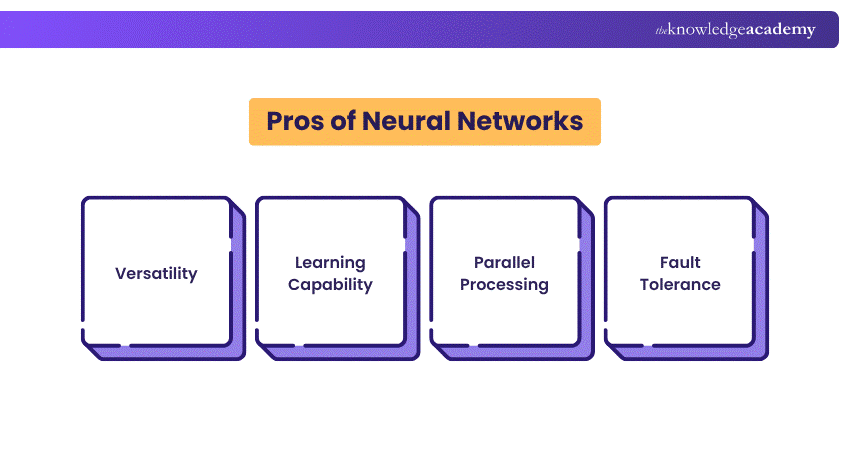
a) Versatility: Neural Networks exhibit remarkable versatility, applicable across various domains such as image and speech recognition, natural language processing, and game playing. Their ability to adapt makes them valuable in diverse scenarios.
b) Learning Capability: Neural Networks excel at learning from data patterns, adjusting their parameters based on experience. This enables them to enhance performance over time, making them suitable for tasks that involve complex relationships.
c) Parallel Processing: Neural Networks leverage parallel processing, mimicking the human brain's simultaneous handling of multiple inputs. This accelerates computations, rendering them suitable for large-scale data processing tasks.
d) Fault Tolerance: Neural Networks demonstrate a degree of fault tolerance. Even with partial damage or loss of neurons, they can often continue functioning, contributing to their robustness in real-world applications.
Cons of Neural Networks
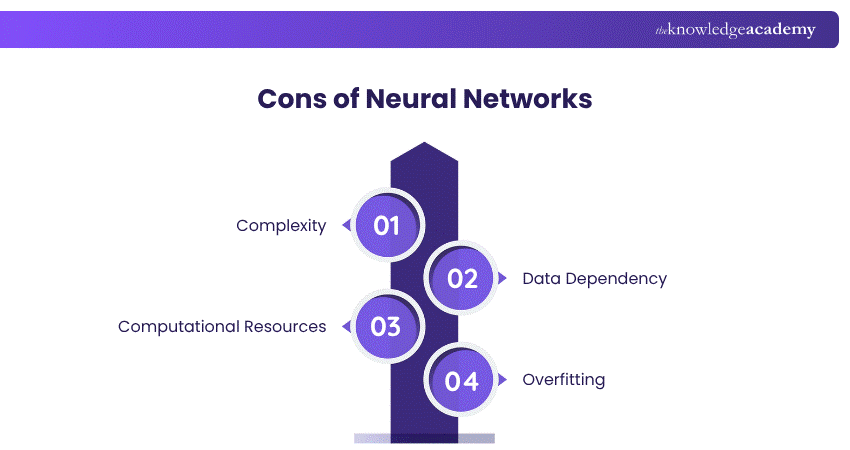
a) Complexity: The inherent complexity of neural networks challenges understanding their decision-making processes. This lack of interpretability can be a significant drawback, particularly in critical applications where transparency is crucial.
b) Data Dependency: Neural Networks heavily rely on extensive, high-quality datasets for training. Inadequate or biased data can result in model inaccuracies and reinforce existing biases, limiting their reliability.
c) Computational Resources: Training large neural networks demands substantial computational resources. This can be a barrier for smaller organisations or projects with limited access to powerful hardware.
d) Overfitting: Neural Networks may overfit, meaning they become too closely tailored to the training data and need help generalising to new, unseen data. Balancing model complexity to prevent overfitting is a constant challenge.
Applications of Neural Networks Across Industries
Neural networks have become a common tool among various industries for solving extremely complicated issues and making better decisions. The following are the main sectors where artificial intelligence, specifically neural networks, is a very important factor in the innovation and efficiency of these sectors.
a) Healthcare: Neural Networks hold up the backbone of medical imaging, detection of diseases, and diagnosis in a highly accurate manner. Additionally, they are instrumental in the personalisation of treatment plans and the speeding up of drug discovery.
b) Finance: Their application includes but is not limited to fraud detection, credit risk assessment, and algorithmic trading. Neural networks process and examine enormous volumes of financial data to unearth patterns and predict results.
c) Retail and E-commerce: Neural networks are the core of recommendation engines and tailored marketing strategies. Besides that, they enhance demand forecasting and consumer behavior analysis.
d) Automotive: They are the ones who allow the self-driving cars by real-time processing of information from the sensors and cameras. Moreover, neural networks also contribute to traffic prediction and predictive maintenance of vehicles.
e) Manufacturing: These are the areas in which they have been used: quality control, fault detection, and predictive maintenance. They also play a crucial role in the optimisation of production processes and the cutting down of operational downtimes.
f) Telecommunications: Neural networks are the ones that keep the network performing at its best, as well as managing the data traffic in a very efficient manner. Moreover, they also assist in speech recognition and real-time language translation.
g) Customer Support: They are the powering force behind intelligent chatbots and virtual assistants that can resolve issues much faster. The neural networks look into the interactions and analyse them to boost the customer experience and quality of service.
What is the Difference Between RNN and GAN?
Recurrent Neural Networks (RNNs) are designed for processing sequential data, utilising loops to retain memory of past inputs. In contrast, Generative Adversarial Networks (GANs) consist of two competing networks a generator and a discriminator that work together to create realistic synthetic data.
How to Choose the Right Neural Network?
The initial step in selecting the appropriate neural network involves comprehending the kind of data you have and the issue you intend to resolve. Various architectures are appropriate for different tasks like image analysis, language processing, or numerical prediction.
In addition, one should keep in mind the size of the dataset, the complexity of the model, and the resources that are available. It is through the testing and refining of several models that one can be sure of the selected neural network providing trustworthy and accurate results.
Conclusion
Neural networks are revolutionising the way smart systems tackle real-life issues. Knowing the Types of Neural Networks allows you to select the proper method and create stronger, future-proof AI systems. This understanding also improves problem-solving accuracy and supports more efficient, scalable machine learning solutions across industries.
Learn to turn raw data into powerful decision with our Data Mining Training, Sign-up Now!
Frequently Asked Questions
Why is CNN Better Than MLP?

CNNs are better than MLPs for image-related tasks because they efficiently capture spatial hierarchies and local patterns using convolutional layers, reducing the number of parameters. This makes CNNs more effective in handling high-dimensional data like images, unlike MLPs.
Why are Neural Networks Used?
Neural Networks are used for their ability to learn complex patterns and relationships from data. They excel in tasks like image recognition, speech processing, natural language understanding, and decision-making, making them valuable for solving diverse problems across AI and Machine Learning.
What are the Other Resources and Offers Provided by The Knowledge Academy?
The Knowledge Academy takes global learning to new heights, offering over 3,000 online courses across 490+ locations in 190+ countries. This expansive reach ensures accessibility and convenience for learners worldwide.
Alongside our diverse Online Course Catalogue, encompassing 17 major categories, we go the extra mile by providing a plethora of free educational Online Resources like Blogs, eBooks, Interview Questions and Videos. Tailoring learning experiences further, professionals can unlock greater value through a wide range of special discounts, seasonal deals, and Exclusive Offers.
What is The Knowledge Pass, and How Does it Work?
The Knowledge Academy’s Knowledge Pass, a prepaid voucher, adds another layer of flexibility, allowing course bookings over a 12-month period. Join us on a journey where education knows no bounds.
What are the Related Courses and Blogs Provided by The Knowledge Academy?
The Knowledge Academy offers various Data Science Courses, including the Predictive Analytics Course, Data Mining Training, and PySpark Training. These courses cater to different skill levels, providing comprehensive insights into Real-Time Data.
Our Data, Analytics and AI Blogs cover a range of topics related to Neural Networks, offering valuable resources, best practices, and industry insights. Whether you are a beginner or looking to advance your Data, Analytics and AI skills, The Knowledge Academy's diverse courses and informative blogs have got you covered.

Lily Turner


Senior AI/ML Engineer and Data Science Author
Lily Turner is a data science professional with over 10 years of experience in artificial intelligence, machine learning, and big data analytics. Her work bridges academic research and industry innovation, with a focus on solving real-world problems using data-driven approaches. Lily’s content empowers aspiring data scientists to build practical, scalable models using the latest tools and techniques.
View Detail
Upcoming Data, Analytics & AI Resources Batches & Dates
Date
 Data Mining Training
Data Mining Training
Thu 17th Sep 2026
Data Mining Training
Thu 19th Nov 2026

 If you wish to make any changes to your course, please


