


 Top Rated Course

We may not have the course you’re looking for. If you enquire or give us a call on 0800 446148 and speak to our training experts, we may still be able to help with your training requirements.
Net Present Value (NPV): Formula and Steps to Calculate
William Brown 11 March 2026Net Present Value (NPV) measures investment profitability by discounting future cash flows, helping organisations compare projects and make informed decisions. It considers the time value of money to assess long-term financial impact. NPV supports strategic planning by identifying investments that generate sustainable value.

Training Outcomes Within Your Budget!
We ensure quality, budget-alignment, and timely delivery by our expert instructors.
Table of Contents

Investment decisions are not just about gut feeling; they require thorough financial evaluation. Net Present Value assists in determining the extent to which the future cash inflows are worth the present investment. In this blog, we explain this notion and also provide a concise overview of the main stages for calculating it with precision.
Table of Contents
1) What is Net Present Value (NPV)?
2) Net Present Value (NPV) Formula
3) How to Calculate NPV in Excel?
4) Examples of Calculating NPV
5) Positive NPV vs. Negative NPV
6) What is NPV Used for?
7) Advantages of Calculating NPV
8) Limitations of NPV
9) Difference Between NPV and Internal Rate of Return (IRR)
10) Conclusion
What is Net Present Value (NPV)?
Net Present Value (NPV) is the difference between the present value of cash inflows and the present value of cash outflows over an investment’s entire life. NPV analysis, a form of intrinsic valuation, is widely used in finance and accounting for capital budgeting and investment planning. It helps assess the value of businesses, capital projects, investment securities, new ventures, and cost reduction programmes. It applies to any scenario that involves future cash flows.

Net Present Value (NPV) Formula
The Net Present Value (NPV) formula calculates the present value of future cash flows discounted at a specific rate, minus the initial investment. It helps determine whether an investment will generate a net gain or loss based on the time value of money.
The formula for Net Present Value is:

Where:
Z1 = Cash flow in Time 1
Z2 = Cash flow in Time 2
R = Discount rate
X0 = Cash outflow in Time 0 (Initial investment or purchase price)
Begin your professional journey with the BCS Foundation Certificate in Business Analysis. Join now to gain essential skills and recognised certification.
How to Calculate NPV in Excel?
To calculate NPV in Excel, use the NPV function to discount a series of future cash flows based on a chosen discount rate. Then add or subtract the initial investment separately to determine the overall value of the project.
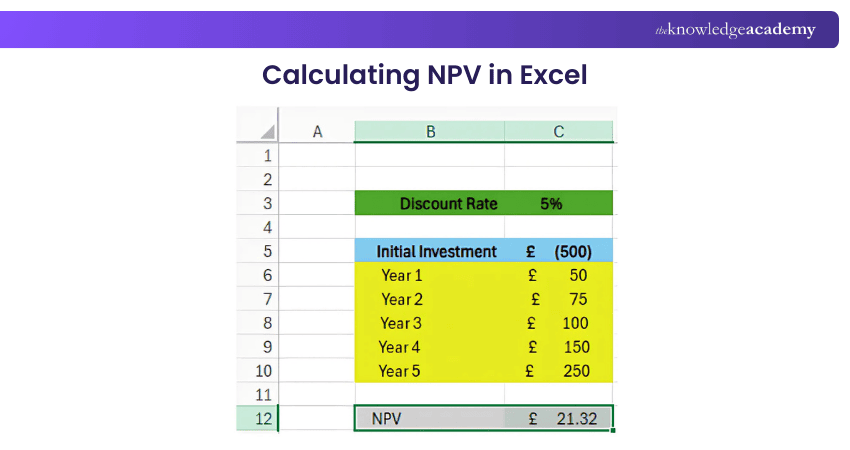
In this example, the formula entered into the grey NPV cell is:

Step 1: Estimate Future Cash Flows
First, project the expected cash inflows and outflows during the investment period. These estimates, which contain all relevant revenues, costs, and even any ancillary benefits, form the backbone of the NPV calculation and will thus be considered for NPV.
Step 2: Determine the Discount Rate
Pick a discount rate that is suitable, and it must reflect the risk and opportunity cost of the investment. A higher rate will devalue the present worth of future cash flows; thus, this selection can extremely influence the NPV outcome.
Step 3: Calculate Present Value of Cash Flows
Discount each future cash flow by applying the discount rate to obtain its present value. Adding these discounted values produces the total present value of all future cash flows for the investment.
Step 4: Subtract Initial Investment
At last, West Parth is the initial investment expense from the present worth of future cash inflows. The outcome is the NPV that shows whether the investment is going to be a value adder or not.
Strengthen strategic decision-making with the BCS Practitioner Certificate in Enterprise and Solution Architecture. Register now!
Examples of Calculating NPV
A company considers investing £1 million in equipment expected to generate £25,000 monthly for 5 years. Alternatively, it could invest the same amount in securities yielding 8% annually. The investment risks are considered similar.
Example 1: NPV of the Initial Investment
The upfront cost is £1 million. Since it is paid immediately, there is no need to discount this amount.
Example 2: NPV of Future Cash Flows
a) Periods (t): 5 years × 12 months = 60 periods
b) Discount Rate (i): 8% annual rate converted to 0.64% monthly
The present value of the 60 monthly cash inflows, discounted at 0.64%, minus the £1 million investment, gives the NPV:
NPV = £242,322.82
This positive NPV indicates the equipment investment is more profitable than the alternative.
Enhance your expertise with the BCS Certificate in Business Analysis Practice. Book now to gain practical tools for real-world business challenges.
Positive NPV vs. Negative NPV
A positive Net Present Value demonstrates that the discounted cash inflows surpass the initial investment, thus indicating the creation of value. Conversely, a negative Net Present Value implies that the anticipated returns are below the costs, and this may lead to the conclusion that the project is not worth doing.
What Is NPV Used for?
NPV becomes a major tool in capital budgeting for assessing and juxtaposing investment options. Thus, it sorts out the projects that contribute long-term financial value in the eyes of the organisations.
Develop value-driven architecture skills with the BCS Foundation And Practitioner Certificate In Enterprise And Solution Architecture. Join now!
Advantages of Calculating NPV
Most businesses utilise NPV calculations to make significant investment decisions. Financial analysts may also be employed to calculate NPV for multiple projects who use spreadsheets or finance software for these calculations. Here are some benefits of calculating NPV:

1) Includes All Cash Flows: NPV considers all relevant cash flows and payback periods, aiding sound decision-making.
2) Accurately Measures Profitability: It helps assess long-term project value and supports investment decisions with lower risk.
3) Accounts for Project Risks: By using discount rates, NPV reflects financial and operational risks in return estimates.
4) Considers Present Value: NPV adjusts future cash flows to their present value, accounting for inflation and time value of money
Limitations of NPV
The Net Present Value is largely impacted by the cash flow forecasts and the interest rate chosen, which means that if the assumptions are wrong, the outcome could be misleading. It is also a financial-only method and might not be suitable for comparing projects of different sizes and durations.
Advance your career with the BCS International Diploma in Business Analysis. Enquire today to validate your strategic analysis capabilities.
Difference Between NPV and Internal Rate of Return (IRR)
Net Present Value and Internal Rate of Return are different investment project evaluation methods, yet they are both used for the same purpose. NPV is the net value that the investment will bring after adjusting the time value of future cash flows, whereas IRR gives the rate at which future cash flows will precisely match the initial investment cost.
IRR denotes the forecasted profit as a percentage of return, making it easier for project comparisons or establishing a required rate of return. On the other hand, NPV grants a degree that indicates the overall value produced and is hence more trustworthy in cases of differing cash flows or differing project sizes.
Conclusion
Having learned all about its calculations and purposes from this blog, now you will be able to assess investment possibilities confidently. Net Present Value provides a reliable structure for evaluating long-term financial implications and thus facilitates the making of informed and value-oriented decisions.
Master advanced business analysis skills in our comprehensive BCS Advanced International Diploma in Business Analysis – Sign up now!
Frequently Asked Questions
Is a Higher or Lower NPV Better?

A higher NPV is better, as it indicates greater profitability after accounting for investment costs and time value of money. A positive and higher NPV suggests the project will generate more value than it costs.
Is NPV or ROI More Important?
Both are important, but NPV is more reliable for long-term investment decisions as it considers the time value of money. ROI is simpler and better for quick comparisons but may overlook cash flow timing and project scale.
What are the Other Resources and Offers Provided by The Knowledge Academy?
The Knowledge Academy takes global learning to new heights, offering over 3,000 online courses across 490+ locations in 190+ countries. This expansive reach ensures accessibility and convenience for learners worldwide.
Alongside our diverse Online Course Catalogue, encompassing 19 major categories, we go the extra mile by providing a plethora of free educational Online Resources like Blogs, eBooks, Interview Questions and Videos. Tailoring learning experiences further, professionals can unlock greater value through a wide range of special discounts, seasonal deals, and Exclusive Offers.
What is The Knowledge Pass, and How Does it Work?
The Knowledge Academy’s Knowledge Pass, a prepaid voucher, adds another layer of flexibility, allowing course bookings over a 12-month period. Join us on a journey where education knows no bounds.
What are the Related Courses and Blogs Provided by The Knowledge Academy?
The Knowledge Academy offers various Business Analysis Courses, including the BCS Practitioner Certificate In Requirements Engineering, BCS Practitioner Certificate In Data Protection Training, and BCS Foundation Level Certificate In DevOps Training. These courses cater to different skill levels, providing comprehensive insights into Value Chain.
Our Business Analysis Blogs cover a range of topics related to Net Present Value, offering valuable resources, best practices, and industry insights. Whether you are a beginner or looking to advance your Business Analysis skills, The Knowledge Academy's diverse courses and informative blogs have got you covered.

William Brown


Senior Business Analyst and Strategic Advisor
William Brown is a senior business analyst with over 15 years of experience driving process improvement and strategic transformation in complex business environments. He specialises in analysing operations, gathering requirements and delivering insights that support effective decision making. William’s practical approach helps bridge the gap between business goals and technical solutions.
View Detail
Upcoming Business Analysis Resources Batches & Dates
Date
 BCS Certificate in Business Analysis Practice
BCS Certificate in Business Analysis Practice
Mon 20th Apr 2026
BCS Certificate in Business Analysis Practice
Mon 20th Jul 2026
BCS Certificate in Business Analysis Practice
Mon 23rd Nov 2026

 If you wish to make any changes to your course, please


