




We may not have the course you’re looking for. If you enquire or give us a call on 01344203999 and speak to our training experts, we may still be able to help with your training requirements.
Who is a Financial Analyst: Career Guide
ByOlivia TaylorLast updated on: 03 October 2026
A Financial Analyst evaluates financial data, market trends, and business performance to support investment, planning, forecasting, and financial decision making.

Quick Snapshot
1. Financial Analysts evaluate data and models to support financial and investment decisions.2. Common roles include buy-side, sell-side, corporate finance, risk, and quantitative analysts.3. Key responsibilities include analysis, planning, forecasting, risk assessment, and reporting.4. Analytical, financial, communication, and technology skills are important for the role.5. Financial Analysts work across banks, investment firms, insurers, and corporate finance teams.
Some people think that numbers are boring, but not you, if you love to dive into data, crunch the figures, and uncover the stories behind them. If you have a knack for finding patterns, trends, and insights that can help businesses and investors make smart decisions, becoming a Financial Analyst is the answer. But who is a Financial Analyst? Prospective job seekers often ask this question.
According to Glassdoor, the median total pay for a Financial Analyst is around £45,000 per year, with base pay typically ranging from £35,000 to £58,000 per year. Salary levels vary according to experience, employer, and role. In this blog, we will explore who a Financial Analyst is, their types, responsibilities, and essential skills. Let's get started!
Who is a Financial Analyst?
A Financial Analyst conducts various research activities to support investment strategy and decision making for their company or clients. They assess financial data, review financial statements, analyse business or market developments and build financial models to evaluate or forecast performance, depending on their role.
Financial Analysts can work across areas such as investment research, corporate finance, risk management and financial planning and analysis. Possessing strong Financial Analyst skills, including mathematical and analytical abilities, is essential for managing large volumes of data. They work across organisations such as banks, investment firms, insurance companies and corporate finance teams, with responsibilities varying considerably by role and industry.

Types of Financial Analysts
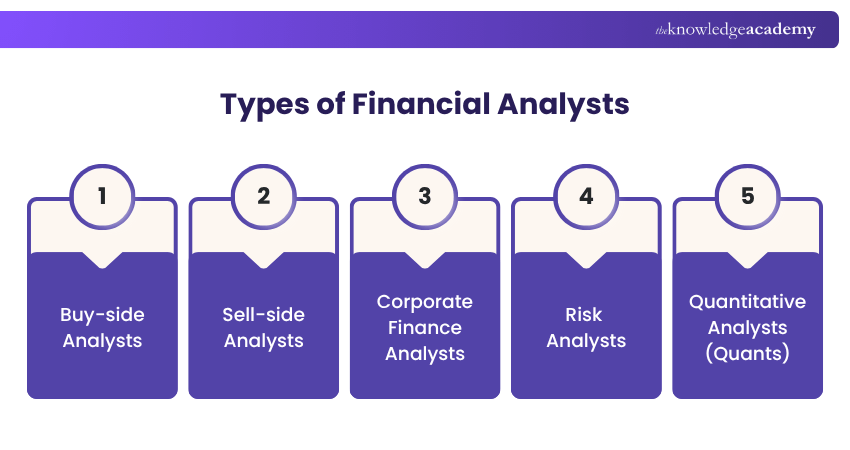
Financial analysis covers a range of roles across investment research, corporate finance, risk, and quantitative analysis. Let's explore some common Financial Analyst roles and related specialisations in detail:
1) Buy-side Analysts
Buy-side Financial Analysts work for organisations that invest capital, such as mutual funds, hedge funds, pension funds, and other investment firms. They research securities, sectors, and markets to support investment decisions and help Portfolio Managers evaluate potential opportunities and risks.
Buy-side Financial Analysts often provide research and recommendations that inform investment decisions made by Portfolio Managers and other investment professionals.
2) Sell-side Analysts
Sell-side Financial Analysts typically research companies and securities within specific sectors or industries. They analyse financial data, build models, prepare research reports, and can issue recommendations such as "buy," "hold," or "sell."
They track the companies and securities they cover, update forecasts and valuations, and provide research to institutional and other clients. Their findings can also inform the decisions of buy-side analysts.
Sell-side Financial Analysts commonly work for investment banks, brokerages, and research firms. Their role focuses on producing company and sector research, financial analysis, valuations, and investment recommendations for clients.
3) Corporate Finance Analysts
Corporate Finance Analysts support strategic financial planning, budgeting, and the evaluation of investment opportunities. Applying corporate finance skills, they can assess the financial feasibility of new projects, analyse Return on Investment (ROI) for expansions, and evaluate potential acquisitions to support organisational decisions.
4) Risk Analysts
In the world of finance, risks are inevitable companions. Risk Analysts are the key players guarding against potential pitfalls. By assessing and quantifying financial risks, they enable businesses to make informed decisions that minimise potential losses. Their work spans market risk, credit risk, operational risk, and more, providing a crucial foundation for prudent decision making.
5) Quantitative Analysts (Quants)
Quantitative Analysts, or Quants, use mathematics, statistics, programming, and financial models to analyse markets and financial data. They develop models and algorithms that can support areas such as investment analysis, trading, pricing, and risk management.
Quick Check
Which Financial Analyst role best matches your interests? Buy-side and sell-side roles focus on investment research, while corporate finance, risk, and quantitative roles concentrate on different areas of financial analysis.
Interpret financial health confidently with the Accounting and Financial Statement Analysis Training – Join now!
Responsibilities of a Financial Analyst
A Financial Analyst's responsibilities vary according to their role, industry, and employer. Common responsibilities can include:
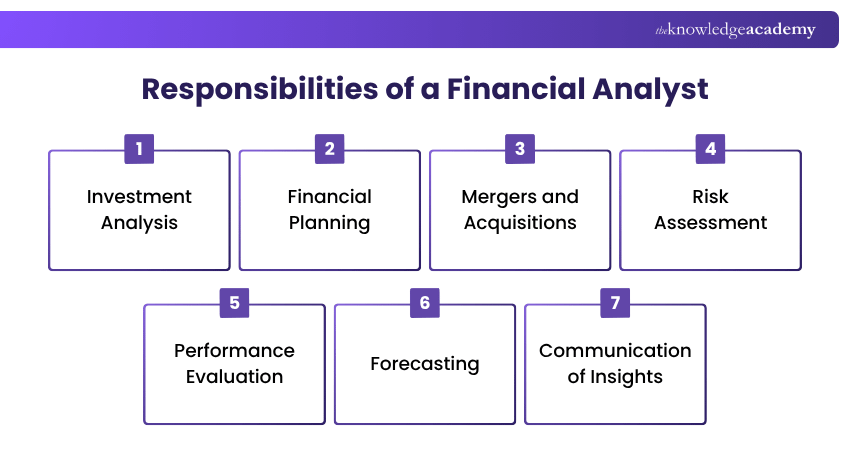
a) Investment Analysis: Financial Analysts working in investment-focused roles scrutinise investment opportunities, considering potential risks and returns. They conduct thorough research to recommend stocks, bonds, or other securities that align with investors' objectives.
b) Financial Planning: Organisations rely on analysts to assist in crafting strategic financial plans. These professionals support resource allocation, budgeting and projections of future financial performance.
c) Mergers and Acquisitions: Some Financial Analysts support mergers and acquisitions by assessing financial feasibility, potential synergies, valuations, and projected financial outcomes.
d) Risk Assessment: Financial Analysts may identify and assess financial risks to help stakeholders understand potential exposures and make informed decisions.
e) Performance Evaluation: By comparing a company's financial performance with industry benchmarks and historical data, Financial Analysts provide insights that help management evaluate performance and identify areas for improvement.
f) Forecasting: Forecasting is an important part of financial analysis. Analysts utilise historical data, assumptions, and market trends to estimate future financial outcomes and help organisations prepare for different scenarios.
g) Communication of Insights: Beyond crunching numbers, Financial Analysts need to communicate their findings clearly to financial and non-financial stakeholders. Translating complex financial information into understandable insights supports better decision making.
Skills Required to Become a Financial Analyst
Financial analysis requires a combination of analytical, financial, communication, and technical skills. Let's look at the essential skills that support effective performance as a Financial Analyst:
Trainer's Insight
Build a balanced skill set rather than focusing only on numbers. Strong financial knowledge, analytical thinking, communication, and technology skills can help you interpret data clearly and present useful insights to decision makers.
1) Analytical Skills
An effective Financial Analyst needs the ability to interpret data, identify financial problems, assess alternatives, and support forecasting and planning. These skills help Financial Analysts analyse financial resources, markets, and products and support sound financial decisions.
2) Financial Knowledge
Financial knowledge is an essential technical skill for a Financial Analyst. It includes understanding financial statements, markets, interest rates, investment principles, and other factors that influence financial decisions. This knowledge can be strengthened through continued learning and professional development.
3) Communication Skills
Communication skills help Financial Analysts explain complex financial information clearly to investors, managers, and other stakeholders. Strong written, verbal, and nonverbal communication also supports effective professional relationships.
4) Attention to Detail
A Financial Analyst needs strong attention to detail when reviewing financial data, models, and market information. This helps reduce errors and supports more reliable analysis and forecasts.
5) Problem Solving Abilities
Financial Analysts often face complex financial problems that require critical thinking and structured analysis. Problem solving skills help them assess risks, evaluate alternatives, and develop practical recommendations.
6) Technological Proficiency
In today's digital age, proficiency with financial software, data analysis tools, and modelling software is important. Financial Analysts use these tools to organise, analyse, and visualise complex data, supporting decision making and strategic planning.
Financial Analysts combine financial knowledge, analytical thinking, technology, and communication to turn complex information into useful insights. The exact responsibilities vary by role, but these skills support effective analysis and financial decision making across different industries.
Build practical analysis and forecasting skills with the Financial Management Course – Join today!

Olivia Taylor makes complex financial subjects easier for professionals to understand and apply. Her content connects accounting principles with the practical requirements of financial control, organisational planning and responsible decision-making.
View Detail

 If you wish to make any changes to your course, please


