


 Top Rated Course


We may not have the course you’re looking for. If you enquire or give us a call on +420 210012971 and speak to our training experts, we may still be able to help with your training requirements.
What is Perl? Definition, Features & Applications
The Knowledge Academy 23 February 2026Curious to learn What is Perl? It’s a high-level, interpreted language known for flexibility, text processing, and strong regular expression support. Initially designed for report processing, Perl is widely used in system administration, Web Development, and networking, excelling in automation and data management.

Training Outcomes Within Your Budget!
We ensure quality, budget-alignment, and timely delivery by our expert instructors.
Table of Contents

Ever heard of Perl but not quite sure what it does? What is Perl? Imagine a coding Swiss Army knife—versatile, sharp, and built to handle just about anything. Originally created in the late ‘80s, Perl is a scripting powerhouse famous for its text-processing magic, automation skills, and flexibility. Whether you're wrangling data, managing networks, or building web applications, Perl makes complex tasks feel effortless.
In this blog, we’ll explore What is Perl, covering its key aspects, applications, and future. From its powerful text-processing capabilities to its role in automation, Perl has shaped the coding world in many ways. Ready to dive into Perl? Let’s get started!
Table of Contents
1) What is Perl?
2) Key Features of Perl
3) Perl Syntax with Examples
4) Hello World Program
5) Variables in Perl
6) Applications of Perl
7) Advantages and Disadvantages of Using Perl
8) Difference Between Perl and Python
9) Implementing Perl in Practice
10) Future of Perl
11) Is Perl the Same as PHP?
12) Which Perl is Best for Windows?
13) Conclusion
What is Perl?
Perl, short for Practical Extraction and Reporting Language, is a versatile and high-level Programming Language known for its text-processing capabilities. Created by Larry Wall in the late 1980s, Perl is designed to handle regular expressions efficiently, making it particularly effective for tasks involving string manipulation and pattern matching.
It's widely used for Web Development, system administration, and network programming. Perl's flexibility and expressive syntax have contributed to its enduring popularity, and it continues to be employed in various domains for scripting, automation, and crafting dynamic content on websites.

Key Features of Perl
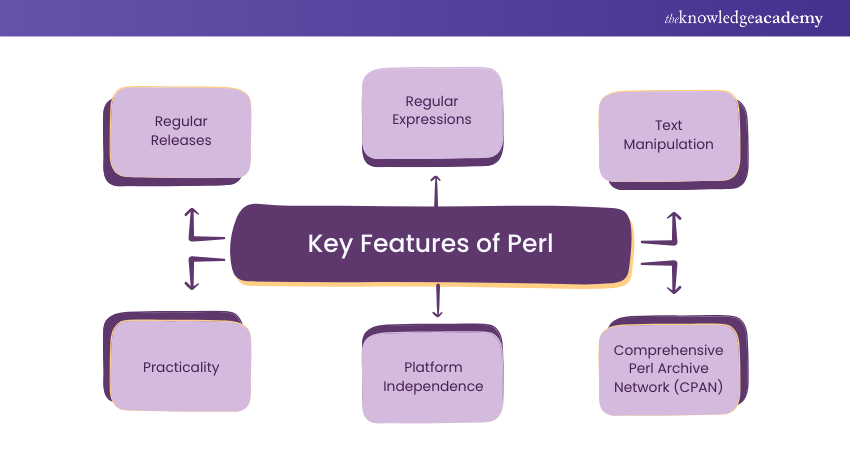
Renowned for its versatility, Perl boasts vital features that contribute to its enduring popularity. The features include:
Renowned for its versatility, Perl boasts vital features that contribute to its enduring popularity. The features include:
a) Regular Expressions: Perl excels in handling text processing and pattern matching, offering robust support for regular expressions. This capability is integral for tasks like parsing and manipulating textual data.
b) Text Manipulation: With rich built-in functions, Perl Data Types enhance text manipulation tasks by efficiently handling different data structures. Perl provides powerful tools for string operations, making it a preferred choice for text processing and analysis tasks.
c) Comprehensive Perl Archive Network (CPAN): Perl's extensive library of modules, available through CPAN, facilitates rapid development. Developers can leverage pre-built modules to add functionalities to their projects efficiently.
d) Platform Independence: Perl is platform-independent, allowing developers to write code that runs seamlessly on numerous operating systems without modification. This feature contributes to its portability and adaptability.
e) Practicality: Perl emphasises practicality and efficiency, embodying "There's more than one way to do it" (TMTOWTDI). This flexibility empowers developers to choose approaches that align with their preferences and project requirements.
f) Regular Releases: Perl's commitment to regular updates ensures the language remains contemporary. This dedication to improvement has kept Perl relevant and capable of meeting modern programming challenges.
Do you want to learn more about Programming Languages? Register now for our Programming Training now!
Perl Syntax with Examples
Perl syntax is flexible and supports various programming paradigms. It uses scalars ($ for single values), arrays (@ for lists), and hashes (% for key-value pairs). Control structures include if-else, loops (for, while), and subroutines (sub). Perl is known for its strong text-processing and regex capabilities, making it ideal for scripting and automation.
Hello World Program
To print this program:
Input:

Output:

The print function is used to display text, and n represents a newline character.
Variables in Perl
Perl has three types of variables: scalars, arrays, and hashes.
Scalar Variables

Scalars store single values, such as numbers or strings.
Arrays

Arrays use @ and are indexed starting from 0.
Hashes (Associative Arrays)
Hashes store key-value pairs.
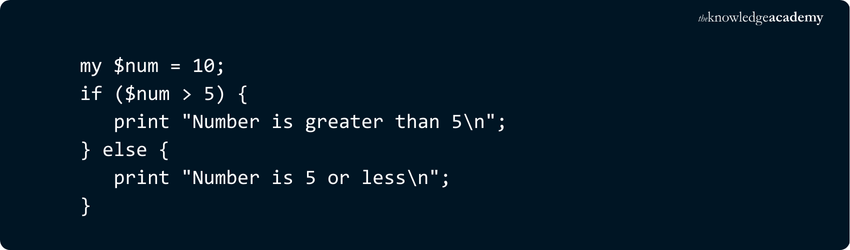
3) Conditional Statements
This program is for the Conditional Statements:
4) Loops
This program is for the Loops:
For Loop

While Loop

Applications of Perl
With its versatile features, Perl finds application across various domains, showcasing its adaptability and usefulness.
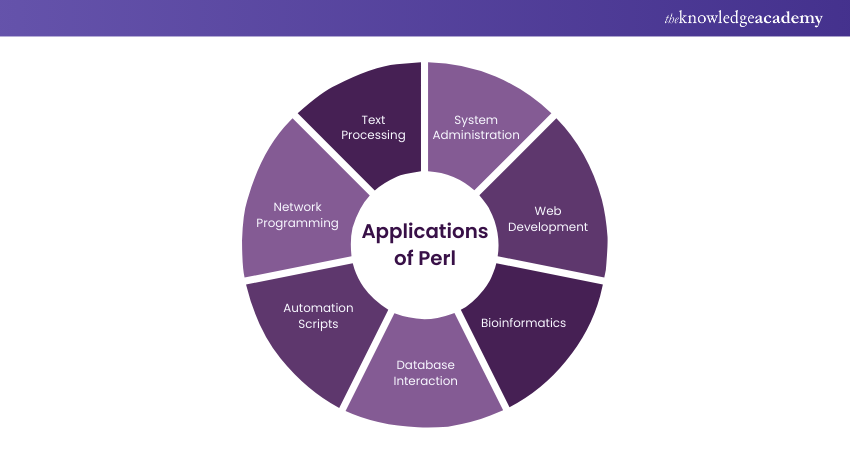
a) System Administration: Perl is extensively used in system administration tasks. Its powerful text processing capabilities make it ideal for managing configuration and log files and automating routine administrative tasks.
b) Web Development: Perl has been a stalwart in Web Development. Common Gateway Interface (CGI) scripts written in Perl were foundational for dynamic web content. While other technologies have gained prominence, Perl remains relevant in Web Development through frameworks like Dancer and Mojolicious.
c) Bioinformatics: Perl plays a vital role in bioinformatics due to its proficiency in handling large datasets and text manipulation. Bioinformaticians use Perl for tasks such as parsing genomic data, running algorithms, and processing biological information.
d) Database Interaction: Perl integrates seamlessly with databases, allowing developers to interact with database systems like MySQL, PostgreSQL, and Oracle. This capability is crucial for building efficient data storage and retrieval applications.
e) Automation Scripts: Perl is widely adopted for creating automation scripts. Its concise syntax and built-in functions make it well-suited for writing scripts that automate repetitive tasks in various domains.
f) Network Programming: Perl's networking capabilities make it suitable for developing network applications. Its modules simplify tasks related to sockets, protocols, and network communication.
g) Text Processing: Perl's roots lie in text processing, a preferred language for handling textual data. It excels in parsing, searching, and transforming text, making it indispensable in data analysis and manipulation.
Enhance your knowledge of R Programming with our R Programming Course today!
Advantages and Disadvantages of Using Perl
Despite its diverse features and applications, Perl comes with a significant mix of advantages and disadvantages that any programmer should consider. Here's a breakdown of Perl's many benefits and drawbacks:
Advantages
a) Text Processing Power: Perl excels in text processing tasks, offering powerful regular expression support and built-in functions for efficient manipulation of textual data.
b) Platform Independence: Perl is platform-independent, allowing scripts written on one operating system to run on others with minimal modifications, and providing excellent cross-platform compatibility.
c) Rich Library Support: Perl boasts a vast library of modules known as Comprehensive Perl Archive Network (CPAN), providing a wealth of ready-to-use functionalities for various applications.
d) Versatility: Perl is a versatile language suitable for various tasks, from Web Development to system administration, making it an excellent choice for diverse projects.
e) Community Support: Perl has an active and dedicated community that contributes to its development, ensuring continuous updates, bug fixes, and a wealth of online resources for learning and problem-solving.
Disadvantages
a) Syntax Complexity: Perl’s syntax, while powerful, can be difficult to read and maintain, especially for beginners. Its TMTOWTDI ("There’s More Than One Way To Do It") philosophy can sometimes lead to inconsistent coding styles.
b) Less Object-oriented: Perl's object-oriented features are less advanced than those in some other languages, making it less suitable for projects where object-oriented solid design is crucial.
c) Slower Execution: Compared to some compiled languages, Perl's interpreted nature can result in slower execution speeds, particularly for compute-intensive tasks.
d) Overreliance on Global Variables: Perl tends to use global variables extensively, which can lead to unintended side effects and make code more complicated to understand and maintain.
e) Lack of Standardised Coding Practices: Due to Perl’s flexibility and multiple ways to achieve the same outcome, teams may struggle to maintain consistent coding standards, making collaboration and long-term maintenance more challenging.
Difference Between Perl and Python
This table summarises the difference between Perl vs Python based on eight parameters:

Implementing Perl in Practice
Perl is a versatile scripting language extensively utilised in system administration, web development, and automation. Its adaptability and robust text-processing capabilities make it suitable for a wide range of practical applications.
Key Areas of Perl Implementation
a) System Administration: Automate tasks such as file management, log analysis, and process monitoring.
b) Web Development: Utilise CGI scripting to create dynamic web pages and handle form data.
c) Database Interaction: Connect to databases using DBI (Database Interface) for data manipulation.
d) Text Processing: Execute complex text parsing, pattern matching, and data extraction with regular expressions.
e) Networking and Security: Develop scripts for network monitoring, security scanning, and encryption.
f) Testing and Automation: Write test scripts for software validation and efficiently automate repetitive tasks.
Future of Perl
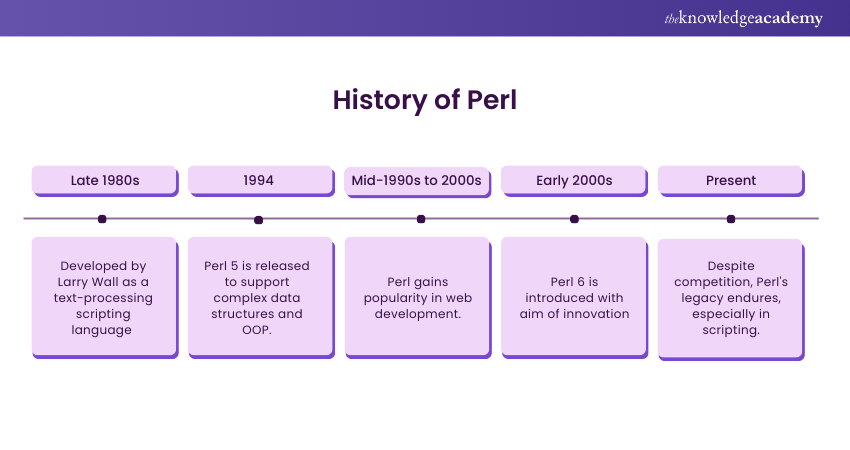
Perl has been around for over 30 years and continues to be relevant in various fields despite the rise of newer languages like Python and Ruby. Its strengths lie in text processing, system administration, and Web Development. Perl's CPAN provides a vast library of modules, making it easy to perform a wide range of tasks.
While Perl may not be as popular as it once was, it still has a dedicated community and remains a powerful tool for specific use cases. Its ability to handle complex text manipulation and integration with Unix systems keeps it valuable for many developers.
Is Perl the Same as PHP?
Perl functions as an independent language system compared to PHP language. Perl functions for general-purpose scripting text processing and system administration, yet PHP delivers solutions for Web Development. Internal operations in Perl achieve maximum automation, while PHP delivers superior performance in dynamic Web Development.
Which Perl is Best for Windows?
Customers looking for the best Perl distribution on Windows should choose Strawberry Perl because it delivers an entire environment that incorporates compilers and libraries. ActivePerl serves enterprises due to its commercial backing while operating as a preferred solution.
Conclusion
Perl is a versatile and powerful scripting language with an extensive collection of modules. Its interpreted nature, rich feature set, and widespread application in system administration, Web Development, and beyond make it a dynamic tool. A clearer understanding of What is Perl and its impactful role in diverse domains will guide you in expanding your prospects and horizons as a developer.
Enhance your skills and learn how to set up a Bootstrap environment and grid system – join our Bootstrap Training now!
Frequently Asked Questions
What is Perl Commonly Used for in Web Development?

In Web Development, Perl is commonly used for server-side scripting to process and generate dynamic content. Its strengths are handling input from web forms, interacting with databases, and creating Common Gateway Interface (CGI) scripts.
Is Perl Still Relevant in Modern Programming?
Yes, Perl remains relevant in modern programming despite the emergence of newer languages. Its strengths in text processing, data manipulation, and system administration continue to be valuable. Perl's extensive library of modules, CPAN repository, and its role in legacy code maintenance ensure its continued use.
What are the Other Resources and Offers Provided by The Knowledge Academy?
The Knowledge Academy takes global learning to new heights, offering over 3,000+ online courses across 490+ locations in 190+ countries. This expansive reach ensures accessibility and convenience for learners worldwide.
Alongside our diverse Online Course Catalogue, encompassing 17 major categories, we go the extra mile by providing a plethora of free educational Online Resources like Blogs, eBooks, Interview Questions and Videos. Tailoring learning experiences further, professionals can unlock greater value through a wide range of special discounts, seasonal deals, and Exclusive Offers.
What is The Knowledge Pass, and How Does it Work?
The Knowledge Academy’s Knowledge Pass, a prepaid voucher, adds another layer of flexibility, allowing course bookings over a 12-month period. Join us on a journey where education knows no bounds.
What are Related Courses and Blogs Provided by The Knowledge Academy?
The Knowledge Academy offers various Programming Courses, including Basic Perl Programming Training, Visual Basic Course, and R Programming Course. These courses cater to different skill levels, providing comprehensive insights into Framework in Programming.
Our Programming & DevOps Blogs cover a range of topics related to Perl, offering valuable resources, best practices, and industry insights. Whether you are a beginner or looking to advance your Programming skills, The Knowledge Academy's diverse courses and informative blogs have you covered.

The Knowledge Academy


Global Training Provider
The Knowledge Academy is a world-leading provider of professional training courses, offering globally recognised qualifications across a wide range of subjects. With expert trainers, up-to-date course material, and flexible learning options, we aim to empower professionals and organisations to achieve their goals through continuous learning.

Upcoming Programming & DevOps Resources Batches & Dates
Date
 Basic Perl Programming Training
Basic Perl Programming Training
Thu 27th Aug 2026
Basic Perl Programming Training
Thu 26th Nov 2026

 If you wish to make any changes to your course, please


