


 Top Rated Course

We may not have the course you’re looking for. If you enquire or give us a call on +420 210012971 and speak to our training experts, we may still be able to help with your training requirements.
What is the Network Layer: The OSI Model Layer 3
John Davies 21 April 2026The Network Layer (OSI Layer 3) routes data between networks using IP addresses, selecting the best path for end-to-end communication across the Internet. It ensures packets reach the correct destination, even when they travel across multiple networks. Without this layer, communication beyond a local network would not be possible.

Training Outcomes Within Your Budget!
We ensure quality, budget-alignment, and timely delivery by our expert instructors.
Table of Contents
Every time you send a message, stream a video, or open a website, data quietly travels across multiple networks to reach you. Behind the scenes, this journey depends on smart routing decisions and accurate addressing to make sure information arrives quickly and correctly. That is where the Network Layer plays a crucial role in modern networking.
This blog explains what the Network Layer is, its key responsibilities, and the Network Protocols that enable efficient data transfer across networks. Let’s explore how this layer keeps data moving smoothly across the Internet.
Table of Contents
1) What is the Network Layer?
2) What is the OSI Model?
3) What Happens at the Network Layer?
4) Key Responsibilities of the Network Layer
5) Understanding Packets in Networking
6) Protocols Used in the Network Layer
7) Advantages of the Network Layer
8) Limitations of the Network Layer
9) What is the TCP/IP Model for Network Layers?
10) Network Layer vs Internet Layer
11) Conclusion
What is the Network Layer?
The Network Layer is the third layer of the Open Systems Interconnection (OSI) model, enabling data transfer between devices on different networks. It handles logical addressing using Internet Protocol (IP) addresses and selects efficient routes for data delivery. This ensures information reaches the correct destination beyond a single local network.
What is a Network?
A network is a group of connected devices that share data and resources. These devices usually connect through networking equipment such as routers or switches, allowing them to communicate smoothly. Large networks are often divided into smaller subnetworks to improve performance, manage traffic efficiently, and simplify IP Address allocation.

What is a Packet?
When data is sent across a network, it is split into small units called packets. Each packet contains a header with source and destination IP addresses and a payload. At the Network Layer, headers direct routing protocols to select the best path for reliable Internet communication.
What is the OSI Model?
The OSI model is a framework that explains how data moves from one computer to another over a network. It has seven layers:
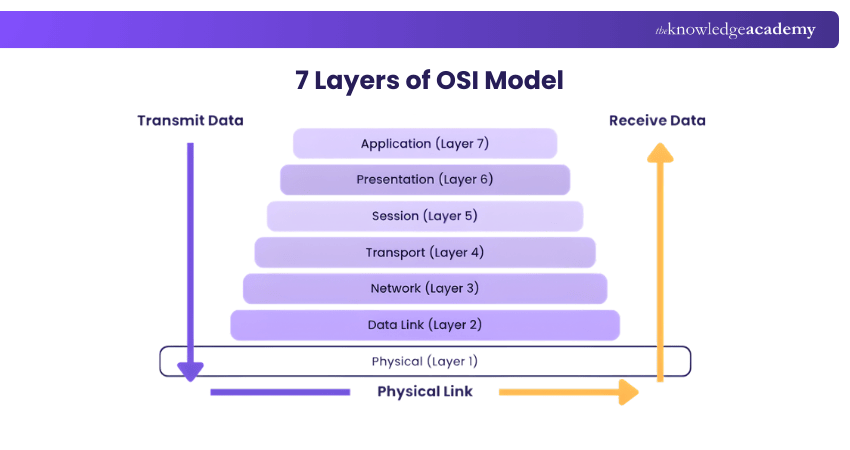
1) Physical Layer: It works with hardware, like cables and signals.
2) Data Link Layer: It makes sure data is transferred between two directly connected devices.
3) Network Layer: It transfers data between different networks.
4) Transport Layer: It ensures reliable data delivery.
5) Session Layer: It handles sessions between applications.
6) Presentation Layer: It is used for formatting or translating data.
7) Application Layer: It is used for providing services where clients interact with the network, such as websites and apps.
The Network Layer has an important role in linking several networks together and deciding how data is routed.
What Happens at the Network Layer?
The Network Layer handles inter-network communication and data transfer. It helps set up routes for data packets, verifies remote servers, and handles sending and receiving IP packets between networks. As the Internet traffic relies on Internet Protocol (IP) for delivery, this process becomes extremely important.
The Network Layer is also responsible for logical addressing and path selection to ensure data reaches the correct destination efficiently. It manages packet forwarding, fragmentation, and reassembly when data travels across different networks. By handling these tasks, the Network Layer plays a critical role in maintaining reliable and organised communication across the internet.
Learn to design, implement, and troubleshoot networks. Join our CCNP Training (Cisco Certified Network Professional) now!
Key Responsibilities of the Network Layer
The Network Layer handles IP addressing, routing, and packet delivery across networks. It ensures that data reaches its correct destination efficiently. Let’s explore the main jobs of the Network Layer:
1) Logical Addressing (IP Addressing): Assigns unique IP addresses to devices so data can be sent and received correctly across networks.
2) Routing and Forwarding: Determines the best path for data and forwards packets through routers to reach the destination efficiently.
3) Packetisation: Converts data into small packets so it can be transmitted efficiently across networks.
4) Fragmentation and Reassembly: Breaks large packets into smaller fragments for transmission and reassembles them correctly at the destination.
5) Host-to-Host Delivery: Ensures data is delivered from the source device to the correct receiving device, even across multiple networks.
6) Network Diagnostics and Error Handling: Supports error reporting and troubleshooting using tools like ping and traceroute.
Understanding Packets in Networking
Data is sent across networks in small units called packets. Each packet has two main parts:
1) Header: It includes essential information like the source and destination IP addresses.
2) Payload: It contains the actual data being transferred.
This layer is accountable for creating, addressing and managing these packets as they travel from one device to another.
Protocols Used in the Network Layer
Many protocols help the Network Layer function smoothly. These are the main protocols:
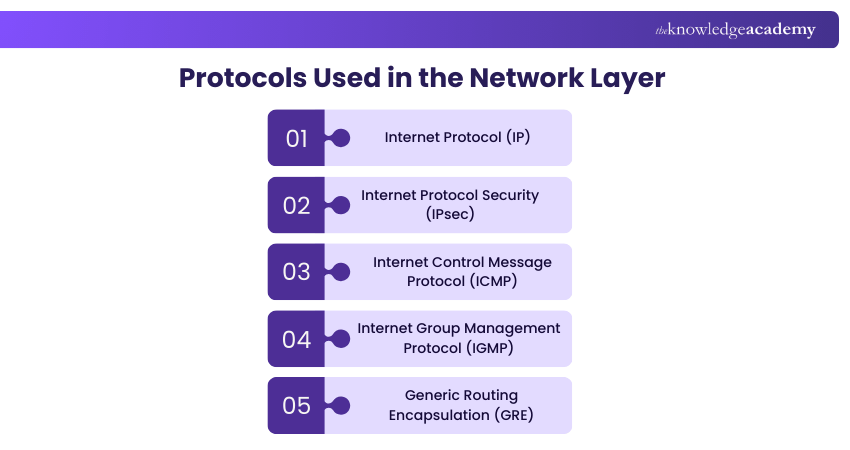
a) Internet Protocol (IP): Defines addressing and routing for data packet delivery.
b) Internet Protocol Security (IPsec): Encrypts and secures data sent across networks.
c) Internet Control Message Protocol (ICMP): Sends error reports and network connectivity messages.
d) Internet Group Management Protocol (IGMP): Manages multicast group memberships within local networks.
e) Generic Routing Encapsulation (GRE): Creates tunnels to transport data between network nodes securely.
Boost your networking career with our industry-recognised Cisco Courses today!
Advantages of the Network Layer
The Network Layer plays an important role in enabling communication across networks. It ensures that data is delivered accurately, efficiently, and at scale. Below are the main advantages:
1) End-to-End Delivery: Enables data to travel from the source to the destination over multiple interconnected networks.
2) Efficient Routing: Selects the best available path for packets, ensuring faster and more reliable data delivery.
3) Scalability: Supports large and growing networks through hierarchical IP addressing.
4) Interoperability: Allows different network technologies and devices to communicate seamlessly.
5) Traffic Management: Reduces congestion by using routers to manage and control data flow.
6) Packetisation: Breaks data into packets, making transmission more efficient and fault-tolerant.
7) Abstraction: Hides complex network details from applications, simplifying Application Development.
8) Improved Reliability: Enhances data integrity using path optimisation and error-handling mechanisms.

Disadvantages of the Network Layer
While the Network Layer enables data delivery across networks, it also has limitations that can impact performance, reliability, and security. Below are the main disadvantages:
1) Traffic Congestion: Heavy data flow can overload routers, resulting in packet drops and reduced network speed.
2) Processing Overhead from Fragmentation: Dividing large packets into smaller pieces increases workload and can slow performance.
3) Weak Error Handling: The Network Layer delivers packets but depends on the Transport Layer for error correction.
4) Operational Complexity: Adds complexity to network design, management, and troubleshooting, particularly in advanced configurations.
5) Security Risks: Can be targeted by cyber threats if proper network-level security measures are not in place.
6) NAT Limitations: Network Address Translation (NAT) may interfere with end-to-end communication in certain applications.
What is the TCP/IP Model for Network Layers?
The TCP/IP model uses a four-layer structure to explain how data moves across networks. Below are the key layers and their roles in Internet communication:
1) Application Layer: Supports user-level services such as web browsing, email, file transfer, and domain name resolution.
2) Transport Layer: Controls end-to-end data delivery using Transmission Control Protocol (TCP) for reliability and User Datagram Protocol (UDP) for faster, connectionless communication.
3) Internet Layer: Manages IP addressing and routes data packets between networks.
4) Network Access Layer: Handles physical data transmission over network hardware like Ethernet and Wi-Fi.
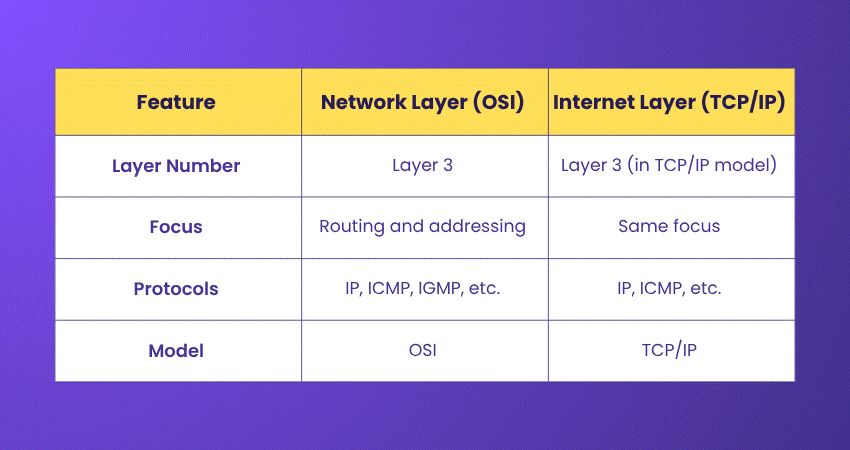
Network Layer vs Internet Layer
These are the main differences between the Network Layer and the Internet Layer:
Conclusion
From routing decisions to secure packet delivery, the Network Layer quietly powers every online interaction. Understanding its mechanics is not just technical knowledge; it is the key to creating resilient and high-performing systems. In a world where connectivity defines progress, this layer reminds us that even the unseen foundations deserve our attention.
Gain knowledge of how to secure the routing and switching infrastructure. Join our Cisco IOS Network Security Training now!
Frequently Asked Questions
What Happens if the Network Layer Fails?

If the Network Layer fails, data cannot be routed between networks. This can cause websites to stop loading, services to become unreachable, and communication beyond the local network to fail.
Can you Give an Example of a Real-world Scenario Where Network Layers are Crucial?
When you send an email to a friend abroad, the Application Layer manages your email client, the Transport Layer ensures the message is delivered correctly, and the Network Layer directs it through multiple networks. Each step follows the structured principles of the OSI model.
What are the Other Resources and Offers Provided by The Knowledge Academy?
The Knowledge Academy takes global learning to new heights, offering over 3,000+ online courses across 490+ locations in 190+ countries. This expansive reach ensures accessibility and convenience for learners worldwide.
Alongside our diverse Online Course Catalogue, encompassing 19 major categories, we go the extra mile by providing a plethora of free educational Online Resources like Blogs, eBooks, Interview Questions and Videos. Tailoring learning experiences further, professionals can unlock greater value through a wide range of special discounts, seasonal deals, and Exclusive Offers.
What is The Knowledge Pass, and How Does it Work?
The Knowledge Academy’s Knowledge Pass, a prepaid voucher, adds another layer of flexibility, allowing course bookings over a 12-month period. Join us on a journey where education knows no bounds.
What are the Related Courses and Blogs Provided by The Knowledge Academy?
The Knowledge Academy offers various Cisco Training, including the Designing Cisco Enterprise Networks (ENSLD) Training, CCNP Training (Cisco Certified Network Professional), and the CCNP Security Training. These courses cater to different skill levels, providing comprehensive insights into What is a Router.
Our IT Infrastructure & Networking Blogs cover a range of topics related to Network Layer, offering valuable resources, best practices, and industry insights. Whether you are a beginner or looking to advance your IT Infrastructure & Networking skills, The Knowledge Academy's diverse courses and informative blogs have got you covered.

John Davies


Cyber Security Governance & Assurance Specialist
John Davies is a cybersecurity expert specialising in governance, risk management, and compliance. With over 15 years in the field, he has led enterprise-wide security programmes across finance, healthcare and public sector organisations. His content provides practical guidance on building secure environments, managing risk and aligning with regulatory frameworks.

Upcoming IT Infrastructure & Networking Resources Batches & Dates
Date
 Cisco Wireless Network Fundamentals Training
Cisco Wireless Network Fundamentals Training
Thu 20th Aug 2026
Cisco Wireless Network Fundamentals Training
Mon 19th Oct 2026
Cisco Wireless Network Fundamentals Training
Thu 19th Nov 2026

 If you wish to make any changes to your course, please


