


 Top Rated Course

We may not have the course you’re looking for. If you enquire or give us a call on +420 210012971 and speak to our training experts, we may still be able to help with your training requirements.
What is Internal Business Environment? A Comprehensive Guide
Amelia Williams 03 February 2026The internal environment of a business refers to the factors and conditions within the organisation that influence its operations, decision-making and performance. This blog takes a deep dive into the Internal Business Environment, exploring its elements, benefits, and the way to build such an environment. Read on to learn more!

Training Outcomes Within Your Budget!
We ensure quality, budget-alignment, and timely delivery by our expert instructors.
Table of Contents

A business or an organisation is much like an organism that stays alive and kicking, thanks to the workforce that resides in it. In that context, the Internal Business Environment is the heartbeat of any organisation, shaping how it operates, evolves, and thrives. It refers to the culture, leadership, resources, and relationships that help drive day-to-day success and long-term business growth.
This blog explores in detail what makes the Internal Business Environment so integral to keeping teams united and innovation flowing in any organisation. So read on and harness its power for your own business!
Table of Contents
1) What is the Internal Environment?
2) Factors Influencing Internal Environment
3) The Importance of internal environment
4) How to Build a Positive Internal Environment?
5) Difference Between Internal and External Environment
6) Advantages of a Well-managed Internal Environment
7) Conclusion
What is the Internal Environment?
The internal environment of a business, sometimes referred to as workplace culture, encompasses the following elements of an organisation:
1) Climate
2) Culture
3) Work processes
4) Members
5) Management
6) Equipment
This environment influences (and is influenced by) the decisions, activities, and behaviours, particularly of the Human Resource.
Members of an internal environment include all individuals directly or indirectly associated with the organisation, such as owners, shareholders, directors, and employees. It plays an important role in shaping team dynamics and decision-making, making it a vital aspect of any successful organisation.

Factors Influencing Internal Environment
From physical resources and Human Resource to Labour Management and policies, there are multiple factors that influence an Internal Business Environment and highlight their interconnectedness, which drives organisational performance and culture. Let’s explore them in detail:
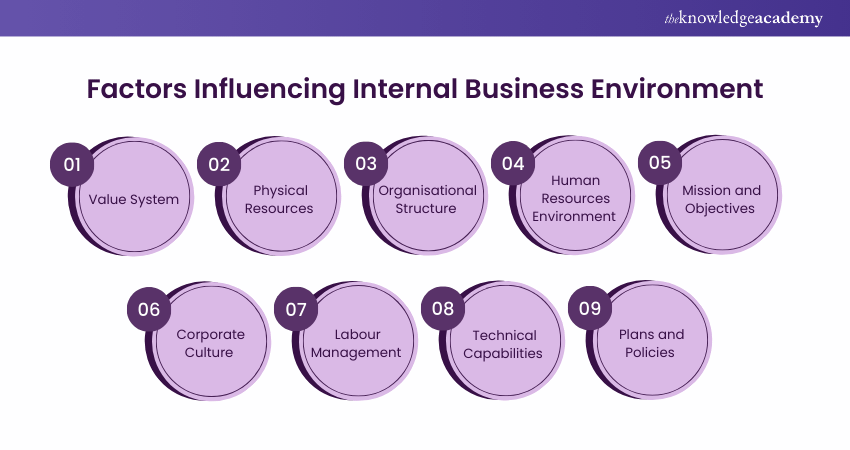
Value System
The value system, also referred to as an organisation's philosophy, covers its work processes, culture, norms, and climate, basically defining how it operates and treats employees and customers. It guides employees in performing their duties within its framework.
Physical Resources
Physical resources refer to the tangible assets of an organisation, such as machinery and tools. These resources are crucial to an organisation’s success, and modern assets offer a significant competitive advantage.
For instance, an organisation with automated machinery can achieve higher productivity in less time compared to one that relies on manually operated equipment. Consequently, companies prioritise acquiring advanced mechanisms and regularly update them to improve production efficiency and maximise profits.
Organisational Structure
Organisational structure outlines how information must flow within an organisation and the roles of the Board of Directors, Management, and Shareholders. Its impact on decision-making is significant as more management levels can cause more delays.
For instance, organisations with four management levels may take longer to address worker issues than those with fewer levels. In these circumstances, the board of directors with effective managerial skills plays a key role in critical decisions and policy design.
Looking for strategies for continuous employee development? Sign up for our Learning and Development Courses now!
Human Resources Environment
Human resources professionals are the key players in shaping internal cultures. They do this by managing employee recruitment, including the Advantages of Internal Recruitment, and addressing workplace concerns. Companies with an effective HR department are better equipped to build stronger relationships between team members and Upper Management. This is because HR is a vital link, facilitating Secure Internal Communication and understanding between leadership and employees.

Mission and Objectives
The mission and objectives of an organisation are what decide the future position of the organisation and its place in the market. Every business plan is developed, and every resource is utilised with the goal of achieving the objectives of the organisation’s internal environment.
Corporate Culture
Corporate culture, also known as organisational culture, refers to the beliefs, values, and assumptions shared by an organisation’s management and Employees. This element of an organisation shapes its unique social and psychological ethos and influences employee interactions, decision-making processes, and information sharing. Corporate culture evolves from the following:
a) Collective beliefs
b) Value systems
c) Management strategies
d) Communication
e) Workplace environment
Over time, it has grown to include company origin stories, often driven by charismatic CEOs and visual symbols like logos and trademarks. This culture defines how an organisation operates and creates a distinct identity that impacts both internal dynamics and external perceptions.
Labour Management
The individuals responsible for creating and delivering a business’s products or services are collectively called its workforce or labour. Labour Management involves the practices and standards a company adopts to align with international principles, national laws, and customer expectations regarding labour. Many of these standards are also legal requirements.
So, Labour Management essentially drives how an organisation manages its employees and labourers, influencing its internal environment in the process. Businesses are typically expected to ensure safe, fair workplaces with ethical practices in areas such as employment terms, hiring and wages.
Learn to manage culture change in your organisation with our Organisational Culture Change Course - Register now!
Technical Capabilities
Technical capabilities refer to an organisation’s technical expertise and the technologies it employs. Much like physical resources, organisations equipped with advanced technology can gain significant competitive advantage over their rivals. In today’s tech-driven era, the importance of technical capabilities grows every day. It plays a crucial role in improving efficiency, innovation, and overall competitiveness.
Plans and Policies
Plans and policies are essential internal factors that guide an organisation's operations and decision-making. While plans outline strategic goals and the steps needed for growth, policies provide rules governing behaviour and processes. Together, they promote efficiency and accountability, supporting crucial elements such as:
a) Resource Management
b) Risk mitigation
c) Alignment with long-term objectives
Regularly reviewing and updating these frameworks helps organisations be responsive to external changes. For instance, Human Resource professionals address employee concerns by referring to company policies. Clear and well-structured policies enhance organisational efficiency and provide a foundation for effective decision-making.
Understand team dynamics and how to nurture collaboration and trust in your organisation in our comprehensive Team Development Training - Sign up now!
The Importance of Internal Environment
The internal environment of a business is essential for the following reasons:
1) It is easier to control those factors within the company than in the external business environment.
2) It determines how much an establishment can leverage external environmental factors for organisational success.
3) It helps Management, Executives, and Supervisors oversee and measure employee productivity and progress.
4) It creates, communicates and delivers market offerings by firm, whether tangible or intangible.
5) It impacts the culture and environment of companies by sharing information about organisational values and ideals.
6) It encourages learning and increases job satisfaction.
How to Build a Positive Internal Environment?
Now that you’ve a deeper insight into the elements, benefits and core factors that make a positive Internal Business Environment essential, let’s explore the steps to build such an environment.
Encourage Open Communication
a) Encourage transparent and open communication channels across the organisation.
b) Create a culture where employees feel confident sharing ideas, concerns, and feedback.
c) Build a collaborative environment that supports informed decision-making and timely problem-solving.
Cultivate Strong Leadership
a) Invest in developing effective and supportive leaders.
b) Offer leadership training and mentorship programs. This will equip Managers with the skills to inspire and guide their teams.
c) Build a strong leadership team to set a positive tone for the organisation and enhance employee morale.
Elevate Employee Engagement
a) Develop initiatives to boost employee engagement and satisfaction.
b) Recognise and reward employees for their achievements.
c) Give people the chance to grow their careers and acquire new skills.
d) Promote work-life balance to support employee well-being.
e) Encourage engagement to foster commitment and motivation, driving organisational success, with a focus on Leadership Team Development to align leaders with employees' goals.
Set Clear Goals and Values
a) Establish clear organisational goals and values that resonate with employees.
b) Effectively communicate these objectives across all levels of the organisation.
c) Ensure employees understand the company’s purpose and direction.
d) Foster alignment of employee efforts with organisational goals to drive success.
Foster a Culture of Continuous Improvement
a) Promote a culture of innovation.
b) Encourage employees to take calculated risks and think creatively.
c) Create an environment that embraces change and seeks growth opportunities.
d) Enable the organisation to remain competitive and adaptable in a dynamic business landscape.
Master essential strategies for managing time and resources efficiently in our Organisational Skills Course - Register now!
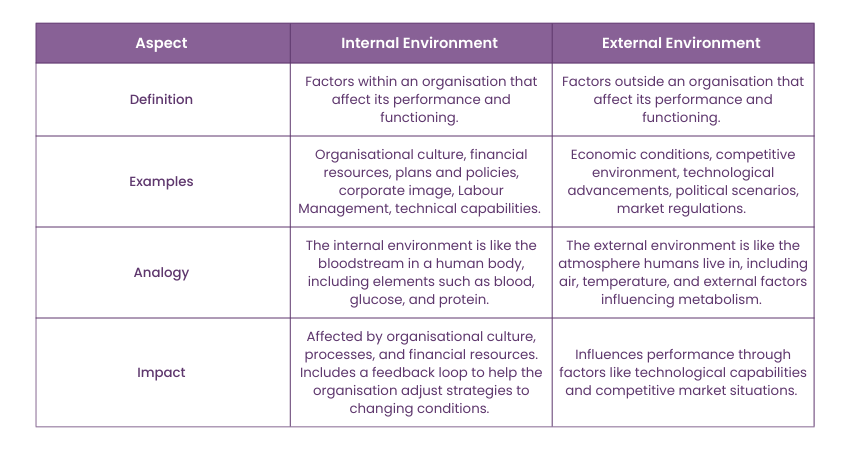
Difference Between Internal and External Environment
Here are the key differences between internal and external environments:
Advantages of a Well-managed Internal Environment
A well-managed internal environment offers numerous benefits to businesses:
1) Increased Employee Engagement: Positive culture and effective Management are proven to boost satisfaction, loyalty, and productivity while reducing turnover.
2) Increased Efficiency: Clear structure and resource allocation help reduce waste, streamline processes, and improve cost-effectiveness.
3) Strategic Alignment: Well-defined goals can ensure teamwork and more focused efforts toward organisational success.
4) Promotes Innovation: Supportive culture fuels creativity and adaptability. It also inspires more agile responses to market changes.
5) Better Decision-making: Open communication and shared values enable informed and strategic decisions.
6) Employee Empowerment: Inclusivity is the key to ownership and confidence. It drives motivation to assure growth.
7) Labor Harmony: Constructive union collaboration improves labour relations and benefits all the parties involved.
8) Long-term Sustainability: Strong internal foundations are key to resilience and adaptability for any business. It ensures sustained success even in challenging times.
Conclusion
The Internal Business Environment forms the backbone of organisational success, impacting everything from culture to strategy. As this blog outlines, businesses can unlock their full potential by embracing the elements of a good internal environment, such as strong leadership, clear goals, and a positive workplace culture. It's the key to a business' adaptability and resilience in an ever-changing world.
Learn how to develop a continuous improvement plan and schedule without any hiccups in our Business Process Improvement Training - Sign up now!
Frequently Asked Questions
What are Five Internal Environments?

The five key internal environments in a business are:
a) Management
b) Culture
c) Resources
d) Processes
e) Structure
What is Internal Environment Analysis?
An internal environmental analysis is an extensive review of a company's operations, internal guidance and mission. Aspects of operations typically reviewed are:
a) Marketing strategy
b) Production capacity
c) Company's vision and leadership
What are the Other Resources and Offers Provided by The Knowledge Academy?
The Knowledge Academy takes global learning to new heights, offering over 3,000+ online courses across 490+ locations in 190+ countries. This expansive reach ensures accessibility and convenience for learners worldwide.
Alongside our diverse Online Course Catalogue, encompassing 19 major categories, we go the extra mile by providing a plethora of free educational Online Resources like Blogs, eBooks, Interview Questions and Videos. Tailoring learning experiences further, professionals can unlock greater value through a wide range of special discounts, seasonal deals, and Exclusive Offers.
What is The Knowledge Pass, and How Does it Work?
The Knowledge Academy’s Knowledge Pass, a prepaid voucher, adds another layer of flexibility, allowing course bookings over a 12-month period. Join us on a journey where education knows no bounds.
What are the Related Courses and Blogs Provided by The Knowledge Academy?
The Knowledge Academy offers various Learning and Development Courses, including the Training Needs Analysis Course and the Organisational Culture Change Training. These courses cater to different skill levels, providing comprehensive insights into Top 9 HR Analytics Tools for Tools for a Smarter Workforce.
Our Project Management Blogs cover a range of topics related to Internal Business Environment, offering valuable resources, best practices, and industry insights. Whether you are a beginner or looking to advance your HR skills, The Knowledge Academy's diverse courses and informative blogs have got you covered.

Amelia Williams


Senior Human Resources Consultant and Learning Specialist
Amelia Williams is a highly respected HR professional with over 12 years of experience in human capital management, talent development and workplace policy. She has worked across sectors including education, healthcare and corporate services, focusing on aligning people strategies with organisational goals. Amelia’s writing blends current HR trends with practical solutions for modern workplace challenges.

Upcoming HR Resources – Learn about Human Resources Batches & Dates
Date
 Organisational Culture Change Masterclass
Organisational Culture Change Masterclass
Fri 10th Jul 2026
Organisational Culture Change Masterclass
Fri 9th Oct 2026

 If you wish to make any changes to your course, please


