


 Top Rated Course

We may not have the course you’re looking for. If you enquire or give us a call on +420 210012971 and speak to our training experts, we may still be able to help with your training requirements.
Business Impact Analysis (BIA): What it is and How to Conduct
William Brown 15 July 2026Business Impact Analysis (BIA) assesses how disruptions affect critical operations, defining recovery priorities and supporting business continuity planning. It helps prioritise critical functions and resources. This process also supports faster decision-making during unexpected incidents through better insight and communication.

Training Outcomes Within Your Budget!
We ensure quality, budget-alignment, and timely delivery by our expert instructors.
Table of Contents

Organisations must be prepared for disruptions that can impact operations, services, and overall performance. Business Impact Analysis (BIA) is a structured process that identifies how incidents affect critical business functions, resources, and systems. By assessing potential downtime and operational consequences, BIA helps organisations strengthen business continuity planning and reduce operational risks.
In this blog, we will explore what BIA is, how to conduct a Business Impact Analysis, and why it is essential for business continuity and disaster recovery planning. We will also cover key components, benefits, challenges, and best practices to help organisations improve resilience and recovery decision making.
Table of Contents
1) What is Business Impact Analysis (BIA)?
2) How to Conduct a Business Impact Analysis?
3) Importance of Business Impact Analysis
4) Key Components of Business Impact Analysis Report
5) Challenges in Business Impact Analysis
6) Business Impact Analysis vs Risk Assessment
7) Conclusion
What is Business Impact Analysis (BIA)?
Business Impact Analysis (BIA) is a comprehensive methodology to evaluate the impact of disruptions on an organisation's essential activities and business processes. It studies the interdependence of human resources, technology, infrastructure, and systems. Consequently, this enables organisations to rank their needs and develop effective continuity of plans.
The first step in the procedure is to pinpoint the fundamental business functions. Subsequently, it assesses the potential internal and external threats that might hinder these operations. Understanding a hazard's probability and severity helps organisations choose the appropriate reaction.

How to Conduct a Business Impact Analysis?
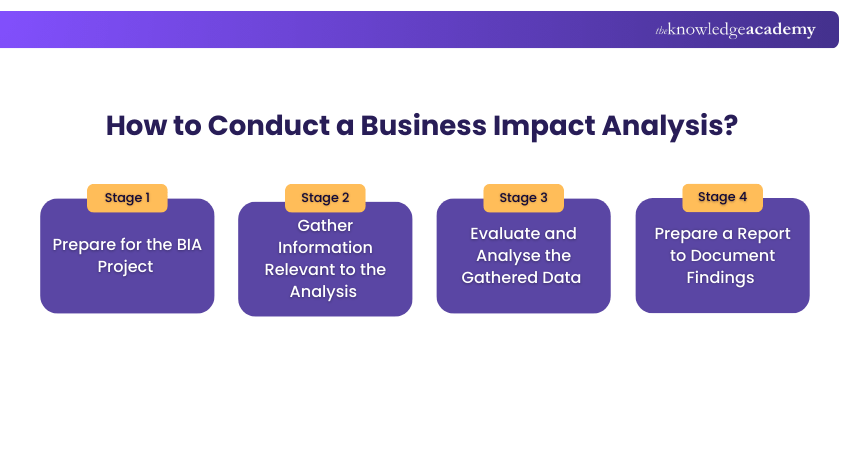
Conducting a thorough Business Impact Analysis requires a structured approach that involves several key steps. By following these steps, organisations can systematically assess the potential impacts of disruptions on their critical business functions and develop effective strategies for business continuity. Here are the steps to conduct a BIA:
Prepare for the BIA Project
The BIA effort should be conducted in a similar manner as an ordinary project, starting with getting formal approval from top management. The process consists of creating a detailed plan and recruiting a team of skilled people either from the company or outside.
Gather Information Relevant to the Analysis
The procedure brings to light the functions, systems, people and technology that are indispensable for the company to operate, aligning the analysis with Business Analysis frameworks for structured and effective evaluation. Interviews, questionnaires, and documentation are common methods that organisations use to gather this type of information.
Evaluate and Analyse the Gathered Data
The study outlines the impacts and results of disruptions to essential business operations and, at the same time, estimates their financial and non-financial costs. It also takes into account the interdependence, recovery timeframes (RTO, RPO), and points of failure with the least resistance to rank the business activities.
Prepare a Report to Document Findings
A BIA report records the results of the study, revealing the possible risks and weaknesses that are characteristic of the company. Besides that, it offers the planning elements that explain the approaches of reducing the consequences of unforeseen incidents.
Learn about business finance with BCS Foundation Certificate in Organisational Behaviour Course!
Importance of Business Impact Analysis
BIA plays a critical role in proactively managing risks and developing effective business continuity strategies. Here are some key reasons why BIA is important for organisations:
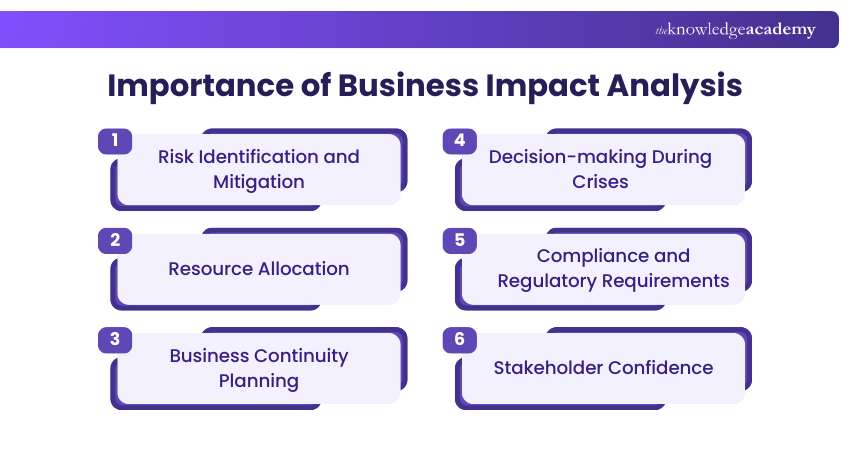
1) Risk Identification and Mitigation: BIA identifies risks affecting critical functions, enabling proactive Risk Management to minimise disruption impact.
2) Resource Allocation: BIA prioritises critical business functions, ensuring resources are aligned with recovery needs and business priorities.
3) Business Continuity Planning: BIA underpins business continuity and disaster recovery by guiding recovery objectives, alternate arrangements, and backup systems.
4) Decision-making During Crises: BIA provides impact insights that support rapid, data-driven decisions to minimise downtime and losses.
5) Compliance and Regulatory Requirements: BIA supports business continuity and disaster recovery compliance by demonstrating organisational preparedness to regulators.
6) Stakeholder Confidence: BIA strengthens trust among stakeholders by showcasing a proactive approach to resilience and continuity.
Lists next steps for implementing BIA outcomes - Enhance your Business Analysis skills with our BCS Certificate in Business Analysis Practice!
Key Components of Business Impact Analysis Report
Business Impact Analysis is structured around clear components that guide organisations from understanding risk to planning recovery. Each element plays a vital role in assessing impact, prioritising functions, and shaping effective continuity strategies. Together, they ensure informed decisions and operational resilience.
1) Executive Summary
a) Provides a high-level overview of objectives, scope, and key outcomes.
b) Summarises critical risks, impacts, and priorities for leadership.
c) Enables quick understanding and executive decision-making.
2) Methodology
a) Outlines how data is collected, analysed, and validated.
b) Defines tools, timelines, and stakeholder involvement.
c) Ensures consistency, accuracy, and transparency in assessment.
3) Findings and Recommendations
a) Presents identified impacts on critical functions.
b) Highlights priority areas and improvement gaps.
c) Guides actionable steps for risk reduction and continuity.
4) Risk Assessment
a) Identifies threats that could disrupt operations.
b) Evaluates likelihood and severity of each risk.
c) Supports proactive Risk Management planning.
5) Recovery Strategies
a) Defines recovery objectives and timelines.
b) Establishes alternate processes and backup solutions.
Ensures rapid restoration of critical functions.Interested in Business Analysis Training? Try our BCS Certificate in Requirements Engineering!
Challenges in Business Impact Analysis
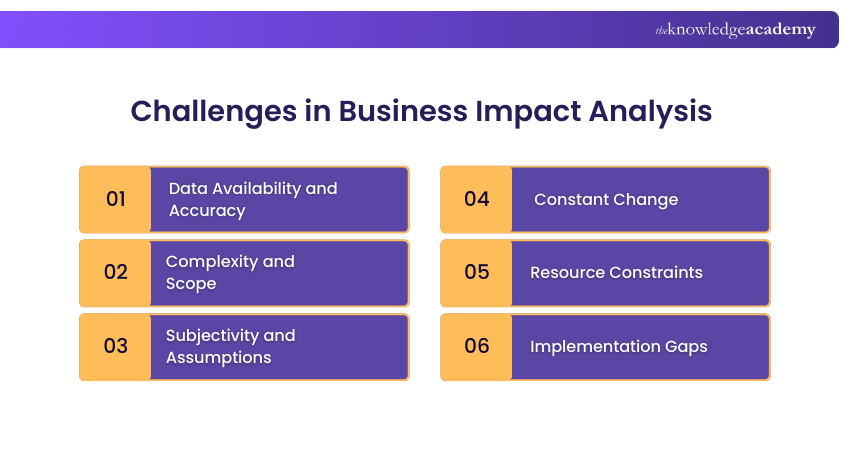
While Business Impact Analysis offers strong value, it also involves practical limitations that organisations must manage. Here are some of the common challenges organisations may face when conducting a BIA:
1) Data Availability and Accuracy: Gathering reliable and current information can be difficult. Missing or outdated data on critical functions and dependencies can reduce accuracy.
2) Complexity and Scope: BIA requires analysing multiple functions and interdependencies. This makes the process time-consuming, especially for large or complex organisations.
3) Subjectivity and Assumptions: Impact assessments often rely on judgment. These assumptions may not fully reflect real situations, creating gaps in analysis.
4) Constant Change: New risks and dependencies emerge over time. Without regular reviews, BIA findings can quickly lose relevance.
5) Resource Constraints: A thorough BIA needs time, expertise, and commitment. Limited resources can restrict the depth of assessment.
6) Implementation Gaps: Insights must be converted into clear actions. Many organisations struggle to apply recommendations effectively.
Business Impact Analysis vs Risk Assessment
Business Impact Analysis (BIA) focuses on understanding how disruptions affect an organisation’s critical operations, resources, and services. It helps identify which functions are most essential and defines recovery priorities, ensuring organisations know what must be restored first to maintain continuity and resilience.
Risk Assessment, on the other hand, identifies potential threats, evaluates how likely they are to occur, and measures their possible impact. While BIA looks at the consequences of disruption, Risk Assessment examines what could go wrong. Together, they provide a complete view of risk exposure and preparedness.
Conclusion
Business Impact Analysis (BIA) is essential for understanding how disruptions affect an organisation’s critical operations, resources, and processes. By identifying key functions, assessing potential impacts, and defining recovery priorities, BIA supports effective business continuity planning. A well-structured BIA helps organisations respond confidently to disruptions, minimise operational downtime, and strengthen long-term organisational resilience.
Interested in Business Analysis Training? Try our BCS Foundation Certificate in Business Analysis Course!
Frequently Asked Questions
What Does Business Impact Analysis Address?

Business Impact Analysis deals with the matter of how a disruption is going to affect the crucial parts of an organisation, such as functions, resources, and processes.
What are the Two Types of BIA?
The two types of BIA are tactical BIA and strategic BIA. Tactical BIA focuses on short-term operational impacts and recovery planning, while strategic BIA takes a broader view, assessing long-term consequences, dependencies, and aligning continuity plans with business objectives.

William Brown


Senior Business Analyst and Strategic Advisor
William Brown is a senior business analyst with over 15 years of experience driving process improvement and strategic transformation in complex business environments. He specialises in analysing operations, gathering requirements and delivering insights that support effective decision making. William’s practical approach helps bridge the gap between business goals and technical solutions.
View Detail

 If you wish to make any changes to your course, please


