


 Top Rated Course

We may not have the course you’re looking for. If you enquire or give us a call on +41 315281584 and speak to our training experts, we may still be able to help with your training requirements.
What is Solana: A Guide to the Blockchain
Richard Harris 13 July 2026Solana is a fast, low-cost Layer 1 blockchain for dApps, NFTs, and gaming, using Proof of History and Proof of Stake with SOL as its native token. As a result, it enables rapid processing with minimal congestion. This strong foundation supports a growing ecosystem driving innovation across DeFi, NFTs, and Web3 applications.

Training Outcomes Within Your Budget!
We ensure quality, budget-alignment, and timely delivery by our expert instructors.
Table of Contents
Solana is a lightning-fast, low-cost gateway to the decentralised future. Designed for speed and scalability, it powers everything from NFTs to DeFi with astonishing efficiency. With the global Blockchain Technology market size projected to grow to £295 billion by 2032, Solana is riding this wave of digital revolution.
But what makes it tick, and why is it gaining so much traction? In this blog, we’ll break down the magic behind What is Solana, explore its unique consensus model, and show you how it’s reshaping the Blockchain landscape, one transaction at a time. So read on and explore this game-changer of a Blockchain!
Table of Contents
1) What is Solana (SOL)?
2) History of Solana
3) How Does Solana Work?
4) Features of Solana
5) What Makes Solana Blockchain Unique?
6) How to Begin Making Investments in Solana?
7) Solana vs Ethereum
8) How is Solana Different From Bitcoin?
9) Is Solana a Buy, Hold, or Sell?
10) Conclusion
What is Solana (SOL)?
Solana is a powerful open-source Blockchain platform designed to support Decentralised Applications (dApps) and crypto assets at scale. It uses a novel hybrid consensus mechanism that combines Proof of Stake (PoS) with the distinctive “Proof of History” (PoH) timestamping system. This enables faster processing of transactions while maintaining decentralisation.
On Solana, its native token, SOL, serves multiple roles:
1) Transaction fee payment
2) Staking for network security
3) Participation in governance
The network boasts ultra-low fees and claims support for thousands of transactions per second (TPS), positioning it as a rival to older platforms like Ethereum in the DeFi, NFT and Web3 space.

History of Solana
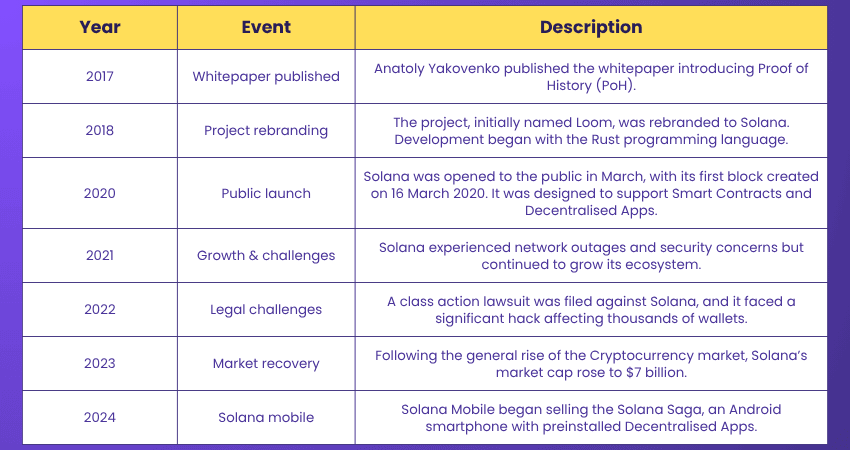
Solana Co-Founder Anatoly Yakovenko's prior work experience included the field of Distributed Systems Design with prominent technology companies like Qualcomm Incorporated (QCOM). This experience made him realise that a reliable clock simplifies network synchronisation, and the resulting network would perform exponentially faster.
Yakovenko predicted that using Proof-of-History would speed up the Blockchain tremendously as compared to Blockchain systems without clocks (Bitcoin and Ethereum). These systems struggled to scale beyond 15 transactions per second (TPS), which is a fraction of the throughput handled by centralised payment systems such as Visa (V).
1) Proof-of-History Concept
In November 2017, Yakovenko published a white paper detailing the proof-of-history (PoH) concept. PoH enables the Blockchain to reach consensus by verifying the passage of time between events. This consensus is used to encode the passage of time into a ledger.
In the white paper, Yakovenko noted that the publicly available Blockchains did not rely on time. Each node in the network depended on its own local clock without any knowledge of other participants' clocks. This meant that when a message timestamp was used to accept or reject a message, there was no guarantee that other participants would make the same decision.
2) Expansion
In 2018, Yakovenko co-founded a project called Loom along with five others. However, due to the possibility of confusion with an Ethereum-based project of a similar name, they renamed it to "Solana,". This name was chosen after the small beach town near San Diego, where the co-founders previously lived.
In June 2018, the project was scaled up to run on cloud-based networks. A month later, the company posted a public test net which supported bursts of up to 250,000 TPS.
How Does Solana Work?
Solana Blockchain’s framework is a combination of a consensus mechanism, advanced data processing and a distributed network of global validators. The transactions are bundled into blocks, verified through Solana’s hybrid Proof-of-History (PoH) and Proof-of-Stake (PoS) protocols and then securely added to the Blockchain.
Validators maintain the network’s integrity by processing transactions and confirming new blocks. Some of its tech features include:
1) Gulf Stream: This feature reduces mempool congestion by forwarding transactions early
2) Tower BFT: It accelerates consensus using PoH-based timing.
3) Sealevel: It enables simultaneous smart-contract execution across processors.
4) Turbine: It breaks data into smaller packets for rapid delivery.
Together, these technologies create Solana’s hallmark: lightning-fast speed and unmatched scalability.
Navigate the digital currency revolution with ease. Sign up for our Bitcoin and Cryptocurrency Course now!
Features of Solana
Fourth-generation Solana Blockchain has all the recognition of its early pioneers as well as a few extra functions. These additional features allow it to do rapid transactions in a flexible way. The features of Solana are listed below.
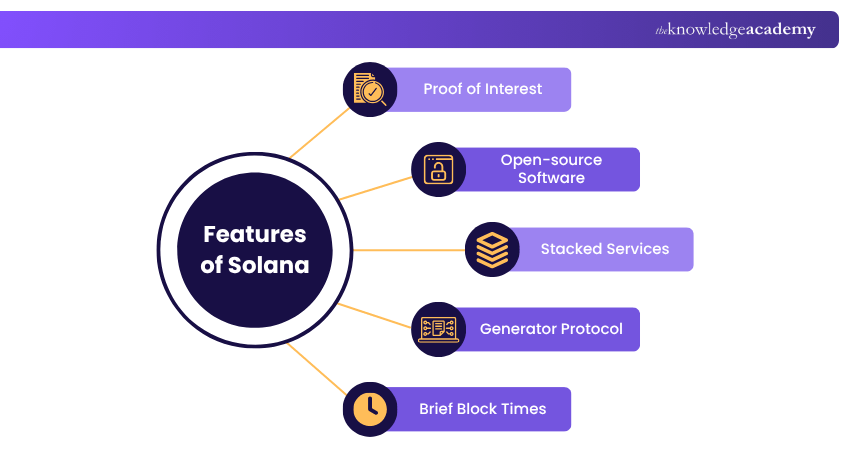
1) Proof of Interest
Similar to Blockchains like Ethereum, Solana enables users to stake SOL tokens, which helps to process transactions more quickly and effectively. Users can vote for Blockchain modifications proposed by members of the Solana Developer community using the staking process.
2) Open-source Software
Solana features an open-source application, as many other Blockchains do. Anyone can use the source code for both personal and business purposes by downloading it.
3) Stacked Services
To increase productivity, Solana Blockchain employs a number of services on top of the network. It is one such technology where different layers conduct a particular function.
4) Generator Protocol
Solana transmits information to neighbourhood node clusters, which are close by, using the Generator protocol in smaller pockets. This makes it possible for it to validate transactions more quickly.
5) Brief Block Times
Solana Blockchain has a block time of 400ms. Transactions are processed quickly and can easily process thousands of transactions per second due to short block periods.
What Makes Solana Blockchain Unique?
Solana stands out in the Blockchain space for its innovative approach to solving the Blockchain trilemma: achieving decentralisation, security, and scalability simultaneously. Here’s what makes it exceptional:
1) Speed
Solana finalises transactions in less than a second. This differs from traditional bank transfers, which can take days, and credit card transactions, which are confirmed in seconds but may take days to settle. This near-instant speed helps with real-time global payments and seamless trading experiences, making digital interactions as fast as sending a text.
2) Cost
Solana’s transaction fees are remarkably low, around £0.00069 per transaction. That means you could execute 1,300 to 1,400 transactions for £1. Such affordability makes microtransactions and frequent on-chain interactions practical, opening opportunities for tipping, gaming or high-frequency trading without worrying about fees.
3) Scale
With the ability to process thousands of transactions per second, Solana rivals some of the best leading payment systems. Its architecture ensures consistent speed and low costs even during network surges. Be it during busy or quiet periods, your transactions remain swift and reliable. This is crucial for real-world scalability.
4) Global Access
Solana is open to anyone with internet access; no bank account, credit score or regional limitation needed. A digital wallet works identically across borders, giving individuals and small businesses equal access to advanced financial tools, from New York to London and beyond.
5) No Need for Layer 2
Solana scales directly on its main chain, unlike networks that rely on Layer 2 or sidechains. This removes the need for bridges or extra tools, ensuring smoother transactions and a simpler, more secure user and developer experience.
6) Developer-friendly Tools
Solana supports Rust and C programming languages, along with robust SDKs, APIs, and detailed tutorials. These accessible and well-structured tools make development faster, easier, and more welcoming for both beginners and experienced builders.
How to Begin Making Investments in Solana?
Here are step-by-step instructions to help you get started with investing in Solana (SOL):
1) Choose a Reliable Exchange: Select a trusted cryptocurrency exchange like Binance, Coinbase, or Kraken that supports SOL trading.
2) Create and Verify Your Account: Register on the platform, complete the KYC (Know Your Customer) process, and add a payment method such as a bank transfer or credit card.
3) Deposit Funds: Add money to your exchange account using your chosen payment option to prepare for your Solana purchase.
4) Buy Solana (SOL): Search for SOL on the exchange and execute your purchase. You can buy at the current market price or set a limit order.
5) Store Your SOL Securely: Transfer your tokens to a digital wallet for better protection.
a) Use hardware wallets for offline security.
b) Use software wallets for quick access and convenience.
6) Stay Informed: Keep track of Solana’s market trends, staking rewards, and updates to make informed decisions and maximise your investment potential.
Power the next generation of the internet with our comprehensive Ethereum Developer Training – Sign up now!
Solana Use Cases
Here are some popular use cases of Solana:
1) Decentralised Exchanges (DEXs): Solana’s high throughput and low latency make it ideal for DEXs, especially those utilising automated market makers or order book models that require rapid trade execution.
2) Payment Solutions: Its ultra-fast and low-cost transactions allow seamless global payments, microtransactions and peer-to-peer transfers with near-instant settlement.
3) Blockchain Gaming: Game Developers utilise Solana Blockchain for in-game tokens, NFT marketplaces and player rewards. They benefit from its real-time speed and minimal transaction costs.
4) Supply Chain Management: Solana improves transparency and traceability in supply chains. This allows businesses to record and verify each transaction securely and instantly.
5) Data Management: Organisations can leverage Solana’s decentralised structure for scalable and verifiable data storage and sharing.
6) Micropayment Platforms: With its low fees and high transaction capacity, Solana is ideal for applications involving frequent, small-value payments such as tipping or content monetisation
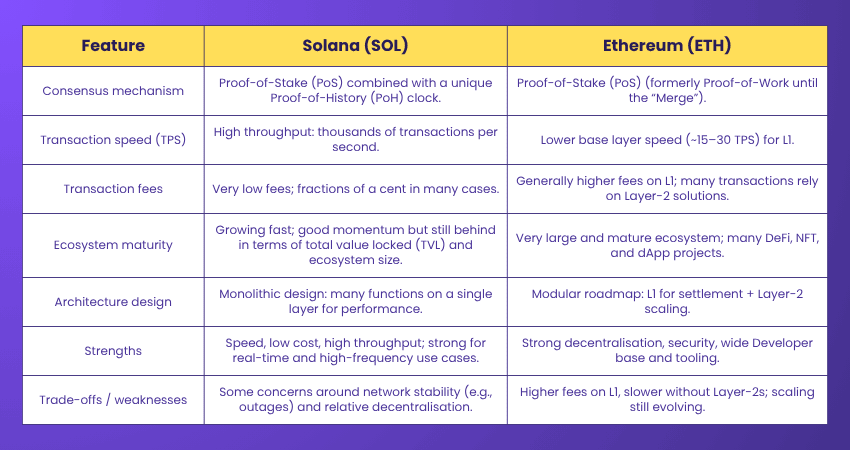
Solana vs Ethereum
Solana's rapidly expanding ecosystem and versatility have inevitably sparked comparisons to Ethereum, positioning it as a key contender in the Solana vs Ethereum debate. Here are the key comparisons:
Boost your knowledge of Blockchain Architecture and Network Design in our comprehensive Blockchain Courses - Sign up now!
How is Solana Different From Bitcoin?
Here are the key distinctions between Solana and Bitcoin:
1) Bitcoin was built primarily as a decentralised digital currency and a store of value, whereas Solana was developed to support decentralised applications (dApps), NFTs and DeFi ecosystems.
2) Solana uses a hybrid PoH and PoS system for rapid transaction validation, while Bitcoin relies on Proof of Work (PoW) mining, which is slower and energy-intensive.
3) Solana processes transactions almost 10,000 times faster than Bitcoin, supporting thousands of transactions per second compared to Bitcoin’s approximate seven.
4) Bitcoin has a fixed supply amounting to 21 million coins, promoting scarcity and long-term value. Solana’s supply, however, grows gradually, targeting around 1.5% annual inflation over time.
5) Solana Blockchain enables high-performance Blockchain applications such as Web3 projects, DeFi platforms and gaming. Meanwhile Bitcoin focuses mainly on secure peer-to-peer transfers and wealth preservation.
Is Solana a Buy, Hold, or Sell?
It depends on your market outlook, risk tolerance, and overall investment strategy. If you believe in Solana’s long-term growth and can handle price volatility, you may choose to buy or hold. If risks outweigh potential returns for you, selling might be the safer option.
Conclusion
Understanding What is Solana helps you see why it stands out in the blockchain space. With fast transactions, low fees, and strong developer support, it continues to attract attention. Whether you are exploring its technology or investment potential, informed decisions are key to navigating its evolving ecosystem confidently.
Looking to lead the next-gen internet? Our Web3 Professional Certification will lead the way – Sign up now!
Frequently Asked Questions
What are Some Challenges or Limitations of the Solana Blockchain?

Solana faces challenges such as centralisation, complexity, security, environmental impact, and competition. The network has also experienced occasional outages and congestion, which can affect reliability and user confidence during periods of high activity.
What is the Best Solana Wallet for Beginners?
Some of the best Solana Wallets include:
1) Trezor Safe 5: Best for security.
2) Coinbase Wallet: Best for beginners and staking.
3) Exodus: Best for mobile users.
4) Solflare: Best for multi-platform access.
5) Phantom: Best for dApp interactions.

Richard Harris


Senior Full Stack Developer and Technology Educator
Richard Harris is a highly experienced full-stack developer with deep expertise in both frontend and backend technologies. Over his 12-year career, he has built scalable web applications for startups, enterprises and government organisations. Richard’s writing combines technical depth with clear explanations, ideal for developers looking to grow in modern frameworks and tools.


 If you wish to make any changes to your course, please


