


We may not have the course you’re looking for. If you enquire or give us a call on 01344203999 and speak to our training experts, we may still be able to help with your training requirements.
Home
 Resources
IT Security & Data Protection
Career Switch to Cyber Security: Skills, Steps and Career Paths
Resources
IT Security & Data Protection
Career Switch to Cyber Security: Skills, Steps and Career Paths
Career Switch to Cyber Security: Skills, Steps and Career Paths
ByVishnu SankarLast updated on: 17 September 2026
This guide explains who can switch to Cyber Security, the skills to develop, practical steps to follow, relevant certifications, career paths, and how to prepare for Cyber Security roles.
Cyber Security may look like a career reserved for programmers and technical experts, but the industry needs much more than coding skills. It needs people who can investigate problems, understand risk, analyse information, communicate clearly and make sound decisions when something does not look right.
That means your previous career could become part of your advantage rather than something you need to leave behind. Whether you come from IT, finance, compliance, software, project management or a completely different field, this blog will show you how to turn your existing strengths into a practical Career Switch to Cyber Security.
Why a Career in Cyber Security?
Cyber Security sits at the intersection of technology, business risk, investigation, and problem-solving. Organisations depend increasingly on cloud platforms, applications, connected devices, APIs, remote access, digital identities, and large volumes of data. Securing these technologies and assets requires knowledge across multiple areas of Cyber Security.
Cyber Security can appeal to people who enjoy:
1) Investigating why something happened
2) Solving complex technical problems
3) Understanding networks and systems
4) Analysing unusual activity
5) Finding weaknesses before attackers exploit them
6) Managing technology-related business risks
7) Continuously learning about new technologies and threats

Who Can Switch to a Cyber Security Career?
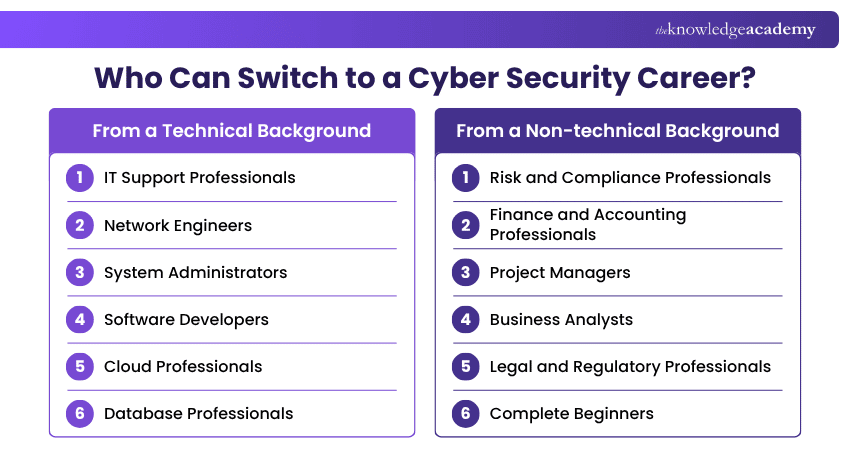
A career switch to Cyber Security is possible for people from both technical and non-technical backgrounds. The transition path differs depending on the skills you already have and the type of Cyber Security role you want to pursue.
From a Technical Background
The following professionals can build on their existing technical experience when transitioning into a Cyber Security career:
1) IT Support Professionals: Their experience with devices, user accounts, troubleshooting, permissions, and system issues provides a useful foundation for security-focused work.
2) Network Engineers: Knowledge of protocols, routing, firewalls, VPNs, and network traffic can support a smoother transition into Cyber Security.
3) System Administrators: Experience managing Windows, Linux, access controls, patches, and system configurations is highly relevant to securing enterprise environments.
4) Software Developers: Programming, APIs, databases, and application architecture knowledge can help them understand vulnerabilities and secure software development.
5) Cloud Professionals: Familiarity with cloud platforms, identities, permissions, virtual networks, and workloads can be extended with cloud security knowledge.
6) Database Professionals: Experience managing sensitive data, access permissions, backups, and database configurations can provide a strong security foundation.
From Non-technical Background
Professionals without a traditional IT background can also switch to Cyber Security, but they generally need to build stronger foundations in computing, networking, operating systems, and security concepts first.
1) Risk and Compliance Professionals: Experience with controls, policies, audits, and risk assessment can transfer well into security governance and compliance work.
2) Finance and Accounting Professionals: Their understanding of internal controls, fraud risks, regulations, and data sensitivity can be valuable in Cyber Security environments.
3) Project Managers: Skills in risk management, stakeholder communication, planning, and coordination can support security projects and transformation initiatives.
4) Business Analysts: Experience gathering requirements, documenting processes, and communicating between business and technical teams can support Cyber Security initiatives.
5) Legal and Regulatory Professionals: Knowledge of privacy, regulations, contracts, and compliance obligations can contribute to security policy and governance activities.
6) Complete Beginners: People without previous technical experience can also switch, but they should first build fundamentals in networking, operating systems, security concepts, and basic computing before moving into more advanced Cyber Security topics.
Skills Required for a Career in Cyber Security
Cyber Security combines technical knowledge with analytical and workplace skills. The exact requirements depend on your chosen role, but several fundamentals appear repeatedly.
1) Networking and System Administration: Understanding TCP/IP, firewalls, VPNs, routing, system configurations, and how data moves across networks is essential for identifying and preventing security threats.
2) Operating System Security: Professionals should know how to secure and harden operating systems such as Windows and Linux, manage permissions, monitor processes, and reduce system vulnerabilities.
3) Threat Detection and Incident Response: The ability to recognise suspicious activity, analyse security incidents and investigate potential attacks is particularly important for security operations and incident response roles.
4) Programming and Scripting: Knowledge of languages such as Python, Bash, or PowerShell helps automate security tasks, analyse logs, investigate threats, and improve operational efficiency.
5) Analytical Thinking and Problem-solving: Cyber Security professionals need to recognise unusual patterns, investigate complex security issues, assess risks, and make effective decisions during security incidents.
Data Insight
According to the ISC2 2025 Cyber Security Workforce Study, AI was the most commonly cited Cyber Security skill need at 41%, followed by Cloud Security at 36%. This indicates growing demand for these capabilities, although career switchers should prioritise skills that align with their chosen role.
How to Switch to a Cyber Security Career?
Switching to Cyber Security becomes easier when you follow a clear step-by-step approach. Instead of trying to learn everything at once, focus on building the right skills, gaining practical experience, and preparing for the type of role you want.
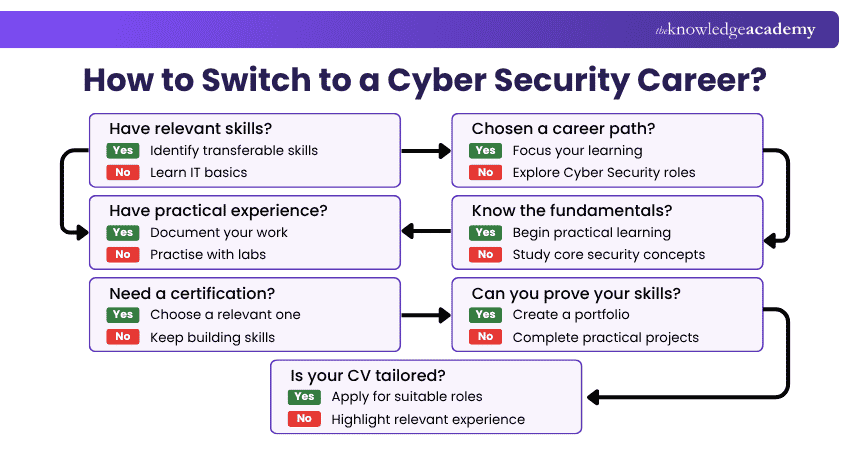
1) Assess Your Existing Skills
Start by looking at the skills you already have. Experience in IT support, networking, software, cloud computing, auditing, risk, or even project coordination can be useful in Cyber Security.
Identify which of your current skills can transfer and where you need more knowledge. This helps you create a more focused learning plan.
2) Choose a Cyber Security Career Path
Cyber Security includes many different areas, so choosing a direction early can make your transition more structured.
For example:
a) If you enjoy investigating suspicious activity, consider Security Operations.
b) If you like networks and infrastructure, explore Network Security.
c) If you enjoy coding, Application Security or DevSecOps may suit you.
d) If you are interested in testing systems, Penetration Testing could be a good option.
e) If you prefer risk, policies, and compliance, Governance, Risk, and Compliance (GRC) may be suitable.
Your chosen direction will help you decide which skills and certifications to prioritise.
3) Learn Cyber Security Fundamentals
Before moving into specialised topics, build a strong understanding of the basics.
Focus on areas such as:
Networking → Operating Systems → Security Fundamentals → Identity and Access Management → Vulnerabilities → Security Monitoring → Incident Response
These fundamentals help you understand how systems work, where security weaknesses can appear, and how threats are detected and managed.
4) Build Practical Experience
Practical experience is important because Cyber Security is not only about understanding concepts. You also need to know how to apply them.
You can use home labs or authorised training environments to practise:
a) Configuring systems and security settings
b) Managing users and permissions
c) Analysing network traffic
d) Reviewing system and security logs
e) Identifying vulnerabilities
f) Applying patches and updates
g) Investigating simulated incidents
h) Hardening Windows or Linux systems
Always practise security testing only on systems you own or have permission to use.
5) Earn Relevant Cyber Security Certifications
Certifications can help validate your knowledge and provide a structured way to develop new skills.
Choose certifications based on your experience level and target role rather than trying to earn as many as possible.
A simple progression could be:
Foundational Knowledge → Entry-level Certification → Role-specific Certification → Advanced or Specialist Development
6) Create a Cyber Security Portfolio
A portfolio helps demonstrate what you can actually do. It can include practical projects, lab exercises, reports, or technical documentation.
For example, you could include:
a) A network traffic analysis
b) A system hardening exercise
c) A vulnerability assessment
d) A security log investigation
e) A basic incident response report
7) Prepare for Cyber Security Job Roles
Finally, update your CV so that it highlights skills and experience relevant to Cyber Security.
Instead of simply writing:
"Managed Windows systems."
You could write:
"Managed Windows systems, user permissions, updates, and access controls to support secure and reliable operations."
Focus on genuine responsibilities that show security relevance. Also review job descriptions for your preferred roles so you can identify common skill requirements and prepare accordingly.
Learn to recognise cyber risks with our Cyber Security Awareness Training - Join now!
Popular Cyber Security Career Paths
Cyber Security is not one career ladder. It contains several pathways. Below you will find some of the popular career paths in Cyber Security.
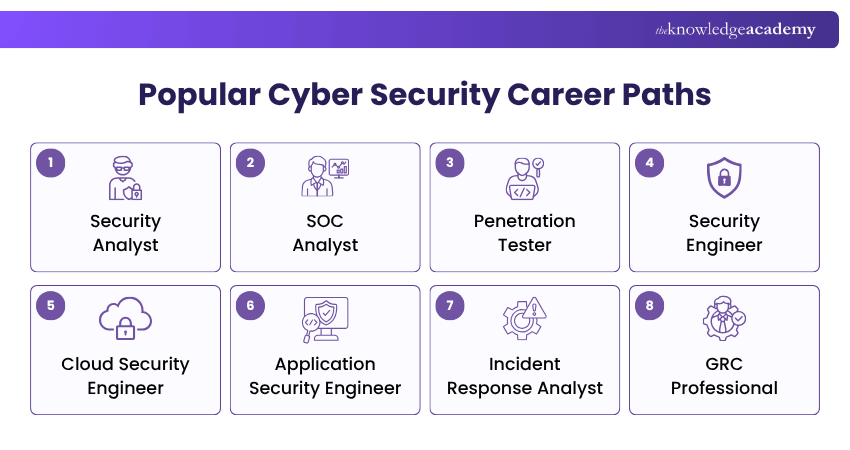
1) Security Analyst
Security Analysts examine security risks, investigate suspicious activity and support improvements to an organisation's security controls. The exact responsibilities vary across organisations.
Useful Skills: Networking, SIEM, log analysis, endpoint security, vulnerability management
2) SOC Analyst
SOC Analysts monitor security alerts, triage suspicious events and escalate or investigate potential incidents within a Security Operations Centre (SOC).
Useful Skills: SIEM, threat detection, networking, incident triage, log analysis
3) Penetration Tester
Penetration Testers perform authorised security assessments to identify exploitable weaknesses before attackers do.
Useful Skills: Networking, Linux, web security, scripting, vulnerability assessment
4) Security Engineer
Security Engineers design, implement, configure, and maintain security technologies and controls.
Useful Skills: Networks, operating systems, automation, IAM, endpoint and cloud security
5) Cloud Security Engineer
These professionals protect cloud infrastructure, identities, workloads, applications, and data.
Useful Skills: AWS/Azure/GCP, IAM, encryption, network security, monitoring
6) Application Security Engineer
Application Security professionals work closely with developers to identify and reduce weaknesses throughout the software lifecycle.
Useful Skills: Programming, APIs, web security, secure coding, threat modelling
7) Incident Response Analyst
Incident Response Analysts investigate security incidents and help organisations contain threats, remove their causes and recover affected systems or operations.
Useful Skills: Digital forensics, log analysis, malware awareness, networking, incident handling
Develop effective response strategies with our Incident Response Training – Register now!
8) GRC Professional
Governance, Risk and Compliance professionals connect Cyber Security requirements with organisational policies, risk management, controls, regulations, and audits.
Useful Skills: Risk assessment, security controls, auditing, policies, compliance frameworks
Cyber Security Certifications for Career Switch
Certification choice should follow your experience level and career objective.
1) Foundation Level
These options are suitable for professionals who are new to Cyber Security and need to understand basic security concepts before moving into specialised areas.
a) Cyber Security Awareness Training
b) Introduction to System and Network Security
c) Incident Reporting Training
d) Computer Forensics Foundation Training
2) Intermediate Level
These are better suited to professionals who already understand Cyber Security fundamentals and want to develop practical or role-specific capabilities.
a) Cyber Security Risk Management
b) Incident Response Training
c) Digital Forensics Training
d) Social Engineering Training
e) Fraud Analytics Training Course
3) Advanced and Specialised Level
These options focus on more specialised Cyber Security domains and are more relevant once delegates have developed a solid foundation.
1) Certified Cyber Security Professional (CCS-PRO)
2) Malware Analysis Training
3) Certified Artificial Intelligence (AI) for Cyber Security Professionals Training
Trainer's Tip: Choose your target job first and certification second. A certification should close a specific knowledge gap, not become the career plan itself.
Build effective cyber risk controls with our Cyber Security Risk Management Training – Join now!

Vishnu Sankar is a Senior Content Writer with 5+ years of experience across content development, software development, web development and system administration. His technical background and professional training support his expertise in IT and Tech, while his extensive research and writing experience covers Project Management and Health and Safety.
View Detail

 If you wish to make any changes to your course, please


