
APM Training

accredited by

Our APM PMQ course is accredited by APM

Online Instructor-led (5 days)

Online Self-paced (40 hours)

APM PMQ Exam

APM PMQ Course Outline

Module 1: Life Cycles

  • Understand Distinct Life Cycle Stages Used to Structure Projects
  • Differences Between a Project Life Cycle and an Extended Life Cycle
  • Influence of Organisational Context and Culture, and Specific Project Needs on Life Cycle Choice and Adaptations
  • Strengths and Limitations of Different Life Cycles

Module 2: Governance Arrangements

  • Organisation Structures and Governance Approach
  • Project Roles and Responsibilities
  • Project Governance Frameworks
  • Project Alignment with Organisational Objectives

Module 3: Sustainability

  • Sustainability Responsibilities, Principles, Priorities, and Their Impact on Projects
  • Monitoring and Reporting on Sustainability Measures

Module 4: Business Case

  • Business Case Analysis Tools and Techniques
  • Business Case Review and Baseline Management

Module 5: Procurement

  • Procurement Strategy and Planning
  • Supplier Selection and Negotiation
  • Contract Types and Supplier Reimbursement Methods

Module 6: Reviews

  • Benefits of Conducting Reviews Throughout the Life Cycle
  • Factors Typically Reported to Ensure Successful Outcomes
  • Importance of Producing Information for Decision-making
  • Re-planning Activities Post-review

Module 7: Assurance

  • Purpose of Assurance and Awareness of Its Scope, Priorities, and Strategic Aims

Module 8: Transition Management

  • Requirements for a Successful Transition
  • Importance of Knowledge Transfer and Continuous Improvement
  • Engaging Stakeholders in Transition Planning

Module 9: Benefits Management

  • Monitoring Benefit Realisation Throughout a Project
  • Meaning, Importance, and Communication of Benefits Management

Module 10: Stakeholder Engagement and Communication Management

  • Stakeholder Analysis and Engagement
  • Stakeholder Communication Planning
  • Communication Plan Benefits
  • Managing Stakeholder Expectations
  • Communication Methods and Tailored Messaging
  • Communication Influencing Factors

Module 11: Conflict Resolution

  • Identifying and Addressing Differences Within a Project
  • Sources and Impacts of Conflict
  • Approaches to Address Conflict in Various Situations

Module 12: Leadership

  • Impact of Leadership on Team Performance
  • Necessity of Varied Leadership Styles
  • Importance of a Coaching and Mentoring Style

Module 13: Team Management

  • Team Development Stages and Models
  • Effective Teams and Teamwork
  • Leadership for Virtual and Hybrid Teams

Module 14: Diversity and Inclusion

  • Building an Inclusive Environment Embracing Diverse Culture
  • Knowledge of Diversity and Its Workplace Impacts
  • Importance of Incorporating Diversity in All Project Parts
  • Addressing Conscious and Unconscious Biases

Module 15: Ethics, Compliance and Professionalism

  • Importance of Continuing Professional Development
  • Specialist Advice and Standards for Project Adherence
  • Impact of the Legal and Regulatory Landscape on Projects

Module 16: Requirements Management

  • Requirements Management and Scope Definition
  • Configuration Management and Scope Control

Module 17: Solutions Development

  • Requirements Evaluation and Prioritisation

Module 18: Quality Management

  • Quality Planning and Indicators
  • Quality Control Techniques

Module 19: Integrated Planning

  • Integrated Project Management Plan Structure
  • Importance of Integrated Planning

Module 20: Schedule Management

  • Scope Definition and Breakdown Structures
  • Project Dependencies and Schedule Impact
  • Re-Estimating and Schedule Optimisation

Module 21: Resource Management

  • Identifying and Scheduling Required Resources
  • Organisational Breakdown Structure and Responsibility Assignment
  • Resource Categorisation and Allocation
  • Differences Between Resource Smoothing and Resource Levelling

Module 22: Budgeting and Cost Control

  • Estimating Costs, Agreeing Budgets, and Monitoring Finances
  • Budget Creation and Refinement
  • Financial Performance Monitoring and Reporting
  • How to Close Down Finances at the End of a Project?

Module 23: Risk and Issue Management

  • Risk and Issue Management Benefits
  • Risk and Issue Management Processes
  • Risk Response Strategies
  • Risk and Issue Governance

Module 24: Change Control

  • Change Control Process
  • Change Request Documentation
  • Change Impact Assessment
  • Change Approval Recommendations
  • Updating Plans and Schedules

Show moredown

Who Should Attend this APM PMQ Course?

This APM PMQ Course is suitable for professionals with existing Project Management knowledge or experience who want to broaden and strengthen their understanding of effective project delivery. It is particularly relevant to those looking to develop their professional Project Management knowledge and support their career progression. This course is ideal for:

  • Project Managers
  • Assistant Project Managers
  • Project Coordinators
  • Change Managers
  • Business Analysts
  • Project Support Professionals
  • Team Leaders
  • Functional Managers

Prerequisites of the APM PMQ Course

There are no formal prerequisites for attending this APM Project Management Qualification Course. However, existing project management knowledge or experience is recommended, as the qualification is designed for professionals looking to deepen their understanding of project management.

APM Project Management Qualification (PMQ) Course Overview

The APM Project Management Qualification (PMQ) develops broad knowledge across key areas of professional project management. It covers life cycles, governance, sustainability, stakeholder engagement, leadership, planning, risk, budgeting, quality, and change control.

Delegates will strengthen their understanding of planning, stakeholder engagement, leadership, risk, resources, budgeting, quality, and project controls. They will also explore governance, sustainability, ethics, benefits, and transition management.

This 5-Day course by The Knowledge Academy prepares delegates for the APM PMQ Examination. It also helps them apply structured project management knowledge across different project environments.

APM Project Management Qualification (PMQ) Course Objectives

  • To understand project life cycles, governance, sustainability, and business cases
  • To manage stakeholders, communication, conflict, leadership, and project teams
  • To understand procurement, reviews, assurance, transition, and benefits management
  • To manage requirements, solutions development, quality, and integrated planning
  • To manage project schedules, resources, budgets, risks, and issues effectively
  • To apply change control, ethical, professional, and inclusive project practices

After completing this APM PMQ Course, delegates will have a broad understanding of project management principles and practices across the project life cycle. They will be better prepared to plan, manage, monitor, and support projects while applying structured approaches to people, resources, risks, governance, and change.

Show moredown

What’s Included in this APM PMQ Course?

  • APM Project Management Qualification (PMQ) Examination
  • World-Class Training Sessions from Experienced Instructors
  • Interactive Learning with 24*7 Support
  • Digital Delegate Pack

Show moredown

APM Project Management Qualification (PMQ) Exam Information

The exam is completed online in the Surpass platform. It has a time limit of 2.5 hours and is split into two parts. You can take a break of up to 30 minutes between parts, if you want to. The break time will be in addition to the 2.5 hour exam time.

The exam is in the following format:

Introduction and instruction pages.

  • Section 1: GPDR, employer and county selection.
  • Section 2: Live examination – Part A.
  • Section 3: Live examination – Part B.
  • Section 4: Survey questions (if applicable).

There are 40 questions in the exam, worth a total of 90 marks.

You should attempt every question in the exam.

Examination scores

The pass mark for the APM Project Management Qualification will vary between exam versions to take account of slight differences in question difficulty between different exam versions. The exam has a maximum score of 90 marks.

Show moredown

accredited by

Our APM PFQ course is accredited by APM

Online Instructor-led (2 days)

Online Self-paced (16 hours)

Official APM PFQ Exam

APM Introductory Certificate PFQ Course Outline

Module 1: Understand Project Management and the Operating Environment

  • Define the Term Project
  • Projects Vs Business as Usual
  • Define the Term Project Management
  • Purpose of Project Management
  • Define the Term Programme Management
  • Define the Term Portfolio Management
  • PESTLE Analysis

Module 2: Understand Project Life Cycles

  • Project Life Cycle
  • Linear Project Life Cycle
  • Iterative Project Life Cycle
  • Hybrid Life Cycle
  • Extended Project Life Cycle

Module 3: Understand the Roles and Responsibilities within Projects

  • What is Project Sponsorship?
  • Role of the Project Sponsor
  • What is an Organisation?
  • Project Team Structure Example
  • Project Sponsor and Project Manager
  • Project Governance
  • Project Team Members
  • End Users
  • Product Owner
  • Project Management Office

Module 4: Understand Project Management Planning

  • Define the Term Deployment Baseline
  • Linear Vs Iterative Life Cycles
  • Stakeholders of a Project Management Plan
  • Purpose of a Business Case
  • Typical Contents
  • Role of a Project Sponsor and Project Manager in a Business Case
  • What is Stakeholder Management?
  • Stakeholder Analysis Process
  • How a Stakeholder Analysis Supports Effective Stakeholder Engagement
  • Define the Term Benefits Management
  • What is Estimating?
  • Typical Estimating Methods
  • Purpose of the Estimating Funnel
  • What is Project Success?
  • What is Success?
  • When to Define Success?
  • Success Criteria
  • Reporting
  • Purpose of Project Progress Reporting
  • Benefits of Project Progress Reporting

Module 5: Understand Project Scope Management

  • Scope Management
  • Scope Management within Linear and Iterative lifecycles
  • Breakdown Structures
  • Product Breakdown Structure
  • Work Breakdown Structure
  • Cost Breakdown Structure
  • Organisational Breakdown Structures
  • Responsibility Assignment Matrix
  • Configuration Management
  • Change Control
  • Why Change Control
  • Change Control Process
  • Configuration Management Process

Module 6: Understand Resource, Scheduling and Optimisation in a Project

  • What is Scheduling?
  • Purpose of Scheduling
  • Purpose of Critical Path Analysis
  • Purpose of Milestones
  • Time Boxing
  • What is Resource Optimisation?
  • Resource Levelling
  • Resource Smoothing
  • Procurement Strategy

Module 7: Understand Project Risk and Issue Management in the Context of a Project

  • What is Risk?
  • What is Project Risk Management?
  • Purpose of Risk Management
  • Risk Management Process
  • Use of Risk Registers
  • What is an ‘Issue’?
  • Terminology
  • Purpose of ‘Issue Management
  • Differentiate Between an Issue and a Risk
  • Issue Resolution Process

Module 8: Understand Quality in the Context of a Project

  • Definition of Quality
  • Quality Management
  • Quality Components
  • Quality Planning
  • Quality Control
  • Quality Assurance
    • Decision Gates
    • Post Project Reviews
    • Benefit Reviews
    • Project Audits

Module 9: Understand Communication in the Context of a Project

  • What is Communication?
  • Communications in Projects
  • Face-to-Face Communication
  • Physical Communication
  • Virtual Communication
  • Contents of a Communication Plan
  • Benefits to a PM of a Communication Plan

Module 10: Understand Leadership and Teamwork within a Project

  • Leadership
  • Impact on Team Performance
  • Challenges to a Project Manager
    • Tuckman Team Development Model
    • Belbin Roles

Show moredown

Who should attend this APM Introductory Certificate PFQ Course?

The APM Project Fundamentals Qualification (PFQ) Course is suitable for professionals seeking a broad understanding of fundamental Project Management principles. It is particularly beneficial for:

  • Project Managers
  • Junior Project Managers
  • Project Coordinators
  • Project Team Members
  • Operations Professionals
  • Professionals Working in Project Environments
  • Individuals New to Project Management

Prerequisites for the APM Introductory Certificate PFQ Course

There are no formal prerequisites for attending this APM Project Fundamentals Qualification (PFQ) Course. However, an interest in Project Management can support the learning experience.

APM Introductory Certificate PFQ Course Overview

The APM Project Fundamentals Qualification (PFQ) Course introduces the core concepts and principles of Project Management. It covers project life cycles, governance, planning, stakeholder engagement, scope, scheduling, resources, risk, quality, communication, leadership, and teamwork.

Delegates will develop knowledge of key Project Management terminology, roles, responsibilities, planning approaches, risk and issue management, quality practices, and communication methods. The training also develops an understanding of how these areas contribute to effective project delivery.

This 2-Day course by The Knowledge Academy enables delegates to apply foundational Project Management knowledge within different project environments. They will be able to support planning, understand project responsibilities, manage basic project activities, and contribute more effectively to project delivery.

APM Introductory Certificate PFQ Course Objectives

  • To understand the fundamental principles and terminology of Project Management
  • To understand project life cycles, governance, planning, and stakeholder engagement
  • To gain knowledge of scope, scheduling, resources, risk, and quality management
  • To understand communication, leadership, and teamwork within project environments
  • To develop the knowledge required to contribute effectively to project delivery

Learning Outcomes of this APM Introductory Certificate PFQ Course

Upon completion of this training course, delegates will understand the fundamental concepts, terminology, roles, and practices of Project Management. They will be able to support project planning, contribute to risk and quality activities, communicate effectively with stakeholders, and work more confidently within project environments.

Show moredown

What’s Included in this APM Introductory Certificate PFQ Course?

  • APM PFQ Examination
  • World-Class Training Sessions from Experienced Instructors
  • Digital Delegate Pack

Show moredown

APM Project Fundamentals Qualification (PFQ) Exam Information

The APM Introductory Certificate in Project Management (PFQ) Exam assesses participants' understanding of the fundamental concepts and principles of project management. This certification focuses on providing individuals with a foundation in project management knowledge and terminology. 

  • Type of Questions: Multiple Choice 
  • Total Questions: 60 
  • Total Marks: 60 Marks 
  • Pass Marks: 60%, or 36/60 Marks 
  • Duration: 60 Minutes 
  • Open Book/Closed Book: Closed book

The assessment will cover the following core principles of Project Management:

  • Planning and Scheduling
  • Communications
  • Quality Management
  • Teamwork
  • Resource Management
  • Risk Management
  • Issue Management
  • Handover
  • Reviews

Show moredown

accredited by

Our APM Project Risk Management Level 1 course is accredited by APM

Online Instructor-led (2 days)

Online Self-paced (16 hours)

APM Project Risk Management Level 1 Exam

APM Project Risk Management Level 1 Certification Outline

Module 1: General

  • Definitions
  • Background to Project Risk Management

Module 2: Benefits

  • Hard Benefits of Project Risk Management
  • Soft Benefits of Project Risk Management
  • Threats to Effective Risk Management

Module 3: Principles

  • Risk as Threat and Opportunity

Module 4: Process

  • Different Phases of the Pram Process
  • Initiate
  • Identification of Risks
  • Assess
  • Assess Risks Qualitatively and Quantitatively
  • Plan Responses
  • Selection of Appropriate Risk Response Strategies Dependent on Importance of the Risk Event and Cost Benefit of The Response

Module 5: Organisation And Control

  • The Risk Management Plan
  • Responsibilities of Different Roles in The Risk Management Process:
  • Sponsor
  • Project Manager
  • Risk Process Manager
  • Risk Manager
  • Risk Owner
  • Action Owner
  • Control of The Process – Risk Management Plan, Risk Register, Risk Analysis, Risk Status Reports, Risk Reviews, Lessons Learnt
  • Project Contingency or Management Reserve

Module 6: Behaviour

  • Risk Attitude of Individuals
  • The Risk Attitude Spectrum
  • Risk-Averse
  • Risk-Tolerant
  • Risk-Neutral
  • Risk-Seeking
  • Biasing Influences on Individual Risk Attitude – The Triple Strand:
  • Situational Factors
  • Subconscious Factors
  • Affective Factors – Feelings and Emotions
  • Biasing Influences on Group Risk Attitude Including:
  • Groupthink
  • The “Moses Factor” (Or “Follow the Leader”)
  • Risky and Cautious Shift
  • Cultural Conformity Including the Influence of National Cultural Differences

Module 7: Application

  • Introducing Risk Management into an Organisation
  • Getting Buy-In to Risk Management

Module 8: Risk Identification Technique

  • Uses of Different Risk Identification Techniques Such As:
  • Assumptions Analysis
  • Constraints Analysis
  • Checklists
  • Prompt Lists
  • Brainstorming
  • Interviews
  • Swot Analysis
  • Delphi Technique
  • Qualitative Risk Assessment
  • Uses of Different Qualitative Risk Assessment Techniques
  • Prioritisation Of Risks Based on Probability, Impact and Proximity
  • Quantitative Risk Assessment
  • Uses of Different Quantitative Risk Assessment Techniques
  • Risk Response
  • Uses of Different Techniques for Responding to Risks

Show moredown

Who Should Attend this APM Project Risk Management Level 1 Course?

This training is suitable for professionals involved in projects who want to strengthen their understanding of Project Risk Management. It is also beneficial for those looking to develop their skills or take on greater responsibilities in managing project risks, including:

  • Project Manager
  • Risk Manager
  • Project Coordinator
  • Business Analyst
  • PMO Analyst
  • Project Team Member
  • Risk Analyst
  • Project Support Officer

Prerequisites for the APM Project Risk Management Level 1 Course

There are no formal prerequisites to attend this APM Project Risk Management Level 1 Training Course. However, a basic understanding of project management concepts can help delegates engage more effectively with the course content.

APM Project Risk Management Level 1 Course Overview

APM Project Risk Management Level 1 provides a structured understanding of Project Risk Management and its importance in supporting successful projects. It covers risk principles, threats and opportunities, the risk management process, and approaches to identifying and assessing project risks.

Delegates will develop skills in qualitative and quantitative risk assessment, selecting suitable risk responses, and understanding risk management roles and controls. They will also gain insight into how individual and group attitudes can influence risk-related decisions.

This 2-Day course by The Knowledge Academy enables delegates to apply structured risk management practices within project environments. They will be better equipped to prioritise risks, select appropriate responses, maintain effective risk controls, and contribute to more informed project decisions.

APM Project Risk Management Level 1 Course Objectives

  • To understand the core principles and processes of Project Risk Management
  • To identify project risks using appropriate risk identification techniques
  • To conduct qualitative and quantitative risk assessments
  • To explore suitable strategies for responding to project risks
  • To examine key roles, responsibilities, and controls in the risk management process
  • To recognise how individual and group attitudes can influence risk management decisions

Learning Outcomes of this APM Project Risk Management Level 1 Course

Upon completing this course, delegates will be equipped with the knowledge and skills to identify, assess, and respond to project risks effectively. They will also be better prepared to apply structured risk management practices and contribute to successful project outcomes.

Show moredown

What's Included in this APM Project Risk Management Level 1 Course?

  • APM Project Risk Management Level 1 Examination
  • World-Class Training from Experienced Instructors
  • Interactive Learning with 24*7 Support
  • Digital Delegate Pack

Show moredown

APM Project Risk Management Level 1 Exam Information

The APM Project Risk Management Level 1 Certification Exam assesses participants on their understanding of the key concepts, principles, and processes of project risk management. This certification helps individuals gain a solid foundation in risk terminology, risk identification, risk analysis, and effective response planning within a project environment.

  • Type of Questions: Multiple Choice Questions
  • Total Questions: 60 Questions
  • Total Marks: 60 Marks 
  • Pass Marks: 60%
  • Duration: 1 Hour
  • Open Book/Closed Book: Closed Book

Show moredown

accredited by

Our APM Project Assurance Practitioner course is accredited by APM

Online Instructor-led (2 days)

Online Self-paced (16 hours)

APM Project Assurance Practitioner Training Course Outline

Module 1: Governance of Enterprise IT

  • What Is Project Assurance?
  • Assurance and Confidence in Delivery
  • Course Structure and Case Study
  • Who Provides Assurance

Module 2: Integrated Assurance Principles

  • Core Assurance Principles
  • Independence and Objectivity
  • Assurance as Critical Friend
  • Aligning to Business Case and Benefits

Module 3: Organisational Landscape of Integrated Assurance

  • Assurance in Governance Structures
  • Key Assurance Stakeholders
  • Project, Programme and Portfolio Levels
  • Organisational Maturity Factors

Module 4: Dimensions of Integrated Assurance

  • Three Lines Model
  • Delegated Assurance Levels
  • Ad Hoc, One-Off and Continuous Assurance
  • Independence vs Collaboration

Module 5: Review Types

  • Gateway Reviews
  • Health Checks and Diagnostics
  • Peer Reviews
  • Choosing the Right Review Type

Module 6: Integrated Assurance Tools and Techniques

  • Risk-Based Assurance Planning
  • Evidence Gathering and Analysis
  • Reporting Findings Clearly
  • Case Study Application

Module 7: Developing an Integrated Assurance Model

  • Designing an Assurance Strategy
  • Selecting an Operating Model
  • Scope, Mandate and Sponsorship
  • Building the Assurance Plan

Module 8: Implementing the Integrated Assurance Plan

  • Scheduling and Coordination
  • Building an Assurance Team
  • Managing Budget and Expectations
  • Follow-Up and Lessons Learned

Module 9: Integrated Assurance Competencies

  • Technical and Analytical Skills
  • Communication and Influencing
  • Ethics and Managing Bias
  • Giving and Receiving Feedback

Show moredown

Who Should Attend this APM Project Assurance Practitioner Training?

This training is suitable for professionals involved in project governance, assurance, reviews, risk, and delivery oversight. It is particularly relevant to delegates who want to strengthen their ability to plan and support integrated assurance activities, including:

  • Project Assurance Professionals
  • Project Managers
  • Programme Managers
  • PMO Professionals
  • Risk Managers
  • Governance Professionals
  • Project Reviewers
  • Project Controls Professionals

Prerequisites for the APM Project Assurance Practitioner Training

There are no formal prerequisites to attend this training. However, a basic understanding of project management, governance, or project delivery would be beneficial for delegates.

APM Project Assurance Practitioner Training Overview

APM Project Assurance Practitioner Training develops knowledge of how assurance supports governance, and effective project delivery. It covers integrated assurance principles, organisational structures, review approaches, implementation, and professional competencies.

Delegates will develop skills in assurance planning, evidence gathering, review selection, reporting, stakeholder engagement, and coordinating assurance activities. They will also understand how independence, objectivity, ethics, and effective communication contribute to credible assurance.

This 2-Day course offered by The Knowledge Academy and endorsed by APM, helps delegates apply integrated assurance approaches within project environments. They will be better equipped to plan assurance activities, evaluate evidence, coordinate reviews, and support effective project governance.

APM Project Assurance Practitioner Training Course Objectives

  • To understand the purpose and principles of project assurance
  • To explain how assurance operates across governance structures
  • To distinguish between different assurance and review approaches
  • To apply risk-based assurance planning and evidence analysis techniques
  • To develop structured assurance strategies, models, and plans
  • To strengthen communication, influencing, ethics, and feedback capabilities

Learning Outcomes of this APM Project Assurance Practitioner Training

Upon completing this APM Endorsed training, delegates will understand how integrated assurance contributes to project governance and confidence in delivery. They will also be better equipped to plan and coordinate assurance activities, assess evidence, communicate findings, and support effective review and follow-up processes.

Show moredown

What's Included in this APM Project Assurance Practitioner Training?

  • World-Class Training from Experienced Instructors
  • Interactive Learning with 24*7 Support
  • Digital Delegate Pack
  • APM Project Assurance Practitioner Certificate

Show moredown

Not sure which course to choose?

Speak to a training expert for advice if you are unsure of what course is right for you. Give us a call on + 1-866 272 8822 or Enquire.

Essential Topics Covered in APM Training

The Knowledge Academy's APM Courses are designed to provide learners with fundamental skills for project management. Key knowledge areas covered in our courses consist of:

  • Comprehensive Project Management: Gain an end-to-end understanding of project management, covering everything from initiation to delivery.
  • Project Life Cycle: Gain foundational knowledge of linear, iterative, and hybrid models to manage each stage of a project effectively.
  • Project Governance and Stakeholder Management: Understand how to monitor stakeholder expectations and establish structures and processes that ensure project success.
  • Project Planning and Scheduling: Learn to create detailed plans and schedules to guide project execution and monitor progress.
  • Risk and Issue Management: Identify, assess, and mitigate risks and issues that could impact project outcomes.
  • Quality Management: Develop an understanding of how to implement procedures that guarantee project deliverables meet required standards.
  • Resource and Cost Management: Learn effective techniques for allocating resources and managing budgets to prevent overspending.
  • Communication and Teamwork: Enhance collaboration and communication among stakeholders and project teams.
  • Project Closure and Handover: Ensure projects are completed successfully with deliverables transferred seamlessly.
     

Benefits of APM Qualifications

Benefits of APM Qualifications

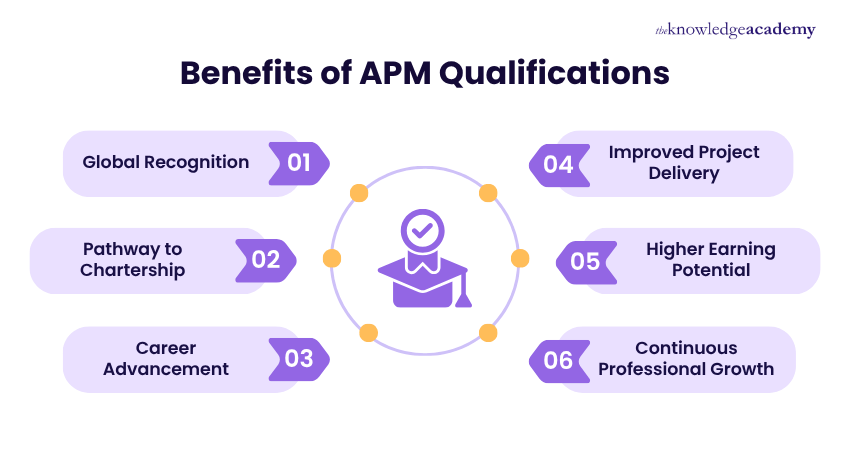
There are many benefits for project management professionals who earn an APM Qualification. Listed below are some of the prominent advantages of being certified:

  • Global Recognition: Earn an internationally respected qualification that highlights your project management expertise.
  • Pathway to Chartership: APM qualifications provide a clear route to Chartered Project Professional (ChPP) status, the highest benchmark in project management.
  • Career Advancement: Access to wider career opportunities and progress into senior leadership roles.
  • Improved Project Delivery: Apply structured methodologies that enhance efficiency, reduce risks, and ensure successful outcomes.
  • Higher Earning Potential: Certified professionals are valued for their expertise and command better compensation.
  • Continuous Professional Growth: Join a professional network that encourages lifelong learning and skill enhancement through ongoing development opportunities.
Show more blue-arrow

Package deals for APM Training

Our training experts have compiled a range of course packages on a variety of categories in APM Training, to boost your career. The packages consist of the best possible qualifications with APM Training, and allows you to purchase multiple courses at a discounted rate.

Swipe for more. Don’t miss out!

APM Training FAQs

The Association for Project Management, also known as APM, is the chartered body of project professionals in the UK. It establishes standards, promotes excellence, and provides recognised qualifications to aid professional development in project, programme, and portfolio management.

APM Courses suit the best project managers, project coordinators, team managers, and potential professionals working in the delivery of projects in various fields. They are also appropriate for individuals wishing to get formal project management training and industry certification.

APM Certification increases knowledge in project management, increases professional credibility, increases employability, and aids career progression. It shows dedication to best practice and offers access to Chartered status routes to recognised project professionals.

Yes, online learning is possible with APM Courses on a virtual instructor-led basis. These provide optimal learning choices, including live instructions, exam support and access to online materials to fit your time and location.

Yes, APM Courses are accredited by the Association of Project Management.

There are APM Project Fundamentals Qualification (PFQ), and APM Project Management Qualification (PMQ). All levels promote advancement in terms of experience, professional objectives and knowledge demand.

The level of study time is different. PFQ normally takes 2 days, and PMQ may take 5 days with supplementary self learning. Timeframes can be different based on the method of delivery and personal pace of learning.

The PMQ is a knowledge qualification that encompasses all the main project management principles such as risk, governance, budgeting, leadership and planning. It shows a thorough knowledge of how to handle non-complex projects.

Yes, the official APM course guides, sample exam questions, revision notes, and mock tests are also available as study materials. These resources are usually provided by accredited training providers to help in exam preparation and retention of learning.

The PMQ exam is a 3-hour written test. The candidates will be required to respond to 10 questions out of 16, showing general knowledge in the Body of Knowledge topics of APM.

The exams may be taken online or in a classroom. Proctored online exams are scheduled and offered by accredited training vendors or APM and provide the opportunity to give remote learners flexibility.

The passing score on the PMQ exam is 55 per cent. For PFQ, it is 60 per cent. The applicants are supposed to show awareness of the main subjects with concise, systematic answers.

Exams are both year-round and can be booked by approved training providers or directly by the APM. You can select a date which will be most appropriate in your study and preparation schedule.

In case of failure, you can rewrite the PMQ exam. Before resits, training providers usually provide support or revision sessions. Feedback may also be used to find areas of improvement in order to succeed in an exam in future.

Yes, it is true that APM PMQ is an internationally known and respected project management qualification. It is consistent with international standards and helps to promote mobility in project roles in different industries all around the world.

The main APM qualifications available in Belize through The Knowledge Academy, a trusted training provider, include the APM PFQ, APM PMQ, and APM ChPP. These recognised certifications support project managers at different stages of their professional journey.

The first qualification that beginners can take is the APM Project Fundamentals Qualification (PFQ). Experienced individuals should consider joining the APM Project Management Qualification (PMQ) as a way of learning more about the project procedures and duties.

Completing an APM Course through The Knowledge Academy, one of the best training provider, can lead to roles such as project manager, project coordinator, PMO analyst, or programme lead, while the certification enhances professional credibility and opens opportunities across both government and private sectors.

The Knowledge Academy stands out as a prestigious training provider known for its extensive course offerings, expert instructors, adaptable learning formats, and industry recognition. It's a dependable option for those seeking these APM Courses.

Please see our APM Training available in Belize

The Knowledge Academy is one of the Leading global training provider for APM Training.

The training fees for APM Training in Belize starts from $5995

Show more down

Why we're the go to training provider for you

icon

Best price in the industry

You won't find better value in the marketplace. If you do find a lower price, we will beat it.

icon

Trusted & Approved

Recognised by leading certification bodies, we deliver training you can trust.

icon

Many delivery methods

Flexible delivery methods are available depending on your learning style.

icon

High quality resources

Resources are included for a comprehensive learning experience.

barclays Logo
deloitte Logo
Thames Water Logo

"Really good course and well organised. Trainer was great with a sense of humour - his experience allowed a free flowing course, structured to help you gain as much information & relevant experience whilst helping prepare you for the exam"

Joshua Davies, Thames Water

santander logo
bmw Logo
Google Logo
cross

Upgrade Your Skills. Save More Today.

superSale Unlock up to 40% off today!

* WHO WILL BE FUNDING THE COURSE?

close

close

Thank you for your enquiry!

One of our training experts will be in touch shortly to go over your training requirements.

close

close

Press esc to close

close close

Back to course information

Thank you for your enquiry!

One of our training experts will be in touch shortly to go overy your training requirements.

close close

Thank you for your enquiry!

One of our training experts will be in touch shortly to go over your training requirements.