


 Top Rated Course

We may not have the course you’re looking for. If you enquire or give us a call on +55 8000201623 and speak to our training experts, we may still be able to help with your training requirements.
What is Facilitation? A Complete Guide
The Knowledge Academy 10 November 2025Facilitation supports effective group work by guiding discussions, staying neutral, and encouraging inclusive, balanced participation. It creates a safe space for diverse perspectives and helps teams stay focused on shared goals. A skilled facilitator brings clarity, encourages collaboration, and helps move forward with confidence.

Training Outcomes Within Your Budget!
We ensure quality, budget-alignment, and timely delivery by our expert instructors.
Table of Contents

To be effective, groups must communicate clearly, participate, and feel accountable in accepting their place and the significance of their contributions. Good, guided support can convert ordinary meetings into bridges on which innovation and collaboration can be achieved. Facilitation is the vehicle bringing this about for maximum impact anywhere. This blog talks about how Facilitation releases the inherent capacity of groups and why Facilitation matters in such a wide variety of settings.
Table of Contents
1) What is Facilitation?
2) What is the Purpose of Facilitation?
3) Exploring the Principles of Facilitation
4) Examples of Applied Facilitation
5) Looking at the Benefits of Facilitation
6) What are the Tools and Techniques Used in Facilitation?
7) When to use Facilitation?
8) Conclusion
What is Facilitation?
What does Facilitation mean? It entails more than just orchestrating a meeting; it involves guiding a group through a collaborative journey for collective outcomes. A facilitator assists groups to create the space for everyone to enter, supports accessible participation and engages in a disposition that is critical for the group's process by maintaining neutral participation and introducing the group with an opportunity to engage in discussion and decision-making on the topic at hand.
Whether in workshops, team meetings or leadership development, Facilitation introduces elements of ownership, creativity and clarity to co-creation that shift dynamics for the group. Facilitating is a mindset and skillset that welcomes alternative methods of engagement where co-created solutions emerge, versus a top-down instructional approach. With an intentional approach, this concept can help the 'ordinary' into a purposeful process of connection for group learning that creates momentum for objectives to be achieved.
What is the Purpose of Facilitation?
Facilitation is important because working effectively together doesn't occur automatically. In a group situation, it is easy for conversations to drift, some voices can dominate, and others can disengage completely. This determines low participation, missed ideas, and very little progression.
Facilitation infiltrates structure, keeps discussions focused, and ensures everyone is heard. When an experienced facilitator leads the process, contributions are better, ideas are constructively challenged, and decisions provide more information. The purpose of this is to effectively utilise time and collective intelligence, unleashing the group's potential and making a difference.
Exploring the Principles of Facilitation
Facilitation is built on key principles that help groups collaborate effectively. These principles guide facilitators in creating inclusive, productive spaces where ideas flow and decisions are made with clarity. Let’s see them below:
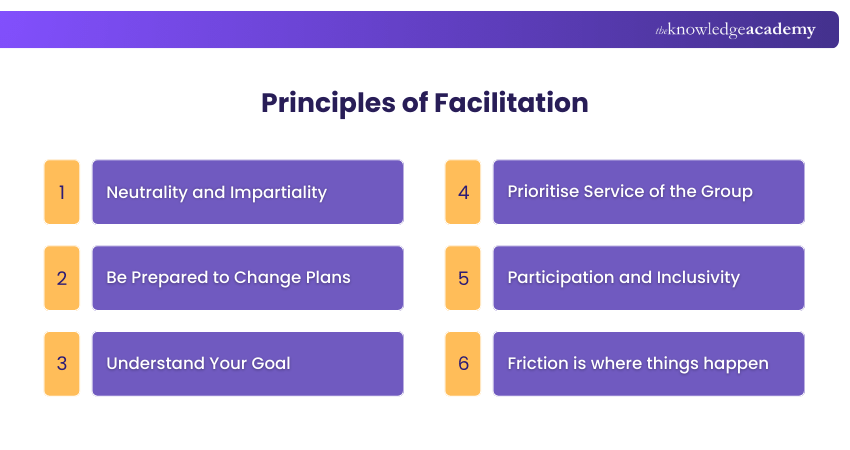
1) Neutrality and Impartiality
These are two concepts that are interconnected and important to fair decision-making processes.
Stay Objective: A facilitator must avoid taking sides or influencing outcomes, allowing the group to own its decisions.
Encourage Balanced Input: Neutrality ensures all voices are heard, not just the most vocal or senior participants.
Build Trust: Impartial Facilitation fosters a safe environment where participants feel respected and valued.
2) Be Prepared to Change Plans
Being flexible is essential as facilitators are expected to adapt to the group's needs in real time.
Adapt to Group Dynamics: If energy drops or confusion arises, a flexible facilitator adjusts the approach to keep momentum.
Respond to Emerging Needs: Sometimes, unexpected insights shift the focus. Being open to change keeps the session relevant.
Avoid Rigid Agendas: Sticking too strictly to a plan can stifle creativity and engagement.
Learn effective communication strategies with our Facilitation Skills Training – Sign-up now!
3) Understand Your Goal
A clear goal helps the group stay focused and aligned to provide meaningful outcomes.
Clarify the Purpose: Knowing the session’s goal helps structure activities and guide discussions effectively.
Align the Group: A shared understanding of the goal keeps everyone focused and reduces distractions.
Measure Progress: Clear goals allow facilitators to track outcomes and ensure the group is moving forward.
4) Prioritise Service of the Group
Seeding the group's success by collaborating is a Facilitator's top priority.
Support, Don’t Lead: The facilitator’s role is to enable the group, not to direct or dominate.
Empower Participants: Encouraging ownership leads to stronger commitment and better results.
Focus on Group Success: Every decision and action should serve the group’s collective interest.
5) Participation and Inclusivity
Inclusive Facilitation makes sure that every voice is heard and values.
Create Safe Spaces: Everyone should feel comfortable sharing ideas, regardless of background or role.
Use Varied Methods: Techniques like breakout groups or anonymous input help engage quieter voices.
Challenge Bias: Inclusive Facilitation actively works to prevent dominance and ensure equity.
6) Friction is Where Things Happen
A well-run workshop encourages open dialogue, creativity, and respectful challenge to support meaningful collaboration.
Create Space for Dialogue: Lively discussions and differing opinions are signs of a healthy group dynamic. Facilitation helps guide these moments with clarity and care.
Stay Present in the Storm: Conflict and passionate debate can be uncomfortable, but facilitators must remain grounded and open, this is often where change begins.
Encourage Vulnerability and Curiosity: Innovation grows when people feel safe to share. Ask thoughtful questions and invite exploration over quick conclusions.
Learn how to identify and mitigate potential risks in export and trade operations with our Export and Trade Compliance Training – Register today!
Examples of Applied Facilitation
Here are some examples of the situations where the Facilitation process can be applied:
1) Workshops
Facilitation is often utilised in workshops to ensure they are productive, inclusive, and outcome focused. A facilitator plans the workshop around clear objectives, outlining activities that engage participants and foster learning. They may also use techniques such as brainstorming, group discussions, role-playing, or problem-solving exercises to encourage active participation.
More importantly, the facilitator ensures all voices are heard, promoting an environment of inclusivity and respect. They guide the conversation, keeping it focused on the objectives, and intervene when necessary to manage conflicts or maintain momentum. Through effective Facilitation, workshops can result in meaningful learning, innovative ideas, and actionable outcomes.
2) Educational Settings
In educational settings, Facilitation serves as a powerful tool to promote active learning, critical thinking, and collaboration among students. Instead of a traditional lecture-style approach, facilitators guide students towards self-discovery and knowledge construction. They might use techniques such as group discussions, project-based learning, or peer teaching to foster student engagement.
Furthermore, facilitators also encourage inclusive participation, ensuring every student feels valued and heard. Moreover, they support students in resolving conflicts constructively and collaboratively.
Moreover, these practices cultivate a positive learning environment, deepen understanding, and foster vital facilitation skills like problem-solving and teamwork. Therefore, Facilitation transforms the learning process into a dynamic, student-centred experience.
Learn fundamental floral design techniques with our Introduction to Floristry Course – Join now!
3) Remote Collaboration
In the context of remote collaboration, Facilitation plays a crucial role in ensuring effective communication, participation, and productivity. Facilitators use digital tools to orchestrate meetings or workshops, employing techniques like virtual brainstorming, breakout rooms, and digital polling to encourage active engagement.
Additionally, they manage online etiquette, ensuring respectful interactions and balanced participation, and adapt their methods to overcome challenges of remote communication, like misunderstandings or technical glitches. They also set clear expectations for remote conduct, reinforcing the importance of timely responses and accountability.
4) Facilitation in Leadership
The practice of facilitation by leaders helps teams achieve targets while bettered communication and enables team cohesion. Some examples include:
a) Team Meetings: The leader should handle meetings as a facilitator to maintain a concentrated dialogue which incorporates all members and drives specific actions.
b) Decision-making Process: A leader supports team decision-making by enabling multiple viewpoints followed by collective agreement.
c) Change Management: Employee transition workshops enabled by leaders aim to assist workers through organisational adjustments.
d) Performance Reviews: Engaging employees in meaningful conversations about their growth and development.
Looking at the Benefits of Facilitation
Facilitation can greatly benefit a team and its members by encouraging effective communication and collaboration and driving momentum for consensus. The process ensures that every member’s voice is heard and valued, improving inclusivity and engagement in discussions. Here are the many benefits of Facilitation, described in the list below as follows:
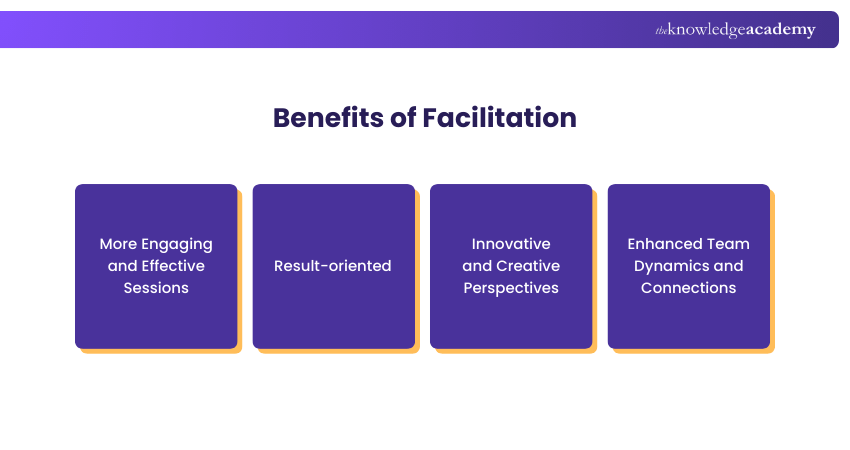
1) More Engaging and Effective Sessions
Facilitation plays a crucial role in making sessions more engaging and effective. A skilled facilitator knows how to spark and sustain interest, ensuring that participants remain focused and invested throughout the session.
Additionally, they use a variety of methods and techniques to keep the conversation flowing and to ensure active participation. This might involve icebreakers, group activities, brainstorming sessions, or interactive presentations that capture attention and encourage interaction.
2) Result-oriented
Facilitation plays a pivotal role in driving sessions towards achieving the team’s desired results. The crux of Facilitation is in its ability to guide a group towards a common objective, keeping the focus on the end goal while fostering an environment conducive to productive discussions.
Furthermore, a facilitator provides structure to a session, ensuring that the process is clearly defined and all participants understand the objectives. They maintain a clear vision of the outcome, guiding discussions and activities to align with the set goals.
3) Innovative and Creative Perspectives
Facilitation is instrumental in fostering innovative and creative perspectives within a group. Through its focus on inclusivity and active participation, it fosters an environment that encourages the sharing of diverse ideas and viewpoints.
Additionally, a skilled facilitator knows how to spark creativity among participants. They might use brainstorming sessions, problem-solving exercises, or thought-provoking questions to stimulate innovative thinking. They challenge participants to think beyond their usual perspectives and explore new possibilities.
4) Enhanced Team Dynamics and Connections
Facilitation plays a vital role in enhancing a team's dynamic and strengthening connections among its members. By selecting the right facilitator through well-structured Facilitator Interview Questions, organizations can ensure more effective sessions where members better understand each other's viewpoints, work more collaboratively, and build stronger relationships.
Now, a seasoned facilitator has the ability to foster an environment of open communication, encouraging team members to freely express their ideas and opinions. This openness enhances understanding and reduces miscommunication, leading to better team dynamics.
What are the Tools and Techniques Used in Facilitation?
Facilitators use a wide range of tools and techniques to guide group dynamics, encourage participation, and foster collaboration. From structured activities to subtle interpersonal skills, these methods help create inclusive, focused, and productive environments for group success.These tools and techniques are:
1) Go-round
2) Ice Breaker
3) IdeaStorm (Roving)
4) Parking Space
5) Small Groups
6) Paired Listening
7) Hot Seat
8) Spectrum Line
9) Fishbowl
10) Reverse Ideastorm
11) Energiser
12) Debrief
13) Evaluation
14) Throwing it Back
15) Weather Reporting
16) Active Listening
17) Forum Theatre
18) Parallel Lines
19) Gallery Report-back
20) Opening a Window
21) Refreshments
22) Straw Poll
23) Evaluation
24) Shared Experience
25) Building the Container
26) Eye Contact
27) Reading Signals
28) Receiving Kick-back
29) Supporting Mainstream and Margins
30) Digging Deeper
31) Supporting Divergence and Convergence of Views
32) Summarising
33) Framing
34) Observation
35) Questionning
36) Reflecting in Action
37) Naming Elephants
38) Designing a Plan
39) Giving Attention to One Individual
40) Timing and Pacing
41) Multipartiality
42) Working with Conflict
43) Noticing and Using Your Feelings
44) Enabling Full Participation
45) Humour and Smiling
When to Use Facilitation?
People benefit from facilitation when they require direction to achieve group goals using structured guidance. This concept works in three specific situations as described below.
a) Workshops & Meetings: The combination of workshops and meetings functions to support productive conversations that both include everyone and maintain goal focus.
b) Conflict Resolution: Through conflict resolution the group creates environment where all members can freely express themselves and find common solutions.
c) Brainstorming Sessions: Workshops with brainstorming sessions create opportunities for creative thinking among participants who stay focused on the task at hand.
d) Strategic Planning: Aligns teams on vision, priorities, and actionable goals.
e) Training & Development: The training and development programs create better engagement levels and increased learning opportunities because of their interactive nature.
f) Agile & Scrum Processes: This enables collaborative teams to bypass barriers while launching a continuous enhancement system.
Unleash your product potential! our Product Management Training will equip you with the skills to drive innovation. Start your journey today.
Conclusion
Effective teamwork doesn’t just happen by chance but is thoughtfully shaped and guided. Facilitation is the secret to turning group efforts into genuine success stories. As you look to strengthen collaboration in your own team or organisation, remember that the right support and structure can make all the difference. By embracing Facilitation, you open the door to more meaningful conversations, better outcomes, and relationships that last. Go ahead, give it a try and see the positive changes for yourself!
Elevate your Logistics Management expertise by joining our Logistics Management Training today!
Frequently Asked Questions
What Skills are Essential for Effective Facilitation?

Effective Facilitation requires strong listening, adaptability, and emotional intelligence. Facilitators must guide discussions with neutrality, encourage inclusive participation, and manage group dynamics with clarity and empathy. These skills help unlock collaboration and drive meaningful outcomes.
What Does a Facilitator do in an Agile or Scrum Team?
In Agile or Scrum teams, a facilitator supports collaboration, removes obstacles, and ensures productive meetings like stand-ups and retrospectives. They guide discussions, foster team ownership, and help maintain focus on goals and values, enabling continuous improvement and effective delivery.
What are the Other Resources and Offers Provided by The Knowledge Academy?
The Knowledge Academy takes global learning to new heights, offering over 3,000 online courses across 490+ locations in 190+ countries. This expansive reach ensures accessibility and convenience for learners worldwide.
Alongside our diverse Online Course Catalogue, encompassing 19 major categories, we go the extra mile by providing a plethora of free educational Online Resources like Blogs, eBooks, Interview Questions and Videos. Tailoring learning experiences further, professionals can unlock greater value through a wide range of special discounts, seasonal deals, and Exclusive Offers.
What is The Knowledge Pass, and How Does it Work?
The Knowledge Academy’s Knowledge Pass, a prepaid voucher, adds another layer of flexibility, allowing course bookings over a 12-month period. Join us on a journey where education knows no bounds.
What are the Related Courses and Blogs Provided by The Knowledge Academy?
The Knowledge Academy offers various Industry Training, including Facilitation Skills Training, Facilities Management Training, and Reliability Engineering Training. These courses cater to different skill levels, providing comprehensive insights into How to Become a Facilities Manager.
Our Business Skills Blogs cover a range of topics related to Facilitation, offering valuable resources, best practices, and industry insights. Whether you are a beginner or looking to advance your Business skills, The Knowledge Academy's diverse courses and informative blogs have got you covered.

The Knowledge Academy


Global Training Provider
The Knowledge Academy is a world-leading provider of professional training courses, offering globally recognised qualifications across a wide range of subjects. With expert trainers, up-to-date course material, and flexible learning options, we aim to empower professionals and organisations to achieve their goals through continuous learning.

Upcoming Business Skills Resources Batches & Dates
Date
 Facilitation Skills Training
Facilitation Skills Training
Fri 24th Jul 2026
Facilitation Skills Training
Fri 9th Oct 2026

 If you wish to make any changes to your course, please


