


 Top Rated Course

We may not have the course you’re looking for. If you enquire or give us a call on +1800812339 and speak to our training experts, we may still be able to help with your training requirements.
What is Google Cloud Platform (GCP): A Complete Overview
Scarlett Adams 15 July 2026Learn how Google Cloud Platform (GCP) helps businesses build, deploy, and manage apps with its powerful products and services. Discover how GCP supports data storage, Machine Learning, analytics, security, and real-world use cases across industries for scalable, smart solutions. Read on to learn more in detail.

Training Outcomes Within Your Budget!
We ensure quality, budget-alignment, and timely delivery by our expert instructors.
Table of Contents
Ever wondered how businesses run apps, store data, and tap into AI without managing heavy servers? That’s where Google Cloud Platform steps in. But What is Google Cloud Platform exactly? It is a powerful suite of cloud services designed to ease tech operations for businesses of all sizes.
From data storage and Machine Learning to app development and security, this platform gives tools that can change how businesses operate. Whether you’re a startup or a large enterprise, exploring What is Google Cloud Platform is could be the key to smarter, more efficient business solutions. In this blog, we’ll explore what GCP is, what it’s used for, its top services and pros and cons.
Table of Contents
1) What is Google Cloud Platform (GCP)?
2) What is Google Cloud Platform Used for?
3) What are Google Cloud Platform Products and Services?
4) Google Cloud Platform Pros and Cons
5) Google Cloud Platform Use Cases
6) Conclusion
What is Google Cloud Platform (GCP)?
Google Cloud Platform (GCP) is a suite of Cloud Computing services provided by Google. It provides a wide array of services including computing, data storage, Data Analytics, and Machine Learning. GCP helps businesses build, deploy and scale applications and services quickly without the need to invest in or manage physical infrastructure. It includes popular Data Analytics services like Google BigQuery and Looker Studio.
Here are some key points to remember about Google Cloud Platform (GCP):
a) Comprehensive Suite: GCP stands for Google Cloud Platform which is Google’s collection of public Cloud Computing products and services.
b) Data Analytics Services: Includes popular services like Google BigQuery and Looker Studio.
c) Infrastructure: Runs on the same infrastructure as Gmail, Google Drive, and Google Docs.
d) Global Network: Supported by Google’s international network of computing facilities.
e) Launch and Expansion: Been in existence since 2008 and has rapidly expanded its offerings.
f) Wide Range of Services: Provides computing services such as network, storage, Internet of Things (IoT), protection, application hosting, and scheduling software.
g) Cloud Artificial Intelligence (AI): One of the latest additions, emphasising Data Analytics, Machine Learning, and Artificial Intelligence.
Google Cloud vs Google Cloud Platform
To clearly understand the distinction between Google Cloud and Google Cloud Platform, let’s break down their key differences in the table below:

Acquire a strong understanding of Google Cloud services with our Google Cloud Platform Fundamentals Course – Register now!
What is Google Cloud Platform Used for?
Google Cloud Platform gives a range of services to help businesses build, deploy and manage applications in the cloud. Here is how GCP is commonly used:
1) Application Development and Hosting:
GCP supports developers create and host websites and mobile apps. Services like App Engine, Compute Engine and Google Cloud Functions enable for flexible and scalable deployment of applications.
2) Data Storage and Databases:
GCP provides storage options for different data types. Cloud Storage is used for unstructured data, while Cloud SQL, Cloud Spanner and Firestore manage structured data.
3) Data Analytics and Big Data:
Businesses can analyse large datasets using tools like BigQuery. Dataflow and Dataproc assist in processing and converting data into useful insights.
4) Machine Learning and AI:
GCP gives tools for developing, training and deploying Machine Learning models through Vertex AI. It also has ready-to-use APIs for image recognition, speech processing and language translation.
5) Networking:
Services like Virtual Private Cloud (VPC), Cloud Load Balancing, and Cloud CDN make sure that content is released quickly and securely across different networks.
6) Security and Identity Management:
GCP includes security tools like Cloud IAM, Cloud Identity, and Security Command Center to manage access, protect data, and comply with regulations.
7) Inter
net of Things (IoT):
GCP offers infrastructure to gather and analyse data from connected devices, making it easier to build IoT applications.
8) Hybrid and Multi-cloud Environments:
With Anthos, businesses can run and control applications across their own servers, GCP, and other cloud providers, providing more flexibility.
These facilities make GCP a valuable platform for businesses looking to use cloud technology for better data management, application development, and security.
Learn how to secure GCP network infrastructure, OS, and data. Register for our Introduction To Google Cloud Security Course today!
What are Google Cloud Platform Products and Services?
Google Cloud Platform gives a comprehensive set of cloud services for developing, deploying, and managing applications. It provides solutions for computing, storage, networking, data analytics, Machine Learning, and security, helping businesses streamline development and manage data effectively. Here are some key products and services:
Google Cloud Platform Products
Google Cloud Platform offers a range of products that enable businesses to build, deploy, and run applications efficiently. These products include computing power, data storage, networking, databases, and AI tools, all designed to provide scalable and secure cloud solutions. These are some of the products:

App Engine
App Engine is a platform-as-a-service (PaaS) that helps developers build and deploy web applications. It automatically handles scaling, load balancing, and Application Management, allowing you to focus on writing code rather than managing infrastructure.
BigQuery
BigQuery is a fully controlled data warehouse designed for fast SQL queries and Big Data Analysis. It enables businesses to analyse massive datasets efficiently and integrate with other GCP services for seamless data processing.
Learn to query BigQuery data with our Google BigQuery Training – Register today!
Cloud Run
Cloud Run allows you to deploy containerised applications in a serverless environment. It automatically scales applications based on traffic and gives a simple way to build, deploy, and manage microservices.
Compute Engine
Compute Engine provides scalable Virtual Machines (VMs) on Google’s infrastructure. It allows you to choose custom configurations, including CPU, memory, and storage, to match your workload needs.
Memorystore for Redis
Memorystore is a fully controlled in-memory data store service. It supports Redis, making it easy to build fast and responsive applications that require real-time data access.
Persistent Disk
Persistent Disk offers high-performance block storage for VMs. It provides reliable and scalable storage that can be attached to instances, offering data redundancy and durability.
Google Tensor Processing Unit (TPU)
Google TPU is a custom-designed chip for Machine Learning workloads. It accelerates training and inference for models built with TensorFlow, making it ideal for AI and data-intensive tasks.
Google Cloud Platform Services
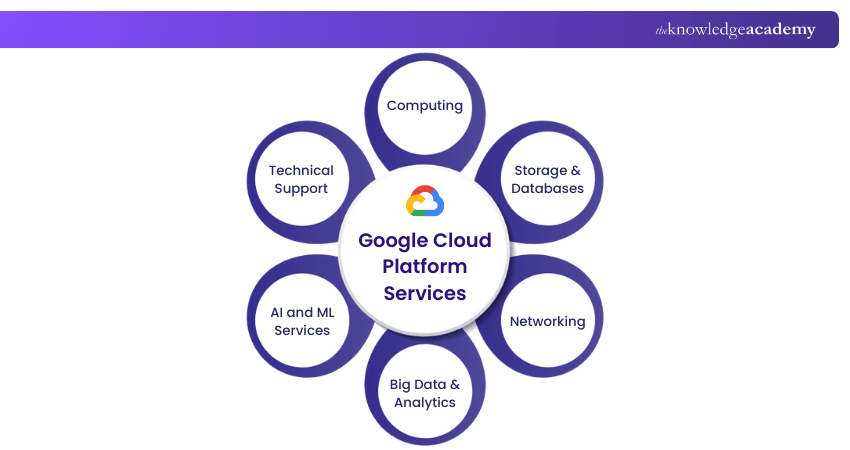
Google Cloud Platform (GCP) provides cloud services for computing, storage, networking, data analysis, Machine Learning, and Technical Support, enabling businesses to build, deploy, and manage applications effectively. These are some of the Google Cloud Platform services:
Computing
GCP offers powerful computing services like Compute Engine (VMs), App Engine (PaaS), Cloud Functions (serverless), and Kubernetes Engine (container orchestration) to build and run applications efficiently.
Storage & Databases
Services include Cloud Storage for unstructured data, Cloud SQL for relational databases, Cloud Spanner for globally distributed data, and Firestore for NoSQL databases, ensuring flexible and scalable data management.
Networking
Networking solutions like Virtual Private Cloud (VPC), Cloud Load Balancing, Cloud CDN, and Cloud Interconnect help deliver content securely and efficiently while connecting on-premises networks with GCP.
Big Data & Analytics
BigQuery, Dataflow, Dataproc, and Pub/Sub are key tools that help process, analyse, and manage large volumes of data, enabling real-time insights and data-driven decisions.
AI and ML Services
Vertex AI, Vision AI, Speech-to-Text, and Natural Language AI provide Machine Learning capabilities, helping build intelligent applications with pre-trained models and custom model training.
Technical Support
GCP offers various support plans to assist users, from basic troubleshooting to dedicated technical account managers. Support includes 24/7 availability, detailed documentation, and personalised assistance for complex issues.
Google Cloud Platform Pros and Cons
Google Cloud Platform (GCP) provides a range of cloud services, from data storage to Machine Learning. While it gives many benefits, there are also some drawbacks to consider.
GCP Strengths
1) Strong Security:
GCP uses data encryption and Identity and Access Management (IAM) to keep data and applications secure.
2) Scalability:
Businesses can manage resources based on their needs, making it cost-effective and efficient.
3) AI and Machine Learning:
Tools like Vertex AI and ready-made APIs make it easy to add AI and Machine Learning features to apps.
4) Global Network:
Google’s vast network ensures reliable service and low latency for users worldwide.
5) Open-Source Support:
GCP works well with open-source tools, giving businesses more flexibility.
6) Data Analytics Tools:
BigQuery and Dataflow help process and analyse large datasets quickly.
7) Sustainability:
Google runs its data centres using renewable energy, supporting its commitment to sustainability.

GCP Weaknesses
1) Complex Pricing:
The pricing structure can be confusing, making cost estimation difficult.
2) Limited Support:
GCP’s support services may not be as extensive as other cloud providers, affecting response times.
3) Fewer Data Centres:
GCP has fewer data centres than some competitors, which can limit availability in certain regions.
4) Learning Curve:
The wide range of services can be difficult for beginners to understand and use effectively.
5) Feature Gaps:
Some features and services are less developed than those of other providers like AWS and Azure.
6) Vendor Lock-In:
While GCP supports open-source tools, some proprietary services may limit flexibility in the long run.
Gain expertise in container management and deployment. Join our Application Development With Cloud Run Training now!
Google Cloud Platform Use Cases
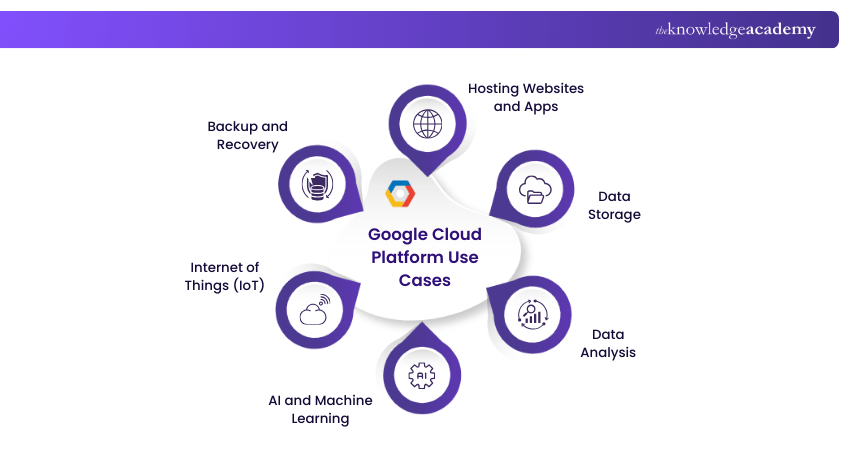
These are the main use cases of Google Cloud Platform:
1) Hosting Websites and Apps:
GCP provides services like Compute Engine, App Engine, and Cloud Run to host websites and applications without needing physical servers.
2) Data Storage:
Services like Cloud Storage, Cloud SQL, and Firestore offer secure and scalable options for storing data.
3) Data Analysis:
BigQuery and Dataflow help businesses analyse large datasets quickly to gain insights and make better decisions.
4) AI and Machine Learning:
Tools like Vertex AI allow companies to build, train, and deploy AI and Machine Learning models.
5) Internet of Things (IoT):
Cloud IoT Core connects and manages devices, allowing businesses to collect and analyse real-time data.
6) Backup and Recovery:
Cloud Storage and Persistent Disk provide reliable data backup and recovery solutions.
7) Content Delivery:
Cloud CDN ensures fast and secure delivery of content like images and videos to global users.
GCP offers these services to help businesses manage data, build apps, and deliver content effectively.
Conclusion
Google Cloud Platform is a versatile cloud solution that helps businesses store data, deploy applications, and implement AI tools efficiently. Understanding What is Google Cloud Platform and assessing its costs, support, and technical features can help determine if it’s the right fit for your business. With its global infrastructure, GCP ensures reliable performance and scalability.
Unleash Machine Learning with Google Cloud. Join our Big Data And Machine Learning With Google Cloud Platform Course now!
Frequently Asked Questions
How Does Google Cloud Platform Work?

Google Cloud Platform provides cloud infrastructure for running apps, storing data, and analysing information. It uses virtual machines, data centres, and networking services to deliver computing power, data storage, and security. GCP scales resources based on demand, ensuring flexibility and reliability.
Is Google Cloud Platform Right for my Business?
Yes, Google Cloud Platform is suitable for businesses needing scalable cloud solutions, data storage, advanced analytics, and AI tools. It’s ideal for companies handling large datasets, building apps, or requiring strong security features. However, consider budget, support options, and service availability before choosing GCP.

 If you wish to make any changes to your course, please


