




We may not have the course you’re looking for. If you enquire or give us a call on 01344203999 and speak to our training experts, we may still be able to help with your training requirements.
How to Become a Google Cloud Engineer?
ByNilotpal SarmahLast updated on: 10 October 2026
To become a Google Cloud Engineer, start by learning cloud fundamentals and gaining hands-on experience with Google Cloud Platform (GCP) services. Get certified with Google’s Associate or Professional Cloud exams to validate your skills. Practice with real-world projects and apply for cloud roles to build hands-on expertise.

Before You Start
1. Google Cloud Engineers help build, manage, secure and optimise cloud environments.2. Cloud Computing, networking, operating systems and security fundamentals provide an important technical foundation.3. Hands-on experience with Google Cloud services helps turn theoretical knowledge into practical skills.4. Relevant certifications can help validate your Google Cloud knowledge.5. Projects and a practical portfolio can demonstrate your abilities when applying for cloud engineering roles.
Ever dreamed of designing scalable, high-performance cloud solutions? Learning how to become a Google Cloud Engineer gives you the chance to harness the full power of Google Cloud platform to build, manage, and secure dynamic cloud environments. It’s not just about mastering technical tools; it’s about solving real-world problems and driving innovation in today’s digital-first world.
In this blog, we’ll explore how to become a Google Cloud Engineer, including the key roles and responsibilities, the benefits of this career path, and the steps you can take to get started. Let’s get started!
Trainer's Insight
Focus on understanding fundamental cloud concepts before trying to memorise individual services. Strong foundations make it easier to understand why and when particular Google Cloud technologies should be used.
How to Become a Google Cloud Engineer?
Becoming a Google Cloud Engineer means learning cloud computing skills and working with the Google Cloud platform. This section will help you understand the steps, from starting with the basics to getting certified and finding a great job.
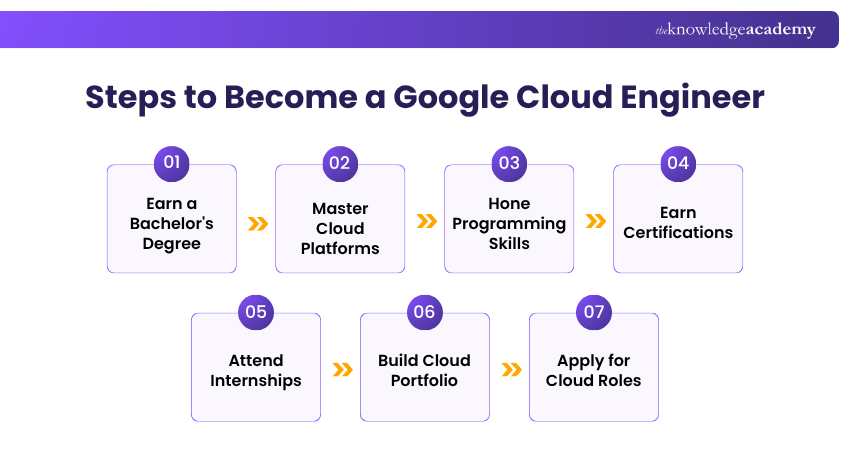
Step 1: Earn a Bachelor's Degree
The first step to kick-start any career is to obtain a bachelor's degree in a relevant field. This is especially true if your career requires technical knowledge. In this case, you will require a bachelor's degree in Computer Science. This will not only look great on your resume but it will also give you an understanding of the subject knowledge you will require to be a Google Cloud Engineer.

Step 2: Gain Proficiency in a Cloud Computing Platform
Choose a cloud platform to focus on, like Google Cloud platform. Learn how to use its core services, such as Virtual Machines, storage, and databases. Practice by working on small projects and using online tutorials and resources. This hands-on experience will help you become comfortable with the platform. Additionally, seek out community forums and groups to share knowledge and ask questions.
Step 3: Gain Experience in Programming Language
Learn a programming language like Python, Java, or Go. Practice writing code and building small projects. Use your programming skills to streamline tasks and develop applications. This experience will be valuable for working with cloud platforms and developing efficient solutions.
Step 4: Earn Relevant Certifications
Certifications can provide a structured learning path and help validate your knowledge. Choose a certification that matches your current experience and intended career direction rather than collecting certifications without applying the underlying skills.
Step 5: Internships
Irrespective of the career path chosen, you are required to have some experience in the field to get employed, but how can you gain this experience? Internships! With a lot of work to manage, companies offer internships to freshers. This creates a win-win situation where you can gain valuable experience under the guidance of your employer while you help them with their tasks.
Step 6: Build a Cloud Portfolio
Create projects that demonstrate how you apply your cloud engineering skills. Possible projects include:
a) Deploying a web application
b) Creating and configuring Virtual Machines
c) Building a cloud storage solution
d) Configuring networking
e) Setting up IAM permissions
f) Deploying a containerised application
g) Configuring monitoring and alerts
h) Automating infrastructure deployment
For each project, document the problem, architecture, services used, security considerations and challenges you solved.
Building a Google Cloud Engineer Portfolio
For each portfolio project, include:
1. Project Objective: Explain what you wanted to build or solve.2. Architecture: Show how the cloud components work together.3. Google Cloud Services: Identify the services and resources used.4. Security: Explain how access and data were protected.5. Challenges: Describe problems encountered during implementation.6. Solution: Explain how you investigated and resolved those problems.7. Outcome: Summarise what the completed project achieved.
Step 7: Apply for Cloud Roles
Once you have developed foundational knowledge and practical experience, begin applying for suitable cloud engineering and related entry-level roles. Highlight your projects, practical Google Cloud experience, technical skills and relevant certifications rather than relying only on academic qualifications.
Learn how to implement a storage bucket with our Google Cloud Storage Training – Join today!
Benefits of Being a Google Cloud Engineer
Here are some of the advantages:
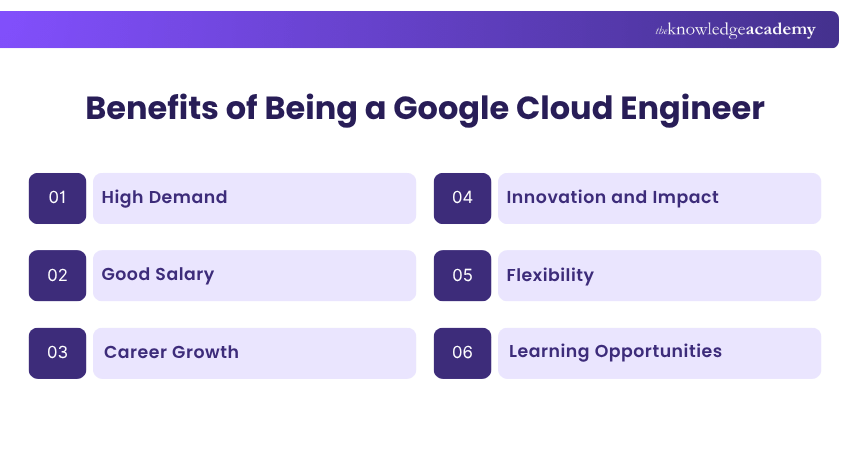
a) High Demand: They are in high demand as more companies move to the cloud. This trend creates many job opportunities in various industries. It also ensures a stable career with potential for growth.
b) Good Salary: Google Cloud Engineers earn competitive salaries due to the specialised skills required. The demand for their expertise makes them highly valued in the job market. This translates to better pay and benefits compared to many other IT roles.
c) Career Growth: There are many opportunities to advance into senior roles or specialise in areas like security or data engineering. Continuous learning and gaining certifications can further boost career prospects. This field offers a clear path for professional development and advancement.
d) Innovation and Impact: They work on cutting-edge technology and innovative projects. Their work significantly impacts how businesses operate and grow. This allows them to be at the forefront of technological advancements and make meaningful contributions.
e) Flexibility: Many cloud engineering roles offer the option to work remotely. This flexibility in job location and working hours can greatly improve work-life balance. It allows professionals to tailor their work environment to their personal needs.
f) Learning Opportunities: Google provides a wealth of resources and training materials for Google Cloud Engineers. Continuous professional development is encouraged through certifications and hands-on projects. This ensures that Engineers are always learning and growing in their field.
Google Cloud Engineer Skills Checklist
□ Cloud Computing fundamentals□ Google Cloud core services□ Networking fundamentals□ Linux and operating systems□ Programming or scripting□ Databases and cloud storage□ Identity and access management□ Security fundamentals□ Containers and orchestration concepts□ Monitoring and troubleshooting□ Communication and problem-solving
Master the art of building serverless databases with the Google Cloud Firestore Training – Join today!
Roles and Responsibilities of a Google Cloud Engineer
Here are the key duties of a Google Cloud Engineer:
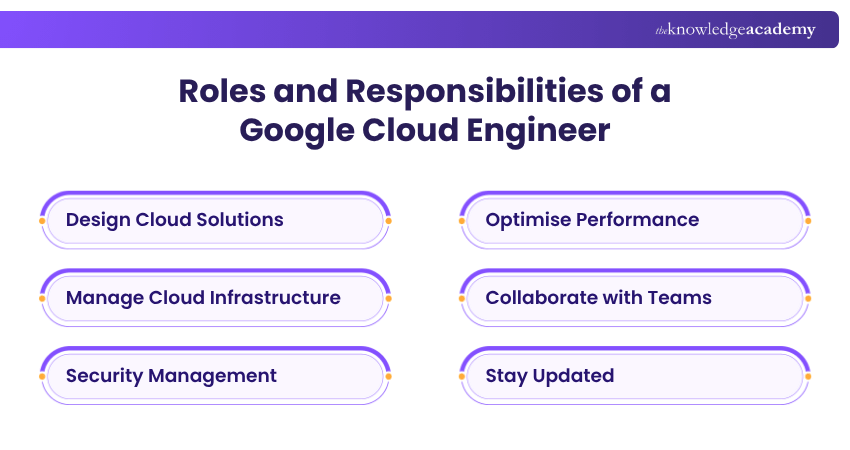
a) Design Cloud Solutions: Create architecture for applications and systems using GCP services. Ensure the design meets business needs and technical requirements. Plan for scalability, reliability, and security in every solution.
b) Manage Cloud Infrastructure: Set up and maintain cloud environments, including Virtual Machines, storage, and databases. Regularly monitor system performance to identify and resolve issues quickly. Ensure the infrastructure runs smoothly and efficiently.
c) Security Management: Implement security measures to protect data and applications. Manage access controls to ensure only authorised users have access to resources. Regularly update security policies to comply with industry standards.
d) Optimise Performance: Improve the efficiency and performance of cloud applications. Use tools and techniques to monitor application performance and identify bottlenecks. Implement changes to enhance speed and reliability.
e) Collaborate with Teams: Work closely with developers, IT staff, and other stakeholders to deliver cloud solutions. Share knowledge and provide training on GCP tools and best practices. Ensure effective communication and collaboration across teams.
f) Stay Updated: Keep up with the latest GCP features and industry trends. Continuously learn about new technologies and integrate them into your work. Be flexible to changes in the technology landscape to stay current and competitive.
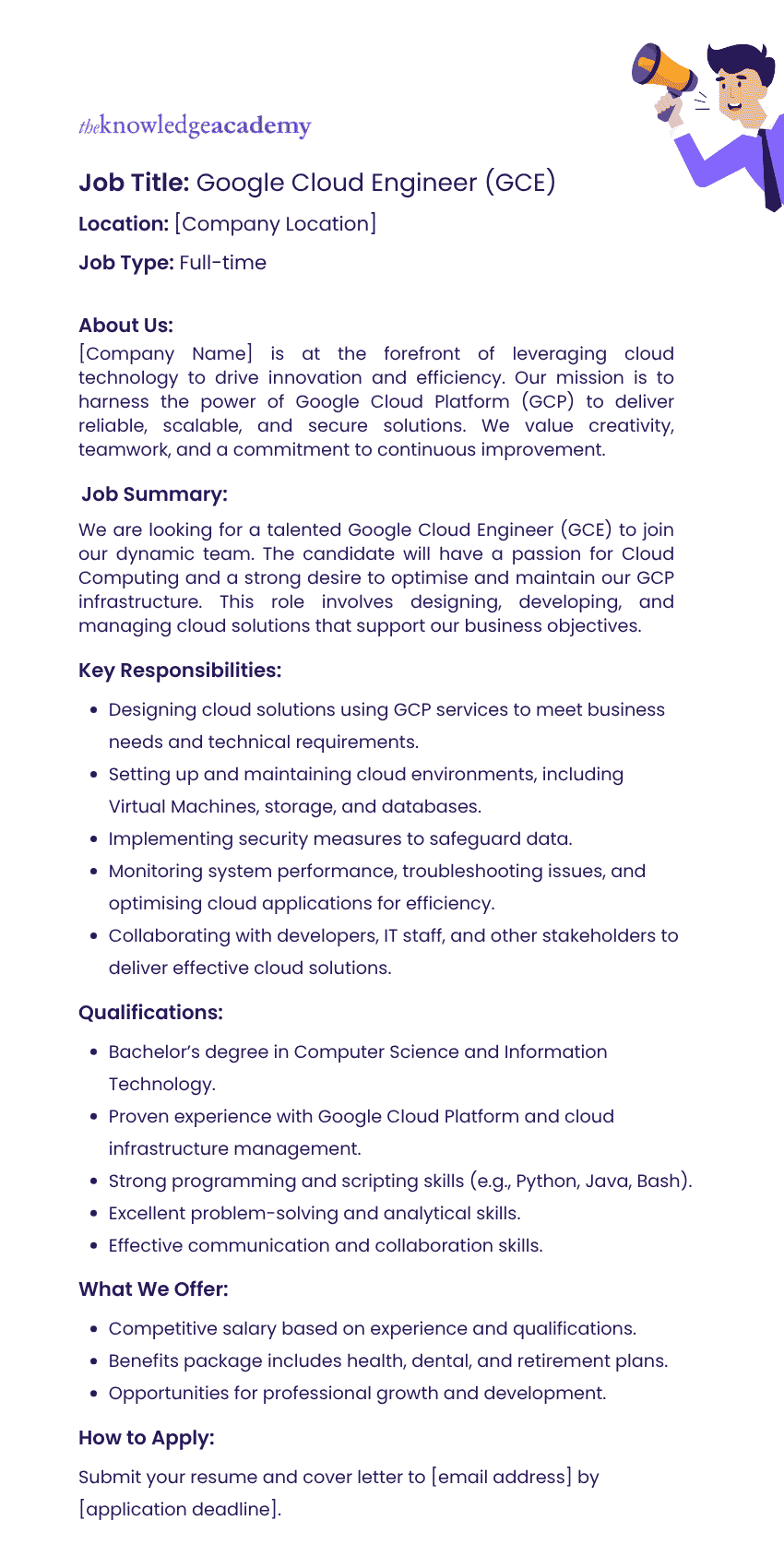
Template for Google Cloud Engineer Job Description
Here is the Template for the Google Cloud Engineer job description:
So, by combining technical knowledge, practical projects, continuous learning and a well-documented portfolio, you can build the skills needed to pursue opportunities in Google Cloud engineering.

Nilotpal Sarmah is a Senior Content Writer with 11+ years of overall experience spanning engineering, operations and content development. His technical knowledge and extensive writing experience enable him to simplify specialised topics across IT and Tech, Business Skills, Project Management, Health and Safety, and ISO and Compliance.
View Detail

 If you wish to make any changes to your course, please


