


 Top Rated Course

We may not have the course you’re looking for. If you enquire or give us a call on +44 20 4538 6376 and speak to our training experts, we may still be able to help with your training requirements.
Page Replacement Algorithms in Operating Systems
Richard Harris 10 February 2026Curious about Page Replacement Algorithms in OS? These algorithms manage how pages are swapped in and out of memory. This blog dives into various algorithms like FIFO, LRU, and Optimal, explaining their functions and performance implications in modern computing environments. Keep reading to learn more.

Training Outcomes Within Your Budget!
We ensure quality, budget-alignment, and timely delivery by our expert instructors.
Table of Contents

Ever questioned how your computer juggles multiple tasks without running out of memory? The answer lies in a complex process called Page Replacement Algorithms in Operating System (OS). When your system's memory fills up, it needs to decide what to keep and what to discard. Understanding these algorithms is crucial for optimising system performance and preventing frustrating slowdowns. Let's dive into the world of memory management and explore how Page Replacement Algorithms in OS keep your computer running smoothly.
Table of Contents
1) What is Paging?
2) What is a Page Fault?
3) Virtual Memory in Operating Systems
4) Frame Allocation in Virtual Memory
5) Common Page Replacement Techniques
6) Conclusion
What is Paging?
Paging is a memory management scheme that expels the need for contiguous allocation of physical memory. In paging, both the logical address space of a process and the physical address space are divided into fixed-size blocks called pages and frames, respectively. A page is a fixed-length contiguous block of virtual memory, and a frame is a fixed-length block of physical memory. The size of a page and a frame is typically the same, facilitating the seamless mapping of virtual addresses to physical addresses.
When a program is executed, its pages are loaded into any available memory frames, not necessarily in a contiguous manner. This allows for more flexible and efficient use of memory, reducing fragmentation. Paging in Operating System simplifies memory allocation and management, as the operating system can easily keep track of free frames and allocate them as needed.

What is a Page Fault?
A page fault occurs when a program seeks to access a page that is absent in physical memory at present. This can happen because the page has either never been loaded into memory or has been swapped out to make room for other pages. When a page fault emerges, the operating system (OS) must take steps to handle it and bring the required page into memory.
Handling a page fault involves several steps:
1) Interrupt Handling: The operating system detects the page fault and pauses the execution of the program.
2) Determine the Cause: The operating system identifies which page is needed and whether it is in secondary storage (e.g., disk).
3) Page Replacement: If no free frames are available, the operating system uses a Page Replacement Algorithm to select a frame to swap out.
4) Load the Page: The required page is loaded from secondary storage into the selected frame.
5) Update Tables: The page tables are updated to reflect the new location of the page.
6) Resume Execution: The program resumes execution from where it was interrupted.
Page faults are essential for efficient memory management, allowing the operating system to utilise available memory resources effectively.
Virtual Memory in Operating Systems
Virtual memory is a memory management technique that permits a computer to offset physical memory shortages by briefly transferring data from random access memory (RAM) to disk storage. This process is facilitated by using virtual addresses, which provide an abstraction of the physical memory addresses. Virtual memory enables the execution of programs that are larger than the available physical memory by paging parts of the program in and out of memory as needed.
Demand Paging
Demand paging is a method of virtual memory management where pages are only loaded into memory when they are needed. This contrasts with loading the entire program into memory at once. Demand paging helps to conserve memory and improve system performance by only loading the necessary pages.
When a program tries to access a page that is absent in memory, a page fault occurs. The operating system then loads the required page from secondary storage into memory. This approach allows the system to handle large programs more efficiently and ensures that memory is used optimally.
Unlock your potential in programming with our C Programming Course. Join now!
Frame Allocation in Virtual Memory
Frame allocation refers to the process of designating physical memory frames to the pages of a process. The operating system must decide how many frames to allocate to each process and how to distribute them among competing processes.
Frame Allocation Constraints
Several constraints influence frame allocation:
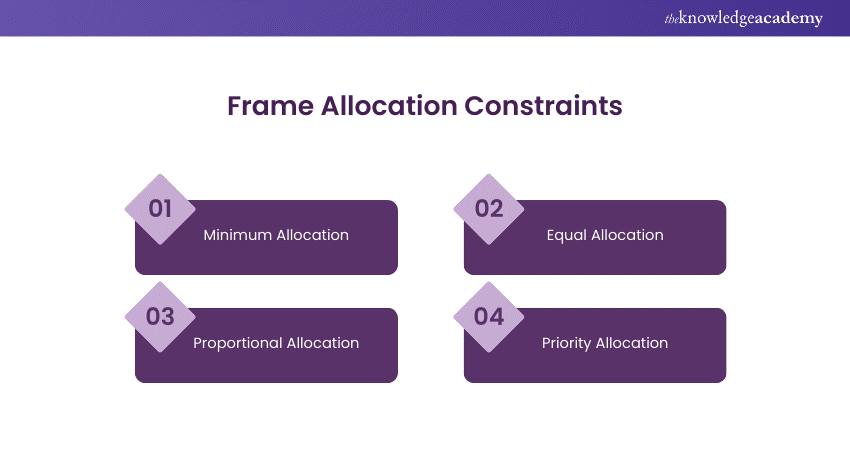
a) Minimum Allocation: Each process must be allocated at least a minimum number of frames to function correctly.
b) Equal Allocation: Frames can be allocated equally among processes, but this may not always be optimal.
c) Proportional Allocation: Frames are allocated based on the size of the processes, with larger processes receiving more frames.
d) Priority Allocation: Processes with higher priority may receive more frames to ensure faster execution.
Frame Allocation Algorithms
Frame allocation algorithms play a crucial role in determining how memory frames are distributed among processes in a system. Efficient allocation is essential for optimising system performance and ensuring that all processes have the necessary resources to function correctly. Below are the common frame allocation algorithms:

a) Equal Allocation: In the equal allocation method, each process is assigned an equal share of the total available frames. This approach is straightforward and easy to incorporate as it does not require any complex calculations or considerations of the process characteristics. However, it may not always be the most efficient method, especially if the processes vary significantly in size or importance. For instance, a small process might not need as many frames, leading to inefficient use of memory, while a larger, more resource-intensive process might suffer from insufficient memory allocation.
b) Proportional Allocation: Proportional allocation is a more sophisticated method where frames are distributed based on the size or importance of the process. This means that larger processes receive more frames compared to smaller ones. The allocation can be determined by the proportion of the process's size relative to the total size of all processes. For example, if a process occupies 25% of the total memory requirements of all processes, it will receive 25% of the available frames. This method ensures a more balanced and efficient use of memory resources, accommodating the needs of larger processes better than equal allocation.
c) Priority Allocation: Priority allocation considers each process's priority level. Processes with higher priority are allocated more frames, ensuring they have the resources needed to run efficiently. This approach is particularly helpful in systems where certain processes are critical and must run smoothly without delays. For example, in a real-time operating system, processes that handle time-sensitive tasks would be given higher priority and, consequently, more frames. This method ensures that critical processes receive the necessary resources to meet their performance requirements, while lower-priority processes receive fewer frames and may experience delays or reduced performance.
Elevate your programming expertise with our C++ Programming Course and gain advanced skills.
Page Replacement Algorithms
Page Replacement Algorithms are essential components of an operating system's memory management system. They determine which page to remove from memory when a new page needs to be loaded, and no free frames are available. The primary objective of these algorithms is to minimise the number of page faults that occur when a program tries to access data that is not currently in memory.
By efficiently selecting the pages to replace, these algorithms help ensure optimal memory usage, reduce access times, and improve overall system performance. Different algorithms, such as FIFO, LRU, and Optimal, offer various strategies to achieve these goals, each with its own advantages and trade-offs.
Common Page Replacement Techniques
Page Replacement Techniques are essential for managing memory in computer systems. These algorithms determine which pages to keep in memory and which to swap out to disk when memory is full. Let's explore some of the most widely used techniques.
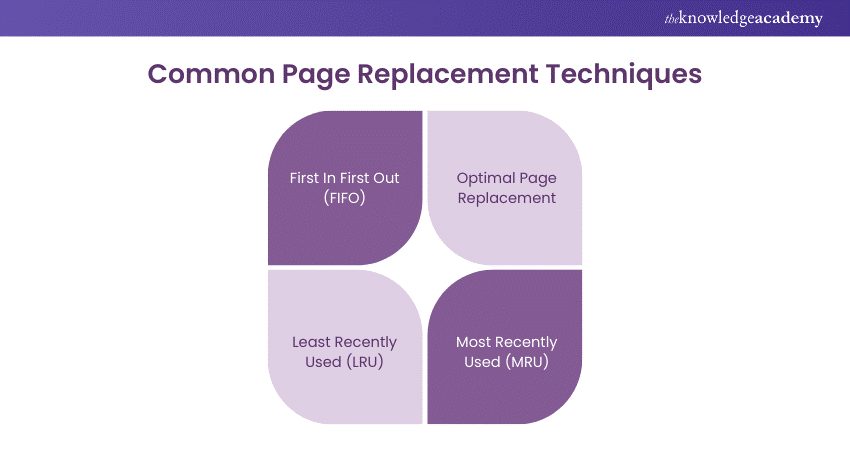
First In First Out (FIFO)
The First In First Out (FIFO) Page Replacement Algorithm is one of the simplest and most straightforward methods for managing memory. In FIFO, pages are loaded into memory in the order they arrive, and when a new page needs to be loaded but memory is full, the oldest page—the one that has been in memory the longest—is replaced. This method uses a queue to keep track of the order of pages in memory, essentially following a First Come First Serve principle.
While FIFO is easy to implement, it has significant drawbacks. One major issue is that it does not consider the frequency or recency of page usage. This can lead to situations where frequently used pages are removed, causing higher page fault rates and reduced performance, especially in cases where the removed page is soon needed again. Despite its simplicity, FIFO may not always be the best choice for systems that require efficient memory management.
Optimal Page Replacement
The Optimal Page Replacement Algorithm (OPT) or MIN, is theoretically the most efficient page replacement strategy. It works by replacing the page that will not be used for the longest period in the future. This method ensures the lowest possible page fault rate since it always makes the best decision based on future page usage. However, the major limitation of the Optimal Page Replacement (OPT) Algorithm is its impracticality in real-world applications.
Implementing OPT requires precise knowledge of future memory access patterns, which is typically unavailable. Therefore, while OPT serves as an ideal benchmark for comparing the effectiveness of other Page Replacement Algorithms, it cannot be directly implemented. Instead, it is used to understand the best possible performance that can be achieved and to evaluate how close other algorithms come to this ideal.
Least Recently Used (LRU)
The Least Recently Used (LRU) algorithm replaces the page that has not been retrieved for the longest time. LRU operates under the assumption that pages used recently will likely be used again soon, while those not used for a while are less likely to be needed. This method aims to retain the most relevant pages in memory, thereby reducing the page fault rate. LRU is generally more effective than FIFO because it considers page usage patterns.
However, implementing LRU is more complex. It requires tracking the order of page accesses, which can be done using data structures like stacks or counters. The complexity of maintaining and updating these structures can add overhead to the system, but the performance gains often justify the additional complexity in many scenarios.
Most Recently Used (MRU)
The Most Recently Used (MRU) algorithm is the opposite of LRU. MRU replaces the page that was most recently used, operating on the principle that if a page was just used, it might not be needed again soon. MRU can be particularly effective in specific scenarios, such as when a process repeatedly accesses a small set of pages in a loop.
In such cases, MRU helps by keeping less recently used pages in memory, anticipating their reuse. However, in broader applications, MRU is generally less effective than LRU because its assumption about page usage patterns does not hold as widely. MRU may lead to higher page fault rates in environments where recently used pages are still frequently needed.
Unlock your potential with comprehensive End User Trainings—Register now and master essential skills for success!
Conclusion
In summary, Page Replacement Algorithms in OS are a critical component of modern operating systems. They play a vital role in managing memory resources, ensuring efficient execution of programs, and maintaining system stability. As technology advances, these algorithms will continue to be refined and optimised to meet the growing demands of computing environments.
Elevate your potential— Join our Computer Science Course today and start your journey towards becoming a tech innovator!
Frequently Asked Questions
What are the Criteria for the Best Page Replacement Algorithm?

The best Page Replacement Algorithm minimises page faults, efficiently uses memory, adapts to varying workloads, and maintains low overhead for implementation and management, ensuring optimal system performance and resource utilisation.
Which Page Replacement Algorithm is Worst?
The First In First Out (FIFO) algorithm is often considered the worst due to its tendency to remove frequently used pages, leading to higher page fault rates and inefficient memory usage.
What is the most frequently used Page Replacement Algorithm?
The Least Recently Used (LRU) algorithm is the most frequently used Page Replacement Algorithm due to its balance between simplicity and effectiveness in reducing page faults by considering recent page usage patterns.
What are the Other Resources and Offers Provided by The Knowledge Academy?
The Knowledge Academy takes global learning to new heights, offering over 3,000+ online courses across 490+ locations in 190+ countries. This expansive reach ensures accessibility and convenience for learners worldwide.
Alongside our diverse Online Course Catalogue, encompassing 19 major categories, we go the extra mile by providing a plethora of free educational Online Resources like Blogs, eBooks, Interview Questions and Videos. Tailoring learning experiences further, professionals can unlock greater value through a wide range of special discounts, seasonal deals, and Exclusive Offers.
What is The Knowledge Pass, and How Does it Work?
The Knowledge Academy’s Knowledge Pass, a prepaid voucher, adds another layer of flexibility, allowing course bookings over a 12-month period. Join us on a journey where education knows no bounds.
What are the Related Courses and Blogs Provided by The Knowledge Academy?
The Knowledge Academy offers various End User Trainings, including the Computer Science Course, the Mac Numbers Course and the MacOS Mojave Training These courses cater to different skill levels, providing comprehensive insights into Computer Science Projects.
Our Office Applications Blogs cover a range of topics related to Page Replacement Algorithm, offering valuable resources, best practices, and industry insights. Whether you are a beginner or looking to advance your Computer Science skills, The Knowledge Academy's diverse courses and informative blogs have got you covered.

Richard Harris


Senior Full Stack Developer and Technology Educator
Richard Harris is a highly experienced full-stack developer with deep expertise in both frontend and backend technologies. Over his 12-year career, he has built scalable web applications for startups, enterprises and government organisations. Richard’s writing combines technical depth with clear explanations, ideal for developers looking to grow in modern frameworks and tools.

Upcoming Office Applications Resources Batches & Dates
Date
 Computer Science Course
Computer Science Course
Fri 10th Jul 2026
Computer Science Course
Fri 9th Oct 2026

 If you wish to make any changes to your course, please


