


 Top Rated Course

We may not have the course you’re looking for. If you enquire or give us a call on 01344 203999 and speak to our training experts, we may still be able to help with your training requirements.
Risk Management Process: Steps, Importance & Best Practices
Grace Mitchell 20 April 2026The Risk Management Process involves identifying, analysing, prioritising, mitigating, and monitoring risks to minimise their impact on an organisation's goals. If risks are not managed well, a business can lose money, harm its reputation, or face legal trouble. This shows why having a clear and structured Risk Management plan is needed.

Training Outcomes Within Your Budget!
We ensure quality, budget-alignment, and timely delivery by our expert instructors.
Table of Contents
Have you ever wondered what separates thriving businesses from those that crumble under pressure? Imagine trying to drive through a winding, foggy road without headlights! That’s what it's like for organisations without a solid Risk Management strategy; unseen threats waiting to disrupt operations. This is where the Risk Management Process steps in, helping foresee and tackle threats before they escalate into disruptions.
But what are the key steps involved, and how do they keep companies on track? In this blog, we’ll take you through the five crucial steps of the Risk Management Process. If you are curious about how this process can help your organisation avoid trouble while opening doors to new opportunities, read on!
Table of Contents
1) What is the Risk Management Process?
2) What are the Steps of the Risk Management Process?
3) Best practices for an effective Risk Management process
4) Why is Risk Management Important?
5) Conclusion
What is the Risk Management Process?
The Risk Management Process is a step-by-step approach that helps people and organisations find, understand and reduce risks. When used with ISO 27001 and ISO 27005, it helps deal with possible problems before they grow, making it easier to manage uncertainty. It can also uncover ways to improve how things are done.
The process of Risk Management builds a forward-thinking mindset by supporting regular checks and smarter choices, which makes organisations stronger. It’s flexible and can be shaped to fit different industries, projects or goals. By following its key ideas, both businesses and individuals can stay more prepared and confident when facing challenges.
What are the Steps of the Risk Management Process?
The Risk Management process is a simple step-by-step plan to deal with risks. It has five main steps: first, you identify the risks, then analyse them, decide which ones are most important, take action to reduce them, and finally, keep an eye on them. Let's explore each of these steps:

1) Identifying Risks
a) The first step in the Risk Management process is to find the risks that a business might face in its day-to-day operations.
b) These can include legal, environmental, market, or regulatory risks.
c) It’s important to spot as many risks as possible. In a manual system, these are written down by hand.
d) However, if the business uses a Risk Management system, all the risk details can be entered directly into the software.
e) This makes it easier for everyone with access to see the risks immediately, instead of waiting for a report by email.
f) This keeps important information visible and easy to find. Learn more about how to identify risks in detail.
Elite risk leadership begins with a black belt! Our Risk Management Black Belt Training will help you get started - Sign up now!
2) Analysing Risks
a) Once a risk is identified, it must be analysed to understand its scope.
b) It’s important to see how the risk connects with various parts of the organisation.
c) The seriousness of the risk is judged by how many business functions it affects.
d) Some risks may shut down the entire business, while others may cause only minor issues.
e) This analysis is done by hand in manual systems and can take time.
f) A Risk Management system helps by linking risks to documents, policies, procedures, and processes.
g) This setup allows the system to assess each risk's impact and reach a decision automatically.
3) Prioritising Risks
a) Risks must be ranked and prioritised based on their potential impact.
b) Most Risk Management systems use categories to classify risks by severity.
c) Minor risks that cause small inconveniences are rated low.
d) Major risks that could cause serious loss are rated high.
e) Prioritising risks helps the organisation understand its overall risk exposure.
f) Multiple low-level risks may not need senior management attention.
g) A single high-level risk might require immediate action from top management.
h) Risk assessments can be done using Qualitative or Quantitative methods.
There are two types of Risk Assessment: Qualitative and Quantitative Risk Assessment. Here are the key differences:

4) Treating Identified Risks
a) Every risk should be reduced or controlled as much as possible.
b) This usually involves talking to experts who understand that specific risk.
c) In a manual system, this means reaching out to each person, setting up meetings, and managing long email chains, phone calls, and scattered documents.
d) With a Risk Management system, things are much simpler.
e) All stakeholders can get alerts directly through the system. Discussions and updates about the risk and its solutions can happen in one place.
f) Management can also easily track progress without needing constant updates, as everything is visible within the system.
5) Monitoring Risks
a) Some risks, like market and environmental risks, cannot be fully eliminated and must be constantly monitored.
b) In manual systems, employees are responsible for closely monitoring these ongoing risks.
c) This requires regular attention and effort to avoid missing important changes.
d) In a digital setup, a Risk Management system monitors all organisational risks.
e) Any changes in risks are instantly visible to all relevant stakeholders.
f) Automated systems are more effective than people at monitoring risks continuously.
g) Regular monitoring helps ensure business continuity and a quick response to potential issues.
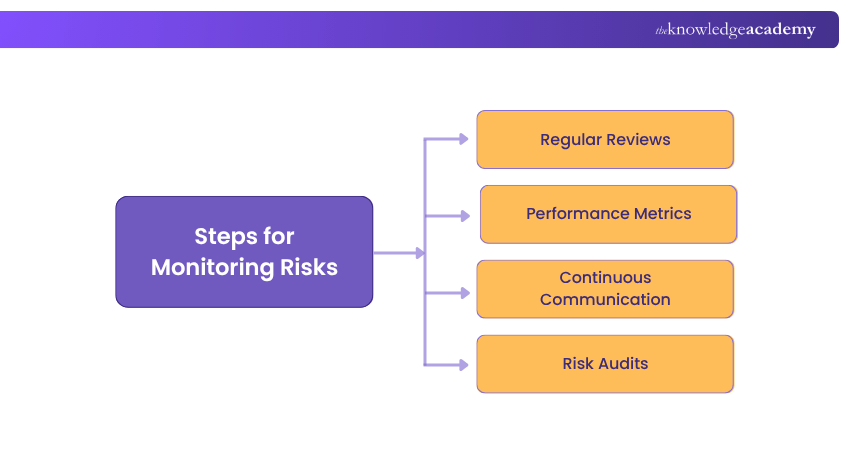
h) The main steps in monitoring risks are:
- Regular reviews: Review the risk register and treatment plans to make sure they are current and relevant.
- Performance Metrics: Key Performance Indicators (KPIs) are used to measure the effectiveness of risk treatments.
- Continuous Communication: Ensure stakeholders are informed of every Risk Management activity and changes in risk status.
- Risk Audits: Conduct internal or external audits to determine the Risk Management process's effectiveness and identify areas for improvement.
Become a Green Belt in Managing the Unexpected - Register for our Risk Management Green Belt Training now!
Best Practices for an Effective Risk Management Process
Risk Management includes some best practices like involving stakeholders early on to spot possible risks sooner, and keeping a risk register to make tracking and organising these risks easier. Additionally, reviewing and updating the risk plan helps you quickly deal with new problems.
Why is Risk Management Important?
Risk Management's importance lies in the fact that it helps businesses spot threats early and take steps to reduce them. Without it, companies could suffer significant losses, as they wouldn’t be prepared for problems that might suddenly appear.
Conclusion
The Risk Management Process helps businesses stay prepared by identifying, evaluating and responding to potential risks before they cause harm. It supports smarter decisions, reduces surprises, and protects both operations and reputation. Following a clear and structured approach, organisations can confidently handle uncertainty even when challenges arise.
Your path to becoming a project maestro awaits! Sign up for our Project Management Courses now!
Frequently Asked Questions
What is the Possible Highest Salary for a Risk Manager?

The highest Salary of a Risk Manager may differ according to factors such as location, experience, and the specific industry. For example, according to Glassdoor, the highest salary for Risk Managers in the UK can reach up to £75K per year.
What Degree is Good for Risk Management?
A degree in Risk Management or a similar field is ideal for a career in Risk Management. Here are some of the best degrees to consider:
a) Bachelor’s Degree in Risk Management
b) Bachelor’s Degree in Finance or Business Administration
c) Master’s Degree in Risk Management
What are the Other Resources and Offers Provided by The Knowledge Academy?
The Knowledge Academy takes global learning to new heights, offering over 3,000+ online courses across 490+ locations in 190+ countries. This expansive reach ensures accessibility and convenience for learners worldwide.
Alongside our diverse Online Course Catalogue, encompassing 17 major categories, we go the extra mile by providing a plethora of free educational Online Resources like Blogs, eBooks, Interview Questions and Videos. Tailoring learning experiences further, professionals can unlock greater value through a wide range of special discounts, seasonal deals, and Exclusive Offers.
What is The Knowledge Pass, and How Does it Work?
The Knowledge Academy’s Knowledge Pass, a prepaid voucher, adds another layer of flexibility, allowing course bookings over a 12-month period. Join us on a journey where education knows no bounds.
What are the Related Courses and Blogs Provided by The Knowledge Academy?
The Knowledge Academy offers various Project Management Courses, including Project Risk Management Course, Risk Management Black Belt, Project Management Certification Course and Project Management Black Belt. These courses cater to different skill levels, providing comprehensive insights into Risk Management Resume.
Our Project Management Blogs cover a range of topics related to Risk Management, offering valuable resources, best practices, and industry insights. Whether you are a beginner or looking to advance your Project Management skills, The Knowledge Academy's diverse courses and informative blogs have got you covered.

Grace Mitchell


Senior Project Management Consultant and Author
Grace Mitchell is a highly experienced project management professional with over 15 years of expertise in leading large-scale projects across industries, including construction, IT, and finance. With qualifications in PRINCE2®, PMP®, AgilePM®, and MSP®, Grace specialises in delivering complex programmes with precision and clarity. Her writing is grounded in real-world application and focuses on helping learners build confidence in project delivery and stakeholder management.
View Detail
Upcoming Project Management Resources Batches & Dates
Date
 Risk Management Black Belt
Risk Management Black Belt
Wed 12th Aug 2026
Risk Management Black Belt
Wed 18th Nov 2026

 If you wish to make any changes to your course, please


