


 Top Rated Course

We may not have the course you’re looking for. If you enquire or give us a call on 01344 203999 and speak to our training experts, we may still be able to help with your training requirements.
Top 5 Benefits of Program Management: A Complete Guide
David Evans 29 April 2026Explore the Top 5 Benefits of Program Management in this insightful blog. Understand the essence of program management and its significant role in achieving organisational goals. Delve into the advantages it offers, such as improved resource optimisation, streamlined communication and collaboration, and proactive risk management.

Training Outcomes Within Your Budget!
We ensure quality, budget-alignment, and timely delivery by our expert instructors.
Table of Contents
Program Management is a strategic approach that involves coordinating and aligning multiple related projects to achieve a common goal. Unlike Project Management, which focuses on individual projects, Program Management takes a broader view and ensures that projects within a program are strategically aligned with the organisation's objectives. Read this blog to learn about the Benefits of Program Management and how it can help in successfully completing a program.
Table of Contents
1) What is Program Management?
2) What are the Benefits of Program Management?
a) Enhanced Strategic Alignment
b) Improved Resource Optimisation and Sharing
c) Streamlined Communication and Collaboration
d) Proactive Risk Management
e) Reaping the Maximum Benefits
3) Conclusion
What is Program Management?
Program Management is a strategic approach that involves coordinating multiple related projects and activities to achieve a common goal or objective. It emphasises managing a set of interdependent projects, collectively known as a program, to maximise benefits and optimise resources. By leveraging program management tools, this approach ensures that various projects are aligned to deliver strategic outcomes. Unlike Project Management, which focuses on individual projects, Program Management takes a broader view to achieve overarching objectives.

What are the Benefits of Program Management?
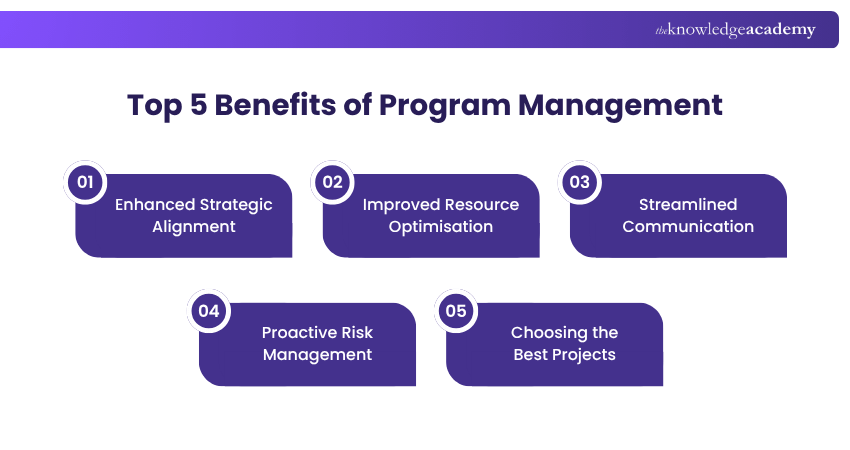
Program Management offers many benefits for organisations that adopt this strategic approach. The following are the Program Management benefits:
Enhanced Strategic Alignment
Program Management ensures that program projects align with the organisation's strategic objectives. It provides a holistic view of Strategic Program Management, enabling Program Managers to identify potential conflicts, dependencies, or synergies among projects. This alignment is essential for organisations to make informed decisions, prioritise initiatives, and allocate resources effectively.
This assessment helps identify projects that contribute most significantly to the overall strategic objectives and ensures that resources are allocated accordingly. By focusing efforts on projects that align closely with strategic goals, organisations can achieve greater results and save resources on initiatives that do not add substantial value.
Program Managers can evaluate the alignment of projects with the evolving business environment and make necessary adjustments to maintain strategic relevance. This adaptability ensures that the program remains responsive to market dynamics, customer needs, and emerging opportunities.
Looking to take your Project Management skills to the next level? Join our PMP® Certification Training and unlock new opportunities in your career.
Improved Resource Optimisation and Sharing
Program Management facilitates improved resource optimisation by coordinating and sharing resources across projects within a program. By centralising resource management, organisations can avoid duplication of efforts, minimise waste, and optimise resource utilisation.
Program Managers comprehensively understand resource capacities, skills, and availability across projects, allowing them to identify resource-sharing and collaboration opportunities. They can strategically allocate resources where they are most needed, ensuring that critical projects receive adequate support and attention. This approach prevents resource bottlenecks, reduces idle time, and maximises organisational capabilities.
Improved resource optimisation also leads to cost savings. Organisations can reduce unnecessary expenses associated with redundant resources or underutilisation by effectively utilising shared resources. This efficient allocation of resources enables organisations to achieve more with the same or even fewer resources, enhancing overall cost-effectiveness and financial performance.
Learn the principles of project management and Program Management with our extensive PMP Training.
Streamlined Communication and Collaboration
Program Management emphasises the importance of Effective Communication and collaboration among stakeholders involved in a program. Clear and consistent communication channels ensure that information flows seamlessly across projects, teams, and organisational levels. This streamlined communication fosters a collaborative environment that enhances productivity and reduces risks associated with miscommunication.
By streamlining communication, Program Management helps to avoid misunderstandings, reduce conflicts, and align expectations. It enables Stakeholders to understand project dependencies, milestones, and deliverables clearly, facilitating effective Decision-Making and timely action. It also promotes transparency and accountability, as stakeholders have access to relevant information and can promptly provide feedback or raise concerns.
Proactive Risk Management
Program Management incorporates proactive risk management practices, identifying and addressing potential risks at project and program levels. Program Managers conduct comprehensive risk assessments, develop mitigation strategies, and monitor the risk landscape continuously. This proactive approach helps organisations minimise the impact of risks, avoid costly delays, and ensure smooth progress throughout the Program Lifecycle Management process.
Reaping the Maximum Benefits and Choosing the Best Projects
One of the primary objectives of Program Management is to maximise benefits and ensure the successful delivery of program outcomes. Program Managers focus on creating value, measuring benefits, and implementing strategies to enhance benefits realisation.
Organisations can optimise program outcomes and achieve the desired business results by consistently monitoring progress, evaluating performance, and making necessary adjustments. With Program Management, you can choose the best projects that align with your strategic objectives, ensuring focused efforts on initiatives that deliver the most value. A clear Benefits Management Job Description plays a key role in ensuring that these projects also align with employee benefits strategies, enhancing both organisational goals and employee satisfaction. By carefully selecting projects within a program, you optimise resource allocation and maximise the chances of achieving successful outcomes.
Ready to kickstart your journey in project management? Join our CAPM® Certification Training and gain the essential knowledge and skills to excel in this dynamic field.
Conclusion
The Benefits of Program Management are invaluable for organisations striving to achieve their strategic objectives. By embracing Program Management practices, organisations can align projects with strategic goals, optimise resource utilisation, streamline communication and collaboration, proactively manage risks, and enhance benefits realisation. Embracing Program Management is a strategic investment that empowers organisations to excel in their projects and drive long-term success.
Learn the fundamentals of project management before you jump into program management with PMI Project Management Ready Training!
Frequently Asked Questions
Can Program Management Help Reduce Costs?

Yes, Program Management helps reduce costs by optimising resource allocation, eliminating inefficiencies, and improving coordination across projects. This leads to better budgeting, reduced waste, and more effective use of organisational resources.
How does Program Management Help Manage Risks?
Program Management helps manage risks by identifying potential issues early, assessing their impact, and implementing mitigation strategies. Continuous monitoring and stakeholder communication ensure risks are controlled and do not affect overall program success.
What are the Other Resources and Offers Provided by The Knowledge Academy?
The Knowledge Academy takes global learning to new heights, offering over 3,000+ online courses across 490+ locations in 190+ countries. This expansive reach ensures accessibility and convenience for learners worldwide.
Alongside our diverse Online Course Catalogue, encompassing 17 major categories, we go the extra mile by providing a plethora of free educational Online Resources like Blogs, eBooks, Interview Questions and Videos. Tailoring learning experiences further, professionals can unlock greater value through a wide range of special discounts, seasonal deals, and Exclusive Offers.
What is The Knowledge Pass, and How Does it Work?
The Knowledge Academy’s Knowledge Pass, a prepaid voucher, adds another layer of flexibility, allowing course bookings over a 12-month period. Join us on a journey where education knows no bounds.
What are the Related Courses and Blogs Provided by The Knowledge Academy?
The Knowledge Academy offers various PMP® Training, including the Program Management Professional (PgMP)® Certification, PMI-RMP® Certification and the Portfolio Management Professional PfMP® Certification. These courses cater to different skill levels, providing comprehensive insights into Prince2 Programme Management.
Our Project Management Blogs cover a range of topics related to Project Management, offering valuable resources, best practices, and industry insights. Whether you are a beginner or looking to advance your Project Management skills, The Knowledge Academy's diverse courses and informative blogs have got you covered.

David Evans


Certified Project Trainer and Agile Delivery Expert
David Evans brings over a decade of hands-on experience in project delivery, Agile transformation, and team leadership. With a background in technology and business consulting, David has led cross-functional teams through Agile and Waterfall projects in both public and private sectors. He combines technical knowledge with practical insights to help readers navigate the challenges of modern project environments.

Upcoming Project Management Resources Batches & Dates
Date
 PMP® Certification Training Course
PMP® Certification Training Course
Mon 22nd Jun 2026
PMP® Certification Training Course
Mon 29th Jun 2026
PMP® Certification Training Course
Sat 4th Jul 2026, Sun 5th Jul 2026
PMP® Certification Training Course
Mon 6th Jul 2026
PMP® Certification Training Course
Mon 13th Jul 2026
PMP® Certification Training Course
Sat 18th Jul 2026, Sun 19th Jul 2026
PMP® Certification Training Course
Mon 20th Jul 2026
PMP® Certification Training Course
Mon 27th Jul 2026
PMP® Certification Training Course
Sat 1st Aug 2026, Sun 2nd Aug 2026
PMP® Certification Training Course
Mon 3rd Aug 2026
PMP® Certification Training Course
Mon 10th Aug 2026
PMP® Certification Training Course
Mon 17th Aug 2026
PMP® Certification Training Course
Sat 22nd Aug 2026, Sun 23rd Aug 2026
PMP® Certification Training Course
Mon 24th Aug 2026
PMP® Certification Training Course
Tue 1st Sep 2026
PMP® Certification Training Course
Sat 5th Sep 2026, Sun 6th Sep 2026
PMP® Certification Training Course
Mon 7th Sep 2026
PMP® Certification Training Course
Mon 14th Sep 2026
PMP® Certification Training Course
Sat 19th Sep 2026, Sun 20th Sep 2026
PMP® Certification Training Course
Mon 21st Sep 2026
PMP® Certification Training Course
Mon 28th Sep 2026
PMP® Certification Training Course
Sat 3rd Oct 2026, Sun 4th Oct 2026
PMP® Certification Training Course
Mon 5th Oct 2026
PMP® Certification Training Course
Mon 12th Oct 2026
PMP® Certification Training Course
Sat 17th Oct 2026, Sun 18th Oct 2026
PMP® Certification Training Course
Mon 19th Oct 2026
PMP® Certification Training Course
Mon 26th Oct 2026
PMP® Certification Training Course
Mon 2nd Nov 2026
PMP® Certification Training Course
Sat 7th Nov 2026, Sun 8th Nov 2026
PMP® Certification Training Course
Mon 9th Nov 2026
PMP® Certification Training Course
Mon 16th Nov 2026
PMP® Certification Training Course
Sat 21st Nov 2026, Sun 22nd Nov 2026
PMP® Certification Training Course
Mon 23rd Nov 2026
PMP® Certification Training Course
Mon 30th Nov 2026
PMP® Certification Training Course
Mon 7th Dec 2026
PMP® Certification Training Course
Sat 12th Dec 2026, Sun 13th Dec 2026
PMP® Certification Training Course
Mon 14th Dec 2026
PMP® Certification Training Course
Mon 21st Dec 2026

 If you wish to make any changes to your course, please


