


 Top Rated Course


We may not have the course you’re looking for. If you enquire or give us a call on + 1-866 272 8822 and speak to our training experts, we may still be able to help with your training requirements.
Floor Division in Python: Explained with Examples
The Knowledge Academy 05 February 2026Wondering how Floor Division in Python works? It’s a mathematical operation that divides two numbers and rounds down to the nearest whole number. This blog explains the concept with examples, covering its syntax, use cases, and tips to use it effectively in Python programming. Let’s explore this fundamental operation!

Training Outcomes Within Your Budget!
We ensure quality, budget-alignment, and timely delivery by our expert instructors.
Table of Contents

Floor Division in Python is both fascinating and, at times, challenging for learners. Unlike the standard division operator (/), Floor Division (//) returns the quotient rounded down to the nearest integer. This approach is particularly useful when working exclusively with whole numbers, such as dividing items into portions or calculating averages.
In this blog, we will explain the idea behind Floor Division in detail and then demonstrate how Floor Division works. From basic to advanced problems and scenarios, this tutorial will provide comprehensive information, practical guides and tips on how and when to use Floor Division in Python programming.
Table of Contents
1) What is Floor Division?
2) Understanding Floor Division using Python
3) How the Floor Division Operator Works?
4) Performing Floor Division in Python
5) Alternative Methods for //
6) Advanced Applications of Floor Division
7) Difference Between Standard Division and Floor Division
8) Conclusion
What is Floor Division?
Floor Division is a type of division that when part of two numbers is divided it is rounded down to the nearest whole number. In Python it is done using the // operator. While division delivers a float in the output, Floor Division will deliver the result in the form of int: it doesn’t matter if the operands are int or float.

Understanding Floor Division Using Python
Floor Division is particularly useful when one needs to remove the remainder from division computation while retaining only the division result as a whole. This can be particularly useful when it is necessary to work with algorithms that recognise only integers.
Let’s consider a practical example: especially when it is necessary to split the list into parts of equal portions, for example, when distributing a number of items between people. In this case, the ‘/’ operator comes to the assistance of a programmer to determine how many full chunks can be made.
The Floor Division operator // available for both integers and floating-point numbers also. However, the chief feature with this method is that it always truncates the decimal part no matter if the result of division is an integer or not. On the other hand, it is different from the most division problems that yield a floating-point answer.
How the Floor Division Operator Works?
The // operator works by performing division and then rounding down the result to the nearest integer. The direction of rounding depends on the sign of the numbers involved:
a) If the result is positive, it rounds down to the nearest lower integer.
b) If the result is negative, it rounds down to the next lower integer (further away from zero).
For Example:
a) 0 // 3 would return 3 because 10 divided by 3 is 3.33, rounded down to 3.
b) -10 // 3 would return -4 because -10 divided by 3 is -3.33, rounded down to -4.
Performing Floor Division in Python
Performing Floor Division in Python is simple. You just use the // operator between two numbers. Here’s an example:
Input:

Output:

The result is 3 because the actual result of 10 divided by 3 is 3.66, and it is rounded down to 3.
Floor Division with Negative Integer
When working with negative numbers, Floor Division may give surprising results. Unlike rounding towards zero, Floor Division always rounds down, which means the result may seem further from zero than expected. For example Input:
 Output:
 Here, -10 divided by 3 is -3.66, but since the result is rounded down, it returns to -4.
Floor Division with Floating Numbers
The Floor Division also works with floating-point numbers. However, the result will always be an integer, even if one or both operands are floats. Let’s look at an example: Input:

Output:
 The result is 3.0, which is a float, but the integer part is the result of the Floor Division.
Floor Division and Modulo in Python
Floor Division is often used in conjunction with the modulo operator (%). Together, they can help you break down a division into two parts: the quotient and the remainder. For example:
Input:

Output:

Here, 9 divided by 4 gives a quotient of 2 (Floor Division) and a remainder of 1 (modulo).
Alternative Methods for //
If you prefer not to use the // operator for Floor Division, Python offers several alternatives. Let’s look at some options:
1) Using math.floor()
You can use the math.floor() function to achieve Floor Division. This function rounds down a float to the nearest whole number.
Input:

Output:

2) Using math.ceil()
While math.ceil() rounds up, it can be used creatively to perform Floor Division by inverting the result:
Input:

Output:

3) Using int()
You can also use the int() function to truncate the decimal part, effectively performing a Floor Division for positive numbers.
Input:

Output:

Advanced Applications of Floor Division
Floor Division is not only a mathematical operation with diverse uses but also various experimental uses in coding. The following are some sample complex scenarios where one can easily notice the superiority of // operator for optimising solutions of practical applications.
1) Calculating the Average of a List
During the process of averaging, we divide one sum by another and then using Floor Division ensures the final integer value discarding the decimal part. This can be used when the exact measurements are not needed and what is needed is a simplified model.
Input:

Output:

Here, we take the sum of the numbers, which is 50 and divide it by the count of the list which is 4 and give me an integer of 12 instead of float.
2) Splitting up a Sequence into Equal Parts
Floor Division aids in partitioning a sequence (such as a list) into parts with each part having the same number of items or if the final part does not have a complete number of items, it is given one or more items.
Input:
 Output:

This splits the list in equal halves for number lines and then calculates the chunk size by dividing, using the Floor Division operator. It is most valuable in pagination or distributing a kind of work around equally.
3) Converting Seconds to Minutes and Seconds
This method is useful in division work on the floor to bring total seconds to minutes and seconds. The first is the full minutes when divided by sixty, and the second one denotes the remaining second.
Input:

Output:

This calculation is used typically to format time duration like in the media player or the countdown timer.
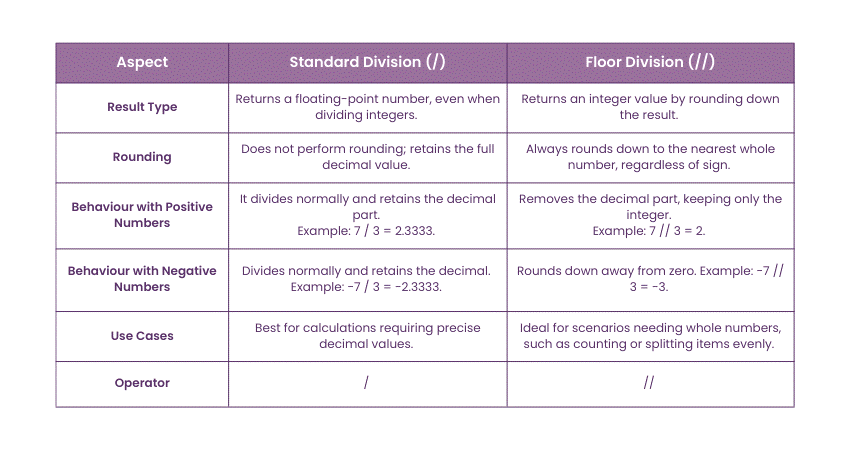
Difference Between Standard Division and Floor Division
The following is the key differences between the Standard Division and Floor Division methods:
Conclusion
Floor Division in Python comes in handy when performing division operations, you are only interested in the quotient part of the division’s result in Python. It is especially useful in general usage such as splitting sequences, averaging, and converting finally from one unit to another. Through learning when and how to use the // operator or consider its analogs, you will be able to improve the search for a solution to many coding problems.
Frequently Asked Questions
Why Would You Use Floor Division?

Floor Division is used when only the whole number portion of a division is required, ignoring the remainder. Examples include evenly dividing items (e.g., oranges), calculating integer averages, or converting seconds to minutes.
What Does Floor Mean in Python?
In Python ‘floor’ refers to rounding a number down to the nearest integer, disregarding the fractional part. This can be done using the math.floor() function or using the ‘//’ operator. For instance, math.floor (4.7) or 4.7 // 1 would return 4. It is important in all calculations requiring integer values.
What are the Other Resources and Offers Provided by The Knowledge Academy?
The Knowledge Academy takes global learning to new heights, offering over 3,000+ online courses across 490+ locations in 190+ countries. This expansive reach ensures accessibility and convenience for learners worldwide.
Alongside our diverse Online Course Catalogue, encompassing 19 major categories, we go the extra mile by providing a plethora of free educational Online Resources like Blogs, eBooks, Interview Questions and Videos. Tailoring learning experiences further, professionals can unlock greater value through a wide range of special discounts, seasonal deals, and Exclusive Offers.
What is The Knowledge Pass, and How Does it Work?
The Knowledge Academy’s Knowledge Pass, a prepaid voucher, adds another layer of flexibility, allowing course bookings over a 12-month period. Join us on a journey where education knows no bounds.
What are the Related Courses and Blogs Provided by The Knowledge Academy?
The Knowledge Academy offers various Programming Training, including the Python Course, PHP Course and the Vue.js Framework Training. These courses cater to different skill levels, providing comprehensive insights into Python Enumerate.
Our Programming and DevOps cover a range of topics related to Python, offering valuable resources, best practices, and industry insights. Whether you are a beginner or looking to advance your Programming Skills, The Knowledge Academy's diverse courses and informative blogs have got you covered.

The Knowledge Academy


Global Training Provider
The Knowledge Academy is a world-leading provider of professional training courses, offering globally recognised qualifications across a wide range of subjects. With expert trainers, up-to-date course material, and flexible learning options, we aim to empower professionals and organisations to achieve their goals through continuous learning.


 If you wish to make any changes to your course, please


