
Industry Training

Online Instructor-led (1 days)

Online Self-paced (8 hours)

Facilitation Skills Training Course Outline

Module 1: Introduction to Facilitation

  • What is Facilitation?
  • Principles of Facilitation

Module 2: Benefits of Facilitation

  • Benefits of Facilitation Skills

Module 3: Importance of Facilitation

  • Importance of Facilitation

Module 4: Facilitation Roles and Responsibilities

  • Role of Facilitators
  • Participants
  • Recorder (scribe) and the Timekeeper
  • Workshop Owner

Module 5: Main Stages in any Workshop

  • Before the Workshop
  • During the Workshop
  • Why Do We Have Meetings/Workshops?
  • Disadvantages of Meeting

Module 6: Ground Rules

  • Introduction

Module 7: Role of Facilitator

  • Role of Facilitators

Module 8: Techniques Contained Within the Toolkit

  • Facilitators Toolkit
  • Role of Facilitators (Types of Questions)
  • Target Audience
  • Audience Participation
  • Space

Module 9: Process and Content Facilitation

  • Process and Content Facilitation

Module 10: Core Practices and Skills Required

  • Facilitation Skills
  • Conversation

Module 11: Handling Conflict

  • How to Manage Conflict?
  • Process of Handling Conflict Positively
  • Defining Your Communication Challenges
  • Understanding Team Dynamics

Show moredown

Who Should Attend this Facilitation Skills Training Course?

This course is ideal for individuals aiming to lead effective group discussions, foster collaboration, and enhance their facilitation techniques for diverse professional settings.

You should attend this Online Facilitation Skills Training Course if you are:

  • Team Leader or Manager: Leading productive meetings and collaborative sessions
  • Trainer or Educator: Facilitating workshops, seminars, and learning activities
  • Project Manager: Driving effective team discussions and project planning sessions
  • HR or L&D Professional: Managing group training, coaching, and development programmes
  • Consultant: Guiding client discussions, workshops, and strategic planning sessions
  • Aspiring Facilitator: Building core online facilitation skills for professional and personal growth

Prerequisites for the Facilitation Skills Training Course

There are no formal prerequisites to attend this Facilitation Skills Online Training.

Facilitation Skills Training Course Overview

Facilitation Skills Training explores the principles of effective group facilitation, focusing on communication, engagement techniques, managing discussions, and guiding groups towards clear outcomes.

Upskilling in Facilitation Skills enhances confidence, collaboration, and influence at work. Delegates strengthen interpersonal abilities, improve group dynamics, and develop techniques to handle challenges, differing viewpoints, and decision-making within teams.

This 1-Day course offered by The Knowledge Academy equips delegates with recognised facilitation practices aligned with workplace needs, using practical learning and interactive scenarios to support confident facilitation of meetings, workshops, and group sessions.

Course Objectives

  • To plan and structure effective meetings and workshops
  • To manage group dynamics and encourage participation
  • To use questioning, listening, and summarising techniques
  • To handle challenging situations and drive consensus
  • Improve facilitation techniques for clear decision-making outcomes
  • Strengthen communication and engagement across diverse groups

Upon completion of this course, delegates gain the ability to design and lead effective facilitation sessions. They strengthen communication, leadership confidence, and skills to achieve productive group outcomes.

Show moredown

What’s Included in this Facilitation Skills Training Course?

  • World-Class Training Sessions from Experienced Instructors
  • Facilitation Skills Certificate
  • Digital Delegate Pack

Show moredown

Online Instructor-led (1 days)

Online Self-paced (8 hours)

Basic Barista Course Outline

Module 1: Introduction to Coffee

  • History of Coffee and Its Origins
  • Coffee Plant and Species Overview
  • Arabica Vs. Robusta Differences
  • Coffee Processing Methods

Module 2: Barista Role and Coffee Quality

  • Barista 4-3-2-1 Theory Explained
  • What Is Specialty Coffee?
  • Green Bean Grading Standards
  • Storage and Handling Basics

Module 3: Sensory Analysis and Tasting

  • Fundamentals of Coffee Aroma and Flavor
  • Basic Sensory Exercises
  • Coffee Cupping Introduction
  • Learner Tasting Activity

Module 4: Espresso Equipment Essentials

  • Espresso Machine Parts and Use
  • Grinder Types and Calibration
  • Setup and Shutdown Routine
  • Cleaning and Safety Measures

Module 5: Espresso Fundamentals

  • Dosing and Tamping Techniques
  • Shot Time and Yield Principles
  • Signs of Proper Extraction
  • Crafting a Balanced Espresso

Module 6: Milk Steaming Techniques

  • Milk Handling and Freshness
  • Stretching Vs. Texturing Milk
  • Creating Smooth Macrofoam
  • Temperature Control for Sweetness

Module 7: Basic Drink Preparation

  • Espresso-Based Drink Recipes
  • Latte Vs. Cappuccino Construction
  • Americanos And Long Blacks
  • Flavor Additions and Balance

Module 8: Customer Service and Workflow

  • Greeting and Order Taking
  • Workspace Setup and Flow
  • Hygiene and Machine Care
  • Professionalism Behind the Bar

Show moredown

Who should attend this Basic Barista Course?

This course is ideal for individuals seeking to master coffee preparation techniques, enhance customer service skills, and pursue a career in the coffee industry.

You should attend this Barista Training Course if you are:

  • Aspiring Barista: Learning the foundations of coffee brewing and latte art
  • Café Owner or Manager: Improving coffee quality and customer experience
  • Hospitality Professional: Expanding beverage service skills for hotels and restaurants
  • Coffee Enthusiast: Gaining professional techniques to brew café-quality coffee at home
  • Food and Beverage Staff: Building expertise in espresso preparation and café service
  • Entrepreneur: Planning to launch a coffee shop or mobile café business

Prerequisites of the Basic Barista Course

There are no formal prerequisites to attend the Basic Barista Course.

Basic Barista Course Overview 

The Barista Course in Azerbaijan offers hands-on training in the fundamentals of the coffee industry. This covers espresso making, milk frothing, grinder calibration, and latte art.  

The course educates the delegates and covers coffee bean selection, brewing techniques, and customer service skills, equipping them with the confidence and expertise. 

This 1-day Barista Course, offered by The Knowledge Academy, teaches delegates essential coffee-making skills, including steaming milk, dosing, latte art, and more.   

Basic Barista Certification Course Objectives 

  • To learn the art of espresso extraction, grind settings, and machine operation
  • To master the skill of steaming and frothing milk for various coffee beverages
  • To develop expertise in creating intricate latte art designs
  • To understand the importance of coffee bean selection and storage
  • To discover the history and cultural significance of coffee
  • To gain insights into customer service and effective communication in a cafe setting
  • To ensure proper hygiene and cleanliness in coffee preparation
  • To learn to troubleshoot common coffee machine issues

After completing this Basic Barista Online Training, delegates will be well-equipped to meet the demands of the coffee industry, delivering top-quality coffee products and exceptional customer experiences while potentially advancing their careers in the thriving coffee and hospitality sector.

Show moredown

What’s Included in this Basic Barista Course?

  • World-Class Training Sessions from Experienced Instructors.
  • Basic Barista Certificate.
  • Digital Delegate Pack.

Show moredown

Online Instructor-led (1 days)

Online Self-paced (8 hours)

Floristry Introduction Course Outline

Module 1: Introduction to Floristry

  • Introduction to Floristry

Module 2: Features of Floristry

  • Features of Floristry
    • Knowledge of Flowers and Plants
    • Creativity
    • Design Skills
    • Technical Skills
    • Business Acumen
    • Attention to Detail
    • Event Planning Skills
    • Time Management Skills

Module 3: Key Concepts

  • Key Concepts
    • Balance
    • Scale
    • Dominance
    • Rhythm
    • Colour
    • Orientation

Module 4: Types of Design including, Commercial, Wedding, Gift, and Event

  • Types of Design including, Commercial, Wedding, Gift, and Event
    • Commercial
    • Wedding
    • Gift
    • Event

Module 5: Design your Own Designs

  • Design your Own Designs
    • Introduction
    • Learn and Polish Your Floral Design Skills
    • Consider the Other Work Florists Do
    • Explore Your Floral Design Style
    • Set Goals

Module 6: Flower Containers and Buttonholes

  • Flower Containers and Buttonholes
  • Flower Containers
    • Choosing Flowers
    • Container Design
    • How to Plant Containers?
    • Caring for Containers
    • Buttonholes
  • How to Wear Buttonholes?
  • Styles of Buttonholes

Module 7: Types of Flowers

  • Types of Flowers

Module 8: Flower Arrangements

  • Flower Arrangements
    • Fan Shaped Flower Arrangement
    • Elliptical Flower Arrangement
    • Vertical Flower Arrangement
    • Horizontal Flower Arrangement
    • Triangular Flowers
    • Crescent Flower Arrangement
    • ‘S’ Shaped Flower Arrangement
    • Oval Shaped Flower Arrangement
    • Cascade Flower Arrangement

Module 9: Flower Materials

  • Flower Materials
    • Mechanics
    • Equipment
    • Containers
    • Bases
    • Support
    • Plant Materials
    • Accessories

Module 10: Floristry Techniques

  • Floristry Techniques
    • Grouping
    • Banding
    • Shadowing
    • Basing
    • Clustering

Module 11: Overview

  • Overview

Show moredown

Who Should Attend this Floristry Introduction Course?

This course is ideal for individuals looking to develop creative floral design skills, understand flower care, and explore opportunities in the floral industry.

You should attend this Floristry Course if you are:

  • Aspiring Florist: Learning the fundamentals of floral design and arrangement
  • Event Planner: Enhancing décor skills for weddings, parties, and corporate events
  • Retail Staff: Working in flower shops or garden centres with customer-facing roles
  • Interior Decorator: Adding floral styling to interior design services
  • Hobbyist or Flower Enthusiast: Exploring floral design as a creative passion
  • Entrepreneur: Planning to start a floral design or flower delivery business

Prerequisites of the Floristry Introduction Course

There are no formal prerequisites to attend the Floristry Introduction Course.

Floristry Introduction Course Overview

This Floristry Course covers essential floral styling techniques, including bouquet creation, flower selection, wiring methods, and display arrangements. Delegates will also learn proper flower care to maintain freshness and longevity.

Floristry combines creativity with practical skill, enabling delegates to design professional arrangements for events, retail, or personal enjoyment. The course helps turn a passion for flowers into a rewarding career or fulfilling hobby.

The 1-Day Floristry Course by The Knowledge Academy is ideal for aspiring florists, decorators, and enthusiasts. Delegates gain practical skills and confidence to create stunning arrangements for any occasion.

Floristry Course Objectives

  • To understand flower types, conditioning, and care
  • To design hand-tied bouquets and floral arrangements
  • To apply techniques for weddings, events, and retail Floristry
  • To gain insight into floral trends, colour theory, and presentation
  • To learn wiring, mechanics, and structural techniques for displays 
  • To develop skills in seasonal styling and innovative floral designs 

This Floristry Training blends theory with hands-on practice. Delegates gain the skills and confidence to create stunning arrangements and explore creative opportunities in the floristry industry.

Show moredown

What’s Included in this Floristry Introduction Course?

  • World-Class Training Sessions from Experienced Instructors
  • Floristry Introduction Certificate
  • Digital Delegate Pack

Show moredown

Online Instructor-led (1 days)

Online Self-paced (8 hours)

Facilities Management Course Outline

Module 1: Introduction to Facilities Management

  • Facilities Management
  • Purpose of Facilities Management

Module 2: Responsibilities of the Facilities Manager

  • Overview
  • Facilitator
  • Key Responsibilities of Facilitator

Module 3: Multi-Unit Residential FM Services

  • Overview

Module 4: Understanding Stakeholders

  • What is a Stakeholder?
  • Types of Stakeholders

Module 5: Basics of Sustainability

  • Overview

Module 6: Overview of Energy Management

  • Process of Energy Management
  • Energy Management Techniques

Module 7: Workplace Facilities

  • What do Facilities Managers do for Workers?
    • Safety
    • Aesthetics
    • Functional Resources
    • Cost

Module 8: Safety, Health and Fire Law

  • What is Safety?
  • Define Health
  • Fire Law

Module 9: Law on Staff and Contract Workers

  • Flexible Working for Employees
  • Flexible Working Right of Request
  • Reasons for Refusal
  • Contract Workers
  • Workplace Surveillance
  • Minimum Wage

Module 10: Hazardous Materials

  • Asbestos-Containing Materials
  • Synthetic Mineral Fibres
  • Lead-Based Paint
  • Ozone Depleting Substances

Module 11: Health and Amenities

  • Indoor Air Quality
  • Lighting and Visual Environment
  • Space Management
  • Thermal Comfort

Module 12: Emergency Management and Security Audits

  • What is Emergency Management?
  • Explore the Security Audits

Module 13: Managing Business Effectively

  • Rules of Effective Management

Module 14: Introduction to Contract Management

  • Contracts and Relationships
  • Contractor Management
  • Sustainable Procurement

Module 15: Monitoring and Reporting

  • Objectives Targets and Performance Indicators

Module 16: Key Principles of Continual Improvement

  • Improvements are Based on Small Changes, Not Only on Major Paradigm Shifts or New Inventions
  • Employee Ideas are Valuable
  • Incremental Improvements are Typically Inexpensive to Implement
  • Employees Take Ownership and Involved in Improvement
  • Improvement is Reflective
  • Improvement is Measurable and Potentially Repeatable

Show moredown

Who Should Attend this Facilities Management Course?

The Facilities Management Training Course is designed for professionals involved in managing and maintaining facilities. This course will benefit the following professionals:

  • Facilities Managers
  • Property Managers
  • Operations Managers
  • Estate Managers
  • Maintenance Supervisors
  • Maintenance Technicians
  • Senior Managers

Prerequisites of the Facilities Management Course

There are no formal prerequisites to attend this Facilities Management Training Course.

Facilities Management Course Overview

Facilities Management Course introduces delegates to the principles of managing people, processes, places, and technology within organisational environments. The training focuses on maintaining safe, efficient, and well-coordinated facilities that support overall operational effectiveness.

This training supports upskilling by strengthening cost control awareness, regulatory compliance understanding, and workplace optimisation practices. Delegates enhance their ability to improve performance and contribute to effective facility operations across diverse industries.

This 1-Day Facilities Management Course offered by The Knowledge Academy helps delegates apply facilities management principles confidently in real-world scenarios. Delegates gain practical insight into current practices and emerging trends to support organisational objectives effectively.

Facilities Management Course Objectives

  • To explore key components of facility maintenance and operations
  • To learn to develop and implement effective facility management strategies
  • To address safety, sustainability, and regulatory compliance in facility management
  • To optimise space utilisation and workplace design
  • To analyse and manage facility budgets and costs
  • To develop emergency response and business continuity plans for facilities
  • To harness technology for improved Facilities Management efficiency

After completing the Facilities Management Course, delegates will receive a certification that attests to their newfound expertise. This certification will validate their ability to drive efficient and sustainable facility management practices, making them valuable assets in their respective industries.

Show moredown

What’s Included in this Facilities Management Course?

  • World-Class Training Sessions from Experienced Instructors
  • Facilities Management Certificate
  • Digital Delegate Pack

Show moredown

Online Instructor-led (1 days)

Online Self-paced (8 hours)

Product Management Training Course Outline

Module 1: Fundamentals of Product Management

  • Introduction to Production Management
  • Process Capabilities and Business Strategy
  • Responsibilities and Development of Product Managers
  • Assessing Product Managers for Performance

Module 2: Role and Strategy of Product Managers

  • Cross-Functional Role of Product Managers
  • Strategy
  • Releases
  • Ideation
  • Features
  • Mental Models in Managing Product Teams
  • Managing and Developing Product Leaders

Module 3: Building and Leading Product Teams

  • Strategies for Creating an All-Star Product Team
  • Power of Product Squads and Effective Team Dynamics
  • Managing Conflicts within Passionate Teams

Module 4: Product Life Cycle and Speed to Market

  • Overview of Product Life Cycle and Its Management
  • Principal Elements and Stages of the Product Life Cycle
  • Enhancing Speed in Product Development and Management

Module 5: Product Strategy and Marketing

  • Product Marketing Planning Process
  • Strategic Product Planning: Significance and Distribution Strategies
  • Pricing Products and Services

Module 6: Customer and Market Orientation

  • Customer Value Management: Concept and Importance
  • New Products
  • Proposal
  • Development
  • Launch
  • Role of Product Manager as Marketing Manager

Module 7: Financial and Portfolio Management

  • Financial Aspects of Product Management
  • Cost Classifications
  • Investment Decisions
  • Evaluating the Product Portfolio using Tools like BCG Matrix
  • Benefits of Product Portfolio Management

Module 8: Annual Product Planning and Review

  • Product Planning Annually
  • Regular Review and Adjustments of Product Strategy
  • Continuous Improvement in Product Management Practices

Show moredown

Who Should Attend this Product Management Training Course?

Product Management Training is designed for professionals seeking to excel in the field of Product Management, from concept to market launch. The following professionals can benefit from attending this course:

  • Product Managers
  • Product Owners
  • Marketing Managers
  • Product Development Teams
  • UX/UI Designers
  • Business Owners
  • E-commerce Managers

Prerequisites of the Product Management Training Course

There are no formal prerequisites to attend this Product Management Training Course.

Product Management Training Course Overview

The Product Management Online Training will allow a delegate to gain knowledge in identifying market trends and creating opportunities that make a well-defined product vision. It is a way that can prove a valuable product quality by building structured strategies.

The Product Management Course sharpens skills to analyse the product requirements to lay a perfect roadmap for collaboration with the team and stakeholders. This hands-on, real-time training will enable delegates to develop customer-centric strategies for successful product launches.

The Knowledge Academy’s 1-Day Product Management Training Course gives practical tools, real-world case studies, and interactive learning to help delegates taste the essence of product success.

Product Management Course Objectives

  • To understand the core principles of Product Management
  • To master the art of market research and customer analysis
  • To develop skills for effective communication and collaboration within cross-functional teams
  • To explore user experience and design thinking principles
  • To measure and improve product performance through key metrics

After completing the Project Management Course, delegates will be well-prepared to take on the challenges of Product Management. They will have the knowledge and skills to develop, launch, and manage successful products, leading to career advancement and contributions to their organisation's growth and profitability.

Career Progression of a Product Management Professional

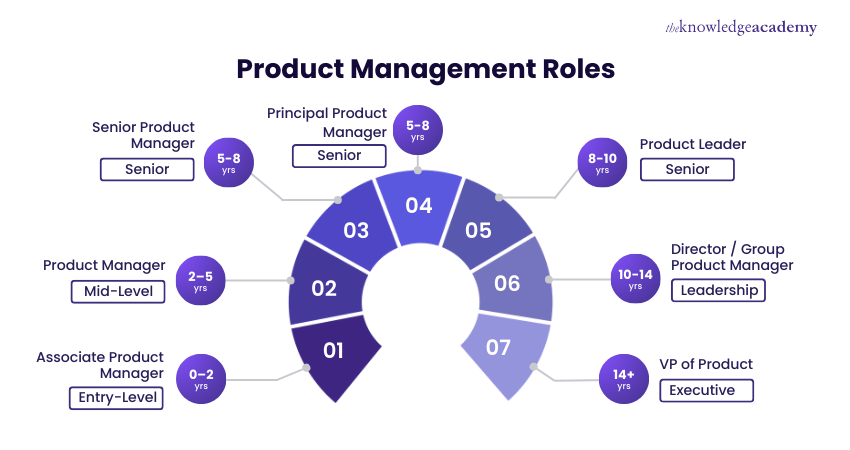
Product Management Training – Roles by Designation

The typical career progression in product management goes from Associate Product Manager to VP of Product. Let us understand the experience required at each stage and what roles to aim for as they grow.

  • Associate Product Manager (0–2 yrs): Entry-level role focused on supporting product teams and learning the fundamentals.
  • Product Manager (2–5 yrs): Mid-level position responsible for product strategy, roadmaps, and cross-functional execution.
  • Senior Product Manager (5–8 yrs): Leads major products or initiatives with full ownership and strategic input.
  • Principal Product Manager (8–10 yrs): Expert-level contributor driving high-impact product decisions and mentoring others.
  • Product Leader (5–8 yrs): Oversees multiple teams or key product lines with senior-level responsibility.
  • Director/Group Product Manager (10–14 yrs): Leadership role managing multiple PMs and aligning product vision with business goals.
  • VP of Product (14+ yrs): Executive position driving overall product strategy, innovation, and organisational outcomes.

Show moredown

What’s Included in this Product Management Training Course?

  • World-Class Training Sessions from Experienced Instructors
  • Product Management Certificate
  • Digital Delegate Pack

Show moredown

Online Instructor-led (1 days)

Online Self-paced (8 hours)

Reliability Engineering Training​ Course Outline

Module 1: Getting Started with Reliability Engineering

  • Introduction to Reliability Engineering
  • Application and Benefits
  • Basic Concepts

Module 2: Reliability Analysis During the Design Phase

  • Predicted Reliability of Equipment and Systems with Simple Structure
  • Reliability of Systems with Complex Structure

Module 3: Qualification Tests for Components and Assemblies

  • Selection Criteria for Electronic Components
  • Tests for Complex Electronic Components
  • Qualification Tests for Electronic Assemblies

Module 4: Introduction to Maintainability Analysis

  • Maintainability and Availability
  • Maintainability Aspects of Design Reviews
  • Predicted Maintainability
  • Models for Spare Part Provisioning
  • Maintenance Strategies

Module 5: Design Guidelines

  • Design Guidelines for Reliability
  • Design Guidelines for Maintainability
  • Design Guidelines for Software Quality

Module 6: Statistical Quality Control and Reliability Tests

  • Statistical Quality Control
  • Statistical Reliability and Maintainability Tests
  • Accelerated Testing

Module 7: Quality and Reliability Assurance

  • Basic Activities
  • Testing and Screening of Electronic Components
  • Test and Screening Strategies

Show moredown

Who should attend this Reliability Engineering Training Course?

The Reliability Engineering Training Course is designed for professionals who want to enhance their skills in ensuring the reliability and performance of systems, products, and processes. The following professionals can benefit from attending this course:

  • Reliability Engineers
  • Warranty Analysts
  • Quality Assurance Professionals
  • Asset Managers
  • Design Engineers
  • Manufacturing Engineers
  • Risk Management Specialists

Prerequisites of the Reliability Engineering Training Course

There are no formal prerequisites for attending this Reliability Engineering Training Course. However, a background in engineering, proficiency in mathematics and data analysis, and familiarity with engineering systems can be beneficial for the delegates.

Reliability Engineering Training Course Overview

Reliability Engineering is a critical discipline in ensuring the dependability and performance of complex systems and products. Reliability Engineering, an essential facet of Industry Training, focuses on providing the trustworthiness and implementation of strategies, products, and processes. This Industry Training is indispensable to understanding how to minimise downtime, reduce costs, and enhance productivity, making it a vital skill in various sectors.

Proficiency in Reliability Engineering is vital for professionals in various industries, including manufacturing, aerospace, automotive, and more. Engineers, Quality Assurance Specialists, and Project Managers should aim to master this field. Reliability Engineering equips individuals with the knowledge and tools to enhance product and system reliability, ultimately reducing downtime and improving customer satisfaction.

This intensive 1-day Reliablity Engineering Training Course offered by The Knowledge Academy is designed to empower delegates with practical skills and insights in the field of Reliability Engineering. Delegates will gain a comprehensive understanding of reliability concepts, tools, and methodologies. Through real-world case studies and hands-on exercises, they will be better equipped to tackle complex reliability challenges in their respective industries.

Course Objectives

  • To understand the fundamentals of Reliability Engineering
  • To apply various reliability assessment techniques
  • To identify and mitigate potential failure modes
  • To develop effective reliability test plans
  • To interpret and use reliable data for decision-making
  • To improve product and system reliability through best practices
  • To enhance maintenance and support strategies
  • To implement Reliability-Centered Maintenance (RCM) principles

After completing this course, delegates will have the expertise to improve the reliability and performance of systems in their respective industries, leading to reduced costs, increased productivity, and a competitive advantage in the job market.

Show moredown

What’s included in this Reliability Engineering Training Course?

  • World-Class Training Sessions from Experienced Instructors
  • Reliability Engineering Certificate
  • Digital Delegate Pack

Show moredown

Online Instructor-led (1 days)

Online Self-paced (8 hours)

SCADA Training Course Outline

Module 1: Social Implications and Impacts

  • Introduction
  • Overview of Threat Vectors
  • Risk Management

Module 2: Governance and Management

  • Disaster Recovery and SCADA Business Continuity
  • Incident Response and SCADA
  • Introduction to Forensics Management
  • Governance and Compliance

Module 3: Architecture and Modelling

  • Communications and Engineering Systems
  • Metrics Framework for a SCADA System
  • Network Topology and Implementation

Module 4: Commissioning and Operations

  • SCADA Obsolescence and Procurement
  • Patching and Change Management
  • Physical Security Management
  • Table-Top and Red-Blue
  • Integrity Monitoring
  • Data Management and Records Retention
  • Record Retention

Show moredown

Who should attend this SCADA Training Course?

The SCADA (Supervisory Control and Data Acquisition) Training is designed for professionals involved in Industrial automation, control systems, and data acquisition. This course is especially beneficial for the following professionals:

  • Control Engineers
  • Automation Engineers
  • Electrical Engineers
  • SCADA System Administrators
  • Plant Operators
  • Maintenance Technicians
  • Industrial IT Professionals
  • Process Engineers

Prerequisites of the SCADA Training Course

There are no formal prerequisites to attend this SCADA Training Course.

SCADA Training Course Overview

Understanding SCADA is crucial for professionals working in the manufacturing, energy, and infrastructure sectors. This course provides a comprehensive understanding of SCADA technology, offering insight into its pivotal role in managing critical infrastructure and SCADA applications in industrial operations. As the backbone of real-time data collection and control systems, SCADA is indispensable in today's technological landscape.

Proficiency in SCADA is imperative for engineers, technicians, and professionals involved in manufacturing, energy, utilities, and transportation. Mastery of SCADA ensures the efficient and secure operation of critical systems, optimising productivity, and safety. Whether you are a seasoned engineer or an aspiring technician, this course equips you with the knowledge and skills necessary to excel in your field.

This intensive 1-day SCADA Training offered by The Knowledge Academy empowers delegates with a deep understanding of SCADA systems, architecture, applications, and the advantages and disadvantages of SCADA. Through hands-on practical exercises and real-world case studies, delegates will learn to configure, troubleshoot, and maintain SCADA networks effectively. This condensed yet comprehensive course offers a quick, actionable skill boost, making delegates proficient in SCADA technology.

SCADA Course Objectives

  • To understand the fundamental principles and components of SCADA systems
  • To configure and troubleshoot SCADA networks for optimal performance
  • To analyse real-world case studies to gain practical insights
  • To ensure the security and reliability of SCADA systems
  • To familiarise themselves with industry best practices and standards
  • To implement strategies for efficient data collection and control
  • To apply their knowledge to various sectors, from manufacturing to utilities

After completing the SCADA Training Course, delegates will receive a certification that validates their expertise in SCADA technology. This certification enhances their professional credentials and opens doors to career advancement in industries reliant on SCADA systems.

Show moredown

What’s included in this SCADA Training Course?

  • World-Class Training Sessions from Experienced Instructors
  • SCADA Training Certificate
  • Digital Delegate Pack

Show moredown

Online Instructor-led (1 days)

Online Self-paced (8 hours)

Supply Chain Management Training Course Outline

Module 1: Logistics and Distribution

  • Introduction
  • Concepts of Logistics and Distribution
  • Integrated Logistics and Supply Chain
  • Customer Service and Logistics
  • Channels of Distribution
  • Issues and Challenges for Logistics and the Supply Chain

Module 2: Planning for Logistics

  • Planning Framework for Logistics
  • Logistics Processes
  • Supply Chain Segmentation
  • Logistics Network Planning
  • Logistics Management and Organisation
  • Multichannel Fulfilment
  • Manufacturing Logistics

Module 3: Procurement and Inventory Decisions

  • Basic Inventory Planning and Management
  • Inventory and Supply Chain
  • Procurement and Supply

Module 4: Warehousing and Storage

  • Principles of Warehousing
  • Storage and Handling Systems (Palletised and Non-Palletised)
  • Order Picking and Packing
  • Receiving and Dispatch
  • Warehouse Design
  • Warehouse Management and Information

Module 5: Freight Transport

  • International Logistics: Modal Choice
  • Maritime Transport
  • Air Transport
  • Rail and Intermodal Transport

Module 6: Operational Management

  • Cost and Performance Monitoring
  • Benchmarking
  • Information and Communication Technology in the Supply Chain
  • Outsourcing
  • Outsourcing Management
  • Security and Safety in Distribution
  • Logistics and Environment
  • Humanitarian Logistics

Show moredown

Who Should Attend this Supply Chain Management Training Course?

The Supply Chain Management Training Course is suitable for individuals seeking to enhance their understanding and proficiency in the field of supply chain management. This course can benefit a wide range of professionals, including:

  • Procurement Professionals
  • Logistics Managers
  • Inventory Supervisors
  • Operations Executives
  • Supply Chain Managers
  • Supply Chain Analysts
  • Warehouse Coordinators
  • Distribution Planners

Prerequisites of the Supply Chain Management Training Course

There are no formal prerequisites for this Supply Chain Management Training Course.

Supply Chain Management Training Course Overview

Supply Chain Management Training equips delegates with a structured understanding of how goods, services, information, and finances move across supply networks. The training covers core areas including procurement and risk mitigation to support efficient operations.

This training enhances analytical, planning, and decision-making capabilities required to manage complex supply chains. Delegates develop practical skills to improve efficiency, reduce costs, and respond effectively to disruptions and changing market conditions.

This 1-Day course offered by The Knowledge Academy helps delegates apply supply chain management principles confidently in real-world business environments. It supports implementation across end-to-end supply chain activities to improve performance, resilience, and operational control.

Supply Chain Management Course Objectives

  • To understand the fundamental principles of Supply Chain Management
  • To explore best practices for procurement, logistics, and inventory management
  • To develop skills in demand forecasting and supplier relationship management
  • To learn how to optimise supply chain processes for cost reduction and efficiency
  • To address risk factors in Supply Chain Management and develop mitigation strategies
  • To apply knowledge through hands-on exercises and case studies

After completing this Supply Chain Management Course, delegates will gain a comprehensive understanding of Supply Chain Management. This will enable them to enhance their career prospects and contribute significantly to their organisation's success by optimising supply chain operations and reducing costs.

Show moredown

What’s Included in this Supply Chain Management Training Course?

  • World-Class Training Sessions from Experienced Instructors
  • Supply Chain Management Certificate
  • Digital Delegate Pack

Show moredown

Online Instructor-led (1 days)

Online Self-paced (8 hours)

Logistics Management Training​ Course Outline

Module 1: Introduction to Logistics and Supply Chain Management

  • What is Logistics Management?
  • Importance of Logistics Management
  • Nature of Logistics and Supply Chain Management
  • Logistics and SCM Trends Affecting Sustainability
  • Sustainable Logistics and Supply Chains

Module 2: Integrating the Supply Chain

  • Progress in Logistics
  • Current Trends in Logistics
  • Integrating Logistics Within an Organisation
  • Integration Along the Supply Chain
  • Achieving Integration

Module 3: Product Design, Cleaner Production, and Packaging

  • Product Design for Environmental and Sustainable Logistics
  • Selection of Materials
  • Cleaner Production
  • Packing for the Environment
  • Sustainable Consumption and Logistics
  • Regulatory Framework

Module 4: Sustainable Logistics and Supply Chain Management Strategy

  • Corporate Strategy
  • Theoretical Motivations Underlying Corporate and Sustainable Strategy
  • Sustainable Logistics and Supply Chain Performance Measurement
  • Environmental Management Systems
  • Lifecycle Assessment
  • Assessing Suitable Choices and Initiatives

Module 5: Planning the Supply Chain

  • Logistics Strategy
  • Delivered Duty Paid (DDP)
  • Implementing the Strategy
  • Locating Facilities
  • Planning Resources
  • Controlling Material Flow
  • Measuring and Improving Performance

Module 6: Logistics Management Information Systems

  • Introduction to Logistics Management Information System
  • Data Selection
  • Data Collection
  • Data Visibility
  • Data LMIS
  • Data Use
  • Data Quality

Show moredown

Who Should Attend this Logistics Management Training?

The Course is designed for professionals who are involved in the planning, coordination, and execution of efficient supply chain and transportation operations. This Logistics Course can particularly be beneficial for the following professionals:

  • Supply Chain Managers
  • Logistics Coordinators
  • Transportation Planners
  • Warehouse Managers
  • Inventory Control Specialists
  • Operations Managers
  • Procurement Professionals
  • Distribution Managers

Prerequisites of the Logistics Management Training

There are no formal prerequisites to attend the Logistics Management Training Course. However, having a basic understanding of math and computer skills would be beneficial for delegates.

Logistics Management Training Overview

Logistics Management Training covers the essential principles of logistics and supply chain operations, including inventory control, transportation, warehousing, demand forecasting, and distribution planning, while addressing the Objectives of Logistics Management

Upskilling in logistics management enhances operational efficiency and career prospects. Delegates strengthen problem-solving skills, improve coordination across supply chain activities, and gain practical insight into the elements of supply chain management

This 1-Day Logistics Course   offered by The Knowledge Academy equips delegates with recognised logistics and supply chain practices aligned with industry standards, blending practical learning and real-world scenarios to support confident application in diverse logistics roles.

Logistics Management Course Objectives

  • To understand the fundamental principles and concepts of Logistics Management
  • To explore strategies for optimising supply chain operations
  • To learn about inventory management and demand forecasting
  • To gain proficiency in transportation and distribution management
  • To develop skills in risk management and crisis response within Logistics
  • To understand the role of technology and data analytics in Logistics

After completing the Logistics Management Training Course, delegates will receive a certification that recognises their expertise in Logistics Management. This certification is a valuable credential, showcasing their ability to contribute to efficient supply chain operations and logistics processes.

Show moredown

What’s Included in this Logistics Management Training?

  • World-Class Training Sessions from Experienced Instructors
  • Logistics Management Certificate
  • Digital Delegate Pack

Show moredown

Online Instructor-led (1 days)

Online Self-paced (8 hours)

Importing and Exporting Course Outline

Module 1: Introduction to Import and Export

  • What are Exports?
  • What are Imports?
  • Importance of Exports and Imports
  • Gross Domestic Product (GDP)
  • Exchange Rates
  • Inflation Levels and Interest Rates

Module 2: Selecting Import Products and Suppliers

  • Types of Products for Importation
  • Finding the Product
  • Selecting the Supplier
  • Pricing the Imported Product
  • Import Marketing Channels

Module 3: Entry Process for Imports

  • Entry Process
  • Customs Valuation
  • Rules of Origin and Other Marking Requirements

Module 4: Planning and Preparations for Export

  • Assessing and Selecting the Product
  • International Market
    • Research
    • Assessment
  • Developing an International Business Plan
  • Overseas Travel and Promotion

Module 5: Export Channels of Distribution

  • Indirect Channels
  • Direct Channels
  • Locating, Contacting, and Evaluating Agents and Distributors
  • Contracts with Foreign Agents and Distributors
  • Major Clauses in Representation Agreements
  • Maintaining and Motivating Overseas Representatives

Module 6: Trade Documents and Transportation

  • Documentation in Export-Import Trade
  • Transportation
  • Air Transportation
  • Ocean Freight
  • Role of Freight Forwarders in Transportation

Module 7: Methods of Payment

  • Consignment Sales
  • Open Account
  • Documentary Collection
  • Documentary Letter of Credit
  • Cash in Advance

Show moredown

Who Should Attend this Import Export Course?

The Import Export Course is designed for professionals seeking comprehensive knowledge and expertise in international trade and commerce. The following professionals can benefit from attending this course:

  • Import Managers
  • Export Managers
  • Supply Chain Professionals
  • International Trade Consultants
  • Logistics Managers
  • Trade Finance Experts
  • International Business Development Managers

Prerequisites of the Import Export Course

There are no formal prerequisites to attend the Import Export Course.

Import Export Course Overview

Import Export Course in in Azerbaijan is designed to equip you with the essential skills needed to navigate the complex world of international trade.

Mastering this subject is the key to minimising risks, maximising profitability, and ensuring compliance with international regulations.

This intensive 1-day Import Export Course by The Knowledge Academy provides the delegates the essential skills and knowledge to be the best in the path of international trade and commerce

Import Export Training Course Objectives

  • To understand the fundamental concepts of Importing and Exporting
  • To master the legal and regulatory frameworks governing international trade
  • To learn effective documentation and compliance procedures
  • To analyse market trends and assess global business opportunities
  • To enhance negotiation skills for successful international partnerships
  • To develop strategies for mitigating risks in cross-border transactions

After completing this Import Export Training Course, delegates will understand Importing and Exporting, enabling them to navigate global trade with confidence. They will be well-equipped to handle the complexities of international transactions, ensuring smooth operations and fostering lucrative business collaborations worldwide.

Show moredown

What’s Included in this Import Export Course?

  • World-Class Training Sessions from Experienced Instructors
  • Import Export Certificate
  • Digital Delegate Pack

Show moredown

Online Instructor-led (1 days)

Online Self-paced (8 hours)

Machinery Systems Risk Assessment Training Course Outline

Module 1: Machine Safety

  • What is Machine Safety?
  • Why It is Important?
  • Best Machine Safety Products
  • Machine Safety in Workplace

Module 2: Principles of Machinery Safety

  • Mechanical Hazards
  • Non-Mechanical Hazards
  • Access Hazards

Module 3: Risk Control of Machinery and Equipment Hazards

  • Risk Control of General Hazards
  • Risk Control of Mechanical Hazards
  • Risk Control of Non - Mechanical Hazards

Module 4: Basic Principles of Risk Assessment

  • Risk Assessment
  • Risk Management
  • Health and Safety Management Systems

Module 5: Machinery Risk Assessment Standards and Tools

  • Standards
    • Type A
    • Type B
    • Type C
  • Requirements of EN ISO 12100
  • Risk Assessment and Reduction Strategy

Module 6: Process Safety

  • Safety Control Systems
  • Functional Safety of Control Systems
  • Standards for the Functional Safety of Control Systems
  • Sil and IEC/EN 62061
  • Pl and EN ISO 13849-1

Module 7: Task-Based Machine Risk Assessment

  • What is a Task-Based Machine Risk Assessment?
  • Why It Requires a Team?
  • How It Works?
  • How Manufacturers Benefit?

Show moredown

Who should attend this Machinery Systems Risk Assessment Training Course?

This Machinery Systems Risk Assessment Training Course teaches professionals how to identify and assess the risks associated with various machinery systems. Pursuing this course can be beneficial for multiple professionals such as:

  • Machinery Engineers
  • Safety Officers
  • Plant Managers
  • Maintenance Supervisors
  • Production Managers
  • Industrial Engineers
  • Health & Safety Consultants
  • Mechanical Technicians
  • Equipment Compliance Officers

Prerequisites of the Machinery Systems Risk Assessment Training Course

There are no formal prerequisites for attending the Machinery Systems Risk Assessment Training Course.

Machinery Systems Risk Assessment Training Course Overview

Machinery Systems Risk Assessment is essential for identifying and mitigating risks associated with machinery operations. This proactive approach ensures safety, enhances efficiency, and complies with regulatory standards, ultimately protecting both personnel and equipment from potential hazards.

Professionals who will benefit from this course include safety managers, engineers, operations supervisors, and maintenance personnel. Those responsible for ensuring workplace safety and machinery compliance will find this Industry Training particularly valuable.

This 1 Day Machinery Systems Risk Assessment Training by The Knowledge Academy equips professionals with the skills to conduct thorough risk assessments of machinery systems. Delegates will learn to identify hazards, evaluate risks, and implement effective control measures. The course emphasises practical strategies for enhancing workplace safety, compliance, and operational efficiency, empowering delegates to make informed decisions in their roles.

Course Objectives

  • To understand the principles of risk assessment in machinery systems
  • To identify common hazards associated with machinery operations
  • To implement control measures and mitigation strategies
  • To conduct effective safety audits and inspections
  • To communicate risks and safety procedures clearly
  • To develop a risk management action plan

Upon completion of the course, delegates will be equipped with vital skills to effectively assess and manage machinery-related risks, fostering a safer and more compliant work environment in their organisations.

Show moredown

What’s included in this Machinery Systems Risk Assessment Training Course?

  • World-Class Training Sessions from Experienced Instructors
  • Machinery Systems Risk Assessment Certificate
  • Digital Delegate Pack

Show moredown

Online Instructor-led (1 days)

Online Self-paced (8 hours)

Export and Trade Compliance Training Exam

Export and Trade Compliance Training Course Outline

Module 1: Export Compliance

  • What is Export Compliance?
  • Importance of Export Compliance
  • What are the Bodies That Regulate Exports?
  • Why Do Organisations Have to Comply with Export Compliance Regulations?
  • What are the Penalties for Not Complying with Export Compliance Regulations?
  • Elements of an Effective Export Compliance

Module 2: Trade Compliance

  • What is Trade Compliance?
  • Why Does Trade Compliance Matter?
  • Competitive Advantage
  • What are the Consequences of Non-Compliance?
  • Ways to Optimise Trade Compliance Strategy

Module 3: Elements of Trade Compliance

  • Tariff Classification
  • Preferential Origin and Non-Preferential Origin
  • Incoterms
  • Licenses and Permits
  • Export Controls
  • Customs Management
  • Screening
  • Valuation‍

Module 4: Solution of Export Compliance Challenges

  • Streamlining Your Documentation
  • Being Aware of Products and Specifications
  • Understanding That Tax Rules and Taxation Systems Will Be Different Everywhere
  • Complying with Industry-Specific Regulations
  • Partnering with the Right People

Show moredown

Who Should Attend this Export and Trade Compliance Training Course?

The Export and Trade Compliance Training Course helps professionals manage international trade rules and guarantee their organisations comply with export legislation. This Export and Trade Compliance Training can be beneficial for a wide range of professionals, including:

  • Export Managers
  • Compliance Officers
  • Supply Chain Managers
  • International Trade Specialists
  • Customs and Logistics Professionals
  • Legal and Regulatory Advisors
  • Trade Operations Managers
  • Procurement Managers

Prerequisites of the Export and Trade Compliance Training Course

There are no formal prerequisites to attend the Export and Trade Compliance Training Course.

Export and Trade Compliance Training Course Overview

Export and Trade Compliance is vital for businesses in the global marketplace. Understanding international regulations ensures legal adherence, prevents penalties, and helps maintain a strong competitive edge in cross-border operations.

Export Managers, Compliance Managers, Supply Chain Executives, and Business Development Executives should take this course. It trains delegates to meet trade standards, reduce non-compliance risks, and run businesses worldwide.

The Knowledge Academy's 1-day Export and Trade Compliance Training covers regulations, best practices, and compliance tactics. Practical examples and case studies teach delegates risk management and operational efficiency.

Export and Trade Compliance Course Objectives

  • To understand the fundamentals of export and trade compliance
  • To identify relevant regulations and legislation
  • To develop effective compliance policies and procedures
  • To assess risks associated with international trade
  • To implement best practices in trade compliance
  • To enhance knowledge of export documentation
  • To ensure proper record-keeping for compliance
  • To understand penalties for non-compliance

Upon completion of the course, delegates will be equipped with vital skills to effectively manage compliance within their organisations, ensuring lawful operations in global trade and reducing potential liabilities.

Show moredown

What’s included in this Export and Trade Compliance Training Course?

  • World-Class Training Sessions from Experienced Instructors
  • Export and Trade Compliance Certificate
  • Digital Delegate Pack

Show moredown

Export and Trade Compliance Training Exam information

  • Question Type: Multiple Choice
  • Total Questions: 40
  • Duration: 1hour
  • Open Book/Closed Book: Closed Book

Show moredown

Online Instructor-led (1 days)

Online Self-paced (8 hours)

Smart Phone Repair Course Outline

Module 1: Introduction to Smartphone Repair

  • Understanding Different Types of Smartphones (Android & iOS)
  • Key Features and Functions of a Smartphone
  • Common Issues and Repair Benefits
  • Tools and Equipment Used in Smartphone Repair
  • Safety Protocols and Electrostatic Discharge (ESD) Precautions

Module 2: Smartphone Hardware Components and Diagnostics

  • Anatomy of a Smartphone: Motherboard, CPU, RAM, Storage, and Battery
  • Identifying Hardware Components and Their Functions
  • How Smartphones Process Data and Power Distribution
  • Introduction to Multimeter and Voltage Testing (Conceptual)
  • Basic Troubleshooting Techniques

Module 3: Understanding Display and Screen Technologies

  • Types of Smartphone Displays: LCD, OLED, AMOLED
  • Common Display Issues and Their Causes
  • Introduction to Digitizers and How They Work
  • Differences Between Glass, Digitizer, and LCD Layers
  • Diagnosing and Troubleshooting Display Problems

Module 4: Battery and Charging System Issues

  • Understanding Different Battery Types (Removable vs. Non-Removable)
  • How Lithium-Ion Batteries Work and Their Lifespan
  • Diagnosing Power and Charging Issues
  • Causes of Overheating, Slow Charging, and Battery Drain
  • Understanding Charging Ports, Wireless Charging, and Power ICs

Module 5: Audio, Camera, and Sensor-Related Issues

  • Understanding the Role of Speakers, Microphones, and Audio ICs
  • Common Audio Issues: No Sound, Distorted Sound, Low Volume
  • Diagnosing Problems with Headphone Jack, Speaker, and Earpiece
  • Software vs. Hardware Causes of Audio Issues
  • Troubleshooting Speaker and Microphone Problems
  • Understanding Smartphone Camera Components (Lenses, Sensors, Processors)
  • Common Camera Issues: Blurry Photos, Auto-Focus Failure, Black Screen
  • Troubleshooting Light Sensors, Proximity Sensors, and Gyroscopes

Module 6: Network Connectivity, Unlocking, and Software Issues

  • Diagnosing Wi-Fi, Bluetooth, and GPS Connectivity Problems
  • How Network Antennas and Signal Processing Work
  • Understanding GSM and CDMA Network Structures
  • Mobile Network Bands and Frequency Technologies
  • Introduction to 3G, 4G, LTE, and 5G Networks
  • ESN, IMEI, and SIM Relationships Explained
  • Troubleshooting SIM Card and Network Issues
  • Introduction to Smartphone Operating Systems (Android vs. iOS)
  • Common Software Problems: Boot Loop, Freezing, Unresponsive Touch
  • Understanding Factory Reset, OS Reinstallation, and Software Updates
  • Why Phones Get Locked (Carrier Locks, Security Locks, IMEI Blocks)
  • Methods for Unlocking Carrier-Locked Phones

Module 7: Water Damage, PCB-Level Issues, and Chip-Level Repair

  • How Water Affects Smartphone Components
  • Identifying Physical and Liquid Damage on PCB Boards
  • Understanding Short Circuits and How They Affect Performance
  • Common Signs of Water Damage and Prevention Techniques
  • Importance of Drying and Cleaning Water-Damaged Devices
  • What Are ICs (Integrated Circuits) and How They Work?
  • Introduction to BGA (Ball Grid Array) Components in Smartphones
  • How Micro-Soldering and Reballing Work
  • Understanding Power ICs, Audio ICs, and Charging ICs
  • Diagnosing Logic Board and Chip-Level Issues

Module 8: Data Recovery, Backup, and Professional Repair Business

  • Methods for Data Backup and Restoration
  • Recovering Data from Corrupt or Damaged Devices
  • How to Retrieve Data from Locked or Disabled Phones
  • Common Software for Data Recovery
  • Importance of Cloud Storage and Backup Strategies
  • Understanding the Smartphone Repair Industry
  • Legal Considerations for Unlocking and Repairing Devices
  • Handling Customer Inquiries and Providing Remote Assistance
  • Setting Up a Smartphone Repair Consultation or Online Business
  • Best Practices for Diagnosing and Offering Repair Solutions Online

Show moredown

Who Should Attend this Smart Phone Repair Course?

This Smart Phone Repair Training Course is designed for individuals interested in acquiring the fundamental skills of Smart Phone Repair. The following professionals can benefit from attending this course:

  • Mobile Device Technicians
  • IT Support Specialists
  • Electronics Repair Technicians
  • Customer Service Representatives
  • Small Business Owners
  • Field Service Technicians
  • Retail Staff in Electronics
  • Gadget Enthusiasts

Prerequisites of the Smart Phone Repair Course

There are no formal prerequisites to attend this Smart Phone Repair Course.

Smart Phone Repair Course Overview

The Smart Phone Repair Course introduces delegates to essential repair techniques used across modern mobile devices. It provides a foundation for understanding faults, tools, and repair methods across smartphone models.

Delegates upskill by learning to diagnose issues, handle repair tools, and apply effective solutions with confidence. This training supports technicians, IT staff, and aspiring repair professionals seeking to expand their skills.

Delivered as a 1-Day practical course by The Knowledge Academy, it offers hands-on experience guided by expert instruction. Delegates gain skills to enhance their services or start a career in smartphone repair.

Smart Phone Repair Training Course Objectives

  • To understand the anatomy of smart phones
  • To identify common hardware and software issues
  • To learn effective diagnostic techniques
  • To master essential repair tools and equipment
  • To practice repairing screens and batteries
  • To explore troubleshooting methods
  • To gain insights into customer service skills
  • To develop a basic understanding of repair business management

Upon completion of the Smart Phone Repair Course, delegates will possess the skills needed to confidently repair smart phones, providing valuable services in a competitive market.

Show moredown

What’s Included in this Smart Phone Repair Course?

  • World-Class Training Sessions from Experienced Instructors
  • Smart Phone Repair Certificate
  • Digital Delegate Pack

Show moredown

Not sure which course to choose?

Speak to a training expert for advice if you are unsure of what course is right for you. Give us a call on +44 1344 203 999 or Enquire.

What is Industry Training?

Industry Training by The Knowledge Academy empowers professionals to build technical, operational, and creative expertise across a diverse range of sectors. The focus lies in developing practical knowledge and specialised abilities that enhance performance, efficiency, and innovation in real-world work environments.

Gaining expertise in areas such as Facilities Management, Product Management, SCADA Systems, and Supply Chain Management enables learners to handle modern industry demands effectively. This training also strengthens technical proficiency and professional adaptability, helping individuals contribute to business growth and operational excellence.
 

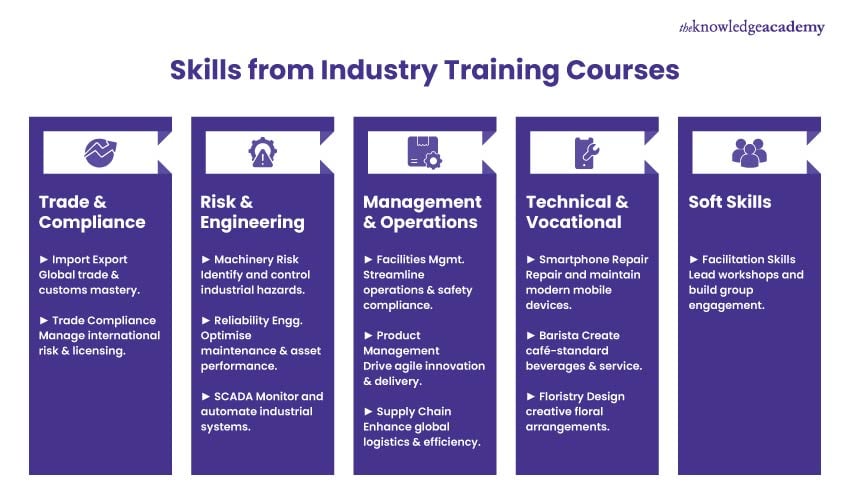
Skills from Industry Training Courses

The Knowledge Academy's Industry Training Courses help professionals gain technical and interpersonal skills. Learners develop confidence to manage changing industry trends effectively. Here are the skills you will gain from our courses:

Skills from Industry Training Courses

1) Trade and Compliance Skills

  • Import Export Course: Learn how international trade works, including shipping goods, handling customs, and completing export paperwork.
  • Export and Trade Compliance Training: Understand how to follow global trade rules, manage export risks, and meet legal requirements for international business.

2) Risk, Reliability, and Engineering Skills

  • Machinery Systems Risk Assessment Training: Learn to identify, assess, and mitigate machinery-related risks using global safety standards.
  • Reliability Engineering Training: Enhance system reliability through predictive maintenance, failure analysis, and performance optimisation.
  • SCADA Training: Build skills in industrial automation, real-time monitoring, and SCADA system configuration.

3) Management and Operations Skills

  • Facilities Management Training: Learn how to manage buildings, equipment, and workplaces to keep them safe, efficient, and sustainable.
  • Product Management Training: Understand how to plan, create, and improve products that meet customer needs using modern business methods.
  • Supply Chain Management Training: Build the skills to manage purchasing, storage, and delivery of goods to make business operations run smoothly.
  • Logistics Management Training: Learn how to organise transport, warehousing, and global deliveries effectively and cost-efficiently.

4) Technical and Vocational Skills

  • Smart Phone Repair Course: Get hands-on training to fix, test, and maintain mobile phones from different brands.
  • Basic Barista Course: Learn how to make great coffee, froth milk, and serve customers professionally.
  • Floristry Introduction: Gain creative skills to design beautiful flower arrangements for events and special occasions.

5) Professional and Soft Skills

  • Facilitation Skills Training: Learn how to lead meetings, group activities, and workshops in a clear and confident way.
Show more blue-arrow

Industry Training FAQs

Industry Training equips professionals with practical, job-focused skills tailored to specific sectors. It helps bridge the gap between theoretical learning and workplace applications, supporting upskilling, compliance, and career progression in today’s evolving business environment.

The prerequisites for the Industry Training are based on the course specifications and the target group of professionals it serves. Check the respective course page of the course that you are planning to take to know about its prerequisites.

You can access the course content through the 'MyTKA Training Portal', your central hub for all training resources. You will retain access to the course materials even after completing your training, allowing for continuous reference and learning.

Industry Training enhances your professional capabilities, boosts productivity, strengthens job prospects, and supports continuous development to meet evolving industry demands with confidence. The Knowledge Academy, a top training provider, ensures each course delivers measurable performance improvement and recognised certification.

In these Industry Training Courses, delegates will have intensive training with our experienced instructors, a digital delegate pack consisting of important notes related to this course, and a certificate after course completion.

The duration of these Industry Training Courses varies. Please visit our course pages for specific information.

Training is offered in various formats including classroom sessions, live virtual classes, online self-paced learning, and onsite group training for businesses or teams.

No, this Industry Training is not formally accredited. However, it is delivered by The Knowledge Academy with expert instructors and high-quality materials, ensuring practical, relevant, and reliable training that is well-regarded by employers.

To register for the course, visit The Knowledge Academy's website, navigate to the course page, and click on the registration button. Fill in the required details, select your preferred schedule, and complete the payment process.

Industry Training covers topics like compliance, safety, quality, leadership, communication, and operational skills. These are tailored to meet specific sector needs, helping professionals apply practical knowledge aligned with current industry standards and workplace expectations.

Industry Certifications are increasingly popular in Azerbaijan due to their role in upskilling, compliance, and enhancing employability across sectors like construction, healthcare, IT, manufacturing, and business services.

Yes, our Industry Certifications are widely recognised across international markets. At The Knowledge Academy, a trusted training provider, we deliver globally respected qualifications that enhance cross-border career opportunities.

Yes, The Knowledge Academy offers 24/7 support via phone & email before attending, during, and after the course. Our customer support team is available to assist and promptly resolve any issues you may encounter.

No, there is no formal exam at the end of this Industry Training. However, delegates are assessed through practical exercises and activities throughout the training to ensure they understand and can apply the concepts effectively.

Certified professionals can pursue roles such as Consultant, Project Manager, Analyst, Operations Lead, or Specialist within their industry. At The Knowledge Academy, a top training provider in in Azerbaijan, we prepare learners for diverse and competitive job markets.

It integrates modern tools, agile methods, and industry updates, ensuring delegates stay relevant, adaptable, and effective in addressing evolving challenges and innovations in the workplace.

Yes, courses are designed for all experience levels. Beginners build foundational skills, while experienced professionals deepen expertise or formalise knowledge with industry-recognised credentials.

Industry Training enhances productivity, strategic thinking, and decision‑making within your current role. The Knowledge Academy, one of the best training providers, ensures that the skills you gain are immediately applicable in the workplace.

Yes, group training improves team alignment, consistency, and effectiveness. It ensures everyone meets industry standards and enhances collaboration on projects and operations.

The Knowledge Academy in Azerbaijan stands out as a prestigious training provider known for its extensive course offerings, expert instructors, adaptable learning formats, and industry recognition. It's a dependable option for those seeking this course.

The Knowledge Academy is one of the Leading global training provider for Industry Training.

The training fees for Industry Training in Azerbaijan starts from €1195

Show more down

Why we're the go to training provider for you

icon

Best price in the industry

You won't find better value in the marketplace. If you do find a lower price, we will beat it.

icon

Trusted & Approved

Recognised by leading certification bodies, we deliver training you can trust.

icon

Many delivery methods

Flexible delivery methods are available depending on your learning style.

icon

High quality resources

Resources are included for a comprehensive learning experience.

barclays Logo
deloitte Logo
Thames Water Logo

"Really good course and well organised. Trainer was great with a sense of humour - his experience allowed a free flowing course, structured to help you gain as much information & relevant experience whilst helping prepare you for the exam"

Joshua Davies, Thames Water

santander logo
bmw Logo
Google Logo
cross

Exclusive Deals Big Savings This March!

Grab up to 40% OFF and level up your skills this spring! march-madness

WHO WILL BE FUNDING THE COURSE?

close

close

Thank you for your enquiry!

One of our training experts will be in touch shortly to go over your training requirements.

close

close

Press esc to close

close close

Back to course information

Thank you for your enquiry!

One of our training experts will be in touch shortly to go overy your training requirements.

close close

Thank you for your enquiry!

One of our training experts will be in touch shortly to go over your training requirements.