




We may not have the course you’re looking for. If you enquire or give us a call on 01344203999 and speak to our training experts, we may still be able to help with your training requirements.
Objectives of Logistics Management: Explained
ByNilotpal SarmahLast updated on: 26 September 2026
Objectives of logistics management encompass the strategic planning, coordination, and optimisation of various processes involved in the movement of goods and services. This blog explores the key goals of logistics management, such as cost reduction, efficient resource utilisation, timely delivery, and enhanced customer satisfaction.
What’s Inside This Blog
1. Logistics management coordinates transportation, inventory, warehousing, fulfilment, and information flow.2. Its objectives include reducing costs, improving customer satisfaction, optimising time, managing inventory, and mitigating risks.3. Automation, analytics and tracking tools support logistics decisions and operations.4. Effective logistics management balances cost, speed, stock availability and customer expectations.5. AI, digital twins and micro-fulfilment are influencing logistics operations.
In today's fast-paced and interconnected global economy, delays and disruptions can affect how businesses serve their customers. At the core of this intricate web lies the dynamic field of logistics management, orchestrating a symphony of processes to ensure products reach the right place when they are needed.
In this blog, you will learn the objectives of logistics management and understand its impact on shaping contemporary business landscapes. Let's begin!
Objectives of Logistics Management
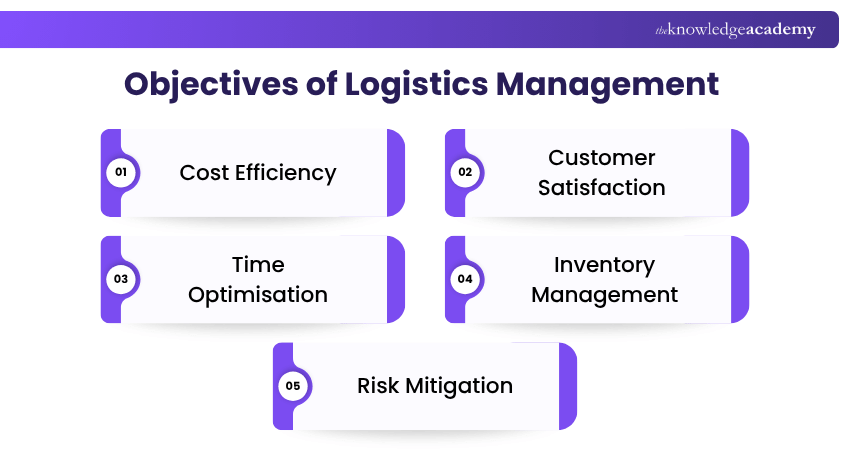
Logistics management is a strategic compass guiding businesses through supply chain operations. The objectives of logistics management provide the framework for decision-making, resource allocation, and process optimisation. Let's explore these pivotal objectives in detail:
1) Cost Efficiency
Cost efficiency stands as a fundamental objective in logistics management. Striking the delicate balance between minimising costs and delivering exceptional service is paramount. From transportation expenses to inventory carrying costs, businesses strive to optimise expenditure at every stage of the supply chain. Techniques such as route optimisation, load consolidation, and careful inventory management contribute to reducing operational costs while maintaining service levels.

2) Customer Satisfaction
Logistics management is pivotal in ensuring customer satisfaction in the age of heightened customer expectations. The seamless flow of goods, accurate order fulfilment, and timely deliveries are essential for creating positive customer experiences. Meeting or surpassing customer expectations can encourage loyalty and generate positive word-of-mouth, amplifying the brand's reputation in the market.
3) Time Optimisation
Time optimisation is a critical objective that goes hand in hand with customer satisfaction. Managing lead times and ensuring timely deliveries are non-negotiable in today's fast-paced business environment. Logistics management strives to enhance efficiency across the supply chain by minimising transit times, streamlining processes, and leveraging technologies like real-time tracking to offer accurate delivery estimates.
4) Inventory Management
Effective inventory management is a multifaceted objective that aims to balance the availability of products with the costs associated with holding inventory. Maintaining optimal stock levels ensures that products are readily available when customers demand them, minimising stockouts and overstocking. Achieving this objective involves precise demand forecasting, safety stock planning, and agile inventory replenishment strategies.
5) Risk Mitigation
Risk mitigation is a vital objective for logistics management in an era characterised by supply chain disruptions. Businesses are exposed to various uncertainties, from natural disasters to geopolitical tensions, that can disrupt operations. To mitigate these risks, logistics professionals diversify their supplier base, develop contingency plans, and establish robust communication networks to ensure timely responses to unforeseen events.
These objectives don't operate in isolation; they are interlinked and mutually reinforcing. For instance, cost-efficient strategies often align with time optimisation, as streamlined processes lead to quicker deliveries and reduced costs. Similarly, effective inventory management directly contributes to cost efficiency and customer satisfaction, ensuring products are available when needed without tying up excess capital.
Trainer’s Pro Tip
When improving logistics performance, focus on balancing cost, speed, inventory levels, and customer expectations rather than optimising one area in isolation.
Build practical skills for industry-focused roles with the Industry Training. Sign up now!
Key Components of Logistics Management
Logistics management is the backbone of supply chain operations, intricately weaving together many components to ensure the efficient flow of products and services. Let's dive into the key components of logistics management:
1) Transportation Management
At the heart of logistics lies the critical aspect of transportation management. This involves strategically selecting transportation modes, such as road, rail, air, or sea, to move goods from source to destination while balancing cost, delivery time and environmental impact. Routes are optimised to minimise distances and associated costs, while transportation schedules are meticulously designed to synchronise with production, inventory, and demand cycles.
2) Inventory Management
Inventory is often considered a vital part of business operations and a core pillar of logistics management. Efficient inventory management strikes the balance between maintaining adequate inventory to fulfil customer needs without overburdening the supply chain with high carrying costs. This component involves demand forecasting, real-time tracking of stock levels, and strategic stock replenishment to minimise stockouts.
3) Warehousing and Distribution
Warehousing and distribution centres act as pivotal nodes within the supply chain. These facilities strategically store products and provide a buffer to accommodate fluctuations in demand. Warehouses are not just storage spaces but hubs of activity involving order picking, packing, labelling, and dispatching. Efficient distribution helps route products to the right destinations promptly, improving the overall speed and accuracy of deliveries.
4) Order Fulfilment
Order fulfilment covers the steps from receiving an order to delivering the product to the customer. This component is intricately linked with inventory management, as accurate order fulfilment hinges on maintaining up-to-date stock records. Seamless coordination between various departments, including sales, warehousing, and transportation, is essential to meet customer expectations for on-time and accurate deliveries.
Bonus Tip
Logistics does not always end when an order arrives. Plan how returned goods will be collected, checked and returned to stock or handled appropriately.
5) Information Management
Information management has become a cornerstone of effective logistics operations in today's digitised landscape. Reliable and timely information exchange throughout the supply chain is crucial for decision-making and problem-solving.
Advanced technologies like Radio Frequency Identification (RFID), Internet of Things (IoT), and real-time tracking systems enable businesses to monitor the condition and whereabouts of products throughout the supply chain. This data-driven approach enhances overall visibility, helps reduce disruptions, and aids in demand forecasting.
Build smarter paths from source to sale by joining the Supply Chain Management Training now!
Role of Technology in Achieving Objectives of Logistics Management
Technology has emerged as an important enabler in achieving logistics management objectives in the modern era. Integrating cutting-edge tools and solutions has transformed how businesses approach challenges and opportunities within the supply chain.
Let's dive into the critical sub-topics that illuminate the pivotal role of technology in achieving logistics management objectives:
1) Digitalisation of Processes
Technology has revolutionised logistics by digitising traditional processes. Automated systems can streamline everything from order processing to inventory management, helping reduce manual errors and enhance efficiency. Advanced digital tools, including Warehouse Management Systems (WMS) and Transportation Management Systems (TMS), enable real-time monitoring, data analysis, and seamless coordination among various supply chain stakeholders.
2) Data Analytics and Predictive Insights
Big data and advanced analytics tools empower logistics professionals with predictive insights. Through the analysis of historical information and patterns, businesses can forecast demand more accurately, align inventory levels, and anticipate potential disruptions. This data-driven approach can help reduce stockouts, improve inventory turnover, and support Agile decision-making.
3) Real-time Tracking and Visibility
Developments in technology have brought greater transparency within the supply chain. Real-time tracking technologies, such as GPS, RFID, and IoT devices, can provide location and status updates for products in transit. This enhanced visibility allows businesses to proactively address delays, optimise routes, and provide customers with accurate delivery information.
4) Automation and Robotics
Automation and robotic technologies are reshaping warehousing and distribution processes. Robotic systems can efficiently handle repetitive tasks like picking, packing, and sorting, increasing speed and accuracy, while allowing staff to focus on their work. This can accelerate order fulfilment and reduce risks associated with human error.
5) E-commerce and Last-mile Innovations
Technology has played a key role in shaping the e-commerce landscape. From automated online order processing to innovative last-mile delivery solutions, businesses are leveraging technology to enhance the customer experience. Drones, autonomous vehicles, and robotics are being explored to support faster and more efficient last-mile deliveries.
6) Supply Chain Optimisation
Sophisticated algorithms and simulations are being used to optimise multiple aspects of the supply chain, such as inventory positioning, transportation routes, and demand forecasting. These tools help businesses achieve cost-efficient operations while responding more effectively to customer demand.
Quick Check
Before introducing a new tool, ask:
1. Which logistics problem should it solve?2. What data will it need?3. How will we measure whether it helped?
Learn about exchange rates and key import and export processes with the Import Export Course. Join now!
Future Trends in Logistics Management
Logistics management is undergoing significant changes driven by technological advancements and evolving market dynamics. Here are some trends that are shaping the future of logistics:
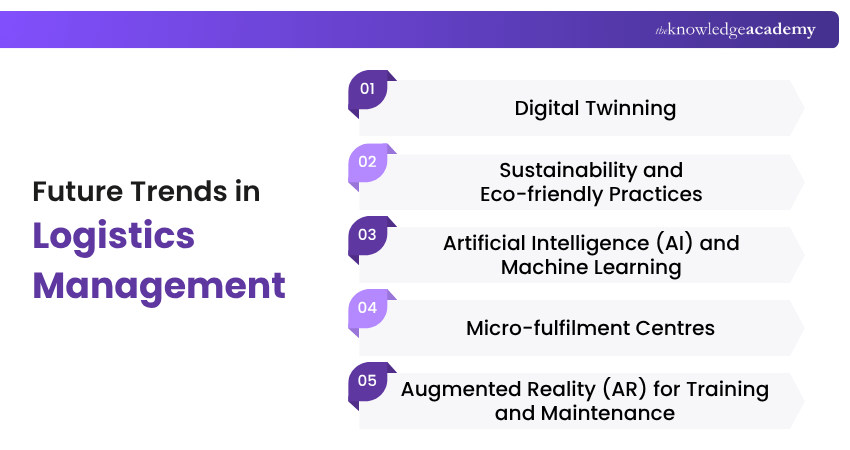
a) Digital Twinning: Digital twinning involves creating virtual replicas of physical supply chain assets, supporting ongoing monitoring, analysis, and simulation. This trend can enhance predictive maintenance, reduce downtime, and optimise resource utilisation.
b) Sustainability and Eco-friendly Practices: Increasing environmental concerns are encouraging businesses to adopt more sustainable logistics practices. From eco-friendly packaging to electric and hydrogen-powered vehicles, businesses strive for greener operations.
c) Artificial Intelligence (AI) and Machine Learning: AI-powered algorithms are being used to optimise various logistics processes, from route planning to demand forecasting. Machine learning enables systems to learn from historical data, supporting more informed decision-making.
d) Micro-fulfilment Centres: Micro-fulfilment centres located closer to urban areas can support faster last-mile deliveries. These compact warehouses leverage automation and robotics to manage inventory and orders efficiently.
e) Augmented Reality (AR) for Training and Maintenance: AR technology aids in training logistics personnel and simplifies maintenance tasks. Where suitable, this may help staff complete tasks accurately and reduce equipment downtime, supporting operational efficiency.
Navigate export rules with confidence by signing up for the Export and Trade Compliance Training today!

Nilotpal Sarmah is a Senior Content Writer with 11+ years of overall experience spanning engineering, operations and content development. His technical knowledge and extensive writing experience enable him to simplify specialised topics across IT and Tech, Business Skills, Project Management, Health and Safety, and ISO and Compliance.
View Detail

 If you wish to make any changes to your course, please


