


 Top Rated Course

We may not have the course you’re looking for. If you enquire or give us a call on +43 720 115337 and speak to our training experts, we may still be able to help with your training requirements.
Negotiation Techniques: Strategies for Succes
Charlotte Wilson 24 March 2026Negotiation Techniques include preparation, active listening, empathy, mirroring, and understanding BATNA to achieve win-win outcomes. They help individuals communicate clearly, manage conflicts, and build stronger professional relationships. These techniques also support better decision-making and mutually beneficial agreements.

Training Outcomes Within Your Budget!
We ensure quality, budget-alignment, and timely delivery by our expert instructors.
Table of Contents

Imagine you’re negotiating a crucial business deal that could significantly impact your company’s future. The stakes are high, and both parties have their own interests and goals. Given such a situation, how do you ensure a favourable outcome? The answer lies in mastering effective Negotiation Techniques.
In this blog, we will explore over 10 powerful tactics that can transform your approach to negotiations. Be it for closing a business deal, negotiating a salary increase, or simply improving your everyday interactions, these Negotiation Techniques can help you confidently navigate any negotiation scenario. Let’s dive in and discover the secrets to successful negotiations!
Table of Contents
1) What is Negotiation?
2) What are Negotiation Techniques?
a) Thorough Preparation
b) Active Listening
c) Open-ended Questions
d) Empathy and Understanding
e) Setting Clear Goals
3) What Are the Four Types of Negotiation Techniques?
4) Conclusion
What is Negotiation?
Negotiation is a tactical dialogue that seeks to work out a difference and come up with a win-win situation. It comprises dialogue, compromise, and finding out the interests of each party. The skills involved in negotiation include preparation, active listening, emotional intelligence, and clear articulation of needs in order to reach successful results.
To take an example, suppose you have a bakery that requires a constant supply of the mixture of doughnuts at a price that would provide you with a profit. You negotiate with the supplier to get a price cut, and the supplier wants to remain profitable and to have a long-term business. Discussion leads the two parties to an agreement that favors both parties, and a number of Factors Affecting Negotiation can affect the result.

What are Negotiation Techniques?
Now that we know the importance of Negotiation and Negotiation Techniques definition, we will look into those basic techniques. This blog section will dive deeper into certain techniques for effective communication and collaboration:
1) Thorough Preparation
Thorough preparation sets the foundation for successful Negotiations. Before engaging, invest time in gathering relevant information, studying the subject matter, and understanding the needs and interests of all parties involved. Thorough preparation allows you to approach Negotiations with confidence, make informed decisions, and adapt to changing circumstances.
2) Active Listening
Active listening is a fundamental quality of effective Negotiation. By attentively listening to the other party, you convey respect and empathy. This technique enables you to understand their perspective, uncover their underlying interests, and identify potential areas of agreement. Active listening builds rapport and lays the groundwork for collaborative problem-solving.
3) Open-ended Questions
Asking open-ended questions motivates the other party to provide detailed responses, going beyond simple "yes" or "no" answers. These questions promote deeper insights into the other party's thoughts, concerns, and motivations. By eliciting comprehensive responses, you gain a better understanding of their perspective, facilitating a more productive and meaningful Negotiation process.
4) Empathy and Understanding
Demonstrating empathy is essential while negotiating. It's an attempt to put yourself in the other party's shoes to understand their emotions, concerns, and motivations. By showing empathy, you can facilitate a safe and trusting environment which encourages open communication and collaboration. Understanding the other party's perspective allows you to craft solutions that meet their needs while addressing your own.
5) Setting Clear Goals
Clear goals are crucial for effective Negotiation. Before commencing, clearly define your objectives and desired outcomes. Setting specific goals keeps you focused and helps you evaluate potential agreements against your predetermined criteria. Clear goals also provide a benchmark for measuring the success of the Negotiation process.
6) Using the Power of Silence
Silence can say more than words ever could, and it can be a potent tool during Negotiations. After the other party speaks, allow brief pauses instead of rushing to respond. This technique encourages the other party to provide additional information or concessions. Silence also creates space for thoughtful reflection, prevents hasty decision-making, and can compel the other party to fill the void with valuable insights or compromises.
7) Focus on Interests
To achieve mutually beneficial outcomes, it is crucial to focus on common interests rather than rigid positions. Positions are often fixed and can lead to an impasse. By understanding the underlying interests and motivations driving each party, you can explore creative solutions that satisfy everyone involved. This approach expands the scope of possibilities and fosters win-win outcomes.
Sign up for our Assertiveness Skills Training and learn to express yourself confidently and stand up for your rights!
8) Finding Common Ground
Identifying areas of agreement and shared interests is essential for effective Negotiation. Emphasise commonalities and seek to build upon them. Finding common ground creates a positive atmosphere, establishes a sense of collaboration, and lays the foundation for constructive problem-solving. By focusing on shared interests, you can forge stronger relationships, which increase the likelihood of reaching agreements.
9) Brainstorming and Problem-solving
Encourage open discussion and brainstorming sessions to generate innovative ideas and alternative solutions. Involve all parties in problem-solving, leveraging their unique perspectives and expertise. By promoting a collaborative environment, you empower each party to contribute actively, increasing their sense of ownership and commitment to the Negotiated outcome.
10) Building Relationships
Negotiations often involve ongoing relationships. Invest time in building positive relationships, even if you disagree on certain issues. Cultivating trust, respect, and goodwill strengthens interpersonal connections, facilitates open communication, and improves long-term outcomes. Building relationships creates a foundation for future collaborations and enhances the potential for mutual success.
11) SPIN Method
The SPIN Method involves the following structured questions concerning the Situation, Problem, Implication, and Need. When negotiators learn the concerns and interests of the other party, they will be able to prevent assumptions and make proposals that will bring value to both parties. This would assist in uncovering concealed interests and enhance decision making.
12) AIDA Method
AIDA Method is an acronym that means Attention, Interest, Desire and Action. In negotiation, it assists to steer the discussions by drawing attention, creating an interest in the offer, pointing out its advantages, and persuading the other party to proceed towards agreement. Clear communication and persuasive framing play a key role in this approach.
Prepare for success with our guide on Negotiation Skills Interview Questions—get the insights you need to answer confidently and professionally!
13) Win-win Technique
Win-win Technique attempts to achieve a win-win situation in which both sides gain. Negotiators seek ways to create value and fulfil common interests, instead of presuming that one party has to lose. This teamwork attitude enhances connection and the probability of lasting contracts.
14) Strategic Empathy
Strategic empathy is the ability to grasp the motivations, concerns, and expectations of the other party in the course of negotiation. Negotiators can develop trust, minimise conflict, and construct proposals that are more likely to be accepted by active listening and recognising their view. This will prevent misconceptions and enhance performance.
15) Face-to-face Strategy
Face-to-face Strategy is concerned with direct interaction of negotiations. Face-to-face meetings enable negotiators to read the body language, establish rapport, and clear misunderstandings within a short period. Face-to-face communication tends to build trust and enable the two parties to pursue creative solutions in a more efficient way.
What Are the Four Types of Negotiation Techniques?
There are different negotiation methods based on the circumstances, the number of individuals, and the objectives of each party. Learning how to distinguish between various forms of negotiation allows people to select the most appropriate method to make a successful deal. Following are the common types of Negotiation Techniques:
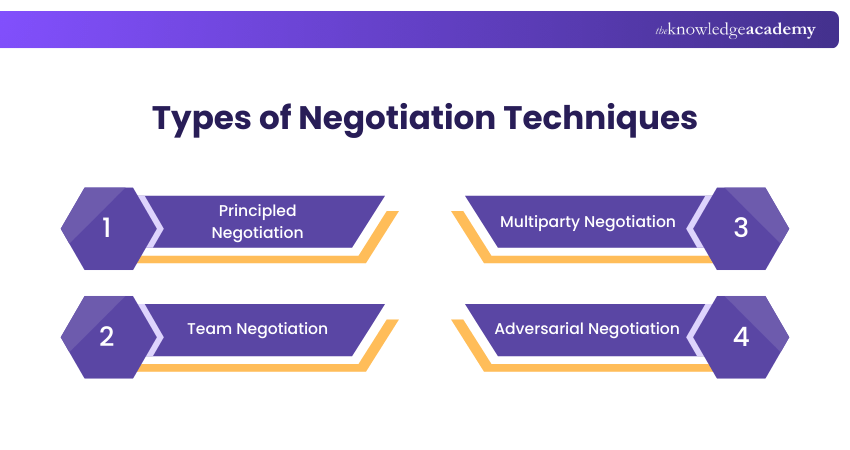
1) Principled Negotiation: Principled negotiation aims at achieving a win win situation, which is fair and satisfactory to all parties involved. It focuses more on transparency, trust, and problem solving instead of competition, enabling negotiators to create value and form long term relationships.
2) Team Negotiation: Team negotiation is a situation that involves groups of two organisations or departments negotiating an agreement. Individuals with various roles and skills can be employed in each team and can consider various aspects and strive to create a balanced and advantageous deal.
3) Multiparty Negotiation: Multiparty negotiation is more than two parties negotiating on an issue to arrive at a mutual agreement. This form of negotiation is predominant in organisations where various departments or stakeholders possess diverse priorities and coordination and communication is therefore vital.
4) Adversarial Negotiation: Adversarial negotiation is an adversarial style in which the parties involved are interested in the optimal result which favors them. Strong bargaining is a common strategy employed by negotiators, and the negotiation process might lead to a net benefit to one party over the other.
Conclusion
All in all, effective Negotiation Techniques are vital for successful communication and collaboration. By incorporating such techniques into your Negotiation repertoire, you can effectively enhance your communication ability to, understand the needs of others, build collaborative relationships, and achieve mutually beneficial outcomes. Additionally, recognising the Difference Between Strategy and Tactics in Negotiation can help you refine your approach, ensuring a balance between long-term objectives and immediate actions for better outcomes.
Transform your personal and professional interactions by joining our Communication Skills Courses – book your spot now!
Frequently Asked Questions
How can Ethical Considerations be Integrated into Negotiation Techniques for Positive Outcomes?

Ethical considerations can be integrated into Negotiation Techniques by following some principles, such as honesty, reciprocity, publicity, universality, and legacy. These principles can help Negotiators avoid unethical behaviour, build trust and credibility, and achieve win-win outcomes.
How can Cultural Awareness and Sensitivity Enhance Cross-cultural Negotiation Skills?
Cultural awareness and sensitivity can enhance cross-cultural Negotiation skills by facilitating understanding and preventing misunderstandings and conflicts. Negotiators can improve their cultural awareness and sensitivity by learning about their counterpart’s culture, communication style, values, and preferences.
What are the Other Resources and Offers Provided by The Knowledge Academy?
The Knowledge Academy takes global learning to new heights, offering over 3,000+ online courses across 490+ locations in 190+ countries. This expansive reach ensures accessibility and convenience for learners worldwide.
Alongside our diverse Online Course Catalogue, encompassing 17 major categories, we go the extra mile by providing a plethora of free educational Online Resources like Blogs, eBooks, Interview Questions and Videos. Tailoring learning experiences further, professionals can unlock greater value through a wide range of special discounts, seasonal deals, and Exclusive Offers.
What is The Knowledge Pass, and How Does it Work?
The Knowledge Academy’s Knowledge Pass, a prepaid voucher, adds another layer of flexibility, allowing course bookings over a 12-month period. Join us on a journey where education knows no bounds.
What are Related Communication Skills Courses and Blogs Provided by The Knowledge Academy?
The Knowledge Academy offers various Communication Skills Courses including Negotiation skills and Negotiation Techniques. These courses cater to different skill levels, providing comprehensive insights into Negotiation Methodologies.
Our Business skills Blogs cover a range of topics related to communication skills along with Negotiation Techniques and examples, offering valuable resources, best practices, and industry insights. Whether you are a beginner or looking to advance your Communication skills, The Knowledge Academy's diverse courses and informative blogs have you covered.

Charlotte Wilson


Soft Skills and Business Training Manager
Charlotte Wilson is an expert in soft skills development, with over 14 years of experience helping individuals and teams improve communication, productivity and emotional intelligence in the workplace. Her training content is focused on enhancing interpersonal effectiveness and fostering positive, collaborative environments across all levels of an organisation.
View Detail
Upcoming Business Skills Resources Batches & Dates
Date
 Public Speaking Course
Public Speaking Course
Fri 31st Jul 2026
Public Speaking Course
Fri 2nd Oct 2026
Public Speaking Course
Fri 27th Nov 2026

 If you wish to make any changes to your course, please


