


 Top Rated Course

We may not have the course you’re looking for. If you enquire or give us a call on +43 720 115337 and speak to our training experts, we may still be able to help with your training requirements.
How to Become a Chief Information Security Officer?
The Knowledge Academy 13 February 2026To become a Chief Information Security Officer, gain a degree in IT or cybersecurity, earn top certifications like CISSP, and build strong leadership experience. Also, you should have deep knowledge of technical skills, risk management, and compliance. Hands-on experience in industry networking and real-world projects also helps a lot.

Training Outcomes Within Your Budget!
We ensure quality, budget-alignment, and timely delivery by our expert instructors.
Table of Contents
Wondering how to become a Chief Information Security Officer? Nowadays, the demand for CISOs has increased a lot because every company needs an expert to keep its data and systems secure. This role demands a perfect combo of technical skills, leadership qualities, and smart thinking.
If you want to make a strong career in the cybersecurity field, then this blog is the best guide for you. Whether you are a beginner or experienced, here you will get all the steps and skills that will help you in becoming a Chief Information Security Officer.
Table of Contents
1) How to become a chief information security officer?
2) What Does a CISO (Chief Information Security Officer) Do?
3) Responsibilities of a Chief Information Security Officer
4) Steps to become a Chief Information Security Officer
5) Skills for Chief Information Security Officer
6) How many years does IT take to become a CISO?
7) How old is the average CISO?
8) Conclusion
How to become a chief information security officer?
To become a CISO, first, you have to get a bachelor's degree in cybersecurity or the IT field. This degree gives you basic technical knowledge, which is necessary for this role.
After that, you need several years of experience in the IT and information security field. You should have technical skills as well as the ability to manage a team. When you prove through your work that you are an expert, only then can you reach a senior role like CISO.

What Does a CISO (Chief Information Security Officer) Do?
The main job of a CISO (Chief Information Security Officer) is to keep the company's important data and systems safe. He sees to it that no hacker or security threat reaches the company's system. The CISO handles the entire security team and makes new security policies.
The CISO introduces new tools, decides the budget, checks risks, and takes care of legal rules. He also explains security to non-technical people in simple language. The role of a CISO may be slightly different in every company, but the main goal is always the same: to keep the data secure.
Responsibilities of a Chief Information Security Officer
The job of a CISO is to keep the company's data, systems, and network safe. They identify risks, make security rules, and ensure that they are followed along with the team. Depending on the types of information systems in use, the CISO works with every department so that everyone takes security seriously. They also suggest new tools, decide the budget, and ensure that the company follows legal rules and standards.
The main work of a CISO is:
1) Keeping the company's data secure and protecting it from cyber attacks
2) Hiring, training, and managing a security team
3) Getting risk assessments and audits done regularly
4) Giving reports and suggestions to top management
5) Giving security awareness training to every employee
To excel in this role, professionals should explore Chief Information Security Officer Interview Questions to understand key challenges which will help them prepare well for the interview.
Join our CISSP Training to grasp the strategies of security systems- join us now!
Steps to become a Chief Information Security Officer
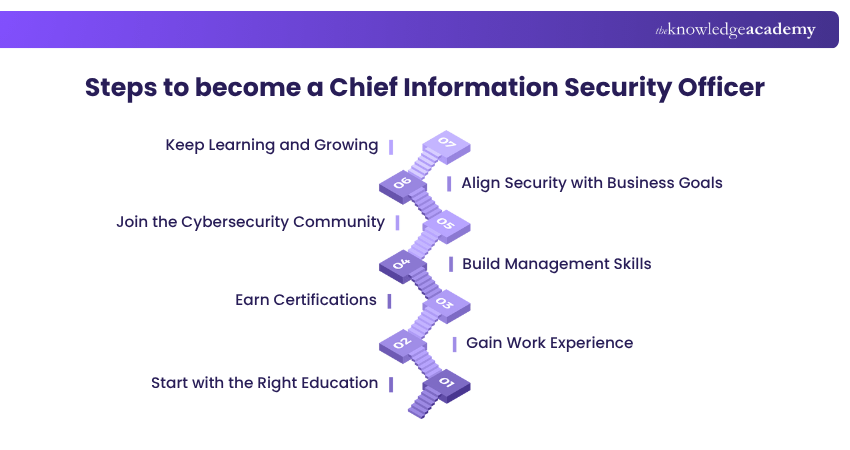
There is no fixed shortcut to becoming a CISO, but you can reach this role by following some important steps. The simple steps given below will help you in giving you the right direction:
1) Start with the Right Education
First of all, it is important to get a Bachelor's degree in Cybersecurity, Computer Science, IT or a Business field. If you want an edge, a Master's degree is also very helpful, especially for leadership roles.
2) Gain Work Experience
To become a CISO, you need at least 7 to 10 years of IT security experience. You can build experience by working in roles such as Security Analyst, Security Architect, Ethical Hacker, and Risk Manager.
3) Earn Certifications
High-level certifications show your skills and dedication. Earning certifications such as CISSP, CAP, CompTIA Security+, or CySA+ makes you an expert in the eyes of an employer.
4) Build Management Skills
Not just technical work, you also need to be able to manage a team, make decisions and formulate an organisation’s security strategy. So it’s important to have experience in leadership and people management.
5) Join the Cybersecurity Community
Attending cybersecurity events, conferences, and online forums helps you stay updated on networking and the latest industry trends. This is the best way to connect with other CISOs.
6) Align Security with Business Goals
A successful CISO is one who can link security with business goals. For this, you should also have knowledge of business operations and compliance.
7) Keep Learning and Growing
You have to become an expert in your subject matter. Writing articles, contributing to industry journals, or taking on roles like Deputy CISO will help in your career growth.
Skills for chief information security officer
To become a CISO, technical knowledge is not enough, leadership, planning, risk handling and communication skills are also very important. CISOs have to understand the company's security goals, work together with other teams, and build security awareness at every level. Below are some key skills that a CISO must have:
1) Strategic Cyber Security Planning
CISOs must know how to make long-term plans for security. They have to decide in which areas investment is needed and how the security roadmap matches the organisation's goals.
2) Cyber Security Governance
CISO makes rules and policies that maintain the security of the company. He has to ensure that the organisation follows current laws and regulations.
3) Cyber Risk Management
CISO should understand risk at every level. He has to assess risk, manage it, and explain it to other leaders in a clear manner so that they can take timely decisions.
4) Security Culture Building
CISO has to create a positive security culture in the entire organisation. For this, he runs training programs and makes everyone security aware.
5) Cyber Incident Management
If there is a security problem, CISO has to respond quickly. His role is to understand the impact, plan a solution, and bring the organisation back to normal mode.
Upgrade your skills and gain expertise with our CISSP Training Course.
How many years does IT take to become a CISO?
To become a CISO, you usually need 7 to 10 years of experience, especially in cybersecurity and leadership roles. If you have an advanced degree or internship/bootcamp training, sometimes less experience will work. But in general, at least 5 years of work experience is required for strong skills and certifications.
How old is the average CISO?
CISO is an important role today, and the average age of CISOs in Fortune 500 companies is 52 years. However, there is also a gender gap in this field, with only 16 percent of women working in CISO roles. Therefore, companies should follow fair hiring practices and give everyone an equal chance. At the same time, CISOs need to maintain a balance between innovation and cyber risk, often relying on resources like CISSP Practice Exam Questions to ensure they are well-prepared to face the evolving challenges in cybersecurity.
Conclusion
While the journey of how to become Chief Information Security Officer is demanding, it is an attainable goal. From our blog, we hope you can implement the correct mix of technical expertise, and business acumen to become an efficient CISO.
Build an indispensable career with our CISSP-ISSAP Training - register today!
Frequently Asked Questions
How long does it take to become a CISO?

The required time-duration to become a CISO entirely depends on individual. However, following the correct route and strategies can make their roadway much smooth and easier.
What is required to become a CISO?
Turning into a CISO calls for following and clinging to certain steps. However, having a relevant educational background and gaining expertise are among the crucial factors to enter this profession.
What are the other resources and offers provided by The Knowledge Academy?
The Knowledge Academy takes global learning to new heights, offering over 3,000 online courses across 490+ locations in 190+ countries. This expansive reach ensures accessibility and convenience for learners worldwide.
Alongside our diverse Online Course Catalogue, encompassing 19 major categories, we go the extra mile by providing a plethora of free educational Online Resources like Blogs, eBooks, Interview Questions and Videos. Tailoring learning experiences further, professionals can unlock greater value through a wide range of special discounts, seasonal deals, and Exclusive Offers.
What is Knowledge Pass, and how does it work?
The Knowledge Academy’s Knowledge Pass, a prepaid voucher, adds another layer of flexibility, allowing course bookings over a 12-month period. Join us on a journey where education knows no bounds.
What are related CISSP courses and blogs provided by The Knowledge Academy?
The Knowledge Academy offers various CISSP Training, including CISSP Course, CISSP-ISSAP Training, and Information Systems Security Management Training. These courses cater to different skill levels, providing comprehensive insights into CCSP vs CISSP.
Our IT Security & Data Protection Blogs cover a range of topics related to CISSP, offering valuable resources, best practices, and industry insights. Whether you are a beginner or looking to advance your IT Security & Data Protection skills, The Knowledge Academy's diverse courses and informative blogs have you covered.

The Knowledge Academy


Global Training Provider
The Knowledge Academy is a world-leading provider of professional training courses, offering globally recognised qualifications across a wide range of subjects. With expert trainers, up-to-date course material, and flexible learning options, we aim to empower professionals and organisations to achieve their goals through continuous learning.

Upcoming Health & Safety Resources Batches & Dates
Date
 CISSP Training
CISSP Training
Mon 13th Jul 2026
CISSP Training
Mon 10th Aug 2026
CISSP Training
Mon 7th Sep 2026
CISSP Training
Mon 12th Oct 2026
CISSP Training
Mon 9th Nov 2026
CISSP Training
Mon 14th Dec 2026

 If you wish to make any changes to your course, please


