


 Top Rated Course

We may not have the course you’re looking for. If you enquire or give us a call on +971 8000311193 and speak to our training experts, we may still be able to help with your training requirements.
What is VUCA? A Complete Guide for Leaders and Organisations
Charlotte Wilson 05 February 2026VUCA represents Volatility, Uncertainty, Complexity, and Ambiguity, highlighting a rapidly changing world that calls for flexible and adaptive leadership. Leaders must think fast, act decisively, and stay resilient under pressure. Success depends on learning, agility, and clear decision-making to thrive amid constant change.

Training Outcomes Within Your Budget!
We ensure quality, budget-alignment, and timely delivery by our expert instructors.
Table of Contents
Leadership is undergoing a transformation more rapidly than ever before, and the traditional approaches are no longer effective. So, What is VUCA, and why is it important in the current erratic environment? Let us see the influence of this idea on leadership that is more intelligent and adaptive.
Table of Contents
1) What is VUCA?
2) The Importance of VUCA
3) Strategies for Dealing With VUCA
4) Advantages and Disadvantages of Implementing VUCA
5) Leadership Actions for a VUCA World
6) How does Agile Help in a VUCA Environment?
7) How can Leaders Manage Volatility and Uncertainty?
8) Conclusion
What is VUCA?
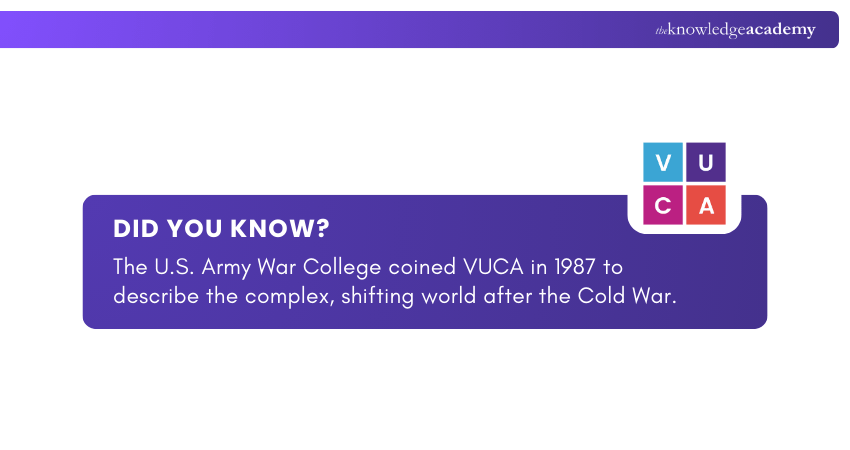
The term VUCA is an acronym for Volatility, Uncertainty, Complexity, and Ambiguity, and it points to the difficulty faced by the management in understanding, predicting, and controlling such environments. It signifies the rapid changes and difficulties that leaders have to deal with in modern times.
1) Volatility
Volatility is the term used to denote how rapid and frequent the changes are in the market or environment. Things are changing very rapidly and in a very unpredictable way. It is an indicator of how fast conditions may vary, thus calling for very quick adaptation.

2) Uncertainty
Uncertainty is the situation where it is very hard to say what the future will bring, even if one has all the information that is available. When things are uncertain, one cannot make any predictions regarding the results or depend on the previous experience.
3) Complexity
Complexity is the term used to describe the huge number of interrelated factors that make a situation very difficult to analyse and understand. The greater the number of elements and the more intricate relationships, the more difficult it is to come up with a direct decision.
4) Ambiguity
Ambiguity is the word used to describe the fact that there is no clear interpretation because the information may be incomplete or vague, or even contradictory. This situation makes it very hard for one to come up with correct conclusions or to determine what the best course of action is.
Learn cutting-edge business strategies with our Business Model Innovation Training - Sign up now!
The Importance of VUCA
In today's post-pandemic world and constantly shifting geopolitical climate, the VUCA framework is more important than ever. It helps organisations stay resilient, adaptable, and competitive. Here’s how:
1) Be Prepared for the Future
Organisations can better spot risks and opportunities by recognising that the world is unpredictable, fast-changing, and sometimes unclear. This helps them stay aware of new trends and prepare for changes ahead of time. This makes them stronger and more flexible.
2) Strategic Agility
VUCA encourages flexibility and adaptability in organisations' strategies and operations. Instead of following strict plans, businesses can adapt quickly to changing situations. This flexibility helps them take advantage of new opportunities, reduce risks and stay ahead in a fast-moving world.
Learn innovative problem-solving techniques to encourage creativity and collaboration in our Design Thinking Course - Sign up now!
3) Think Outside the Box
In a fast-changing world, traditional methods may not always work, so businesses need to find new and creative solutions. In fact, the challenges of unpredictability and complexity can encourage fresh ideas and experimentation. By embracing innovation, companies can discover new opportunities, offer something unique and stand out from the competition.
4) Commit to Continuous Learning
Handling VUCA means always learning and growing, both as individuals and as a company. Accepting uncertainty and complexity builds a mindset of curiosity and improvement. Businesses can strengthen their skills by offering training, sharing knowledge, and encouraging development. This is the key to creating a learning-inclined culture.
5) Spot Opportunities Early
VUCA environments can be tough, but they also bring opportunities for those who know how to spot them. By accepting uncertainty and change, businesses can find new possibilities, enter fresh markets and come up with innovative solutions. Staying alert and open-minded helps you take advantage of these chances and stay ahead of the competition.
6) Understand Global Trends
VUCA environments are influenced by global factors like economic changes, politics, and new technology. To succeed, businesses need to think in terms of global trends and consider different cultures, perspectives and markets. By going for diversity, working across cultures and expanding internationally, companies can become more future-ready.
7) Leverage Collaborative Networks
No organisation can tackle big challenges alone. So, teamwork is key in a VUCA environment. By building strong partnerships, businesses can combine their strengths, share resources and create more opportunities than before. Collaborating with others helps companies reach new markets and innovate more efficiently
8) Lead with Integrity and Ethics
In a VUCA world, ethical Leadership and responsible decision-making are more important than ever. Leaders must stay honest, transparent, and true to their values, even in complex and uncertain situations. By leading with integrity, organisations can build trust, elevate their reputation and create a culture of accountability.
Gain insights into diverse motivational techniques and Leadership styles in our detailed Leadership Skills Training - Register now!
Strategies for Dealing With VUCA
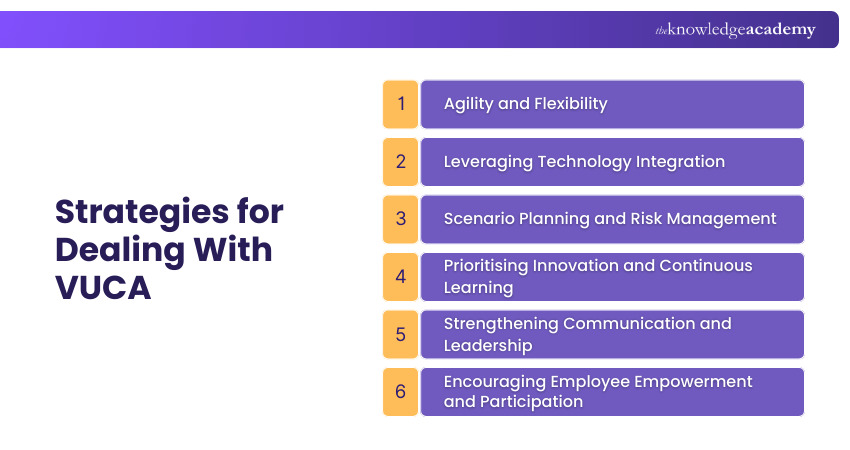
Handling VUCA can be an uphill battle. However, there are ways to mitigate its effects. The following strategies will help you deal with VUCA efficiently.
During VUCA times, leaders are compelled to place their mindset and practice in reflection to come out of the uncertainties, transitions, and complexities with a very resilient and insightful approach. The characteristics of effective leadership in the present time are positivity, good communication, empathy, a clear vision, and the ability to adjust quickly.
1) Stay Positive
Optimism should be the main focus to see chances and hold the right view even when the situations are not clear or are stressful. A positive attitude makes the leaders and the team stay actively involved and productive.
2) Be Transparent and Honest in Communication
Transparency in communication is the foundation of trust and understanding, which allows the teams to comprehend the problems better and work together for the solutions. Openness reduces misunderstandings and brings the efforts together.
3) Demonstrate Empathy and Emotional Intelligence
Putting oneself in the position of the co-workers and listening to their needs in the right way can deepen the connection and win their loyalty. The leader who cares for his followers takes the most difficult times as an opportunity to uplift the spirits and bring about stability.
4) Explore New Opportunities
Leaders should regularly look for innovative ways and problem-solving approaches to change the negative side of emblems into the positive side. A curious and open-minded attitude paves the way for the emergence of new ideas and thus the creation of a stronghold against setbacks.
5) Communicate a Clear Vision
A powerful vision is a source of direction and meaning that makes it easier for the teams to stay focused during the period of transition. By communicating this vision, the alignment and the sense of ownership across the whole organisation are enhanced.
Struggling to balance flexibility with your Project Management schedule? Our Agile Leadership Training will guide you - Sign up now!
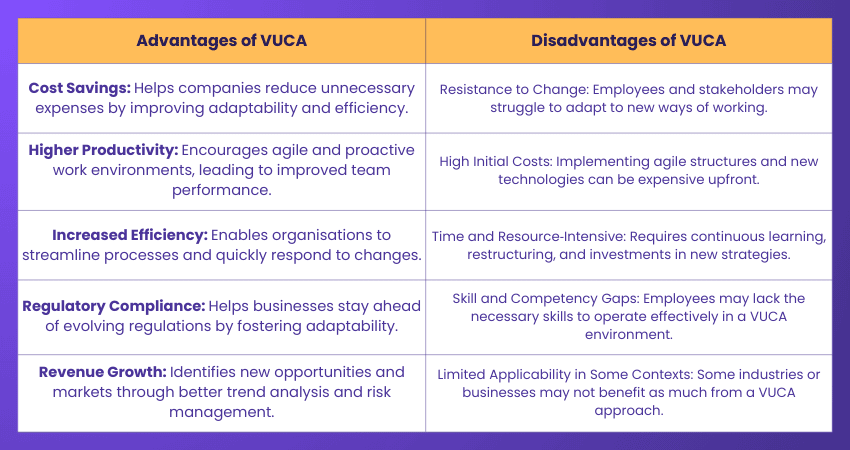
Advantages and Disadvantages of Implementing VUCA
Consider these benefits and drawbacks of implementing VUCA:
Leadership Actions for a VUCA World
In a VUCA world, leaders must focus on self-awareness, team dynamics, clear vision, and continuous learning to steer their organisations through change. These actions help build resilient teams and adaptive cultures that thrive amid volatility and ambiguity. Key leadership actions include:
a) Know Yourself: Understand your strengths and weaknesses to lead more effectively and support your team where needed.
b) Build a Balanced Team: Create teams with complementary skills to enhance trust and collaboration.
c) Empower with Vision: Share a clear view of the future to inspire and energise your people.
d) Foster Innovation: Encourage trust, respect, and creativity to solve ambiguous challenges.
e) Check Decisions: Avoid biases like pride or risk aversion by evaluating choices critically.
f) Communicate Informally: Use informal conversations to reduce anxiety and align teams.
g) Plan for Change: Anticipate why change fails and prepare thoughtful action plans.
h) Keep Learning: Stay open to new ideas and encourage ongoing learning across your organisation.
How Does Agile Help in a VUCA Environment?
Agile provides a way for organisations to be successful in a volatile, uncertain, complex, and ambiguous environment by changing the mindset from strict planning to iterative development, constant feedback, and flexibility. Teams can then skillfully adapt, lower the risk, and transform uncertainty into a competitive advantage.
How can Leaders Manage Volatility and Uncertainty?
Leaders tackle the volatility and uncertainty that are prevailing in the market by taking an Agile, purpose-led and communication-friendly approach to go along with scenario-based planning. They manage the change by building resilience, empowering decision-making, and using emotional intelligence to keep the team focused and calm at all times.
Conclusion
In the current unstable environment, understanding What is VUCA can significantly influence the strategy of leaders and organisations in coping with the change. We hope this blog has given you some useful insights and practical tips. If it has made you more knowledgeable and more secure, then it has performed its function perfectly.
Become familiar with using creativity in leadership with our Creative Leadership Training – Join now!
Frequently Asked Questions
What are the Big Five Models of Leadership?

The big five model of Leadership identifies five broad dimensions used by many researchers:
a) Openness
b) Conscientiousness
c) Extraversion
d) Agreeableness
e) Neuroticism (Emotional stability)
What is an Example of a VUCA Situation?
An example of a VUCA situation is the COVID-19 pandemic. It brought volatility, uncertainty, complexity and ambiguity to various aspects of life and business.
What are the Other Resources and Offers Provided by The Knowledge Academy?
The Knowledge Academy takes global learning to new heights, offering over 3,000+ online courses across 490+ locations in 190+ countries. This expansive reach ensures accessibility and convenience for learners worldwide.
Alongside our diverse Online Course Catalogue, encompassing 19 major categories, we go the extra mile by providing a plethora of free educational Online Resources like Blogs, eBooks, Interview Questions and Videos. Tailoring learning experiences further, professionals can unlock greater value through a wide range of special discounts, seasonal deals, and Exclusive Offers.
What is The Knowledge Pass, and How Does it Work?
The Knowledge Academy’s Knowledge Pass, a prepaid voucher, adds another layer of flexibility, allowing course bookings over a 12-month period. Join us on a journey where education knows no bounds.
What are the Related Courses and Blogs Provided by The Knowledge Academy?
The Knowledge Academy offers various Leadership Courses, including the Agile Leadership Training, Design Thinking Course, Creative and Analytical Thinking Training. These courses cater to different skill levels, providing comprehensive insights into Building an Effective Team.
Our Business Skills Blogs cover a range of topics related to VUCA , offering valuable resources, best practices, and industry insights. Whether you are a beginner or looking to advance your Business skills, The Knowledge Academy's diverse courses and informative blogs have got you covered.

Charlotte Wilson


Soft Skills and Business Training Manager
Charlotte Wilson is an expert in soft skills development, with over 14 years of experience helping individuals and teams improve communication, productivity and emotional intelligence in the workplace. Her training content is focused on enhancing interpersonal effectiveness and fostering positive, collaborative environments across all levels of an organisation.
View Detail
Upcoming Business Skills Resources Batches & Dates
Date
 Leadership Skills Training
Leadership Skills Training
Fri 31st Jul 2026
Leadership Skills Training
Fri 2nd Oct 2026
Leadership Skills Training
Fri 27th Nov 2026

 If you wish to make any changes to your course, please


