


 Top Rated Course

We may not have the course you’re looking for. If you enquire or give us a call on +44 1344 203 999 and speak to our training experts, we may still be able to help with your training requirements.
What is Corporate Finance? Everything You Need to Know
The Knowledge Academy 24 April 2026Want to maximise the growth of your business? Then, adopt Corporate Finance. It plans and implements strategies while maintaining the profitability and risk associated with your company. Let’s dive in and learn What is Corporate Finance in detail, along with its critical functionalities. Also, know its importance.

Training Outcomes Within Your Budget!
We ensure quality, budget-alignment, and timely delivery by our expert instructors.
Table of Contents

We all know that running a firm successfully takes work. A lot of things go in, starting from funding to management. So, it becomes a little hassle to deal with it. That’s where the term ‘Corporate Finance’ comes into play. But What is Corporate Finance? It’s an essential domain of Finance that takes care of a corporation's financial decisions.
Since Finance is one of the vital aspects of a business, companies need concrete financial planning. The sole purpose of Corporate Finance is to maximise the growth of your business. With careful planning and implementation, risk and profitability are backed. Read on to explore several aspects of What is Corporate Finance and the activities it governs.
Table of Contents
1) What is Corporate Finance?
2) The Importance of Corporate Finance
3) Functions of Corporate Finance
4) Types of Corporate Finance
5) Principles of Corporate Finance
6) Corporate Finance Activities
7) Four Key Elements of Corporate Finance
8) Examples of Corporate Finance in Action
9) Conclusion
What is Corporate Finance?
Corporate Finance is a subfield of Finance that focuses on corporations pertaining to capital structuring, accounting, and financial analysis. This branch of finance aids in the financial computations of an organization that, in large, caters to the shareholder’s value. Excel for Finance is often used to streamline these financial calculations and track corporate performance.
It consists of managing long-term investments through capital budgeting techniques.

The Importance of Corporate Finance
What do you think contributes to the growth of any company? It all starts with making calculated and strategic decisions to reach financial goals. Corporate Finance is essential when it comes to maximising shareholder value. Here are some pointers that state its importance:

a) Acquiring Capital: Capital allocation can be done using Corporate Finance. It begins with determining investments that reap higher returns. It consists of determining the various investments that will potentially generate higher returns.
b) Risk Management: Acknowledging different investments can mitigate financial risk. Professionals should choose the best ones that can be adjusted.
c) Increase Shareholder Value: The concept of Corporate Finance aids in increasing shareholder value by boosting profitability in terms of investments with good ROI and dividends.
d) Seize Opportunities: Companies can find new chances to grow their business. However, they need to effectively analyse the feasibility of projects and make decisions according to them.
e) Competitive Benefits: Corporate Finance gives competitive benefits via strategic financial planning. This way, companies beat their competitors. Some benefits include expansion in the market, adding new technology, and buying a new company.
Functions of Corporate Finance
Corporate Finance pertains to specific functions that influence company’s allocation of financial resources. Some of the primary functions include:
1) Capital Budgeting: This phenomenon aids in determining the company’s long-term growth and profitability.
2) Capital Structure Management: It involves determining the ideal balance of debt and equity financing to support a company's operations and investments. The primary objective is to reduce the company's weighted average cost of capital (WACC) while maximising shareholder value.
3) Financial Planning & Forecasting: These two are crucial components in determining a company’s financial objectives and stability.
4) Dividend Policy: The policy helps in structuring dividend payout. It also distributes profits to shareholders.
5) Liquidity & Cash Management: Corporate Finance implements strategies to cope with cash flow and liquidity asset
6) Corporate Regulation and Compliance: Corporate compliance refers to corporate procedures and its compliance with the law.
7) Merger and Acquisitions: Corporate Finance helps in acquiring another company through mergers and acquisitions M&A.
8) Reporting and Analysis: Collection as well as monitoring of data from time to time can be done using Corporate Finance
9) Building Relations with Investors: Building good relations with Investors results in gaining new opportunities.
Types of Corporate Finance
Corporate Finance has primary types, each with its advantages and challenges. They are as follows:
1) Debt Financing
Debt financing is the act of taking loans from big institutions. Under this, the principal amount gets paid after loan tenure. Avoiding it results in bankruptcy, and the company might fall under the defaulter category.
2) Equity Financing
Companies can raise earnings through equity issuance. Preferred and common stock fall into this category. The company sells its shares anytime via over the counter and stock exchanges.
Learn how to read Accounting and Financial statements effectively with our Accounting and Financial Statement Analysis Training - join now!
Principles of Corporate Finance
Corporate Finance uses strategies and rules to handle a company's resources. Here are four fundamental principles of it:
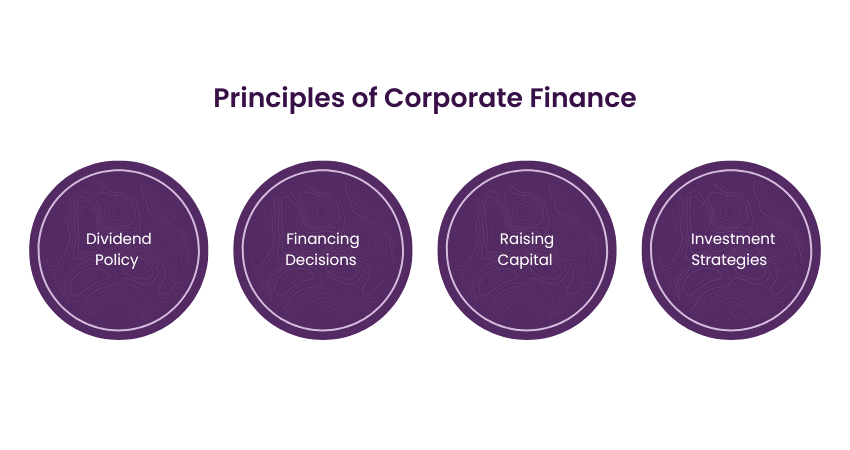
1) Dividend Policy
Companies have their dividend policies to create a hierarchy of dividend payouts. It includes when dividends need to be shared among shareholders.
2) Financing Decisions
Managers make decisions related to funds, assets, and management to make decisions. They can be for both short-term and long-term.
3) Raising Capital
Raising funds through funds issuing, taking loans, and other activities comes under raising capital. It secures resources for strategic initiatives.
4) Investment Strategies
To achieve corporate goals, companies constantly assess their strategies. Factors like market conditions affect investment. To overcome it, diversification of investment and risk management must be done.
Corporate Finance Activities
Corporate Finance uses a dozen strategies to make operational decisions in financial management. Other key activities include:
Capital Financing
Capital Financing is the core of Corporate Finance, as it makes vital decisions regarding a company's assets to fund investments. The company may issue debentures, sell shares, or take out a loan to raise funds.
a) Debt Financing: It’s a strategy through which businesses secure loans
b) Equity Financing: Initial Public Offerings (IPOs) provide shares to Investors
c) Hybrid Financing: The combination of both debt and equity financing makes hybrid financing
Short-Term Liquidity Management
Companies ensure a healthy cash flow is maintained to satisfy short-term debts. Some strategies that help them include:
a) Cash Flow Forecasting: Cash forecasting fulfils future cash needs. The company takes out either a line of credit or a loan.
b) Working Capital Management: Constant monitoring of liabilities and assets must be done for proper management
c) Short-term Borrowing: To meet temporary requirements, companies should take loans for a short period
Master financial management like an expert with our QuickBooks Training!
Capital Investments
It can be either fixed or working capital assets. The activities it carries include:
a) Project Guaging: For evaluation, tools like PB Analysis, and IRR, and NPV gets used
b) Capital Budgeting: Capital Budgeting determine value of a financial project. The approach uses NPV, IRR, and PB.
c) Risk Assessment: The impact of risk associated with investment needs assessment to mitigate it
Four Key Elements of Corporate Finance
Corporate Finance contains four vital fundamental elements that allow strategic working of operations inside a company.
1) Dividend Distribution
Dividends are distributed to shareholders from the profit share. Otherwise, companies invest a profit percentage to grow business. However, dividend distribution plays an important role in keeping the company healthy and stable.
Some things connected with dividend distribution include Tax Implications and Dividend Policy.
2) Working Capital Management
In working capital companies use their funds to execute their day-to-day activities, such as inventory, etc. The result of working capital management is effective operational obligations.
3) Capital Financing
What decides the optimal workings of a business? Capital financing ensures investments are up to date via equity and debt forecasting. Professionals also optimise a company's capital structure to achieve goals. Weighted Average Cost of Capital (WACC) is an index that finds out the average rate at which enterprises pays to finance assets.
4) Capital Budgeting
Capital budgeting determines the accuracy of investment proposals to maximise the growth of a business. The most profitable projects receive top-level priority. Budgeting aims to use tools to identify expenditures and cash flow and compare investment plans. It has two key components:
a) Internal Rate of Return (IRR): The Profitability of an investment is calculated using IRR (Internal Rate of Return), which helps assess returns over time, especially in Present Value vs Internal Rate of Return comparisons.
b) Net Present Value (NPV): Cash inflows and outflows equals NPV
Learn Practical Management Skills with our Financial Management Course - Register now!
Examples of Corporate Finance in Action
Corporate Finance implements various strategies for business operations to improve performance, aligning with Corporate Performance Management to ensure long-term success. Given below are examples in action:
Risk Management
Example: A multinational company wants to escape fluctuations drop in currencies
Strategy: Corporate Finance helps multinational companies in identifying why currency rates fluctuate and how it can be minimised using tools
Financial derivates hedge against the risk. Also, locking exchange rates reduces uncertainty and protects profits.
Financial Management
Example: A startup requires funds for its research and development
(R&D)
Strategy: A startup can safeguard venture capital for research purposes. The startup need not have to pay initially; once it profits, the borrowed capital needs repayment.
Growth Planning Strategies
Example: A manufacturing company needs to increase its production capacity to fulfil international demands
Strategy: IRR and NPV calculations flourish budgeting techniques to secure financing and determine investment profitability.
Conclusion
What is Corporate Finance? Corporate Finance is the breath of any company. Since it works with financial decision-making, the health and stability of the company depend on it. However, techniques, strategies, and Corporate Governance Best Practices are required to raise funds and enhance performance for top-notch growth. In conclusion, it's a complex field of Finance that backs businesses to achieve short- and long-term objectives. For companies managing their obligations efficiently, knowing How to Pay Corporation Tax correctly is also essential to maintain compliance and financial stability.
Learn the fundamentals with our Accounting & Finance Training – sign up now!
Frequently Asked Questions
What are the Five Basic Functions of Corporate Finance?

Five essential Corporate Finance functions are:
1) Budgeting of Capital
2) Structuring of Capital
3) Working Capital Management
4) Dividend Policy
5) Risk Management
How Difficult is Corporate Finance?
As mentioned earlier, Corporate Finance is a complex method that supports several financial concepts, such as assessing investment opportunities, reading financial statements, and effectively governing capital. Risk factors need to be solicited to reduce a company's losses.
What do I Need to Know about Corporate Finance?
Corporate Finance requires a basic understanding of financial concepts encompassing Financial Statements, Capital Budgeting techniques, cost of capital, financial markets and Advisory.
What are the Other Resources and Offers Provided by The Knowledge Academy?
The Knowledge Academy takes global learning to new heights, offering over 3,000+ online courses across 490+ locations in 190+ countries. This expansive reach ensures accessibility and convenience for learners worldwide.
Alongside our diverse Online Course Catalogue, encompassing 19 major categories, we go the extra mile by providing a plethora of free educational Online Resources like Blogs, eBooks, Interview Questions and Videos. Tailoring learning experiences further, professionals can unlock greater value through a wide range of special discounts, seasonal deals, and Exclusive Offers.
What is The Knowledge Pass, and How Does it Work?
The Knowledge Academy’s Knowledge Pass, a prepaid voucher, adds another layer of flexibility, allowing course bookings over a 12-month period. Join us on a journey where education knows no bounds.
What are the Related Courses and Blogs Provided by The Knowledge Academy?
The Knowledge Academy offers various Accounting & Finance Training, including Corporate Finance Training. These courses cater to different skill levels and provide comprehensive insights into Top Budgeting Skills.
Our Business Skills Blogs cover a range of topics related to Account and Finance, offering valuable resources, best practices, and industry insights. Whether you are a beginner or looking to advance your Financial Management skills, The Knowledge Academy's diverse courses and informative blogs have got you covered.

The Knowledge Academy


Global Training Provider
The Knowledge Academy is a world-leading provider of professional training courses, offering globally recognised qualifications across a wide range of subjects. With expert trainers, up-to-date course material, and flexible learning options, we aim to empower professionals and organisations to achieve their goals through continuous learning.

Upcoming Accounting and Finance Resources Batches & Dates
Date
 Capital Accounting Course
Capital Accounting Course
Fri 25th Sep 2026
Capital Accounting Course
Fri 18th Dec 2026

 If you wish to make any changes to your course, please


