Who Should Attend this R Programming Course?
This course is ideal for individuals looking to analyse data, create visualisations, and develop statistical models using R programming. You should attend this R Programming Course if you are:
- Data Analyst: Using R for data wrangling, visualisation, and statistical analysis
- Statistician: Applying R to perform hypothesis testing and predictive modelling
- Researcher: Analysing complex data sets and presenting results effectively
- Business Intelligence Professional: Building data-driven insights and custom reports in R
- Academic or Student: Learning R for coursework, research, or thesis projects
- Aspiring Data Scientist: Building a foundation in statistical programming and data analysis
Prerequisites of the R Programming Course
There are no formal prerequisites to attend the R Programming Course. However, a basic knowledge of computers and programming would be beneficial for the delegates.
R Programming Course Overview
The R Programming Course introduces delegates to the R programming language for data analysis and statistical computing. It covers core programming concepts and essential R functions. Delegates gain a strong foundation in working with data.
This training develops skills in data manipulation, statistical analysis, and data visualisation. Delegates learn to create scripts, manage datasets, and generate reports. It helps strengthen analytical and problem-solving abilities.
This 1-day R Programming Course in Shanghai by The Knowledge Academy enables delegates to apply R to real-world data projects. They will be able to analyse data, identify trends, and create visual insights. These skills support roles in analytics, research, and business intelligence.
R Programming Course Objectives
- To understand R syntax and data structures
- To perform data analysis and statistical modelling
- To create data visualisations using R libraries
- To automate workflows and build reproducible reports
- To import, export, clean, and manipulate data using R
- To apply regression analysis and probability concepts in R
Upon completing this R Programming Course, delegates will gain the skills to use R syntax, data structures, and functions for data-focused tasks. This training also helps them analyse datasets, apply statistical modelling, create visualisations, and support data-driven decision-making through practical R programming techniques.
Reasons to Learn R Programming
R Programming is a valuable language for working with data, performing statistical analysis, and creating clear visual insights. Some of the key reasons to choose our R Programming Course are:
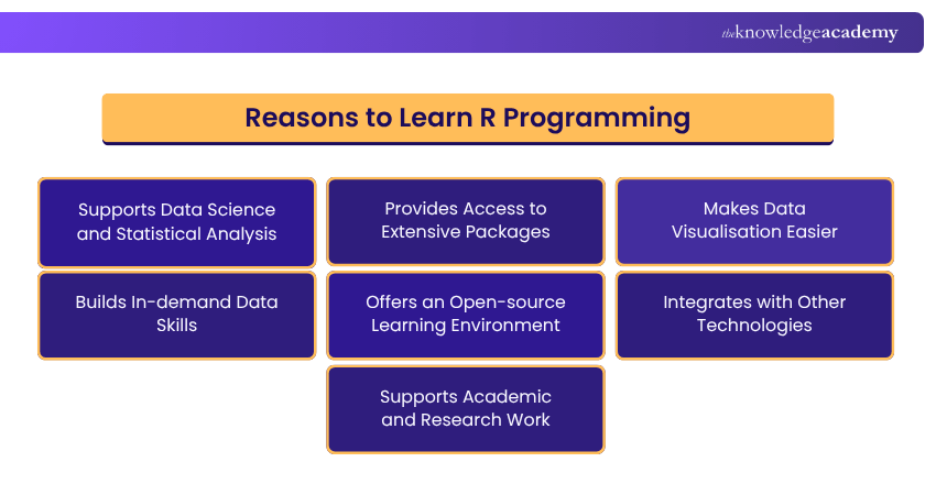
- Supports Data Science and Statistical Analysis: R helps users analyse datasets, apply statistical methods, and build predictive models for solving data-related problems.
- Provides Access to Extensive Packages: R offers many packages for data manipulation, machine learning, reporting, and visualisation, making analytical tasks easier.
- Makes Data Visualisation Easier: R supports clear charts, graphs, and reports that help present data insights in a simple visual format.
- Builds In-demand Data Skills: Learning R helps develop analytical skills required for data analysis, business intelligence, research, and decision-making roles.
- Offers an Open-source Learning Environment: R is free to use and supported by a strong community, making it accessible for both individuals and organisations.
- Integrates with Other Technologies: R works with tools such as Python, SQL, and big data platforms, supporting flexible data workflows.
- Supports Academic and Research Work: R is widely used in research and education for statistical analysis, modelling, and data interpretation across many fields.





 If you miss out, enquire to get yourself on the waiting list for the next day!













 If you wish to make any changes to your course, please


