


 Top Rated Course

We may not have the course you’re looking for. If you enquire or give us a call on +44 1344 203 999 and speak to our training experts, we may still be able to help with your training requirements.
What is Reverse Logistics: Types, Stages and Benefits
The Knowledge Academy 27 February 2026Reverse logistics moves products from customers back to manufacturers or retailers for returns, repairs, recycling, or resale, reducing waste and recovering value.It enhances supply chain efficiency, lowers costs, and promotes sustainable business practices. By managing returns and product life cycles, companies can boost customer satisfaction and brand reputation.

Training Outcomes Within Your Budget!
We ensure quality, budget-alignment, and timely delivery by our expert instructors.
Table of Contents
Suppose you buy something online and it turns out to be defective, or a customer returns something to your store. The next step defines the customer experience. Reverse Logistics comes into play here. Far more than return management, Reverse logistics can be a strategic tool that converts waste into value, fosters sustainability, and improves business efficiency.
In this blog we will highlight the different types, stages, and main advantages of reverse logistics to help you understand how businesses can transform hurdles into opportunities for growth.
Table of Contents
1) What is Reverse Logistics?
2) Types of Reverse Logistics
3) 5 Stages of Reverse Logistics
4) Distinguishing Reverse Logistics from Traditional Logistics
5) Importance of Reverse Logistics
6) Benefits of Optimised Reverse Logistics
7) Challenges of Reverse Logistics
8) Technologies Used in Reverse Logistics
9) 7 Strategies to Optimise Reverse Logistics
10) How do companies measure reverse logistics performance?
11) Future Trends in Reverse Logistics
12) Conclusion
What is Reverse Logistics?
Reverse Logistics is a part of Supply Chain Management that deals with moving products back from customers to sellers or manufacturers. When a customer receives a product, returns, recycling, or repairs may be needed, and that’s where Reverse Logistics comes in.
It starts with the customer and moves backwards through the supply chain, either to the distributor or manufacturer. Sometimes, customers handle final disposal, like recycling, refurbishing, or reselling the product. This process helps reduce waste, save costs, and make better use of returned items. In the context of logistics, many businesses partner with Third Party Logistics companies to streamline returns and manage disposal processes efficiently.
Types of Reverse Logistics
Reverse Logistics includes different processes to handle returned, unsold, or outdated products. Here are the key types:

1) Returns Management
This is the most common type of Reverse Logistics. It deals with customer returns, ensuring a smooth and hassle-free experience. A good return process helps build customer trust and improves brand reputation.
2) Return Policy and Procedure
A clear return policy sets the rules for handling returns. Both customers and employees should follow these guidelines consistently. Keeping return policies easy to find helps avoid confusion and ensures a better experience.
3) Remanufacturing or Refurbishment
Returned products can be repaired, reconditioned, or refurbished instead of being discarded. This helps companies save money and reduce waste while offering better-quality products to customers.
4) Packaging Management
Some companies reuse packaging to cut costs and reduce waste. Instead of using new materials for returned items, they reprocess packaging to make it usable again. This is an eco-friendly and cost-effective approach.
Learn how to craft market-winning Product Management strategies by joining our Product Management Training now!
5) Unsold Products
Sometimes, products don’t sell as expected. They may be returned by fulfillment centers or customers due to low demand, delivery refusals, or other reasons. These unsold products are often sent back to manufacturers.
6) End of Service Life
Some products need to be returned when they are no longer usable. Manufacturers then take responsibility for recycling or disposing of them properly to reduce environmental impact.
7) Delivery Failure
If a product cannot be delivered, it is sent back to a fulfilment centre. Companies may either return it to the manufacturer or try to correct the issue and resend it to the customer.
8) Rental Equipment
Leased or rented products, like cars or electronics, are returned once the rental period ends. They are then either recycled, refurbished, or prepared for use by another customer.
9) Repair and Maintenance
Some products, like laptops and home appliances, are sent back for repairs or warranty service. This process helps customers get their items fixed while ensuring brands maintain product quality.
10) Recycling
End-of-life products and materials like electronics, metals, or plastics are collected for recycling. This reduces environmental impact, conserves resources, and helps companies comply with green regulations.
Advance your career with industry-ready supply chain skills with our Supply Chain Management Training- Join today!
5 Stages of Reverse Logistics
Reverse logistics is a strategic process that enables businesses to manage product returns, recover value, and reduce environmental impact. It follows a structured flow that includes five key stages:
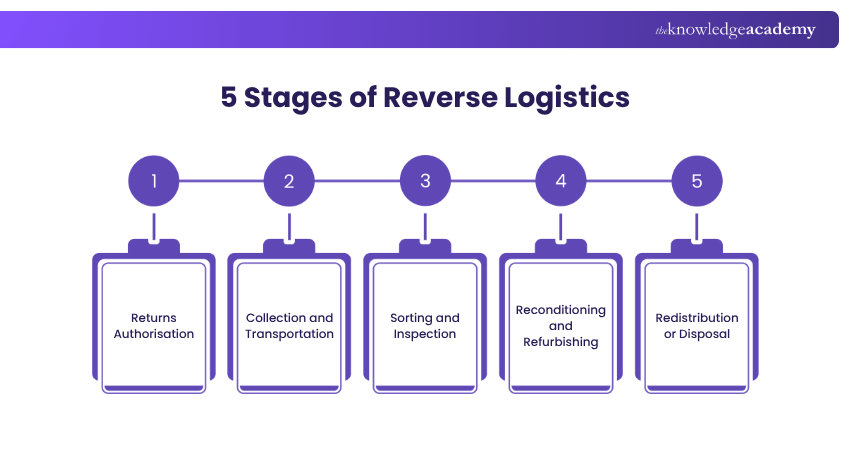
1) Returns Authorisation: The reverse logistics process starts when a customer initiates a return. This stage involves reviewing the return request, validating its eligibility, and issuing the appropriate return label or guidance to proceed with the return.
2) Collection and Transportation: Once approved, the returned goods are picked up from the customer or drop-off location and transported to a designated facility. Efficient logistics at this stage ensure timely movement and minimal delays.
3) Sorting and Inspection: At the processing centre, returned items are categorised and thoroughly examined. This inspection helps decide the next course of action whether the product is suitable for resale, repair, recycling, or discarded.
4) Reconditioning and Refurbishing: Items that can be salvaged undergo necessary repairs, updates, or cleaning. Reconditioning gives products a second life and allows businesses to reintegrate them into the market at reduced cost.
5) Redistribution or Disposal: Depending on their condition, products are either re-entered into the supply chain through resale or safely disposed of in compliance with environmental regulations. This final step ensures maximum value recovery and minimal waste.
Learn how to craft market-winning Product Management strategies by joining our Product Management Course now!
Distinguishing Reverse Logistics from Traditional Logistics
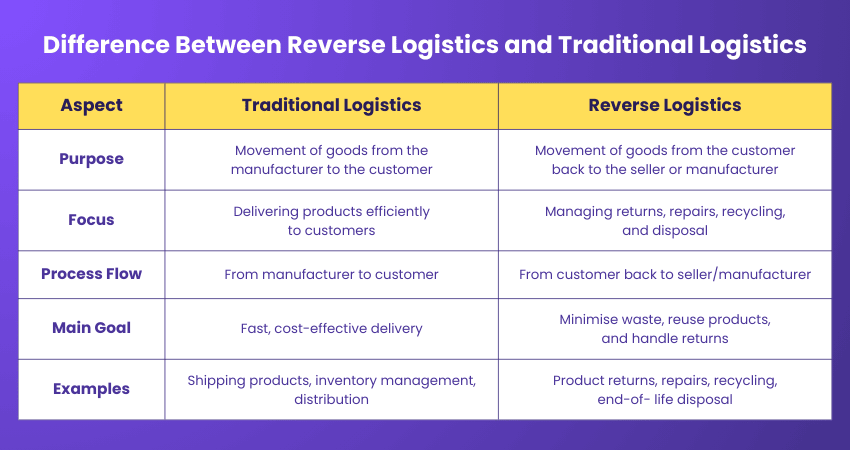
Traditional Logistics involves the movement of goods from the manufacturer to the customer. It focuses on delivering products efficiently to stores or customers, ensuring smooth supply chain operations. The goal is to get products to the end user as quickly and cost-effectively as possible.
Reverse Logistics, on the other hand, deals with the return journey of products. It includes the return of goods from customers back to the seller or manufacturer, whether for returns, repairs, recycling, or disposal. The focus is on managing returns, reusing products, and minimising waste.
In short, Traditional Logistics focuses on getting products to customers. Meanwhile, Reverse Logistics focuses on managing what happens after the sale.
Importance of Reverse Logistics
Reverse logistics is no longer just a backend operation. It is a strategic asset for modern businesses. As product returns increase and sustainability becomes a business priority, reverse logistics helps companies recover value, reduce waste, and build lasting customer trust.
Instead of treating returned or outdated products as dead weight, smart businesses are giving them a second life through repair, resale, or recycling. This approach not only minimises financial losses but also turns potential waste into revenue. It benefits both the environment and the bottom line.
The shift toward sustainability is also being driven by regulations. Around 70% of businesses are now investing in the circular economy, according to Gartner. These closed-loop supply chains reduce landfill dependence and help meet government requirements for recycling, waste reduction, and responsible disposal. Companies that comply may receive subsidies, while those that do not could face penalties.
The numbers speak volumes. In 2022, U.S. retailers faced over $740 billion in losses from returns. With an efficient reverse logistics process in place, many of these losses can be recovered. Returned products can be repaired, restocked, or recycled, and in many cases, turned back into profit.
With the global reverse logistics market expected to reach $1.17 trillion by 2032, this function is quickly becoming a major growth driver. Whether managed as part of the main supply chain or handled separately, reverse logistics helps businesses stay efficient, sustainable, and competitive.
Benefits of Optimised Reverse Logistics
Reverse Logistics offers several benefits for businesses and the environment:
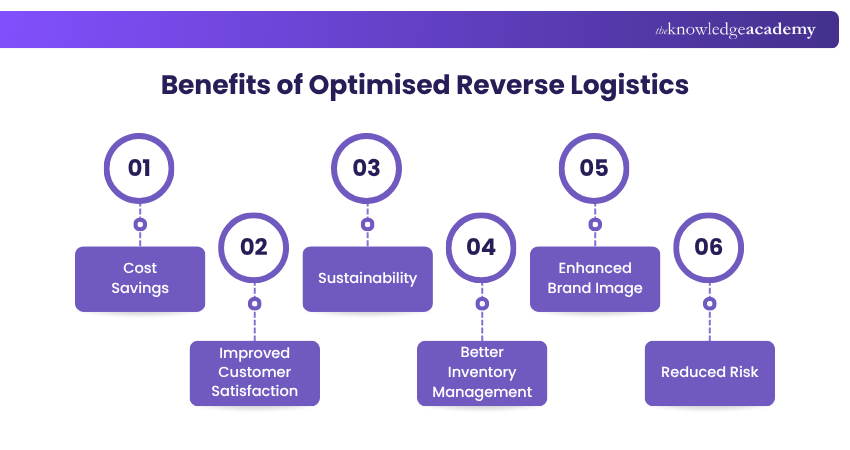
Cost Savings
Reverse Logistics helps businesses reduce waste and manage returns more effectively. By reusing or recycling returned products, companies can save money on new inventory and minimise the costs of disposal.
Improved Customer Satisfaction
A smooth and easy return process boosts customer loyalty and satisfaction. When customers can easily return or exchange products, it increases trust and the likelihood of repeat purchases.
Sustainability
Reverse Logistics plays a key role in reducing waste and promoting recycling. By recycling products and repurposing materials, businesses contribute to a more sustainable environment.
Better Inventory Management
Through Reverse Logistics, businesses can recover valuable products that are returned and refurbish them for resale. This improves inventory control and helps avoid overproduction.
Enhanced Brand Image
A well-managed Reverse Logistics process demonstrates a commitment to customer care and environmental responsibility. This can positively impact a company’s reputation, attracting customers who value sustainability.
Reduced Risk
Proper handling of returned goods minimises the risk of legal issues, data breaches, or environmental fines. It also ensures compliance with industry regulations and reduces uncertainty in the supply chain.
Gain expertise in cost-effective maintenance with our Facilities Management Course – Join today!
Challenges of Reverse Logistics
Reverse logistics brings valuable benefits, but it also comes with a set of complex challenges that businesses must overcome to keep operations efficient and customer friendly.

Cost
Managing reverse logistics can be expensive. From transportation and labour to restocking and repairs, the costs of handling return often exceed those of standard forward logistics. Without proper planning, these expenses can quickly add up and increase profits.
Lack of Returns Process
Many businesses lack a defined and streamlined process for handling returns. Without clear guidelines, returns can become chaotic, causing delays, customer dissatisfaction, and confusion for warehouse teams.
Inventory Management
Returned products can be difficult to track and categorise, especially when mixed with regular inventory. If not managed carefully, they can disrupt stock accuracy, slow fulfilment times, and affect forecasting.
Consumer Expectations
Customers expect fast and easy returns. Meeting these demands while keeping operations cost-effective is a challenge. A poor returns experience can damage a brand's reputation and reduce future sales.
Lack of Warehouse Storage Space
Returned goods take up valuable space in warehouses, especially when not processed quickly. Without enough room or a proper layout for sorting and repurposing, operations can become inefficient and cluttered.
Technologies Used in Reverse Logistics
To meet rising customer demands and operate more sustainably, companies are turning to advanced technologies to streamline their reverse logistics processes. These tools enhance visibility, efficiency, and decision-making across the entire returns cycle.
Automation and Data Analytics
Automation accelerates routine tasks like returns processing, restocking, and sorting. Paired with data analytics, it helps businesses make sense of large volumes of return data, identify patterns, and optimise their reverse supply chains for cost and speed.
Internet of Things IoT) and Tracking Solutions
IoT devices and smart sensors enable real-time tracking of returned items. From transit updates to condition monitoring, these tools increase visibility and help prevent delays, losses, or damage during reverse transportation.
Artificial Intelligence (AI) and Machine Learning (ML)
AI and ML power predictive models that assess return reasons, forecast return volumes, and suggest optimal recovery strategies. They help automate complex decisions such as whether to restock, recycle, or refurbish a product.
E-commerce and Online Marketplaces
Online platforms play a crucial role in managing reverse logistics. They provide consumers with return portals, automate refund processes, and offer remarketing options for returned or refurbished items, expanding the product lifecycle.
Blockchain and Transparency
Blockchain builds trust in reverse logistics by providing secure, tamper-proof records of product journeys. This improves traceability, ensures authenticity, and supports sustainable claims by verifying return and recycling processes.
7 Strategies to Optimise Reverse Logistics
To improve Reverse Logistics, companies need clear strategies focused on speed, efficiency, and cost. When making improvements, consider policies, partners, data, capacity, logistics, and transportation. Here are seven strategies to optimise Reverse Logistics:
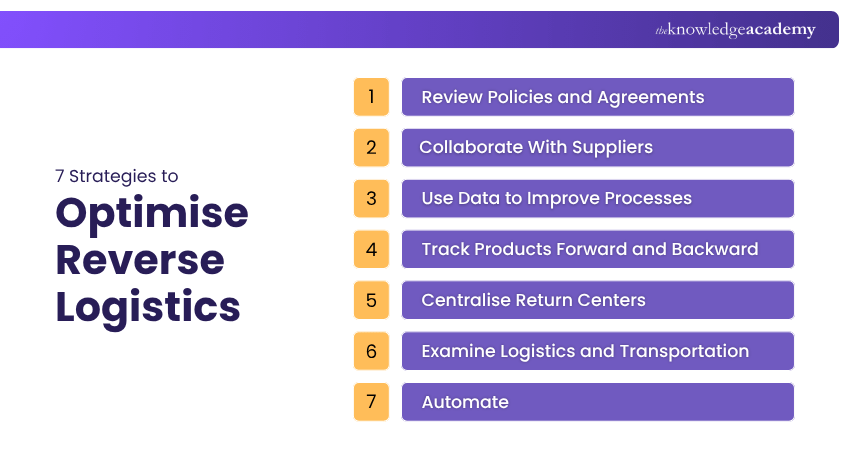
Review Policies and Agreements
Take a close look at your return and repair procedures. Make sure they are clear and address the reasons for returns. How a company handles returns can set it apart from competitors.
Collaborate with Suppliers
Working closely with suppliers ensures a smooth and integrated process for your customers. A good relationship can help avoid issues and create a seamless experience for everyone.
Use Data to Improve Processes
Collect data on returns to understand why customers are sending products back. This information can help adjust sales, product design, and logistics processes to reduce returns.
Track Products Forward and Backward
By tracking products from raw materials to the customer, you can easily identify issues. This helps you handle recalls more effectively by addressing specific problems instead of recalling entire product lines.
Centralise Return Centers
Having a dedicated return centre helps you sort products quickly and decide the best way to handle each return. If you don’t have a separate return centre, consider setting up a section of your warehouse for returns.
Examine Logistics and Transportation
Regularly assess your logistics and transportation processes. See if you can combine forward and Reverse Logistics to save time and money, like having delivery drivers pick up empty pallets on their return trip.
Automate
Use cloud-based logistics software to streamline operations. This system can track returns, manage refurbishing, and provide helpful business insights to make Reverse Logistics more efficient.
How do companies measure reverse logistics performance?
Companies measure reverse logistics performance using key metrics such as return rate, recovery value, processing time, customer satisfaction, and cost per return. These indicators help evaluate efficiency, identify bottlenecks, and improve the overall effectiveness of the reverse logistics process.
Future Trends in Reverse Logistics
Reverse logistics is headed towards a flexible, customer-centric, and sustainable future. Here are the predictions for the future.
1) Flexible Returns: With the aim of maximising transactions, retailers offer quick refunds and encourage exchanges.
2) Optimised Customer Experience: Convenient returns contribute to customers’ satisfaction and retention.
3) Focus on Sustainability: Companies are reducing waste and reusing materials, which, in turn, results in a reduced carbon footprint.
4) Omnichannel Returns: Customers can return their products online, in person at the store, or through the mail.
Conclusion
Understanding reverse logistics is key to turning challenges into opportunities, boosting efficiency, and supporting sustainability. By embracing smart strategies and staying ahead of emerging trends, businesses can not only save costs but also create a positive impact on customers and the environment. Reverse logistics isn’t just a process, it’s a pathway to smarter, more resilient operations.
Unlock new opportunities and advance your career with our Industry Training - Register now!
Frequently Asked Questions
What are the Five R’s of Reverse Logistics?

The 5 R's of Reverse Logistics are Returns, Remanufacturing, Repairs, Recycling, and Reuse. These steps focus on efficiently handling returns, repairing products, reusing parts, recycling materials, and remanufacturing items to reduce waste and recapture value.
Can reverse logistics be outsourced?
Yes, reverse logistics can be outsourced to third-party logistics providers. This helps businesses save time, reduce costs, and improve efficiency by leveraging expert handling of returns, repairs, recycling, and restocking across various supply chain stages.
What are the Other Resources and Offers Provided by The Knowledge Academy?
The Knowledge Academy takes global learning to new heights, offering over 3,000 online courses across 490+ locations in 190+ countries. This expansive reach ensures accessibility and convenience for learners worldwide.
Alongside our diverse Online Course Catalogue, encompassing 17 major categories, we go the extra mile by providing a plethora of free educational Online Resources like Blogs, eBooks, Interview Questions and Videos. Tailoring learning experiences further, professionals can unlock greater value through a wide range of special discounts, seasonal deals, and Exclusive Offers.
What is The Knowledge Pass, and How Does it Work?
The Knowledge Academy’s Knowledge Pass, a prepaid voucher, adds another layer of flexibility, allowing course bookings over a 12-month period. Join us on a journey where education knows no bounds.
What are the Related Courses and Blogs Provided by The Knowledge Academy?
The Knowledge Academy offers various Industry Training, including Logistics Management Training, Facilities Management Training and Supply Chain Management Training. These courses cater to different skill levels, providing comprehensive insights into Importance of Logistics.
Our Business Skills Blogs cover a range of topics related to Reverse Logistics, offering valuable resources, best practices, and industry insights. Whether you are a beginner or looking to advance your Business Management skills, The Knowledge Academy's diverse courses and informative blogs have you covered.

The Knowledge Academy


Global Training Provider
The Knowledge Academy is a world-leading provider of professional training courses, offering globally recognised qualifications across a wide range of subjects. With expert trainers, up-to-date course material, and flexible learning options, we aim to empower professionals and organisations to achieve their goals through continuous learning.

Upcoming Business Skills Resources Batches & Dates
Date
 Logistics Management Training
Logistics Management Training
Fri 7th Aug 2026
Logistics Management Training
Fri 9th Oct 2026

 If you wish to make any changes to your course, please


