


 Top Rated Course

We may not have the course you’re looking for. If you enquire or give us a call on +44 1344 203 999 and speak to our training experts, we may still be able to help with your training requirements.
Scrum Case Studies: Top Real-Life Examples
The Knowledge Academy 25 May 2026Scrum Case Studies are detailed analyses of how the Scrum framework is implemented. They offer valuable insights into successes and challenges. This blog examines practical implementations of Scrum across different sectors, highlights what worked, and provides expert perspectives to help teams adopt or refine agile practices effectively.

Training Outcomes Within Your Budget!
We ensure quality, budget-alignment, and timely delivery by our expert instructors.
Table of Contents

Scrum Case Studies provide valuable perspectives on the implementation of the Scrum framework in actual projects. They offer in-depth examinations of accomplishments, obstacles, and insights gained. The examples in this blog demonstrate how Scrum can lead to enhanced team cooperation, more efficient processes, and improved project results. By studying practical cases, experts can learn how to apply Scrum principles to their specific circumstances.
If you're a beginner in Scrum or aiming to improve your strategy, these Scrum Case Studies can be a useful resource for guidance. They provide practical tips that can be put into practice to improve your team's productivity and performance in Project Management.
Table of Contents
1) What is the Importance of Case Studies in Scrum?
2) Top Scrum Case Study Examples
3) What is a Real-world Example of Scrum?
4) What is the 3:5:3 Rule in Scrum?
5) Conclusion
What is the Importance of Case Studies in Scrum?
Case studies play a crucial role in Scrum by providing actual scenarios and perspectives on how the framework can be put into practice. Let’s explore what makes Scrum Case Studies so important.
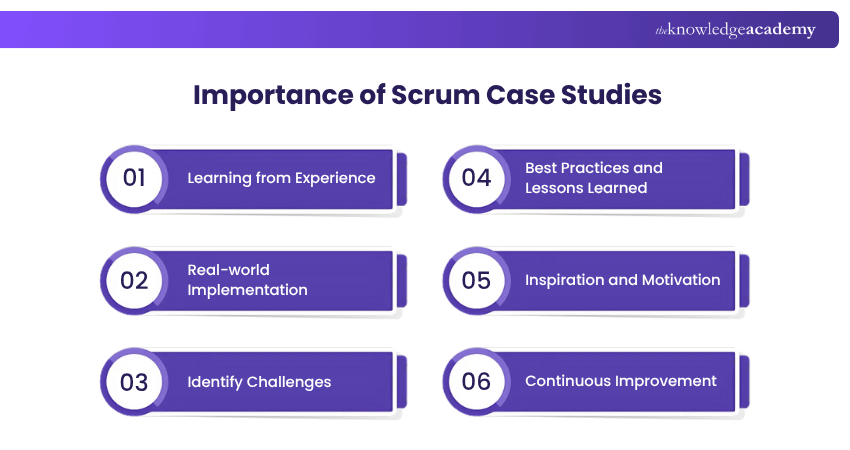
1) Learning from Experience: Practical Application Scrum Master Case Studies offer valuable lessons from others' encounters with Scrum, uncovering obstacles, remedies, and implementation paths.
2) Real-world Implementation: These instances demonstrate the practical application of Scrum principles and practices.
3) Identify Challenges: Scrum examples assist in foreseeing challenges, enabling teams to plan tactics for overcoming possible hurdles.
4) Best Practices and Lessons Learned: Case studies offer best practices and lessons learned to help with effective Scrum implementation and avoid common mistakes.
5) Inspiration and Motivation: It encourage and drive teams by demonstrating positive results accomplished through implementing Scrum.
6) Continuous Improvement: Scrum case studies help enhance Scrum practices by providing feedback and insights to the Scrum community, thus contributing to ongoing improvement.
Overall, case studies of Scrum Masters offer valuable insights, inspiring ideas, and helpful advice for effective Scrum adoption and ongoing enhancement. By integrating these case studies, a thorough grasp of Scrum and how it is applied in real-world scenarios is achieved.

Top Scrum Case Study Examples
The successful implementation of Scrum in various organisations around different industries has improved efficiency and enhanced collaboration and, in turn, achieved better results. These real experiences show that the Scrum framework is flexible and effective.
1) Mayden's Transformation from Waterfall to Scrum
According to Mayden, a healthcare software-focused company based in the United Kingdom, Scrum was implemented to replace the inefficiencies in its system and to enhance responsiveness.
Problem:
Mayden faced failure to meet its delivery commitment, fixed planning, and the incapability of changing its delivery under its Waterfall way of thinking. A model that was flexible and team oriented would have been required to execute timely outcomes and match the user requirements in an ever-changing industry.
Solutions:
1) Sent a team member for Scrum Master training
2) Partnered with Agilify to train the entire organisation in Scrum
3) Gained full management support for Agile transformation
4) Unified the team under shared Scrum values and processes
5) Conducted team-wide Scrum Master training within one week
6) Achieved fast adoption through team enthusiasm and cross-functional buy-in
2) Scrum Methodology as Used by a Capstone Team
The university capstone project team implemented Scrum in a bid to enhance the project coordination and productivity of the team.
Problem:
The student group did not have well organized strategy to work effectively. They had to find a way to make that cooperation works faster, to boost the development process, and to deliver on time amidst academic and project-related tasks with little time.
Solutions:
1) Adopted Scrum with defined roles and ceremonies
2) Conducted asynchronous stand-ups to reduce scheduling conflicts
3) Held regular sprint reviews and retrospectives
4) Tracked velocity to evaluate team performance
5) Adapted processes based on velocity insights
6) Enhanced visibility with improved backlog management
3) Increasing Visibility and Cross-product Alignment at Radware
Radware had to have a scalable, synchronised product development that was needed across various teams across the globe.
Problem:
The sequential process that Radware had implied delays in handoff, lack of visibility and cross-team misalignment. It did not have adaptive structures sufficient to help its cybersecurity activities, which needed quick response and delivery coordination along its five product lines.
Solutions:
1) Held Agile workshops to address organisational challenges
2) Engaged global teams for unified Agile adoption
3) Introduced Rally ALM tool for real-time visibility
4) Delivered training for Scrum Masters and Product Owners
5) Launched Agile Release Trains across product lines
6) Implemented Program Increment Planning for work alignment
7) Standardised Agile cadence company-wide
Master Scrum development skills with our Scrum Developer Training – Register today!
4) Blue Flash Conversion to Scrum Practices
A racing group of students submitted to Scrum to increase cooperation and respond to the challenges of pandemic change.
Problem:
The Blue Flash team had difficulties in terms of coordination, a lack of priority, and an impediment to remote work due to COVID-19. Using volunteers and ever-changing team dynamics meant they needed a light process which would enable them to manage backlogs, autonomously empower users, and keep them moving.
Solutions:
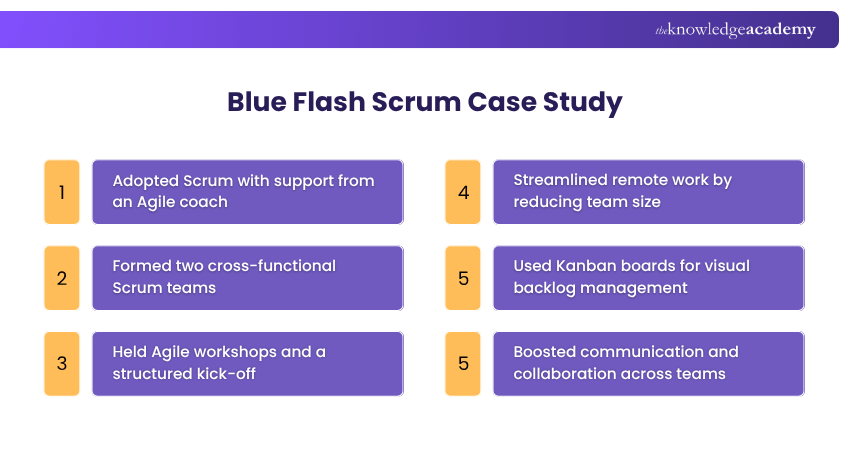
1) Adopted Scrum with help from a dedicated Agile coach
2) Formed two Scrum teams with clear roles
3) Conducted Agile workshops and a structured kick-off
4) Reduced team size for effective remote work
5) Used Kanban boards to manage workflow visually
6) Improved communication and cross-team alignment
5) Agile Project Management at Intel – A Scrum Odyssey
Intel adopted Scrum to facilitate the process of engineering development and minimise the burnout of the working teams.
Problem:
Waterfall culture at Intel implied the lack of communication among departments, low staff morale and burnt-out teams. Prolonged projects that were inefficiently handed off and unclear requirements direct to delay projects, promoting staff turnover, necessitating a culture and operation reset by adopting Scrum.
Solutions:
1) Launched external Scrum coaching and initial pilot teams
2) Formed a Process Action Team to track Scrum rollout
3) Reinforced adherence to Scrum events and artefacts
4) Piloted cross-functional teams to reduce workflow friction
5) Scaled two-week Sprints for consistent output
6) Established capacity-based planning to manage workload
7) Improved communication, morale, and delivery predictability
6) Scrum Boosts Productivity at BBC
The New Media division at BBC employed Scrum, and it was able to enhance delivery and respond to changing demands.
Problem:
The department had a problem of unpredictability, lack of coordination, and flexibility in software operations. Past approaches have failed to work in fast growth, team collaboration, and cross-functional team development critical in the process of digital media production.
Solutions:
1) Introduced Scrum under guidance of a Scrum Master
2) Created cross-disciplinary teams for end-to-end collaboration
3) Trained internal Scrum Masters to lead team transitions
4) Adopted Agile events like stand-ups and sprint reviews
5) Regularly refined backlog to prioritise user needs
6) Held retrospectives to implement ongoing improvements
7) Built a culture of shared ownership and visibility
7) Effective Practices and Federal Challenges in Applying Agile Methods
Agile was considered by Federal IT agencies to tackle delays and inefficiencies of large-scale software development.
Problem:
The lack of timely delivery, cost expenditures, and value delivery of US government IT projects was atrocious. The inflexible Water Fall model could not keep up with the evolutionary stakeholder requirements, and Agile was adopted, despite structural, cultural and procedural resistance.
Solutions:
1) Rolled out formal Agile adoption guidance and terminology
2) Provided relatable use cases for better comprehension
3) Embedded continuous improvement in project workflows
4) Identified and resolved Agile adoption impediments
5) Encouraged regular stakeholder engagement and feedback
6) Empowered small, self-organising cross-functional teams
7) Addressed risk and compliance in product backlog
Empower team collaboration and efficiency with our Scrum Team Course – Sign up today!
What is a Real-world Example of Scrum?
An example of Scrum in real life is Social Media Marketing. Short-term sprints mean that teams develop posts, plan and schedule, analyze effectiveness, and react to trends. Campaigns are kept on track, and the engagement of the audience is steadily enhanced with frequent reviews.
Website development is another case. Scrum can be used to simplify complicated tasks such as user-interface development, coding, and content development into sprints. Sprint review provides constant feedback on what has been done on the site, which allows teams to further improve it as it is user-friendly, functional, and meets business requirements.
What is the 3:5:3 Rule in Scrum?

The 3:5:3 rule or the Scrum core structure is composed of 3 Scrum roles, 5 events, and 3 artifacts. Such a straightforward structure is clear to teams to handle the work effectively, promote openness, teamwork, and constant development throughout the working process on each project.
The three roles include Product Owner, Scrum Master, and Developer. These roles communicate with each other using five such key events as Sprint, Sprint Planning, Daily Scrum, Sprint Review and Retrospective to generate three artifacts, which are Product Backlog, Sprint Backlog and Product Increment.
Conclusion
In conclusion, Scrum Case Studies offer essential perspectives on how Scrum is used in various industries. They showcase the difficulties, achievements, and knowledge gained from actual projects. Through analysing these instances, teams can gain a deeper comprehension of how to successfully apply Scrum, conquer challenges, and consistently enhance their methodologies. If you are a beginner in Scrum or aiming to improve your methods, these case studies can help you succeed in Agile Project Management.
Become a successful Scrum team leader with our Scrum Master Course – Register now!
Frequently Asked Questions
What are the 3 Pillars of Scrum?

Scrum is based on three main principles: Transparency, Inspection, and Adaptation. Transparency ensures that the process is visible to all. Regular examinations are required for monitoring progress, while flexibility enables the team to make necessary adjustments according to feedback.
Who Should Use Scrum?
Scrum is well-suited for teams dealing with complicated projects, especially in Software Development, but it is also advantageous for any sector that needs flexibility, gradual advancement, and teamwork.
What are the Other Resources and Offers Provided by The Knowledge Academy?
The Knowledge Academy takes global learning to new heights, offering over 3,000 online courses across 490+ locations in 190+ countries. This expansive reach ensures accessibility and convenience for learners worldwide.
Alongside our diverse Online Course Catalogue, encompassing 19 major categories, we go the extra mile by providing a plethora of free educational Online Resources like Blogs, eBooks, Interview Questions and Videos. Tailoring learning experiences further, professionals can unlock greater value through a wide range of special discounts, seasonal deals, and Exclusive Offers.
What is The Knowledge Pass, and How Does it Work?
The Knowledge Academy’s Knowledge Pass, a prepaid voucher, adds another layer of flexibility, allowing course bookings over a 12-month period. Join us on a journey where education knows no bounds.
What are the Related Courses and Blogs Provided by The Knowledge Academy?
The Knowledge Academy offers various Scrum Certification, including the Scrum Master Certification, Scrum For Teams, and Scrum Overview. These courses cater to different skill levels, providing comprehensive insights into Scrum Theory.
Our Project Management Blogs cover a range of topics related to Scrum, offering valuable resources, best practices, and industry insights. Whether you are a beginner or looking to advance your Project Management skills, The Knowledge Academy's diverse courses and informative blogs have got you covered.

The Knowledge Academy


Global Training Provider
The Knowledge Academy is a world-leading provider of professional training courses, offering globally recognised qualifications across a wide range of subjects. With expert trainers, up-to-date course material, and flexible learning options, we aim to empower professionals and organisations to achieve their goals through continuous learning.

Upcoming Project Management Resources Batches & Dates
Date
 Scrum Master Certification
Scrum Master Certification
Thu 2nd Jul 2026
Scrum Master Certification
Thu 3rd Sep 2026
Scrum Master Certification
Thu 5th Nov 2026

 If you wish to make any changes to your course, please


